What types of denture are there?
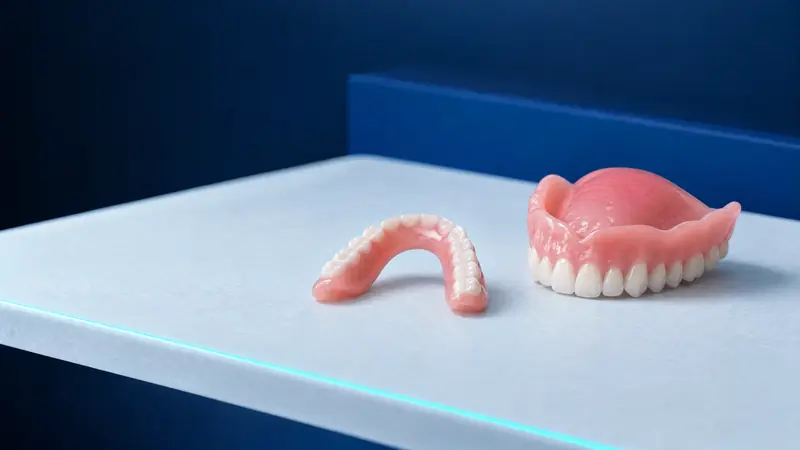
Dentures differ in what they are made of and what supports them. A complete denture replaces all the teeth in an arch and is held on the gum and the palate, while a partial denture replaces a few missing teeth and also rests on the patient’s own teeth.
The table lists the types of denture that most often appear in treatment plans, with prices from the clinic’s price list. The prices are for the denture alone; crowns, attachments and treatment of the abutment teeth are separate items in the price list, and the dentist sets the final scope and cost at the consultation.
| Type of denture | When it is used | What to bear in mind | Price in the clinic’s price list |
|---|---|---|---|
| Complete acrylic | All teeth missing in the arch | Rests on the gum, usually needs relining over time | 2 500 zł |
| Partial acrylic | Several teeth missing, also as an interim solution | Rests mainly on the gum, wire clasps | 2 000 zł |
| Cast metal (skeletal) | Several teeth missing, with own teeth able to support it | Metal framework with clasps, transfers part of the load to the teeth | 3 500 zł |
| Combined (on attachments) | When the abutment teeth carry crowns with attachments | No visible clasps, the retentive parts wear | 3 700 zł |
| Acetal (thermoplastic) | For example with a metal allergy | Thermoplastic materials hold their colour less well than acrylic | 3 500 zł |
| Immediate | When a replacement is needed quickly, e.g. after extractions | Often needs adjusting or replacing within a year | 2 000 zł |
| Overdenture on roots | When root-treated roots can be kept | The roots need treatment and regular check-ups | Root attachment: 1 350 zł |
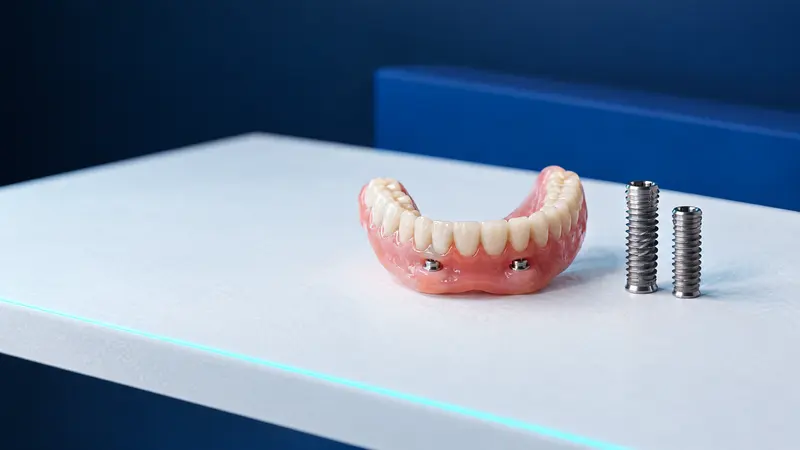
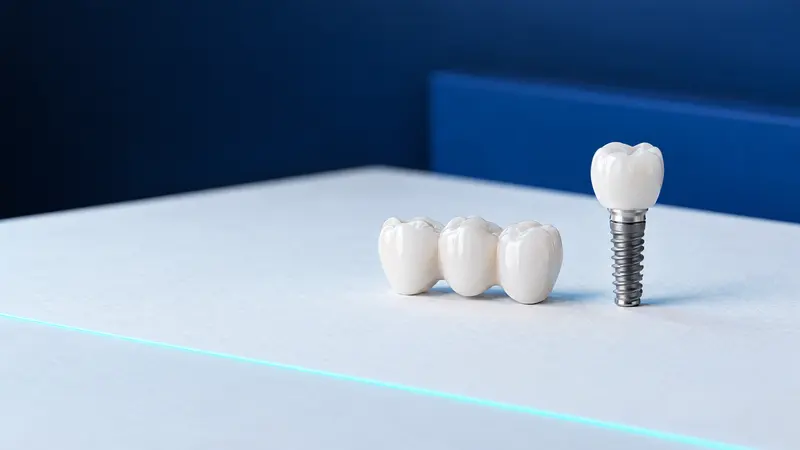
| On implants | All teeth missing, especially in the lower jaw | Requires a surgical procedure and enough bone | On 2 implants: 10 000 zł |
Which type of denture is best?
No single denture is right for everyone, because the choice is driven by the situation in the mouth, not by the material alone. A cast metal denture, which works well with a few gaps and healthy abutment teeth, has no use in a toothless upper jaw, and a complete denture is not needed when a few strong teeth remain in the arch.
The layout of the gap also matters. In a study of 886 cast metal dentures, those with a so-called free-end saddle, meaning one that ends where there is no tooth behind it, more often needed adjustments to the part resting on the gum (Vermeulen et al., 1996). When choosing, the dentist weighs several factors at once:
- The number and position of the missing teeth, including whether the gap has teeth on both sides.
- The condition of the teeth that are to hold the denture: decay, fillings, root canal treatment and loosening in gum disease.
- The amount of bone and the shape of the ridge, on which the stability of a complete denture and the possibility of placing implants depend.
- Allergy to components of the material, for example to metal, which can rule out some designs.
- How it is paid for: the NFZ funds acrylic dentures only.
- Expectations about appearance, for example whether clasps will show when smiling.
Cast metal or acrylic denture: how do they differ?
A cast metal (skeletal) denture and an acrylic denture differ in their construction. An acrylic denture is made entirely of resin and rests mainly on the gum, and its clasps are bent from wire. A cast metal denture has a cast metal framework with clasps, which transfers part of the chewing forces to the patient’s own teeth, so the plate can be smaller.
A cast metal denture is a solution for years, but not for ever. In a Dutch study of 886 cast metal dentures, 75% were still in use after 5 years and 50% after 10 years; the framework fractured in 10 to 20% of dentures after 5 years (Vermeulen et al., 1996). These are older data from simple designs, so they show the scale of the issue, not a forecast for a particular person.
Flexible dentures and other dentures made of thermoplastic materials have no metal clasps, which can matter for appearance. The Japan Prosthodontic Society does not recommend flexible dentures without metal clasps as definitive dentures, except in limited situations such as metal allergy (Fueki et al., 2014). Thermoplastic materials also have lower colour stability and a higher risk of fracture than conventional acrylic.
Denture on attachments: on teeth, on roots or on implants?
A denture on attachments is held not by clasps around the teeth but by precision connectors: one part of the attachment is fixed to an abutment tooth, most often to a crown, and the other to the denture. A cast metal denture combined with crowns fitted with attachments or slide locks is called a combined denture.
A systematic review of 21 studies found that partial dentures on attachments have good retention and look better than dentures with conventional clasps. However, the overall failure rate was 16.6%, and studies comparing different attachment systems are lacking (Carneiro et al., 2024). In the clinic’s price list, “Proteza kombinowana” (combined denture) costs 3 700 zł, and “Zasuwa/Zatrzask” (slide lock/attachment, 1 300 zł) is a separate item.
Attachments can also be placed in retained root-treated roots; since 2025 such an overdenture has been an NFZ service, no more than once every 5 years. When all the teeth are missing, a denture can be supported by implants, which is described in a separate article on implant-supported dentures.
Acrylic denture on the NFZ: who is eligible and how often?
For adults, the NFZ funds acrylic dentures only: a partial denture with wire clasps if at least 5 teeth are missing in one arch, and a complete upper or lower denture made from a functional impression in a custom tray. A new funded denture is available no more than once every 5 years; the limit does not apply to people who have had a tumour of the facial skeleton removed surgically.
Cast metal, combined, acetal and flexible dentures and dentures on implants are not on the NFZ list of services, nor are partial dentures when fewer than 5 teeth are missing in an arch. A funded denture is made by a practice that has an NFZ contract covering prosthodontics. Legal position as of 12 October 2026 (Ministry of Health regulation, consolidated text Dz.U. 2025 poz. 615).
| NFZ service | How often | Condition |
|---|---|---|
| Partial acrylic denture | Once every 5 years | 5 to 8, or more than 8, teeth missing in one arch |
| Complete acrylic denture | Once every 5 years | Upper or lower, functional impression in a custom tray |
| Overdenture on roots | Once every 5 years | Retained roots after root canal treatment |
| Denture repair with an impression | Once every 2 years | More extensive repair |
| Denture relining | Once every 2 years | Separately for the upper and the lower denture |
| After surgery for a facial skeleton tumour | The 5-year limit does not apply | Applies to people after surgical removal of a tumour |
How is a denture made, step by step?
Making a denture takes several visits, because it is made by a dental technician from impressions and a bite registration, and the dentist checks it in the mouth at successive stages. According to the NHS, making a denture usually takes a few weeks, and an immediate denture can be prepared within a few days.
In the clinic’s price list, “Konsultacja protetyczna” (prosthodontic consultation) costs 300 zł and “Wzornik zwarciowy” (bite block) 100 zł. The usual order of stages is:
- Consultation and examination: the dentist assesses the teeth, gums and bone, often on a panoramic X-ray, and decides which teeth need treating or removing first.
- Impressions or a scan: for a complete denture, a preliminary impression is followed by a functional impression in a custom tray.
- Recording the bite on a bite block, that is, setting the height and the relative position of the upper and lower jaws.
- A try-in of the teeth set in wax, at which appearance, bite and speech are assessed.
- Fitting the denture, with instructions on putting it in, taking it out and cleaning it.
- Follow-up visits, at which the dentist adjusts spots that press on the gum.
How long does it take to get used to a denture?
Getting used to a new denture usually takes a few weeks. During this time the NHS advises practising putting the denture in and taking it out, and eating soft food until a normal diet becomes comfortable.
A spot where the denture presses or rubs on the gum is not worth waiting out, because the dentist can adjust it at a follow-up visit. Over time a denture also loses its fit, because the gum and bone underneath change shape (NHS). If it slips or no longer fits, a loose denture does not always mean a new one: relining, that is, building up the fitting surface of the plate, is often enough, and the dentist decides on it after an examination.
How to clean a denture, and should it come out at night?
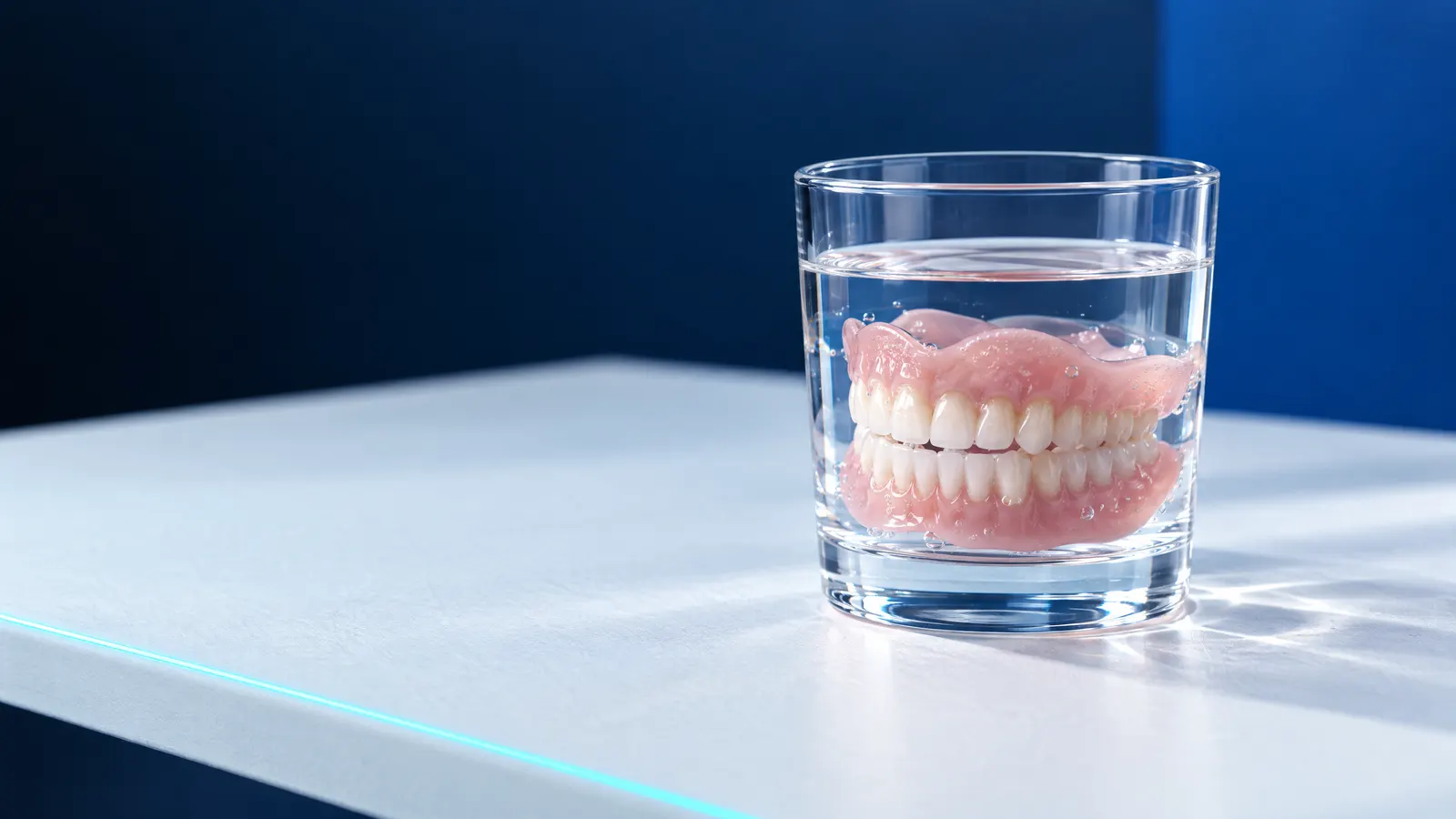
A denture is taken out at night. Guidelines from the American College of Prosthodontists (ACP) state that a denture should not stay in the mouth overnight without a particular reason, and the NHS advises keeping it in water or a denture cleaning solution during that time (Felton et al., 2011; NHS).
Combining brushing with a chemical cleaner cleans a denture more effectively than either method alone (Papadiochou and Polyzois, 2018). Daily care looks like this:
- Morning and evening, take the denture out and brush it with mild soap or washing-up liquid.
- Do not use ordinary toothpaste, because it can damage the surface of the denture.
- Rinse the denture after meals.
- Soak the denture in a denture cleaning solution every day.
- At night, keep it in water, in a cleaning solution or in a bag with damp cotton wool.
- Attend regular check-ups, also with a complete denture, because the ACP guidelines include an ongoing programme of check-ups.
How dentures are made at DentalBlue
At DentalBlue in Białystok, prosthodontics works in the same building as oral surgery, implantology and endodontics under the microscope, so a denture plan can take extractions, root treatment for attachments or implants into account from the start. Panoramic X-rays and CBCT scans are taken in the clinic’s own radiology unit. A patient without pain can start with a “Wizyta bez bólu” (visit without pain, 300 zł), which includes a panoramic X-ray, a consultation, an examination and a written treatment plan. The dentist sets the final scope and cost, and prices may change. A consultation can be booked by phone.
Frequently asked questions
How much does a private denture cost?
The price depends on the type of denture. In the DentalBlue price list, a partial acrylic denture costs 2 000 zł, a complete one 2 500 zł, a cast metal denture 3 500 zł and a combined denture 3 700 zł. Attachments, crowns and treatment of the abutment teeth are separate items, and the dentist sets the final cost at the consultation.
How long does a denture last?
There is no single figure. Over time a denture stops fitting closely because the gum and bone change, and the NFZ allows an acrylic denture to be replaced once every 5 years. In a study of cast metal dentures, 75% were in use after 5 years and 50% after 10 years (Vermeulen et al., 1996).
What should I do if a denture presses or rubs on the gum?
Come in for an adjustment rather than waiting for the gum to get used to it. The dentist adjusts the plate where it presses. A sore that does not heal despite adjustment needs to be examined again.
Do I need a referral for an NFZ denture?
No. No referral is needed to see a dentist on the NFZ (Article 57 of the Act on publicly funded health care services). An acrylic denture is made by a practice with an NFZ contract covering prosthodontics, and eligibility for a new denture depends on whether 5 years have passed since the previous one.
Can a cracked denture be repaired?
Usually yes: a cracked plate can be repaired, and a tooth can be added to the denture when another natural tooth has been removed. The NFZ funds a repair with an impression once every 2 years. In the clinic’s price list, “Naprawa protezy” (denture repair) costs 500 zł and “Dostawienie zęba do protezy” (adding a tooth to a denture) 600 zł.
Sources
- Dz.U. 2025 poz. 615: rozporządzenie MZ w sprawie świadczeń z zakresu leczenia stomatologicznego, tekst jednolity (2025)
- NHS: Dentures (2025)
- Felton D et al., J Prosthodont: ACP guidelines on the care of dentures (2011)
- Papadiochou S, Polyzois G, Int J Dent Hyg: denture hygiene, systematic review (2018)
- Vermeulen AH et al., J Prosthet Dent: survival of cast metal partial dentures after 10 years (1996)
- Fueki K et al., J Prosthodont Res: JPS position paper on non-metal clasp dentures (2014)
- Fueki K et al., J Prosthodont Res: non-metal clasp dentures, part II, materials (2014)
- Carneiro CA et al., Int J Prosthodont: attachments in partial dentures, systematic review (2024)
An informational article. It does not replace a consultation, and treatment decisions are made during a visit.