What is a metal partial denture and what are its components?
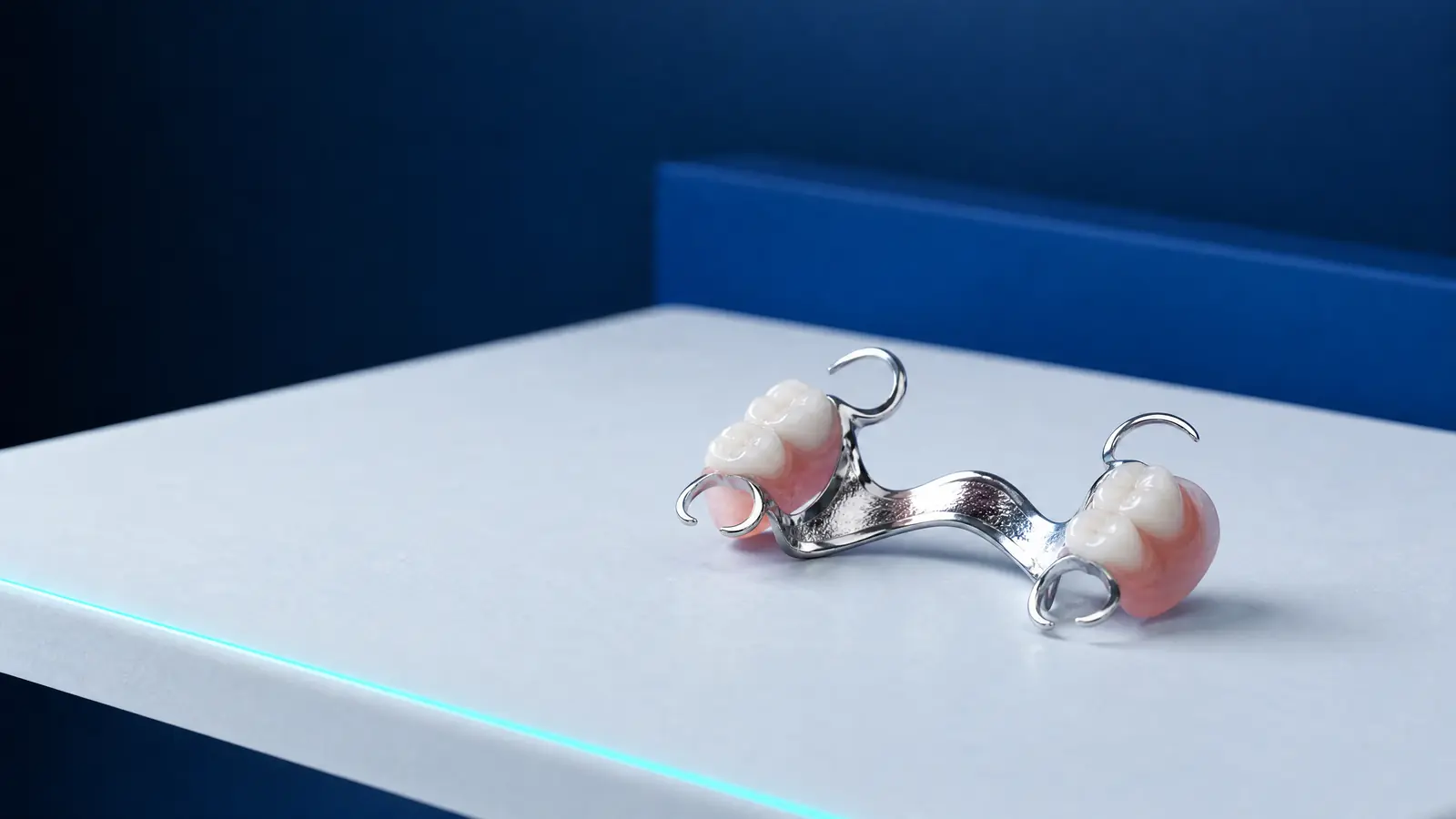
A metal partial denture is a removable partial denture built on a thin cast metal framework, for example cobalt-chromium alloy. The framework connects artificial teeth set in resin saddles to components supported by your own teeth, so some chewing forces reach the teeth rather than just the gum.
Training materials for dentists published on the NHS Scotland portal (Jagger, 2017) describe the components of a partial denture. Below we explain the role of the structural components, describing the major connector and the minor connectors separately:
- Saddles: the resin parts resting on the toothless ridge, in which the artificial teeth are set.
- Rests: small metal supports on the surface of a tooth that transfer pressure to the tooth and limit the denture sinking into the gum.
- Clasps: flexible arms engaging an undercut on a tooth to retain the denture against forces pulling it away from its supporting tissues.
- Bracing components: parts that counterbalance clasp pressure and limit sideways movement of the denture.
- Major connector: the rigid part linking both sides of the arch, for example a palatal plate or a frame-shaped connector in the upper jaw, or a lingual bar in the lower jaw.
- Minor connectors: parts joining the clasps, rests and saddles to the major connector.
Metal or acrylic partial denture: what does research say?
Metal and acrylic partial dentures differ mainly in their support: an acrylic partial denture rests mainly on the oral mucosa, whereas a metal one also rests on the teeth through its rests. According to NHS Scotland materials, tooth-supported dentures have better support and retention than dentures supported solely by the mucosa (Jagger, 2017).
A systematic review of 15 studies, with a meta-analysis of 10, found no significant difference between metal and acrylic dentures in patient satisfaction or quality of life (Almufleh et al., 2020). However, people with metal dentures were more likely actually to wear them, and the authors rated the evidence in most papers as low quality.
The review’s authors also note that metal dentures are often regarded as long-term replacements and acrylic partial dentures as interim ones. A separate article on dentures reviews all types and their prices.
Clasps or attachments: what holds a metal partial denture in place?
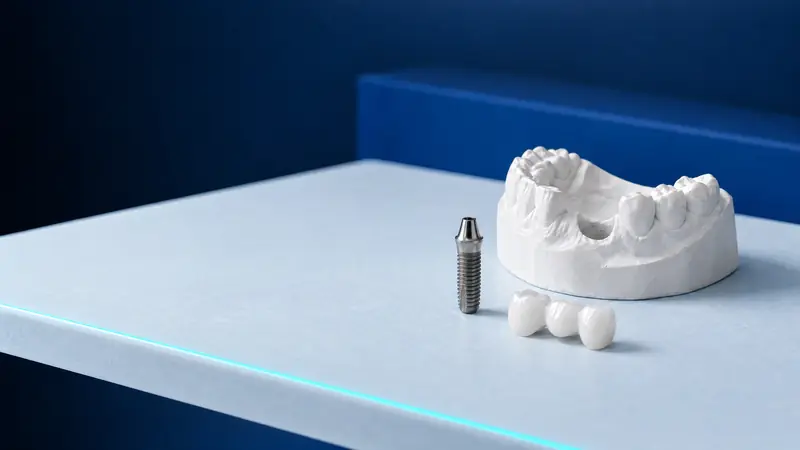
A metal partial denture is retained by clasps or precision attachments, including studs and slides. A clasp embraces a natural tooth, while an attachment has two parts: one connected to a crown on an abutment tooth, the other to the denture. A framework combined with crowns and attachments is called a combination denture.
The systematic review by Moldovan et al. (2016) reports failure rates after 5 years of 11 to 30% for dentures with attachments on both sides of the arch, and 75% for those with attachments on one side only. For conventional clasp-retained metal partial dentures, the authors report 33 to 50% failure after 5 years, although the studies differed too much for their results to be pooled.
An attachment requires a crown on the abutment tooth, so the tooth has to be ground down, and crowns and attachments add to the denture’s cost. In the study by Vermeulen et al. (1996), crowns on abutments for attachment-retained dentures appeared to delay the need to treat those teeth again.
| Feature | Clasp-retained denture | Attachment-retained combination denture |
|---|---|---|
| Appearance | A metal clasp may show when you smile | Attachments concealed in the crown and denture, with no visible clasps |
| Abutment teeth | Healthy teeth do not need crowns | A crown on every tooth with an attachment |
| How retention works | The clasp engages a tooth undercut | The denture component clicks onto the component in the crown |
| Failure after 5 years in studies | 33 to 50% (clasp-retained frameworks) | 11 to 30% (attachments on both sides of the arch) |
| What the cost includes | Framework with clasps | Framework, abutment crowns and each attachment separately |
| Clinic price-list item | “Proteza szkieletowa” (metal partial denture): 3 500 zł | “Proteza kombinowana” (combination denture): 3 700 zł, “Zasuwa/Zatrzask” (slide/stud attachment): 1 300 zł |
Does a clasp on a metal partial denture have to be metal?
A clasp on a metal partial denture does not have to be metal. NHS Scotland materials list cast or wrought cobalt-chromium clasps, steel and gold clasps, and clasps made of acetal resin or nylon (Jagger, 2017).
A resin clasp is close to the colour of a tooth or gum, which matters when the abutment tooth shows in the smile. In the clinic’s price list, “Klamra acetalowa” (acetal clasp) costs 700 zł. The dentist decides whether it is suitable for a particular tooth after assessing its shape, undercut and bone support.
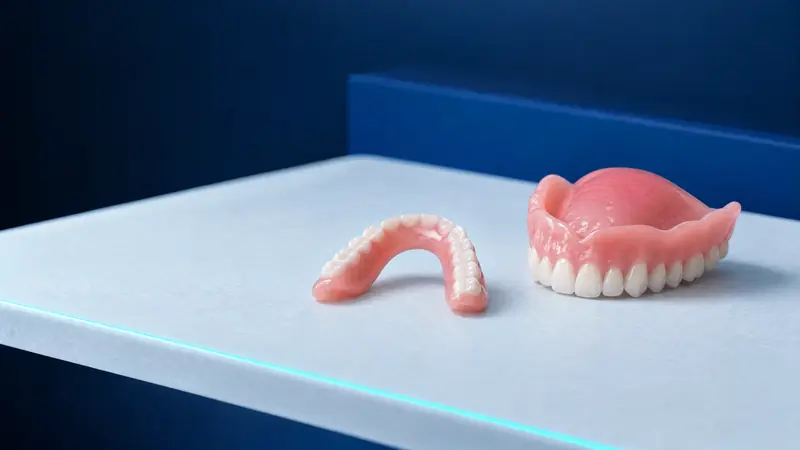
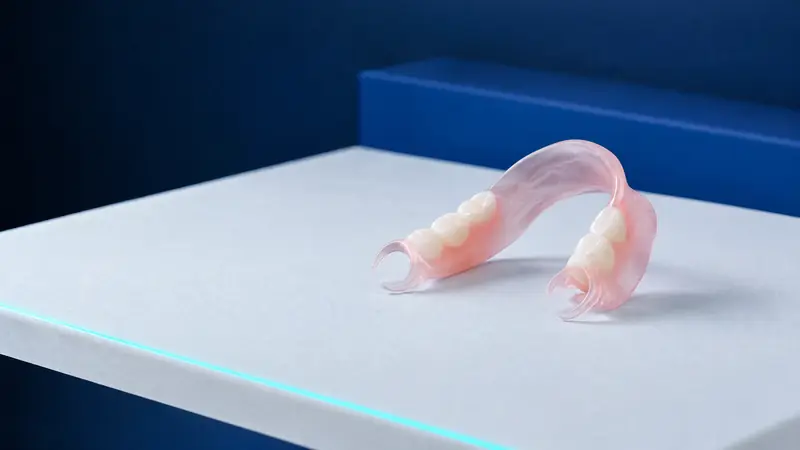
Dentures made entirely of resin, without a metal framework, are a separate group with different indications and limitations; these are discussed in the article on flexible dentures.
How long does a metal partial denture take to make and what does treatment involve?
Making a metal partial denture usually takes several weeks and several visits, because a dental technician casts the framework from an impression and the dentist checks it in the mouth before arranging the teeth. The NHS says making a denture usually takes several weeks; it takes longer when teeth first need treatment or extraction.
The usual sequence is:
- Consultation and examination, usually with a panoramic X-ray: assessment of the abutment teeth, periodontal tissues and bite.
- Preparatory treatment: fillings, root canal treatment, removal of teeth with a hopeless prognosis, professional cleaning and, for a combination denture, crowns with attachments.
- An impression or scan, from which the technician analyses the model on a dental surveyor to establish the path of insertion and clasp undercuts.
- Try-in of the metal framework in the mouth and recording the bite.
- Try-in of teeth set in wax, followed by delivery of the denture with instructions on inserting, removing and cleaning it.
- Check-ups at which the dentist adjusts pressure points; according to the NHS, getting used to a denture usually takes several weeks.
How long do metal partial dentures last according to studies?
In studies, metal partial dentures usually last many years, but the result depends on what the authors define as failure. In a Dutch study of 886 metal partial dentures, 75% were still worn after 5 years and 50% after 10 years; framework fracture was found in 10 to 20% after 5 years and 27 to 44% after 10 years (Vermeulen et al., 1996).
Abutment teeth need attention more often than the metal itself. In the same study, if the need to treat an abutment tooth again counted as failure, 40% of conventional dentures avoided this for 5 years and over 20% for 10 years.
Free-end saddle dentures, which end where there is no tooth beyond the saddle, more often needed adjustments to the gum-supported part. The review by Moldovan et al. (2016) stresses that careful preparatory treatment and regular check-ups were associated with better outcomes.
Does a metal partial denture harm teeth and how should you care for it?
There is no strong evidence that a metal partial denture itself causes periodontal destruction or tooth loss, but this does not mean there is no risk to the abutment teeth. A systematic review by Gotfredsen et al. (2022), concerning people with periodontitis, found no strong evidence that a removable denture itself causes periodontal destruction and tooth loss, although several studies found more plaque accumulation.
Daily hygiene therefore matters just as much for the supporting teeth as for the denture. NHS advice for denture wearers includes:
- Remove the denture morning and evening and wash it with mild soap or washing-up liquid, without toothpaste, which may damage it.
- Brush the remaining teeth, gums and tongue with fluoride toothpaste, including the areas where clasps and rests sit.
- Rinse the denture in cold water after meals.
- Clean it over a basin of water or a towel, as it may break if dropped.
- Take it out at night unless your dentist advises otherwise.
- See a dentist if it slips, no longer fits, causes pain or is damaged.
Metal partial dentures in Białystok: NFZ or private care?
Metal partial dentures are not an NFZ service. The regulation on guaranteed dental services provides adults only with acrylic dentures: partial dentures with wrought clasps when at least 5 teeth are missing in an arch, and complete dentures, no more than once every 5 years (legal status as of 24 October 2026).
According to the Podlaskie regional branch of the NFZ, 25 service locations in Podlaskie province provide dental prosthetics under contract with the fund; their addresses appear in the NFZ “Gdzie się leczyć” (where to get treatment) search tool after selecting a district or town (as of 24 October 2026). A separate prosthetics contract for patients after surgery for cancer of the facial skeleton covers one location: the Specialist Dental Treatment Centre of the Medical University of Białystok.
How it works at DentalBlue
At DentalBlue in Białystok, prosthodontics is one of five specialist teams at one address, alongside surgery and implantology, endodontics, orthodontics and paediatric dentistry. The clinic’s own radiology unit takes panoramic and intraoral X-rays of abutment teeth. In its price list, “Proteza szkieletowa” costs 3 500 zł, “Proteza kombinowana” 3 700 zł and “Konsultacja protetyczna” (prosthodontic consultation) 300 zł. The dentist sets the final scope and cost at the consultation, and prices may change. A consultation can be booked by phone.
Frequently asked questions
How much does a metal partial denture cost?
In DentalBlue’s price list, “Proteza szkieletowa” costs 3 500 zł, and an attachment-retained “Proteza kombinowana” 3 700 zł. Each “Zasuwa/Zatrzask” (1 300 zł) and the abutment crowns are separate items. Preparatory dental treatment also affects the cost, and the dentist sets the final amount at the consultation. Prices may change.
Can you sleep with a metal partial denture in?
Usually not. The NHS advises against wearing dentures at night unless your dentist recommends it. At night, clean the denture and store it in water or denture-cleaning solution, then put it in after brushing your teeth in the morning.
How long does it take to get used to a metal partial denture?
According to the NHS, getting used to a new denture usually takes several weeks. Practising insertion and removal and eating soft food initially can help. The dentist adjusts areas pressing on the gum or a tooth at a check-up, so you do not have to wait for these to settle by themselves.
Is a metal partial denture suitable if you have a metal allergy?
With a confirmed metal allergy, the dentist considers a thermoplastic denture without a metal framework. These dentures have their own limitations, including repair and relining, which the article on flexible dentures explains.
Can you have a metal partial denture with periodontitis?
Usually yes, after periodontal treatment. The review by Gotfredsen et al. (2022) indicates that prospective studies maintained removable dentures for years without significant periodontal destruction, although two retrospective studies linked them to more tooth loss than bridges. Hygiene and regular check-ups matter.
Sources
- Clinical Oral Investigations: Moldovan O et al., removable dentures in reduced dentitions, systematic review (2016)
- Journal of Prosthetic Dentistry: Vermeulen AH et al., ten-year evaluation of partial dentures (1996)
- Journal of Prosthodontics: Almufleh B et al., metal and acrylic partial dentures, meta-analysis (2020)
- Journal of Clinical Periodontology: Gotfredsen K et al., partial dentures in periodontitis, systematic review (2022)
- NHS: Dentures (2025)
- NHS Scotland: Jagger R, Successful partial dentures, training materials (2017)
- ELI: Rozporządzenie MZ w sprawie świadczeń gwarantowanych z zakresu leczenia stomatologicznego, t.j. Dz.U. 2025 poz. 615
- Podlaski Oddział Wojewódzki NFZ: dental treatment, service locations from 1 July 2025
An informational article. It does not replace a consultation, and treatment decisions are made during a visit.