What is a panoramic dental X-ray, and what does it show?
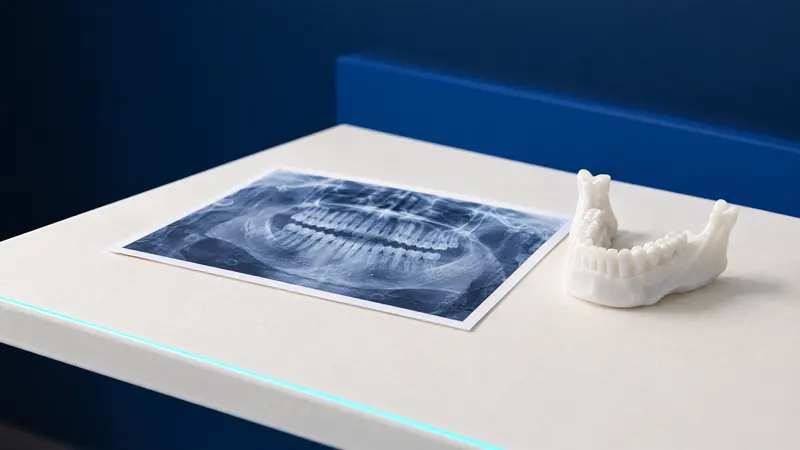
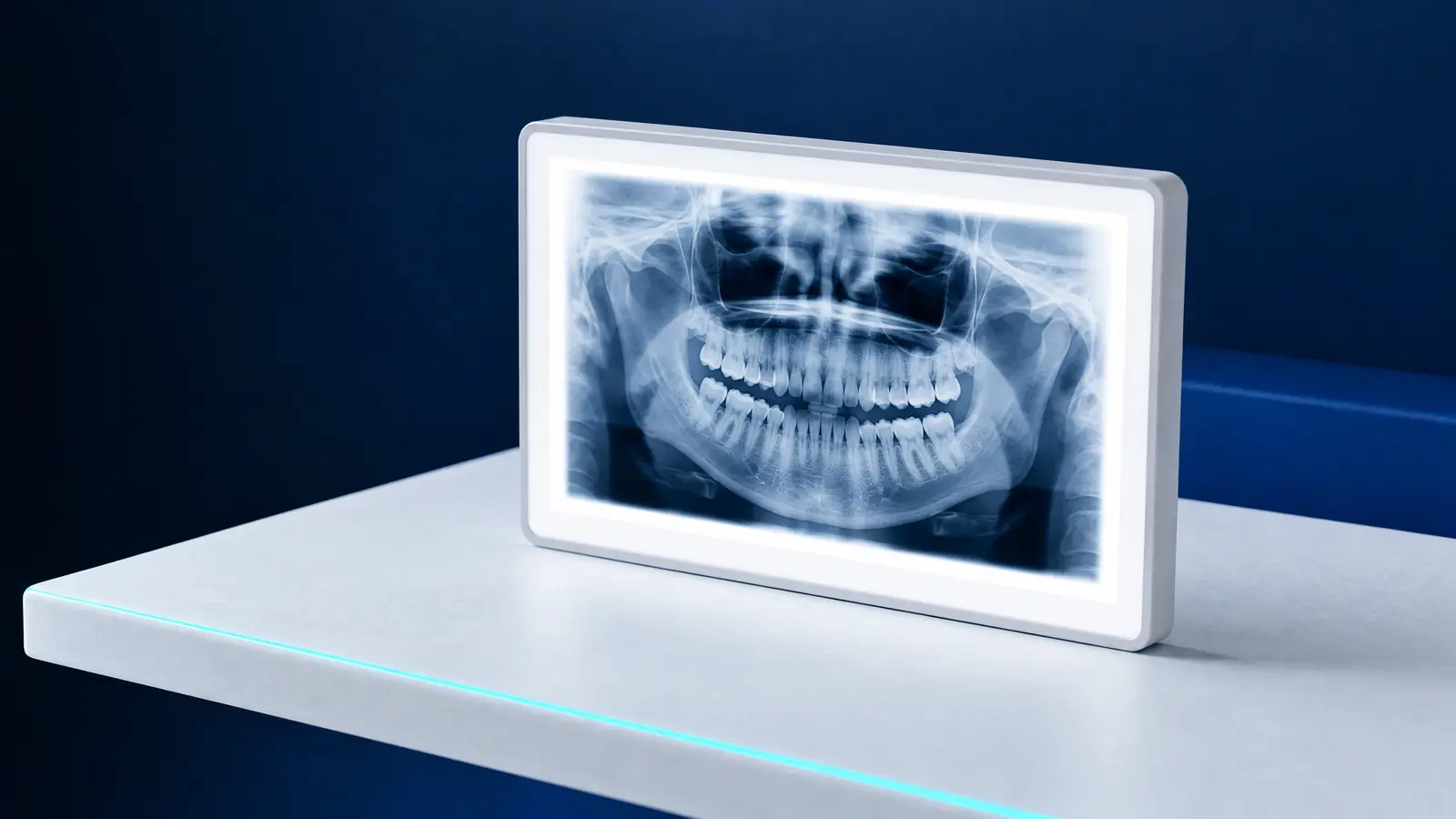
A panoramic dental X-ray, also known as an orthopantomogram or OPG, is a single two-dimensional X-ray of the whole mouth: all the teeth, their roots and the bones of the upper and lower jaws. The arm of the machine rotates around the head, recording an image laid out like a map, hence the name panoramic X-ray.
According to RadiologyInfo, run by the American radiological societies ACR and RSNA, a panoramic X-ray helps identify advanced periodontal disease, jaw cysts and tumours, impacted wisdom teeth, temporomandibular joint disorders and sinusitis. It is also used to plan dentures, orthodontic appliances, tooth extractions and implants.
The 2012 guidelines from the American Dental Association (ADA) and the FDA list the situations in which a panoramic X-ray in an adult is most likely to contribute to diagnosis: suspected changes around root tips, partially erupted teeth, cavities, swelling and suspected impacted teeth. In people with no teeth, studies found abnormalities on panoramic X-rays in 30 to 50% of patients.
| Question | Brief answer |
|---|---|
| What does it show? | All the teeth, roots, jawbones, temporomandibular joints and sinuses |
| What does it not show in detail? | Early decay between teeth and fine details of an individual tooth |
| How long is the exposure? | Usually 12 to 20 seconds as the machine’s arm rotates |
| What is the dose? | Typically 2.7 to 24.3 µSv (European Commission, Radiation Protection 172) |
| Do I need a referral? | Yes, a referral or an order from a doctor or dentist |
| Is it funded by the NFZ? | In specified circumstances: adults once every 5 years, children aged 5 and over once every 3 years |
| How should I prepare? | No special preparation; remove jewellery, glasses and metal objects from around your head |
| What about pregnancy? | Mention pregnancy or possible pregnancy; the doctor will assess whether the X-ray is needed now |
| What does it cost? | The clinic’s price list gives 120 zł for a panoramic X-ray and 60 zł for a partial panoramic X-ray |
What cannot be seen on a panoramic dental X-ray?
A panoramic X-ray provides an overview rather than details of an individual tooth. RadiologyInfo notes that it shows limited detail of teeth and soft tissues, and the curvature of the arch can make the image slightly blurred, so it is unsuitable for precise measurements of teeth and bone.
The ADA and FDA guidelines state that intraoral X-rays are more accurate than panoramic X-rays for assessing dental injuries, root shape, root resorption and pulp disease. They identify bitewing X-rays as the most effective method for detecting decay on the surfaces where teeth touch. A dentist therefore sometimes adds an X-ray of an individual tooth after a panoramic image, as described in the article on dental X-rays.
When the answer depends on the third dimension, for example when planning an implant or assessing an impacted tooth close to a nerve, the dentist refers the patient for cone beam computed tomography (CBCT). The differences between these examinations and their doses are explained in a separate article on when CBCT is chosen and when a panoramic X-ray is used.
What happens during a panoramic dental X-ray?
A panoramic dental X-ray is quick and requires no special preparation; you do not need to fast. The Radiology Department at the University Clinical Hospital in Białystok also lists panoramic X-rays among the examinations requiring no preparation in its patient information (as of 24 October 2026).
- Before the examination, remove earrings, glasses, hair clips and other metal objects from around your head, as they cast shadows on the image.
- Tell the staff if you are pregnant or cannot rule out pregnancy.
- The radiographer positions your head using supports, and you usually place your teeth on a bite block to keep them in the correct position.
- The examination is usually performed standing up, but the machine can also accommodate someone sitting in a wheelchair.
- The machine’s arm rotates around your head for about 12 to 20 seconds; keep still during this time, as movement blurs the image and may mean it has to be repeated.
Do you need a referral for a panoramic dental X-ray?
Yes, a panoramic dental X-ray requires a referral or an order, even if you pay privately. The Minister of Health’s regulation on the safe use of ionising radiation states that an examination using radiation must be based on a referral or an order. The only exception is intraoral dental X-rays taken using machines intended exclusively for that purpose (§ 3 ust. 1 i 3, t.j. Dz.U. 2025 poz. 1288).
A doctor or a dentist can refer you: the Polish Atomic Law Act includes both in its definition of referring practitioners (art. 3 pkt 8a, t.j. Dz.U. 2026 poz. 1). The referral contains the purpose and justification of the examination, the provisional diagnosis and the information needed to perform it. In a surgery with its own machine, the dentist examining you can order the X-ray.
A referral is more than a formality. The Atomic Law Act requires every examination using radiation to be justified by a benefit to the patient, and the practitioner responsible for the examination assesses whether that justification is valid (art. 33c i art. 33i). Legal status as of 24 October 2026.
Panoramic X-rays on the NFZ: who is eligible, and how often?
The NFZ, Poland’s National Health Fund, funds panoramic X-rays for adults undergoing root canal treatment and for all patients before prosthetic treatment, no more than once every 5 years. Children and young people aged 5 to 18 are eligible once every 3 years where medically justified (Minister of Health’s regulation, t.j. Dz.U. 2025 poz. 615).
For children, the regulation lists suspected abnormalities of tooth development, changes in the jawbones or periodontitis, as well as identifying sources of infection. An NFZ referral is issued by a dentist who is a specialist or undergoing specialist training and must explain why the examination is needed. The service includes a report entered in the medical records.
CBCT is not included in the list of NFZ-funded dental services, as discussed in more detail in the article on CBCT and panoramic X-rays. Legal status as of 24 October 2026.
Are panoramic dental X-rays safe during pregnancy and for children?
A panoramic dental X-ray involves a low radiation dose: the European Radiation Protection 172 guidelines give a typical effective dose of 2.7 to 24.3 µSv, depending on the machine. Nevertheless, the Atomic Law Act provides special protection for women of childbearing age, pregnant and breastfeeding women, and people under 16 (art. 33e ust. 1).
Under art. 33e ust. 2 of the Atomic Law Act, the referring practitioner and the practitioner responsible for the examination obtain information from a woman on pregnancy or breastfeeding where it is relevant to the radiological procedure. RadiologyInfo also advises always mentioning possible pregnancy. The doctor then assesses whether the X-ray is needed now or can wait, as explained further in the article on dental treatment during pregnancy.
In children, a panoramic X-ray helps assess tooth development, as the ADA and FDA guidelines emphasise. Only a bite block goes into the mouth, but the child must stand still for a dozen or so seconds, so the doctor decides on the appropriate age and method of examination. For teenagers, the ADA and FDA guidelines also recommend assessing the presence, position and stage of development of wisdom teeth.
How do I obtain my panoramic X-ray, and will I receive a report?
The result of a panoramic dental X-ray is a digital image assessed by a doctor: the Atomic Law Act includes clinical evaluation of the result among the duties of the referring practitioner and the practitioner responsible for the examination (art. 33h ust. 2). Under the NFZ, the service includes preparing a report and entering it in the medical records.
Digital images are transferred and archived in DICOM format, which another surgery can read (§ 3 ust. 4 of the regulation). You are entitled to a copy of your records, including on a data storage medium or electronically, and the first copy within a given scope is free (art. 27 i 28 of the Patient Rights Act, t.j. Dz.U. 2024 poz. 581). A provider keeps X-rays stored separately from the patient’s records for 10 years from the end of the year in which they were taken (art. 29 ust. 1 pkt 2).
Keep the result and bring it to subsequent appointments. Radiation protection rules require unnecessary repeat examinations to be limited (art. 33d ust. 2 of the Atomic Law Act), and a recent image from another surgery is sometimes sufficient for planning treatment.
How much does a panoramic dental X-ray cost?
The price of a panoramic dental X-ray depends on the area imaged. In the clinic’s price list, “Pantomogram” (panoramic dental X-ray) costs 120 zł, while “Pantomogram wycinek” (partial panoramic X-ray), an image of a selected part of the arch, costs 60 zł.
A panoramic X-ray is also part of the first visit: “Wizyta z bólem” (visit with pain, 340 zł) includes a panoramic X-ray, a consultation, an examination and pain relief, while “Wizyta bez bólu” (visit without pain, 300 zł) includes a panoramic X-ray, a consultation, an examination and a written treatment plan. The dentist establishes the final scope of investigations and cost at the consultation, and prices may change.
Panoramic dental X-rays at DentalBlue
DentalBlue in Białystok has its own radiology unit providing panoramic X-rays, CBCT scans, cephalometric X-rays, sinus X-rays and intraoral X-rays, so patients do not need to travel elsewhere for imaging. The clinic’s team includes radiographers. A panoramic X-ray is part of “Wizyta z bólem” and “Wizyta bez bólu”, and the dentist decides after the examination whether additional images are needed.
Frequently asked questions
Can you see wisdom teeth on a panoramic dental X-ray?
Yes. A panoramic X-ray shows impacted wisdom teeth, their position and stage of development, so it is usually the first image taken before deciding whether to remove a wisdom tooth. If a root lies close to the nerve canal in the lower jaw, the dentist may also order a CBCT scan.
How many panoramic dental X-rays can you have in a year?
Frequency depends on justification: an X-ray is taken when its result could change treatment (art. 33c of the Atomic Law Act). The NFZ funds a panoramic X-ray for adults once every 5 years in specified circumstances, and for children aged 5 and over once every 3 years, but these are funding limits, not medical recommendations.
Can I bring a panoramic X-ray from another surgery?
Yes. Ask for a copy on a disc or as a file; the first copy of records within a given scope is free. The dentist will assess whether the image is recent and detailed enough for the planned treatment.
How does a panoramic X-ray differ from an RVG image?
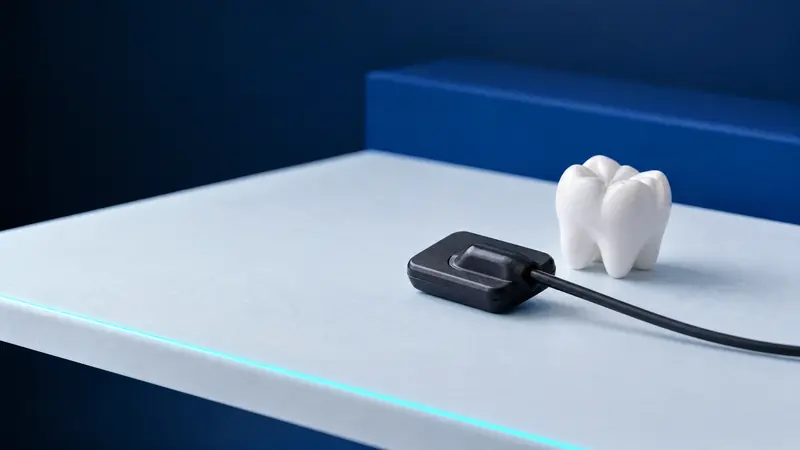
A panoramic X-ray shows the whole mouth in one image, while RVG is a digital intraoral X-ray of one or two teeth taken using a sensor placed inside the mouth. An intraoral X-ray shows the tooth in greater detail, while a panoramic image gives an overview of a wider area.
Does a panoramic dental X-ray hurt?
No. Only a bite block goes into your mouth, and exposure itself usually takes 12 to 20 seconds. You simply need to stand calmly and keep still; if needed, the examination can also be performed with the patient sitting in a wheelchair.
Sources
- RadiologyInfo (ACR and RSNA): Panoramic Dental X-ray (2024)
- ADA and FDA: Dental Radiographic Examinations, Recommendations for Patient Selection and Limiting Radiation Exposure (2012)
- European Commission: Radiation Protection 172, CBCT in dentistry, SEDENTEXCT guidelines (2012)
- Dz.U. 2025 poz. 1288: rozporządzenie MZ w sprawie warunków bezpiecznego stosowania promieniowania jonizującego dla wszystkich rodzajów ekspozycji medycznej (2025)
- Dz.U. 2026 poz. 1: ustawa Prawo atomowe, consolidated text (2026)
- Dz.U. 2025 poz. 615: rozporządzenie MZ w sprawie świadczeń gwarantowanych z zakresu leczenia stomatologicznego (2025)
- Dz.U. 2024 poz. 581: ustawa o prawach pacjenta i Rzeczniku Praw Pacjenta, consolidated text (2024)
- University Clinical Hospital in Białystok: Radiology Department, preparation for examinations (2026)
An informational article. It does not replace a consultation, and treatment decisions are made during a visit.