When should you first take your child to an orthodontist?
The first visit to an orthodontist should take place by the age of 7 at the latest: this is the recommendation of the American Association of Orthodontists (AAO), even when the parent sees no problem at all. At this age the jaws are still growing, and some problems are easier to correct by making use of that growth, for example with an appliance that widens the palate.
A check-up at 7 does not mean the child will get braces straight away. The AAO stresses that many children are simply monitored at further visits while the face and jaws develop, and the orthodontist decides when treatment begins. Some problems are treated early, for example an anterior crossbite.
The British Orthodontic Society (BOS) states that most children start treatment at around 12 or 13, when all the permanent teeth have come through. So an early check-up and later treatment do not contradict each other: the first makes it possible to plan the second.
Which signs in a child are a reason to see an orthodontist?
Reasons to see an orthodontist include crooked or crowded teeth, teeth that do not meet properly, the lower jaw shifting to one side when the mouth closes, and habits such as thumb sucking. The AAO also lists excessive gaps between the teeth and extra or missing teeth.
Malocclusion is common in children. In a study of 653 children aged 9 to 12 from Gdańsk, malocclusion was found in 81.6%, most often crowding and Class II malocclusion. These are data from one region, not a figure for the whole of Poland, but they show that a check-up is rarely unnecessary.
- Teeth that are crowded, overlapping or with large gaps.
- Upper front teeth sticking out well in front of the lower ones, or lower teeth in front of the upper ones.
- A crossbite, where upper teeth bite inside the lower ones.
- A lower jaw that shifts to one side when the teeth are clenched.
- Extra teeth, missing buds of permanent teeth, or very early or late loss of milk teeth.
- Persistent sucking of a thumb or dummy, or another habit that affects the position of the teeth.
The orthodontist and your child’s age: what happens at each stage?
A child’s age determines which treatment is possible and what the NFZ funds. The table combines the recommendations of orthodontic societies with the rules in Annex 6 to the regulation on guaranteed dental services, with the law as at 12 October 2026.
| Age | What happens | What follows from it |
|---|---|---|
| By 7 at the latest | First orthodontic check-up, according to the AAO | Most often monitoring, sometimes early treatment |
| Mixed dentition | The jaws grow, milk teeth are replaced by permanent ones | Removable and expansion appliances make use of growth |
| Up to the 12th birthday | The NFZ funds treatment with a removable appliance | The NFZ does not fund fixed braces |
| Up to the 13th birthday | The NFZ funds check-ups during retention | Applies to children treated under the NFZ |
| Around 12 to 13 | Most children start treatment, according to the BOS | Most often after all the permanent teeth have come through |
| After treatment ends | Retention, keeping the result in place | The BOS recommends long-term retention |
Removable or fixed braces for a child: how do they differ?
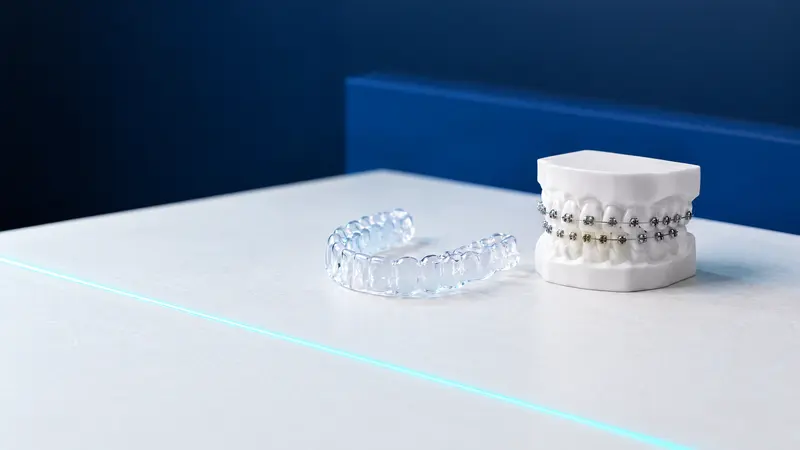
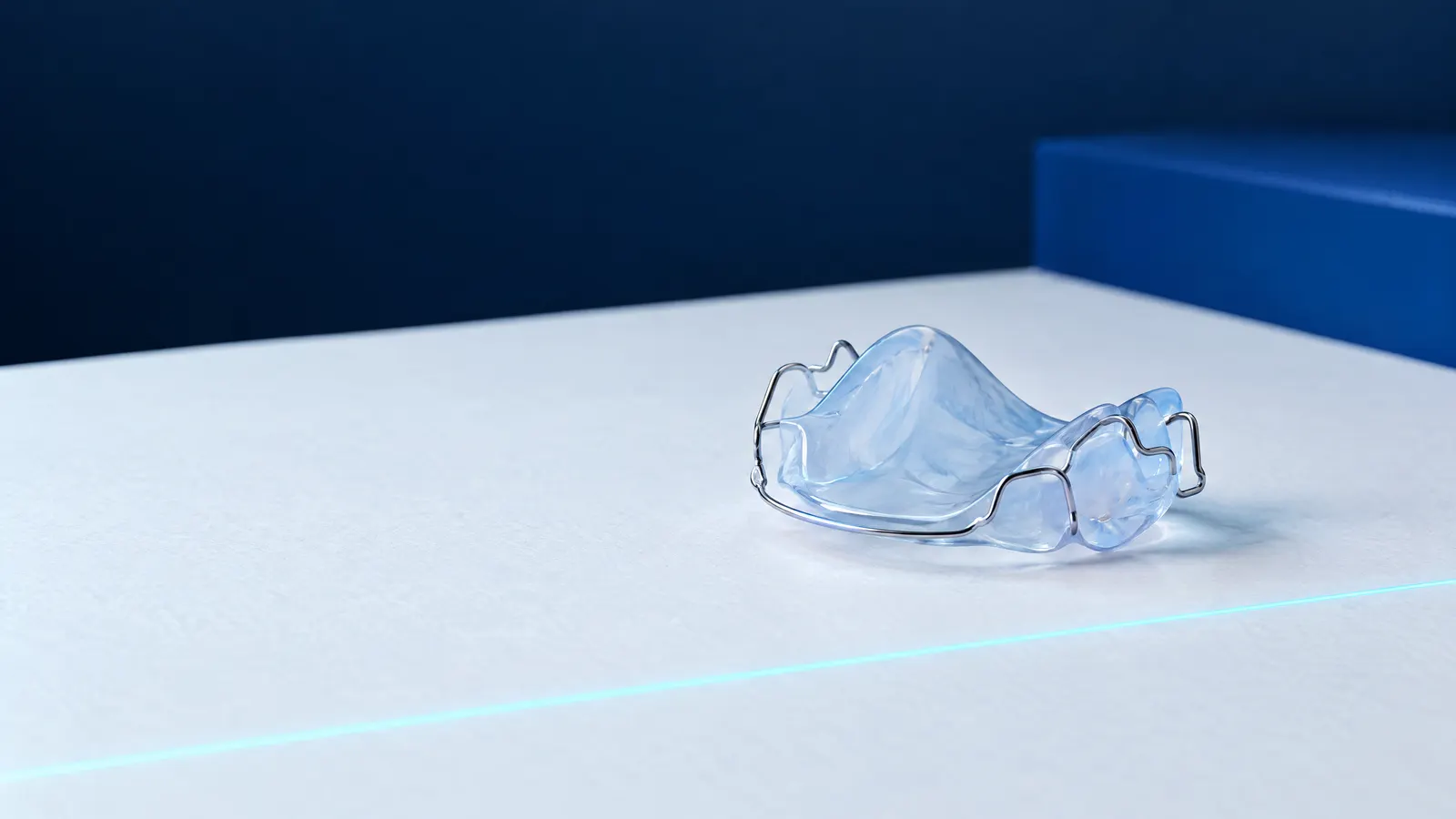
A child puts in and takes out a removable appliance themselves, while fixed braces are bonded to the teeth for the whole of treatment. Removable appliances are used mainly in younger children, when jaw growth needs guiding or the dental arch needs widening, and fixed braces most often once the permanent teeth have come through and each tooth needs positioning precisely.
A removable appliance works only when the child wears it, so its effectiveness depends on daily cooperation and on the parent keeping watch. Fixed braces do not need remembering to put in, but they do need careful cleaning of the teeth around the brackets. Appliances fixed to the teeth, for example the Hyrax type, are also used to widen the palate.
Orthodontic treatment often takes 1 to 2 years, and simple straightening of the front teeth alone can be shorter, according to the BOS even about 6 months. The type of appliance and the order of stages are decided by the orthodontist after an examination and analysis of the X-rays.
Braces on the NFZ: up to what age and what do they cover?
An orthodontic appliance on the NFZ is available up to the 12th birthday, and it is only a removable appliance, for one or both jaws; fixed braces are explicitly excluded from the list of services. Check-ups during retention, that is after treatment ends, are funded by the NFZ up to the 13th birthday for children treated within guaranteed services.
This treatment includes, among other things, a space maintainer, check-up visits and repair of the appliance once a year. The NFZ does not fund a new appliance if the previous one was used incorrectly, damaged or lost. A panoramic X-ray and a cephalometric X-ray with analysis are available in justified cases up to 2 times during the whole of treatment.
Orthodontic practices with an NFZ contract, in Białystok too, are shown by the NFZ search tool “Gdzie się leczyć” (Where to get treatment). After the 12th birthday, orthodontic treatment is paid for privately.
What happens at the first visit and in treatment planning?
At the first visit the orthodontist looks at the teeth and bite, checks how the lower jaw moves and any habits, and orders X-rays where needed. A panoramic X-ray shows all the teeth, including the buds of the permanent teeth, and a cephalometric X-ray, a side view of the skull, makes it possible to measure how the jaws and teeth are positioned relative to each other.
The radiation dose from a cephalometric X-ray is small: according to a European Commission review it is below 6 µSv. On the basis of the measurements, the cephalometric analysis, the orthodontist prepares a plan: what needs correcting, in what order, and which appliance this requires.
Why is retention needed after the braces come off?
Retention is needed because after treatment teeth tend to move back to their old positions. A 2016 Cochrane review states that almost everyone who has had orthodontic treatment will need some form of retention, and the BOS regards retainers as essential and recommends wearing them long term.
Retention is provided by a thin wire bonded behind the teeth on the tongue side (a fixed retainer), a removable plate or a clear tray. The 2023 update of the Cochrane review rated the evidence as low certainty, so no type of retainer has a proven advantage, and the choice depends on the problem and on the child.
How much do braces for a child cost?
The cost of a child’s orthodontic treatment depends on the type of problem, the type of appliance, the number of arches, the length of treatment and the number of check-up visits, as well as on retention after treatment. That is why the estimate is prepared after the consultation and the treatment plan.
In the clinic’s price list, an orthodontic consultation costs 300 zł, a treatment plan with cephalometric analysis 380 zł, and a cephalometric X-ray and a panoramic X-ray 120 zł each. A removable appliance is 1 150 zł, and a check-up visit for a removable appliance 250 zł. A Hyrax appliance and a Twinblock cost 1 500 zł each, a space maintainer 400 zł, a retention plate for 1 arch 700 zł and a fixed retainer for 1 arch 600 zł.
A check-up visit for metal braces on 1 arch costs 270 zł, and on 2 arches 350 zł. The final scope and cost are set at the consultation, and prices may change; the full list is in the clinic’s price list.
How it works at DentalBlue
At DentalBlue in Białystok, orthodontic treatment includes fixed braces and Clear Aligner trays, planned digitally on the basis of cephalometric analysis. Cephalometric and panoramic X-rays are taken in the clinic’s own radiology unit, so there is no need to go elsewhere for them. The clinic also provides paediatric dentistry and prevention, including fissure sealing and fluoride treatment. Patients can be seen in Polish, English, Ukrainian and Russian. A consultation can be booked by phone.
Frequently asked questions
Can a child with milk teeth have braces?
Yes, some problems are treated while the child still has milk or mixed teeth. The AAO gives as examples widening the palate, which works while the child is still growing, and correcting an anterior crossbite. Whether to treat early or monitor is decided by the orthodontist after an examination.
How long does orthodontic treatment take in a child?
According to the BOS, aligning the teeth so that they meet properly often takes 1 to 2 years, and simple straightening of the front teeth can be shorter. After treatment, retention begins, which the BOS recommends keeping up long term.
What happens if a child loses an appliance made on the NFZ?
The regulation states that a new orthodontic appliance is not available on the NFZ if the previous one was used incorrectly, damaged or lost. Repair of an appliance made on the NFZ is available once per calendar year, up to the 13th birthday.
Does my child need X-rays before the first visit to the orthodontist?
No. Whether X-rays are needed, and which ones, is decided by the orthodontist during the visit, because not every check-up requires them. If your child has a recent panoramic X-ray or earlier images, bring them along so that the examination is not repeated unnecessarily.
Does thumb sucking affect a child’s bite?
It can. The AAO lists thumb sucking among the habits that can disturb the development of the bite and regards it as one of the reasons for an orthodontic check-up. The orthodontist will assess whether the habit has already changed the position of the teeth and whether treatment is needed.
Sources
- AAO: Why Kids Should See an Orthodontist by Age 7 (2026)
- AAO: When Should Your Child See an Orthodontist? (2020, updated 2026)
- British Orthodontic Society: FAQs, treatment and retention
- ELI: Rozporządzenie MZ w sprawie świadczeń gwarantowanych z zakresu leczenia stomatologicznego, t.j. Dz.U. 2025 poz. 615, Annex 6
- Cochrane: Littlewood et al., retention procedures after orthodontic treatment (2016)
- Cochrane: Martin, Littlewood et al., retention procedures after orthodontic treatment, update (2023)
- PubMed: Kalinowska et al., malocclusion in children aged 9 to 12, Dent Med Probl (2025)
- European Commission: Radiation Protection 172, doses in dental radiology (2012)
An informational article. It does not replace a consultation, and treatment decisions are made during a visit.