How do clear aligners differ from fixed braces?
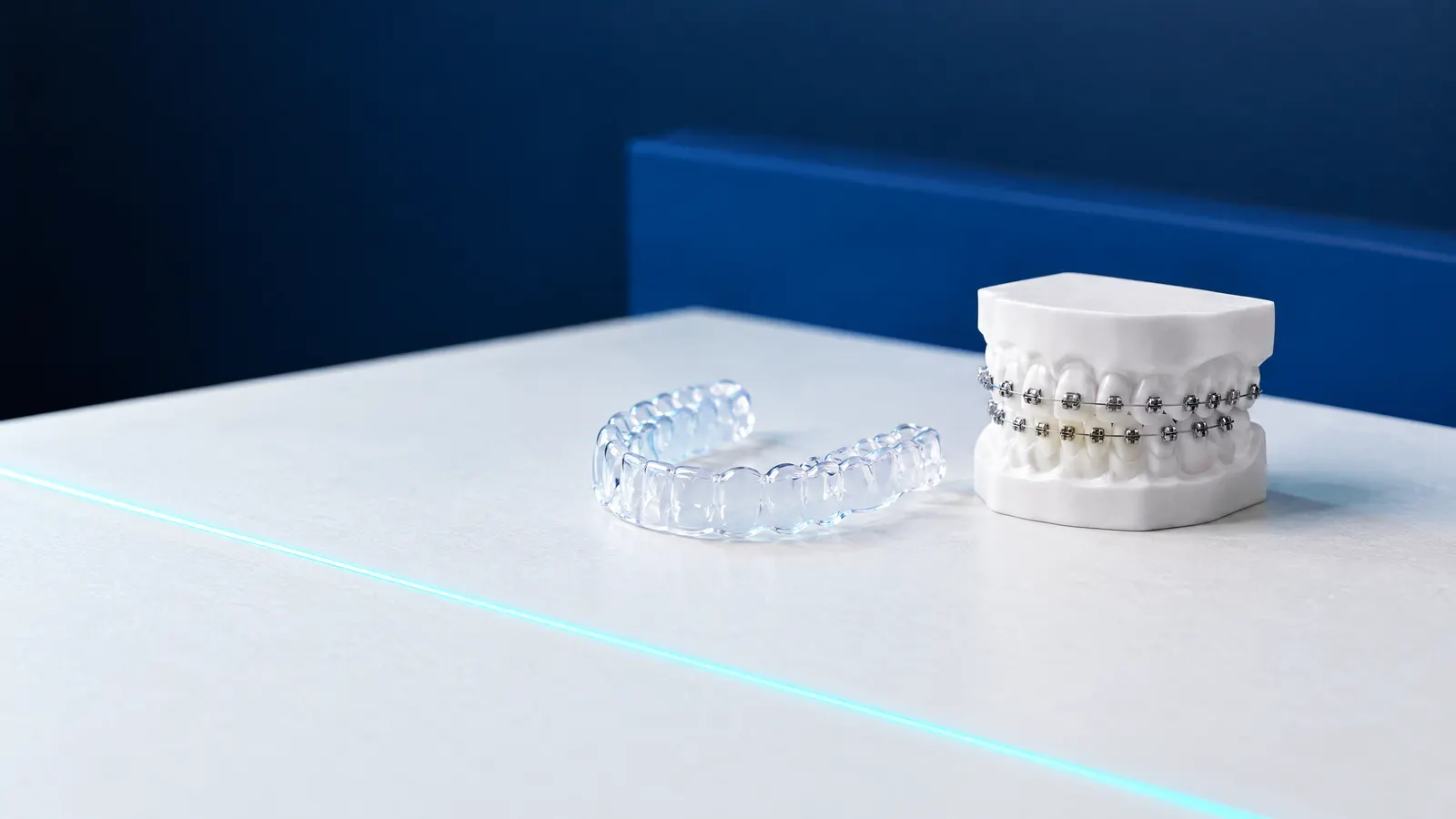
Fixed braces are brackets bonded to the teeth with a metal archwire running through them, while clear aligners are a series of transparent plastic trays that patients put in and take out themselves. Both move teeth with a constant, gentle force, and the bone around the roots remodels in the wake of that movement.
The difference lies in who controls the force and when. With fixed braces the orthodontist adjusts it at check-up visits by replacing or bending the archwire. With aligners the whole movement is planned digitally in advance, and each tray differs very slightly from the one before, so the patient moves from stage to stage at home.
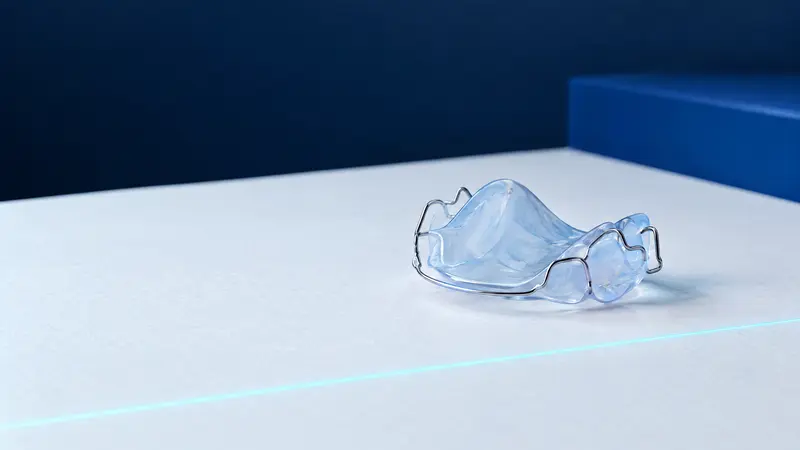
A removable appliance (a plate), fitted mainly in children, is a separate category and not the subject of this comparison. It is described in the article on orthodontics for children.
Which is better, fixed braces or aligners? What the research says
Research reviews do not treat aligners and fixed braces as equivalent for every malocclusion. For simpler problems aligners are a good option, while in complex cases fixed braces give more predictable results, so the choice depends on the diagnosis and not only on the patient's preference.
A systematic review of 8 studies (Ke et al., 2019) found that aligners perform less well at establishing occlusal contacts, controlling root inclination (so-called torque), expanding the arch and maintaining the result. The same review did, however, record shorter treatment times with aligners.
A meta-analysis of 11 studies (Papageorgiou et al., 2020) assessed the quality of the treatment finish on the American Board of Orthodontics (ABO) scale. Results after aligners were on average 9.9 points worse, and an outcome rated unacceptable occurred 1.6 times more often. Treatment time did not differ between the methods, and the authors concluded that current evidence does not allow aligners to be regarded as equally effective.
These studies have limitations: there are few of them, they are often small, and aligner technology changes faster than the literature. The sensible rule therefore remains matching the method to the problem, a choice the orthodontist justifies on the basis of X-rays and measurements.
Aligners and fixed braces: a comparison table
The table sets out the differences that most often decide the choice. The rows on effectiveness and treatment time are based on the two research reviews described above; the others follow from how each appliance works.
| Feature | Clear aligners | Fixed braces |
|---|---|---|
| Appearance | Transparent, barely visible up close | Brackets and wire visible on the teeth |
| Removal | The patient takes them out to eat and to brush | Bonded in place throughout treatment |
| Eating | No restrictions, because the trays come out | Hard and sticky foods can debond a bracket |
| Hygiene | Teeth are brushed as normal, trays cleaned separately | Interdental brushes needed around the brackets |
| Difficult tooth movements | Weaker: torque, arch expansion, occlusal contacts | Better controlled in complex cases |
| Quality of finish in studies | On average 9.9 points worse on the ABO scale | The reference point in comparative studies |
| Treatment time | Studies disagree: shorter or similar | Studies disagree: longer or similar |
| What the result depends on | Wearing the trays for most of the day | Check-up visits and hygiene around the brackets |
| Retention after treatment | Needed | Needed |
When are clear aligners enough, and when are fixed braces needed?
Clear aligners are usually enough when the problem is simpler and the planned tooth movements do not require a large change in root inclination or arch expansion. The second condition is the patient: an aligner left in its case does not move teeth.
Fixed braces more often prove the sensible choice when the problem is complex, when the upper teeth need to be positioned precisely against the lower ones, or when patients know they will not keep up with wearing the trays. The final answer comes from diagnostics, and its elements are usually the same for both methods.
- An orthodontic examination and a conversation about what bothers the patient in the position of their teeth.
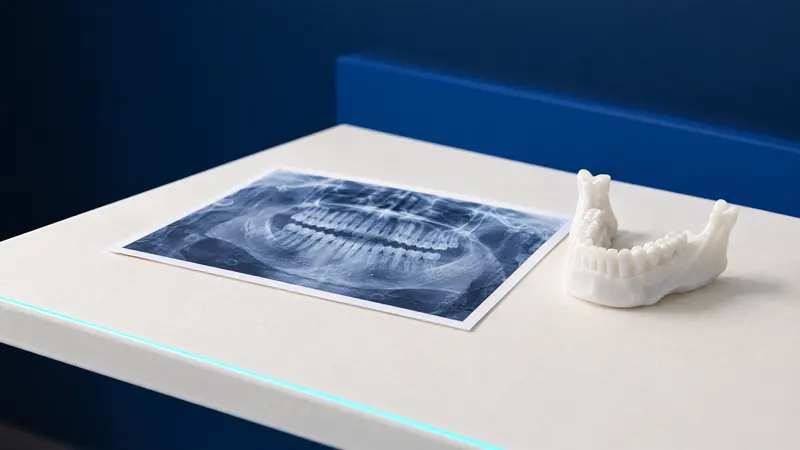
- A panoramic X-ray (pantomogram), which shows all the teeth, roots and bone.
- A cephalometric X-ray and its analysis, that is, measurements of the position of the jaws and teeth relative to the skull.
- Scans or models of the teeth, on which the successive movements are planned.
- A written plan with the proposed method, stages and expected treatment time.
How long does aligner treatment take, and how much of the day are they worn?
The length of aligner treatment depends on the problem and on how consistently the patient wears the trays, so there is no single number of months that fits everyone. Studies give conflicting results here: the 2019 review recorded shorter treatment with aligners, while the 2020 meta-analysis found no difference.
Aligners only work when they are on the teeth. They come out for eating, for drinking anything other than water and for brushing, and are worn for the rest of the day and night, as instructed by the orthodontist at the start of treatment.
Digital planning makes it possible to see, before starting, how many trays the plan includes and how the teeth are to move stage by stage. This visualisation is a separate item in the price list and helps with the decision before the first aligner is made.
Braces for adults: what does eligibility depend on?
Braces for adults work on the same principle as in teenagers, and eligibility is decided by the condition of the teeth, gums and bone, not by age alone. Adults more often have missing teeth, large fillings, crowns and gum disease, all of which have to be taken into account in the plan.
Periodontitis (in Polish, paradontoza) needs treating before the teeth start to move, because orthodontic movement is planned on gums and bone in a stable condition. That is why an adult patient with bleeding gums usually starts with a professional hygiene visit and an assessment of the gums and supporting tissues.
Under the NFZ (Poland's National Health Fund), orthodontic treatment covers removable appliances for children up to the age of 12 and retention check-ups up to the age of 13. Fixed braces are explicitly excluded from the publicly funded package, so adult patients pay privately for orthodontic treatment, whichever method they choose.
Retainer after braces: how long does it have to be worn?
A retainer is worn after braces so that the teeth do not drift back to their old position, and a 2016 Cochrane review concludes that almost everyone who has had orthodontic treatment needs some form of retention. The British Orthodontic Society calls retainers essential and points to a likely need to wear them for life.
Retention is a recommendation, not a promise of a permanent result. The position of the teeth can change even years later, and a retainer limits that movement only while it is worn or stays bonded and undamaged.
The 2023 update of the Cochrane review (47 studies) rates the certainty of the evidence as low or very low, so no type of retainer has proved better than the others. The choice depends on the problem, the patient's hygiene and their way of life.
- Fixed retainer: a thin wire bonded to the inner surface of the front teeth, invisible from the outside.
- Retention tray: transparent and removable, worn as instructed by the orthodontist.
- Retention plate: a removable appliance made of plastic and wire, worn according to the same instructions.
How much do clear aligners and fixed braces cost?
The cost of aligner treatment depends mainly on the number of trays in the plan, and the cost of fixed braces on the number of arches and the length of treatment, that is, the number of check-up visits. In both cases there are diagnostics at the start and retention at the end.
In the clinic's price list an orthodontic consultation costs 300 zł, a treatment plan with cephalometric analysis 380 zł and diagnostic scans 300 zł. In the Clear Aligner category one tray costs 900 zł, the plan visualisation (price list item “Wizualizacja CA”) 350 zł, a check-up visit 200 zł and a retainer 500 zł.
With fixed braces a check-up visit with one metal arch costs 270 zł and with two arches 350 zł; the price of the braces themselves follows from the plan and is set at the consultation. A fixed retainer for one arch is 600 zł, a retention plate for one arch 700 zł and a thermoformed retention plate 450 zł.
The final scope and cost of treatment are set at the consultation, and prices may change. Current amounts are in the clinic's price list.
How orthodontic treatment works at DentalBlue
At DentalBlue orthodontic treatment is carried out with Clear Aligner trays and with fixed braces, and the plan is drawn up digitally on the basis of cephalometric analysis. The cephalometric X-ray, the panoramic X-ray and, where indicated, cone beam computed tomography (CBCT) are taken in the clinic's own radiology unit, in the same building in Białystok.
Before treatment begins, the patient receives a written plan with the prices of each stage. A consultation can be booked by phone.
Frequently asked questions
Do clear aligners hurt?
Aligners should not cause sharp pain, but after a new tray goes in the teeth can be sensitive to pressure for the first few days, because they are starting to move. A similar feeling follows the activation of fixed braces. Pain that gets worse, a rubbed gum or a cracked tray are reasons to contact the orthodontist.
Can you eat and drink with aligners in?
No, aligners come out for eating, and with aligners in you drink only water. It is worth brushing your teeth before putting the trays back in, because food debris and sugar trapped under an aligner stay in contact with the enamel for a long time.
Are braces available on the NFZ for adults?
No. In orthodontics the NFZ funds removable appliances for children up to the age of 12 and retention check-ups up to the age of 13, and fixed braces are explicitly excluded from the package. Adults have orthodontic treatment privately, whether with fixed braces or with aligners.
Do teeth have to be extracted before braces are fitted?
Not always. Extraction is sometimes part of the plan when there is not enough space in the arch, but the decision is made after the X-rays and models have been analysed, not before. The treatment plan states whether extractions are needed and why, before the patient agrees to anything.
What should I do if a fixed retainer has come unstuck?
Book a check-up visit before the teeth start to move. A debonded section of wire no longer holds the teeth that were attached to it, and tooth movement after treatment can be harder to reverse than to prevent by repairing the retainer.
Sources
- BMC Oral Health: Ke Y et al., clear aligners versus fixed appliances, systematic review (2019)
- European Journal of Orthodontics: Papageorgiou SN et al., clear aligners versus fixed appliances, meta-analysis (2020)
- Cochrane: Retention procedures for stabilising tooth position after treatment with orthodontic braces (2016)
- Cochrane: Retention procedures for stabilising tooth position after treatment with orthodontic braces, update (2023)
- British Orthodontic Society: Frequently asked questions from patients (undated)
- Dz.U. 2025 poz. 615: Rozporządzenie MZ w sprawie świadczeń z zakresu leczenia stomatologicznego, consolidated text (2025)
An informational article. It does not replace a consultation, and treatment decisions are made during a visit.