What is periodontitis and how does it differ from gingivitis?
Periodontitis (in Polish usually paradontoza, correctly parodontoza) is a chronic inflammation of the tissues that hold a tooth in the bone: the gum, the periodontal ligament and the alveolar bone. It starts with gingivitis caused by bacterial plaque, but not every case of gingivitis progresses to periodontitis.
Gingivitis affects only the gum and resolves once plaque and tartar are removed and hygiene improves. Periodontitis destroys the ligament and the bone, and good brushing alone does not reverse that loss. The table shows the main differences.
| Feature | Gingivitis | Periodontitis (gum disease) |
|---|---|---|
| What it affects | The gum only | The gum, the periodontal ligament and the bone around the root |
| Typical symptoms | Bleeding when brushing, redness, swelling | Bleeding, receding gums, loose teeth, bad breath |
| Pockets around the teeth | Do not form | Deepen; 4 to 5 mm and more |
| Bone | Unchanged | Is lost, as an X-ray shows |
| Is it reversible | Yes, once plaque and tartar are removed | Bone loss usually not; the disease can be stopped |
| Treatment | Professional cleaning and better brushing | Staged treatment and regular maintenance visits |
What are the symptoms of periodontitis?
The symptoms of periodontitis build up slowly and for a long time do not hurt, which is why many people only learn about the disease when a tooth becomes loose. The dentist diagnoses it by measuring the depth of the pockets around each tooth with a probe and assessing the bone on an X-ray.
- Gums that bleed when you brush, floss or eat hard food.
- Red, swollen, tender gums.
- Receding gums: the teeth look longer, the necks of the teeth are exposed and sensitivity appears.
- Bad breath or an unpleasant taste that comes back despite brushing.
- Loose teeth, new gaps between them or a change in how the teeth meet when you bite.
- Pus at the gum or a painful swelling by one tooth, that is, a periodontal abscess, which needs a prompt visit.
Why do gums bleed, and what helps with bleeding gums?
Bleeding gums are most often a sign of inflammation caused by bacterial plaque that builds up at the gum line and between the teeth. The answer is therefore more thorough cleaning, not gentler cleaning: brushing twice a day with fluoride toothpaste, floss or interdental brushes, and removal of tartar at the surgery.
Bleeding when brushing is not a reason to avoid that area with the toothbrush, because the plaque stays and the inflammation continues. If the gums keep bleeding despite careful hygiene, a visit is needed at which the dentist measures the pockets and assesses whether it is already periodontitis.
In pregnancy, hormonal changes intensify the gums' reaction to bacteria and bleeding occurs more easily. Spontaneous bleeding from the gums without brushing, together with bruising on the skin or marked weakness, needs an urgent medical consultation, because it may have a systemic cause.
- Brush your teeth twice a day with fluoride toothpaste, guiding a soft brush along the gum line as well.
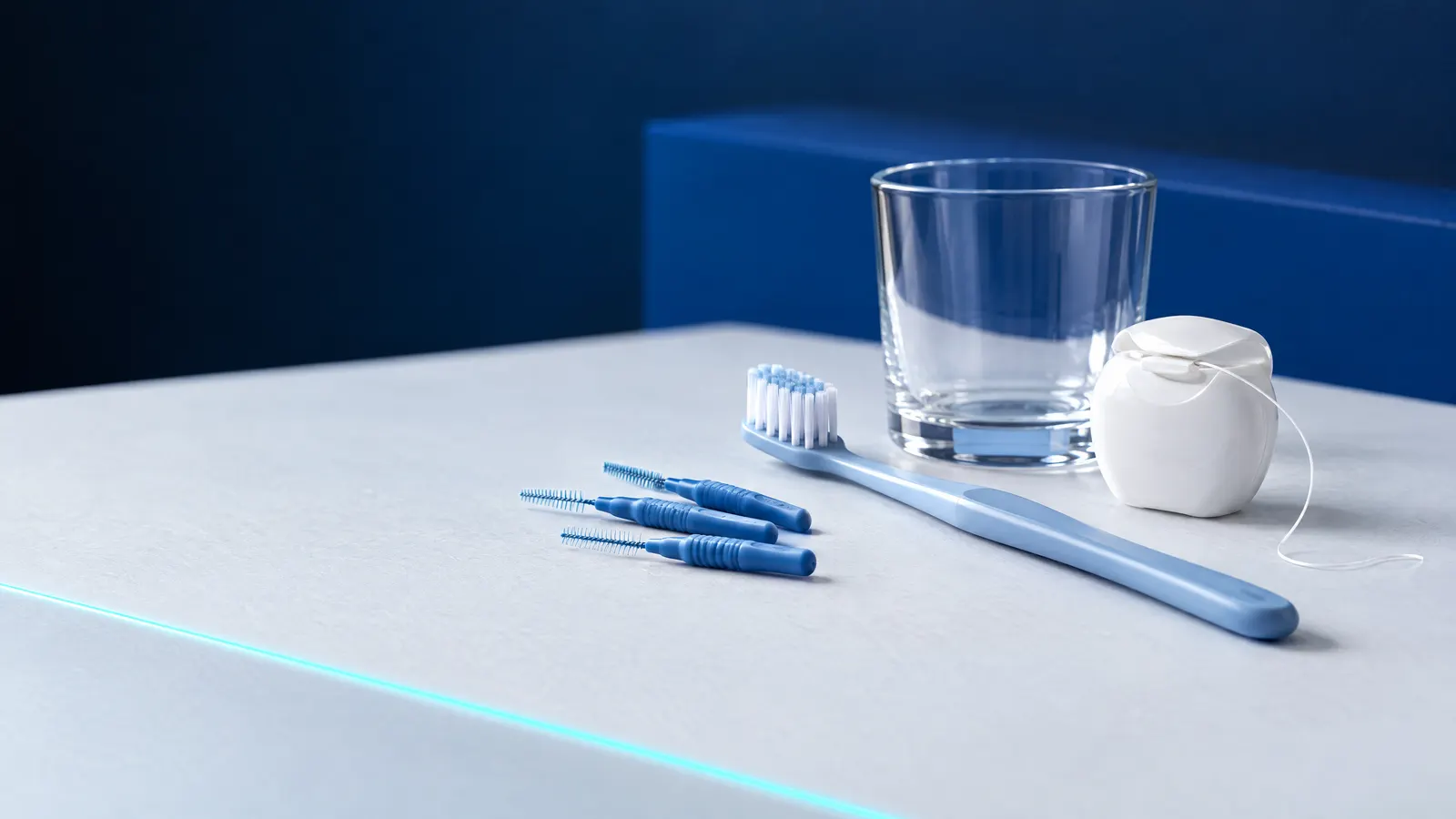
- Clean between your teeth every day with floss or an interdental brush sized to the gap.
- Do not skip areas that bleed; with regular cleaning, bleeding from gingivitis usually decreases.
- If you smoke, treat stopping as part of gum treatment, as the EFP recommends.
- Book a check-up with professional cleaning if the bleeding does not settle or the gums start to recede.
How common is periodontitis in Poland?
Periodontitis is common in Poland by middle age: according to the most recent national survey, 25.0% of people aged 35 to 44 had pockets of 4 to 5 mm, and a further 7.1% had pockets of 6 mm or deeper. Healthy periodontal tissues were found in 33.0% of this group, and bleeding or tartar in 34.6%.
In the 65 to 74 age group, 34.7% of those examined had pockets of 4 to 5 mm and 9.8% pockets of 6 mm or deeper. Bleeding gums already affected 30.9% of eighteen-year-olds. The World Health Organization (WHO) estimates that severe periodontal disease affects 22.2% of people in Poland aged 15 and over.
Can periodontitis be cured?
Periodontitis usually cannot be reversed in the sense that lost bone does not grow back by itself, but the disease can be stopped and kept stable for many years. The European Federation of Periodontology (EFP) describes treatment in four steps, and each step depends on the result of the one before.
The same guideline recommends that the first step include helping the patient stop smoking and attending to diabetes control, because both factors affect the course of the disease. Without this, even careful treatment at the surgery gives a weaker result.
- Step one: hygiene instruction, removal of plaque and tartar above the gum and control of risk factors.
- Step two: cleaning the roots below the gum, that is, removing deposits and biofilm from the pockets (closed curettage).
- Step three: treating sites that have not responded, for example open curettage with the root exposed, or regenerative procedures.
- Step four: supportive treatment, that is, regular check-ups and professional cleaning, with no end date.
Periodontitis, diabetes and heart disease
Periodontitis and diabetes affect each other in both directions: poorly controlled diabetes promotes periodontitis, and periodontitis makes blood sugar harder to control. The 2018 consensus of the International Diabetes Federation and the EFP reports that periodontal treatment lowers HbA1c by 0.27 to 0.48 percentage points after 3 months; long-term data are inconclusive.
Periodontitis is also independently associated with cardiovascular disease. The 2020 consensus of the EFP and the World Heart Federation indicates that treatment improves markers of inflammation, but there is no hard evidence that treating the gums prevents heart attack or stroke. This is an association, not a proven cause, and a good reason to mention gum disease to your GP as well.
How often should you have professional cleaning with periodontitis?
People treated for periodontitis should have maintenance visits every 3 to at most 12 months, with the interval set according to risk. This is the recommendation of the 2020 EFP guideline. For comparison, for adults without gum disease, the UK's NICE allows intervals of 3 to 24 months between check-ups.
A maintenance visit is not an ordinary tooth cleaning. The dentist or hygienist measures the pockets again, compares the result with the previous one, removes deposits above and below the gum, and plans additional treatment where a pocket has deepened. The date of the next visit is set on this basis.
The NFZ (Poland's National Health Fund) funds removal of tartar from the whole mouth for adults once per calendar year, as well as pocket irrigation, closed curettage within one quadrant of the arch and treatment of the oral mucosa. Women who are pregnant or in the postnatal period are entitled to tartar removal no more often than once every 6 months. No referral is needed to see a dentist who has an NFZ contract.
How much does private periodontitis treatment cost?
The cost of treating periodontitis depends on the number of teeth with deep pockets, on whether closed treatment is enough or surgery is needed, and on how often maintenance visits take place. That is why the plan and its cost are only drawn up after a periodontal examination.
In the clinic's price list a periodontal consultation costs 300 zł, complete hygiene treatment (scaling, air polishing, fluoride) 350 zł, gum pocket irrigation 100 zł and open curettage of one tooth 400 zł. The final scope and cost are set at the consultation, and prices may change; the full amounts are in the clinic's price list.
How gum treatment works at DentalBlue
At DentalBlue in Białystok, treatment of gum disease is provided within periodontology and prevention: from a periodontal consultation, through professional cleaning and curettage, to surgical procedures on the gums. The X-rays needed to assess the bone, that is, a panoramic X-ray and intraoral X-rays and, where indicated, a CBCT scan, are taken in the clinic's own radiology unit. At a first visit without pain, the patient receives a written treatment plan with the prices of each stage.
Frequently asked questions
How long does it take for teeth to fall out with periodontitis?
There is no single answer, because the pace of the disease depends on its form, smoking, diabetes and hygiene. In some people bone loss progresses slowly, in others faster. Treatment and maintenance visits are meant to slow or stop this process, which is why the moment of diagnosis matters.
Can you have implants if you have periodontitis?
Yes, but only once the disease is under control and with regular check-ups. Inflammation also develops around implants: a research review reports inflammation of the mucosa around an implant in 43% of patients on average, and inflammation with bone loss (peri-implantitis) in 22%.
Will a mouthwash cure bleeding gums?
No. A mouthwash does not remove plaque stuck to the teeth or tartar below the gum, and these are what keep the inflammation going. It can be an addition, but the basis is mechanical cleaning: a toothbrush, floss or interdental brushes, and professional cleaning at the surgery.
Is periodontitis treatment funded by the NFZ?
Partly. For adults the NFZ funds tartar removal once per calendar year, pocket irrigation, closed curettage and treatment of the oral mucosa. The procedures are carried out by a dentist with an NFZ contract, with no referral.
Are bleeding gums in pregnancy dangerous?
Bleeding gums are common in pregnancy, because hormonal changes intensify the gums' reaction to bacterial plaque. They call for careful hygiene and a check-up with the dentist, and during pregnancy the NFZ funds tartar removal as often as every 6 months. The details are in the article on dental treatment in pregnancy.
Sources
- Ministerstwo Zdrowia, WUM: Choroba próchnicowa i stan tkanek przyzębia populacji polskiej, wyniki badań z lat 2016 do 2019 (2021)
- WHO: Oral Health Country Profile, Poland (2022)
- WHO: Oral health, fact sheet (2025)
- Journal of Clinical Periodontology: Sanz M et al., EFP S3 guideline, treatment of stage I to III periodontitis (2020)
- Journal of Clinical Periodontology: Sanz M et al., IDF and EFP consensus, periodontal diseases and diabetes (2018)
- Journal of Clinical Periodontology: Sanz M et al., EFP and WHF consensus, periodontitis and cardiovascular diseases (2020)
- Journal of Clinical Periodontology: Derks J, Tomasi C, prevalence of peri-implant diseases (2015)
- Dz.U. 2025 poz. 615: Rozporządzenie MZ w sprawie świadczeń z zakresu leczenia stomatologicznego, consolidated text (2025)
An informational article. It does not replace a consultation, and treatment decisions are made during a visit.