What is dental tartar, and how does it form?
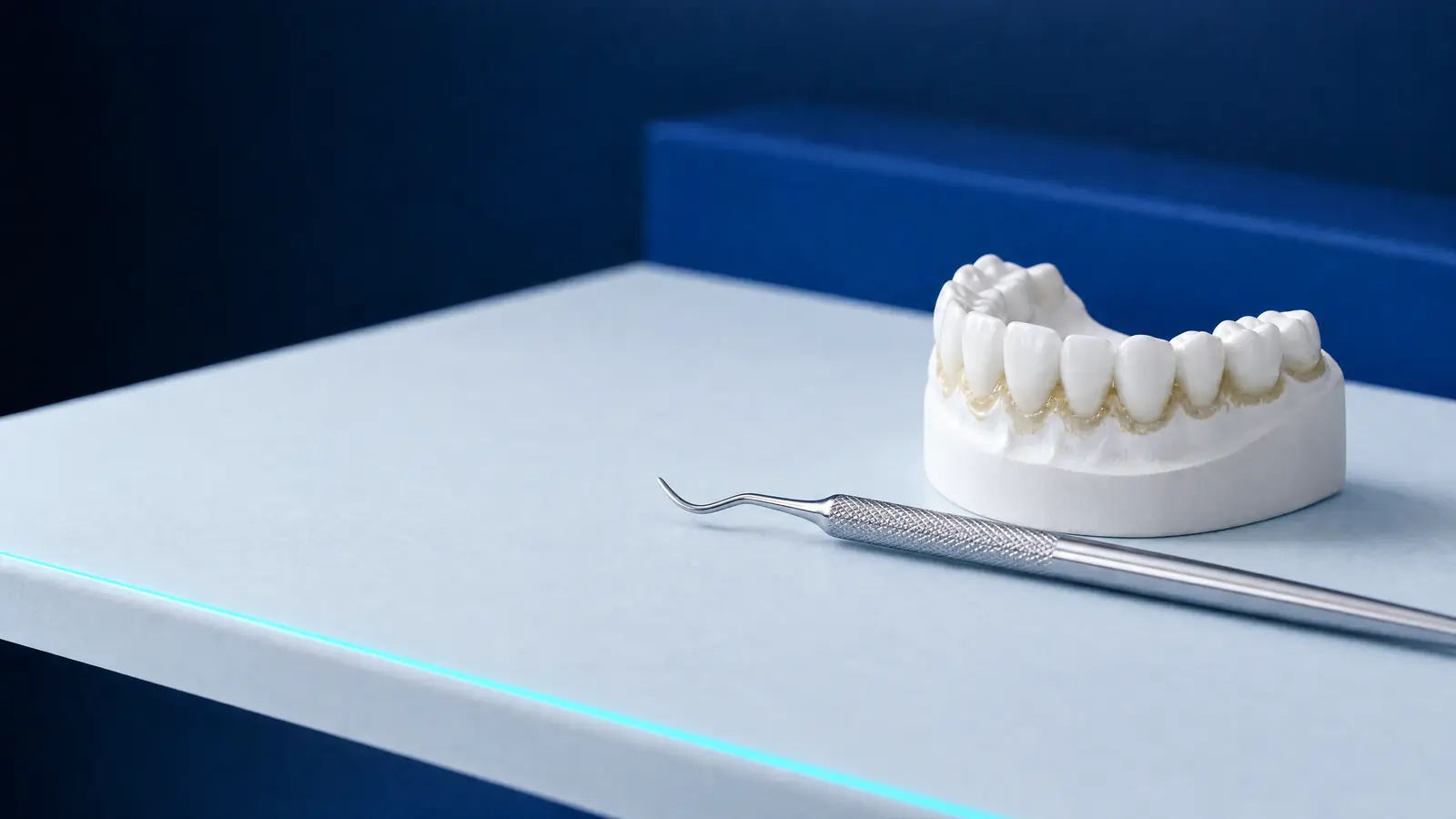
Dental tartar, also called calculus, is calcified bacterial plaque, made mainly of calcium phosphates deposited within the remains of previous microorganisms. White’s 1997 review stresses that calculus is always covered in living plaque, making a deposit beside the gum a permanent bacterial habitat.
The process starts with biofilm: bacteria colonise a cleaned tooth within a dozen or so hours. Plaque bacteria raise local calcium and phosphorus concentrations, triggering mineralisation; the most common crystals in calculus are hydroxyapatite, octacalcium phosphate and whitlockite (Wei et al., 2024).
Tartar is very common: a 2024 review estimates that around 90% of people have it. In Poland’s national survey from 2016 to 2019, calculus was found in 36.9% of 18-year-olds. In 2017, 34.6% of adults aged 35 to 44 had bleeding or deposits without pockets.
What causes tartar, and why does it build up faster in some people?
The basic cause is plaque left on teeth after incomplete brushing. White lists the factors affecting how much calculus forms: hygiene habits, access to professional cleaning, diet, age, ethnicity, time since the last removal, systemic diseases and medicines.
Saliva also matters, supplying the minerals in calculus above the gums. In people who regularly care for their teeth, these deposits form mainly beside salivary duct openings. The 2024 review notes that smoking increases salivary calcium and favours calculus build-up, while a carbohydrate-rich diet helps bacteria colonise teeth.
How does tartar above the gum line differ from tartar below it?
Supragingival calculus forms on the crown from salivary minerals. Subgingival calculus forms on the root, in the crevice or pocket below the gum, from minerals in gingival fluid. White notes that people with regular oral hygiene have little supragingival calculus, with little health impact, while subgingival calculus accompanies periodontitis.
| Feature | Supragingival calculus | Subgingival calculus |
|---|---|---|
| Where it forms | On the crown, above the gum margin | On the root, in a crevice or pocket |
| Source of minerals | Saliva | Gingival fluid |
| Is it visible? | Usually, especially near salivary duct openings | Usually not, because it lies below the gum |
| Link with disease | With poor hygiene, favours gum recession | With poor hygiene, associated with attachment loss |
| How it is removed | Professional scaling | Subgingival cleaning, or closed curettage |
| Role of anti-tartar toothpaste | Slows new calculus build-up | Toothpaste studies concern calculus above the gum line |
What problems can tartar cause?
Calculus has a rough surface that encourages bacteria to attach and multiply, while the plaque covering it constantly irritates the gum. The 2024 review calls it a cradle for bacterial colonisation and notes that it accumulates mainly along the gum line.
In people without regular hygiene or access to dental care, White describes widespread supragingival calculus associated with gum recession and extensive subgingival calculus linked to periodontal attachment loss. Whether subgingival calculus causes inflammation or results from it is not fully understood, but at a minimum it extends plaque-induced damage.
Removing calculus and plaque beneath the gums therefore remains fundamental to periodontal treatment, described in the article on periodontitis. Calculus above the gum line also makes daily cleaning harder and, when it accumulates at the gum margin, encourages swelling and bleeding.
Can you remove tartar at home?
Tartar cannot be safely removed at home: a toothbrush, floss and toothpaste act on soft plaque, not mineralised deposits firmly attached to a tooth. Home hygiene can, at most, remove fresh deposits before they harden.
The European Federation of Periodontology (EFP) 2020 guideline notes that cleaning roots below the gum line requires specific training because results depend on technique. Subgingival calculus is therefore removed by a dentist or hygienist at the surgery. At home, focus on preventing new build-up.
- Metal scrapers and DIY tartar-removal kits do not let you safely assess and clean the area below the gums; a sharp tool used without a clear view or skill can injure the tissues.
- Even in dental practice, enamel damage from hand and ultrasonic instruments is a recognised problem, as the 2024 review discusses.
- Acids such as vinegar or lemon juice will not dissolve calculus without harming the tooth, because both calculus and enamel contain calcium phosphates, including hydroxyapatite.
- Mouthwashes do not dissolve calculus. Studies of longer-term chlorhexidine use have even reported calculus build-up and tooth staining.
Black tartar: are dark deposits beside the gums always calculus?
Dark, brown or black deposits around tooth necks are not always calculus. In children, they are often black stain: a dark line or dots beside the gum coloured by compounds of iron or copper with sulphur. A 2015 review by Polish authors reports it in 2.4 to 18% of those studied, mainly children, and associates it with fewer carious lesions.
Longer-term chlorhexidine rinsing also causes dark staining and markedly increased tooth staining in the Cochrane review of 2017. A hard, rough deposit that does not brush off is usually calculus. Subgingival calculus becomes visible only when the gum shrinks, for example after swelling subsides.
A dentist determines the nature of a particular person’s dark deposits at a check-up. The article on professional cleaning for children discusses black stain in children.
How does a dentist remove tartar, and how often is scaling needed?
Calculus is removed by professional scaling using an ultrasonic tip or hand instruments. The ultrasonic tip breaks up deposits through cavitation and acoustic microstreaming. Air polishing removes soft deposits and staining but not hard calculus, so it follows scaling. A separate article describes the full cleaning procedure, while the article on curettage covers pocket cleaning.
The dentist sets the interval according to risk. A 2018 Cochrane review covering 1711 adults without severe periodontitis found that scaling and polishing every 6 or 12 months over 2 to 3 years made little difference to gingivitis but slightly reduced calculus, more so at 6-month intervals. The authors considered the clinical importance of this difference uncertain.
The NFZ funds deposit removal from the whole dentition once per calendar year, and for pregnant and postpartum women no more often than every 6 months. No referral is needed for a dentist with an NFZ contract. The basis is the Ministry of Health regulation (consolidated text Dz.U. 2025 poz. 615), legal status as of 24 October 2026.
How can you slow tartar build-up?
Calculus cannot be avoided completely, but removing plaque before it mineralises can slow its accumulation. A few habits help; the article on brushing teeth properly explains them in more detail.
- Brush twice a day for around 2 minutes with fluoride toothpaste, paying attention to the gum line and tongue-facing surfaces.
- Clean between teeth every day with floss or an interdental brush.
- Consider anti-tartar toothpaste: a 2004 systematic review found that toothpastes containing pyrophosphates, zinc compounds or copolymers significantly reduced calculus by delaying plaque mineralisation.
- If you smoke, stopping removes one factor that favours calculus build-up.
- Have calculus removed at intervals set by your dentist, or sooner if your gums begin to bleed.
How tartar is removed at DentalBlue
At DentalBlue in Białystok, calculus removal is part of professional cleaning and preventive care, and the team includes dental hygienists. The price list gives “Scaling 1 łuk” (scaling, one arch) at 150 zł, “Scaling+piaskowanie 1 łuk” (scaling and air polishing, one arch) at 200 zł, “Kompleksowa higienizacja (skaling, piaskowanie, fluoryzacja)” (comprehensive cleaning: scaling, air polishing and fluoride treatment) at 350 zł and “Kontrola po higienizacji” (review after professional cleaning) at 50 zł. Where calculus lies below the gums and pockets are present, further treatment is provided within periodontology, with bone assessment images taken by the clinic’s own radiology unit. The final scope and cost are agreed at consultation, and prices may change.
Frequently asked questions
Will baking soda toothpaste remove tartar?
It will not remove hard calculus. Toothpastes and powders work on soft plaque and fresh deposits; mineralised deposits require professional scaling. Anti-tartar toothpastes can only slow the formation of new calculus above the gum line.
Can teeth be sensitive after tartar removal?
Yes, especially after cleaning below the gums. In the review by Lin and Gillam (2012), 62.5 to 90% of patients reported root sensitivity the day after non-surgical treatment, and around half after a week. Symptoms were usually mild or moderate and temporary.
How quickly does tartar return after scaling?
It varies: White lists hygiene, diet, age, systemic diseases, medicines and time since the last cleaning among the factors. Bacteria begin recolonising a cleaned tooth within a dozen or so hours, so daily plaque removal largely determines how fast calculus builds up.
Can calculus also form on a denture?
Yes. The 2024 review describes bacterial biofilm forming and mineralising on dentures as well as teeth. Dentures therefore need daily cleaning, with deposits that cannot be removed at home dealt with at the surgery.
Can children have tartar?
Yes. Poland’s national survey from 2016 to 2019 found calculus in 22.2% of 12-year-olds and 25.3% of 15-year-olds. In young children, dark marks beside the gums may be black stain rather than calculus; the dentist makes the diagnosis. The article on professional cleaning for children explains both.
Sources
- European Journal of Oral Sciences: White DJ, supragingival and subgingival calculus, formation, prevention and removal (1997)
- NPJ Biofilms and Microbiomes: Wei Y et al., calculus formation and prevention strategies (2024)
- Oral Health and Preventive Dentistry: Netuveli GS et al., effectiveness of anti-calculus toothpastes, systematic review (2004)
- Cochrane: Lamont T et al., routine scale and polish for adults (2018)
- Cochrane: James P et al., chlorhexidine mouthwash as an adjunct in gingivitis treatment (2017)
- BioMed Research International: Żyła T et al., black stain and dental caries, review (2015)
- Ministerstwo Zdrowia, WUM: Choroba próchnicowa i stan tkanek przyzębia populacji polskiej, findings from 2016 to 2019 (2021)
- ELI: Rozporządzenie MZ w sprawie świadczeń gwarantowanych z zakresu leczenia stomatologicznego, t.j. Dz.U. 2025 poz. 615
An informational article. It does not replace a consultation, and treatment decisions are made during a visit.