What is gum recession?
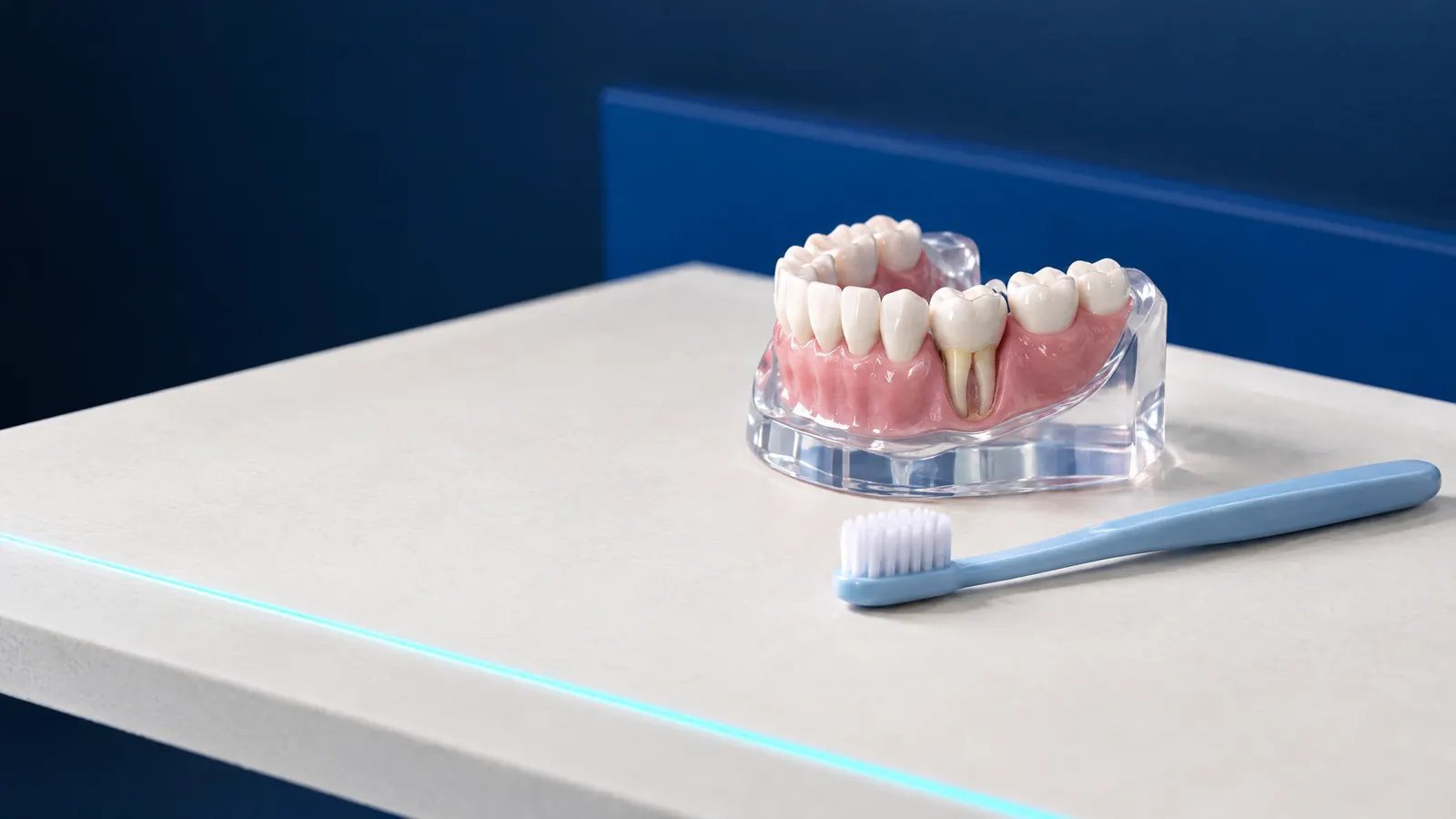
Gum recession is a condition in which the gum margin moves towards the root tip and exposes the neck and part of the root of a tooth. The tooth then looks longer, a yellowish band of root is visible at the gum margin, and sometimes sensitivity to cold appears.
Receding gums are very common. A review published in 2003 in the journal of the American Dental Association (JADA) reports that 88% of people aged 65 and over and 50% of people aged 18 to 64 have at least one site with recession.
Recession is not the same as periodontitis (gum disease), although periodontal disease is one of its causes. How to recognise and treat periodontitis is covered in a separate article.
Why do gums recede?
Gums usually recede for several reasons at once, and the structure of the gum itself matters most. The report of the 2017 World Workshop on periodontology (Cortellini and Bissada, 2018) indicates that thin gum and thin bone around a tooth are more prone to recession, and that recession occurs in people with both very good and poor oral hygiene.
Brushing too hard is often blamed, but the evidence is weaker than is commonly thought. A 2007 systematic review found the data confirming or ruling out a link between brushing and recession inconclusive, so brushing technique may contribute but is not a proven cause. The same 2018 report found no evidence that excessive biting forces lead to recession.
- Thin gum and thin bone around the root, the so-called thin gingival phenotype.
- Periodontitis (gum disease), which destroys the gum attachment between the teeth as well.
- Inadequate oral hygiene, which keeps inflammation going at the gum margin.
- Orthodontic treatment, which according to the 2018 report may increase the risk.
- Fillings at the neck of the tooth, named in the same report as a possible risk factor.
- A lower lip frenulum that pulls on the gum margin by the incisors.
What can an exposed tooth neck lead to?
An exposed tooth neck mainly leads to sensitivity and root decay, and with progressing recession also to further loss of the tissues around the tooth. The root is not covered by enamel but by thinner cementum and dentine, so it conducts stimuli more easily and decays more easily.
In a study of more than 3,000 young adults from 7 European countries (Journal of Dentistry, 2013), tooth sensitivity was associated with, among other things, gum recession and enamel erosion. Typical is a short, sharp pain after a cold drink or air, which passes once the stimulus is removed.
For many people the appearance matters just as much: recession in the front teeth makes the teeth look longer in a smile. See a dentist when you notice that the gum by one of your teeth has clearly dropped, when sensitivity appears or when your gums bleed, because it then needs checking whether periodontitis is the cause.
How the dentist assesses recession: types RT1, RT2 and RT3
The dentist assesses recession by measuring its depth and width with a probe, the thickness of the gum, and whether attachment has also been lost between the teeth. On that basis, it is assigned to one of three types under the 2011 Cairo classification, adopted by the 2017 World Workshop on periodontology.
The type of recession matters, because it changes the outlook for the procedure. The greater the loss of tissue between the teeth, the smaller the chance that a graft will cover the root completely, so the classification helps to discuss the possible result honestly with the patient.
| Recession type | What it means | What it means for treatment |
|---|---|---|
| RT1 | No loss of attachment between the teeth | The most favourable situation for root coverage |
| RT2 | Loss of attachment between the teeth no greater than on the cheek side | A lower chance of complete coverage |
| RT3 | Loss of attachment between the teeth greater than on the cheek side | The lowest chance of complete coverage |
How can receding gums be stopped?
Receding gums are stopped by removing or limiting the cause, not by a procedure alone. Recession caused by periodontitis first needs periodontal treatment, while recession with thin gum needs above all gentle but thorough oral hygiene and regular check-ups.
Because the link between brushing and recession has not been clearly proven, nobody can promise that changing your toothbrush will stop the gum from receding. It is sensible, though, to choose a technique and a toothbrush together with your dentist or hygienist.
- Brush your teeth twice a day with fluoride toothpaste, guiding the brush along the gum margin without pressing too hard.
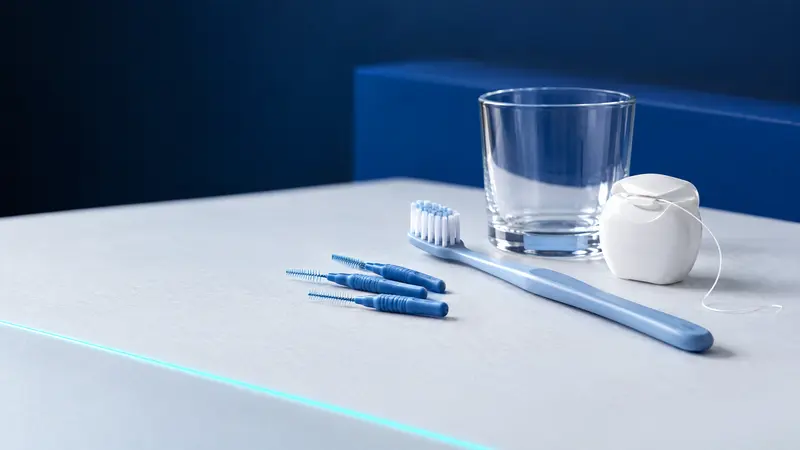
- Clean between your teeth every day with floss or an interdental brush sized to the gap.
- Treat bleeding gums and periodontitis before they destroy the attachment between the teeth.
- Before orthodontic treatment with thin gums, ask for a periodontal assessment.
- If you have sensitivity, talk to your dentist about a toothpaste or in-surgery treatments for sensitivity.
- Come for check-ups, at which the dentist compares the recession measurements with the previous ones.
What do a gum graft and root coverage involve?
Root coverage is a periodontal surgical procedure in which the gum is moved towards the crown of the tooth so that it covers the exposed root, most often together with a connective tissue graft. The graft is usually taken from the palate and placed under the moved flap of gum to thicken it.
The procedure is carried out under local anaesthesia, on one tooth or on several neighbouring teeth. When the gum is very thin and the root does not need covering, the dentist may suggest thickening the gum with a graft alone, which is called soft tissue augmentation.
Before the procedure, the inflammation has to be brought under control and the cause of the recession established, because without that the graft makes no sense. Aftercare advice, including on eating and brushing around the wound, is given individually by the dentist.
What results does root coverage give according to research?
Root coverage with a connective tissue graft and a coronally advanced flap compares favourably with other methods in studies, but complete coverage of the root is not the rule. A 2018 Cochrane review (48 studies, only 1 at low risk of bias) found that this technique gives slightly greater reduction of recession than guided tissue regeneration with a membrane, with low-quality evidence.
In a 2012 review covering various techniques, complete root coverage was achieved in 310 of 602 recessions, that is 51.5%, and the chance was lower with deeper recessions. In many patients the exposed root can be covered completely or to a large extent; the chances fall with deeper recessions and with loss of attachment between the teeth.
How much does root coverage cost, and is it funded by the NFZ?
The cost of root coverage depends on the number of teeth, the type of graft and whether the gums need periodontal treatment first. That is why the scope and price are only set after a periodontal examination.
In the clinic’s price list, “Pokrycie pojedynczej recesji dziąsła” (coverage of a single gum recession) costs 1 300 zł, “Pokrycie recesji dziąsła” (gum recession coverage) is priced “od 2 000 zł” (from 2 000 zł), and “Augmentacja tkanką miękką” (soft tissue augmentation) “od 1 500 zł” (from 1 500 zł). A periodontal consultation costs 300 zł. The final scope and cost are agreed at the consultation, and prices may change.
The lists of guaranteed dental services of the NFZ (Poland’s National Health Fund) do not include root coverage with a graft. For adults, the NFZ funds, among other things, scaling once a calendar year, irrigation of gum pockets and closed curettage, that is, treatment of the cause rather than coverage of the root itself. Legal position as of 12 October 2026.
How it works at DentalBlue
At DentalBlue in Białystok, recession is assessed within periodontology: from a periodontal consultation with measurement of pockets and recession, through treatment of the cause, to root coverage and soft tissue augmentation procedures. The images needed to assess the bone, a panoramic X-ray and intraoral X-rays, and a CBCT scan where indicated, are taken in the clinic’s own radiology unit. At a visit without pain, the patient receives a written treatment plan with the prices of each stage; in the price list this visit costs 300 zł.
Frequently asked questions
Do receding gums grow back?
No. A gum that has receded does not return to where it was on its own, even after hygiene improves. Treating the cause can stop further recession, and the exposed root can only be covered by a surgical procedure whose result depends on the type of recession.
Is gum recession the same as periodontitis?
Not always. Periodontitis (gum disease) is one of the causes of recession, but gums also recede in people with healthy periodontal tissues, for example with thin gums or after orthodontic treatment. A probe examination and an assessment of the bone on an X-ray settle the question.
Do gums recede after braces?
It can happen. The report of the 2017 World Workshop on periodontology lists orthodontic treatment among the factors that may increase the risk of recession, especially with thin gums. That is why, with thin gums, it is worth having the periodontal tissues assessed before and during treatment.
Will a sensitivity toothpaste help with recession?
A sensitivity toothpaste can reduce the pain of an exposed tooth neck, but it will not stop the gum from receding or cover the root. It treats the symptom, while the cause of the recession and the need for a procedure are assessed by the dentist.
Does a gum graft hurt?
The procedure itself is carried out under local anaesthesia. Afterwards, the wound area and the site on the palate where the graft was taken may be tender for a while, and the dentist gives advice on eating, oral hygiene and painkillers.
Sources
- JADA: Kassab MM, Cohen RE, gingival recession, causes and treatment (2003)
- Journal of Periodontology: Cortellini P, Bissada NF, mucogingival conditions, 2017 World Workshop (2018)
- Journal of Clinical Periodontology: Rajapakse PS et al., toothbrushing and gingival recession, systematic review (2007)
- Journal of Clinical Periodontology: Cairo F et al., classification of gingival recession (2011)
- Cochrane: Chambrone L et al., root coverage procedures for treating recession (2018)
- Journal of Periodontology: Chambrone L et al., factors influencing complete root coverage (2012)
- Journal of Dentistry: West NX et al., dentine hypersensitivity in young European adults (2013)
- ELI: Rozporządzenie MZ w sprawie świadczeń gwarantowanych z zakresu leczenia stomatologicznego, t.j. Dz.U. 2025 poz. 615
An informational article. It does not replace a consultation, and treatment decisions are made during a visit.