What is a dental filling, and when is it needed?
A dental filling is the material a dentist uses to restore the shape and seal of a tooth after removing tissue destroyed by decay. A filling is needed when decay has gone through the enamel and formed a cavity, and also after a tooth has chipped or broken, or when an old filling has started to leak.
A filling does not treat the cause of decay, it only repairs its effect. A 2026 Cochrane review bringing together studies of filling materials concludes that the key to lasting oral health is preventing tooth decay (Lewis et al., 2026).
What types of filling are there?
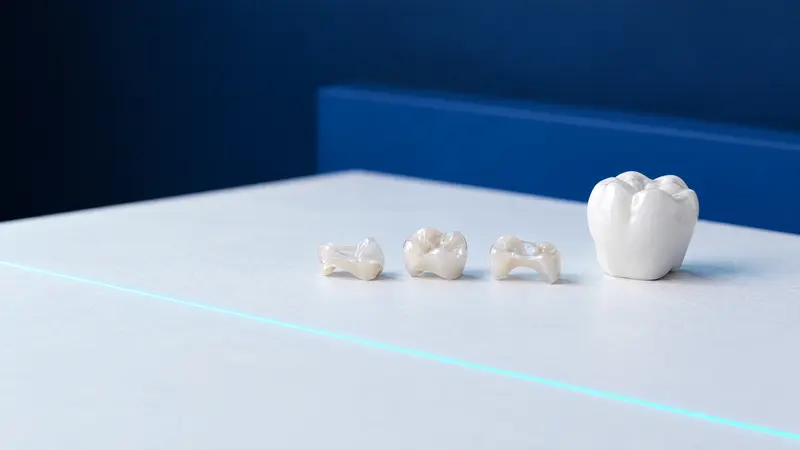
The most widely used types of filling are composite and glass ionomer cement, and for large cavities also restorations made outside the mouth, such as inlays and onlays. Each material has a different use, and the choice depends on the position and size of the cavity, whether the tooth can be kept dry and the risk of decay.
Composite is a material made of resin and filler, set chemically or hardened with a curing lamp, that is, light-cured. In an overview of reviews, glass ionomer cement had lower survival than composite, but it remains useful when the risk of decay is high and when the tooth is hard to keep dry (Fernández et al., 2026).
| Material | Use | What studies show |
|---|---|---|
| Light-cured composite | Front and back teeth, cavities of various sizes | Over 90% survival after 5 years |
| Bulk-fill composite | Deeper cavities in back teeth, placed in a thicker layer | No difference from layered composite, under 5% failures |
| Chemically cured composite | Sets without a lamp; on the NFZ in teeth 3 to 3 | No separate data in the reviews |
| Glass ionomer cement | Cavities at the gum line, high risk of decay, moisture | Lower survival than composite |
| Resin-modified glass ionomer cement | Similar uses to conventional cement | May fail less often than conventional cement (small studies) |
| Amalgam | Since 1 January 2025 only for specific medical needs | In older studies it failed less often than composite |
| Inlay or onlay | Large cavity, weakened cusp, when a crown is not necessary | Made in a laboratory; details in a separate article |
How long does a filling last?
A filling has no expiry date, but every year a certain share of fillings need repair or replacement. A meta-analysis of data on 2 816 composite fillings in back teeth (Opdam et al., 2014) reports an average of 1.8% failures a year over 5 years and 2.4% a year over 10 years, and the most common causes were secondary decay and fracture.
How long a filling lasts depends more on the patient and the cavity than on the material itself. In people at high risk of decay the annual failure rate was 3.2% over 5 years, and in people at low risk 1.2%. Each additional tooth surface included in the filling raised the risk by 30 to 40% (Opdam et al., 2014).
So a filling in a small cavity, in someone who looks after their oral hygiene and limits sugar, usually has many years ahead of it, while an extensive filling in a back tooth more often needs replacing in time, or replacing with an onlay or a crown. The dentist can detect leakage and secondary decay at a check-up, before anything starts to hurt.
Composite or amalgam: what do studies show?
In older studies composite failed more often than amalgam, but newer data suggest this difference may not apply to today’s materials. A 2021 Cochrane review, based on two trials involving 921 children, found roughly twice the risk of failure (RR 1.89) and of secondary decay for composites, with low-certainty evidence (Worthington et al., 2021).
The 2026 Cochrane review points out that the trials comparing the two materials began in the late 1990s, and in them composite failed in almost 15% of cases, whereas current data put the figure at about 5% (Lewis et al., 2026). The 2021 review found no consistent or clinically significant health harms associated with amalgam.
Is amalgam banned, and do old fillings have to be replaced?
Amalgam has been banned in dental treatment in the European Union since 1 January 2025, except where the dentist considers it strictly necessary because of the patient’s specific medical needs (Regulation (EU) 2024/1849). Since 1 July 2026 a ban on its manufacture and import has also applied, with the same medical exception.
The ban applies to placing new fillings and does not mean that old amalgam fillings have to be removed. The US FDA does not recommend removing or replacing intact amalgam fillings unless the dentist considers it medically necessary, because removal means losing healthy tooth tissue and a temporary rise in the release of mercury vapour during the procedure (FDA, 2021).
Replacing an amalgam filling makes sense when the filling is cracked or leaking, or decay has developed under it, that is, for the same reasons as with any other filling. The dentist assesses this at an examination, sometimes with an X-ray.
Which filling do you get on the NFZ, and can it be light-cured?
A filling on the NFZ (Poland’s National Health Fund) for an adult is glass ionomer cement in all teeth, and in the front teeth, from canine to canine (3 to 3), also chemically cured composite. Light-cured composite is available to children and young people up to 18 in the incisors and canines, and to people with disabilities when there are medical indications. Amalgam is not on the list of materials.
In 2025 the Ministry of Health prepared a draft that would let the dentist choose the material for permanent fillings, excluding amalgam. As of 12 October 2026 the draft had not come into force, so adults without an orzeczenie (an official disability certificate) still do not get light-cured composite on the NFZ (consolidated text, Dz.U. 2025 poz. 615, Annex 11). The full scope of services is described in the article on what the NFZ covers at the dentist.
| Patient | Front teeth (3 to 3) | Back teeth (4 to 8) |
|---|---|---|
| Adult | Glass ionomer cement or chemically cured composite | Glass ionomer cement |
| Child and teenager up to 18 | As for adults, and in the incisors and canines also light-cured composite | Glass ionomer cement |
| Pregnant woman and after childbirth | As for adults | As for adults |
| Person with a disability (under 16 any degree, from 16 moderate or severe) | Light-cured composite, when there are medical indications | Light-cured composite, when there are medical indications |
How much does a private filling cost?
The price of a private filling depends above all on how many tooth surfaces the filling covers, because a larger cavity means more work, material and time. The cost may also include anaesthesia, an X-ray of the tooth and, for a deep cavity, a material that protects the pulp.
In the clinic’s price list, “Wypełnienie jednopowierzchniowe” (one-surface filling) costs 300 zł, “Wypełnienie dwupowierzchniowe” (two-surface filling) 350 zł, “Wypełnienie trzypowierzchniowe” (three-surface filling) 400 zł and “Wypełnienie więcej niż trzech powierzchni” (filling of more than three surfaces) 500 zł. The price list has separate items for children. The dentist sets the final scope and cost after the examination, and prices may change.
| Item in the clinic’s price list | Price |
|---|---|
| Wypełnienie jednopowierzchniowe (one-surface filling) | 300 zł |
| Wypełnienie dwupowierzchniowe (two-surface filling) | 350 zł |
| Wypełnienie trzypowierzchniowe (three-surface filling) | 400 zł |
| Wypełnienie więcej niż trzech powierzchni (more than three surfaces) | 500 zł |
| Naprawa wypełnienia (filling repair) | 200 zł |
| Korekta wypełnienia (filling adjustment) | 100 zł |
| Wypełnienie tymczasowe długofalowe (long-term temporary filling) | 340 zł |
| Biodentyna (Biodentine) | 240 zł |
| Znieczulenie (anaesthetic) | 60 zł |
| Zdjęcie wewnątrzustne (intraoral X-ray) | 60 zł |
| Wypełnienie w zębie stałym jednopowierzchniowe (one-surface filling in a permanent tooth, children’s category) | 290 zł |
| Wypełnienie kompozyt ząb mleczny (composite filling in a milk tooth, children’s category) | 270 zł |
What to expect after a filling, and when to go back to the dentist?
After a filling, the tooth may be sensitive to cold or to biting for a few days, and this sensitivity usually passes within a few weeks. Patient information from one NHS trust advises contacting the surgery if sensitivity has not settled within 4 weeks (Sussex Community NHS Foundation Trust).
You should go back sooner if the pain gets worse, comes on by itself or at night, if the tooth swells, or if when biting you feel that the filling is too high. The causes and what to do next are described in a separate article on toothache after a filling.
How fillings are done at DentalBlue
At DentalBlue in Białystok, treating tooth decay is part of conservative dentistry, and intraoral X-rays, panoramic X-rays and CBCT scans are taken in the clinic’s own radiology unit. At a “Wizyta bez bólu” (visit without pain, 300 zł) the dentist takes a panoramic X-ray, examines the teeth and prepares a written treatment plan with prices, and a patient in pain can come for a “Wizyta z bólem” (visit in pain, 340 zł), which includes pain relief. The dentist discusses the choice of material for the specific cavity. A consultation can be booked by phone.
Frequently asked questions
Can a filling fall out?
Yes. A filling can chip, crack or fall out, and the most common causes of filling failure are secondary decay and fracture (Opdam et al., 2014). If a filling falls out or chips, it is worth seeing a dentist without undue delay, because a tooth without a sealed filling is exposed to further decay.
Does having a filling hurt?
For a deeper cavity the dentist usually gives a local anaesthetic, so preparing the tooth itself should not hurt. In the pooled studies, discomfort after the procedure affected about 5% of patients, similarly after composite and after amalgam, with very low-certainty evidence (Lewis et al., 2026).
Is a bulk-fill filling worse than composite placed in layers?
Not according to current studies. The 2026 Cochrane review found no difference between bulk-fill composite and composite placed in layers: failures in both groups did not exceed 5%, and sensitivity after the procedure hardly occurred (Lewis et al., 2026).
When is an inlay or onlay better than a filling?
An inlay or onlay is considered for a large cavity, especially with a weakened cusp, when a filling would be very extensive but enough of the tooth remains for a crown not to be necessary. In the clinic’s price list, “Inlay/Onlay kompozytowy” (composite inlay or onlay) costs 1 200 zł and “Inlay/Onlay porcelanowy” (porcelain inlay or onlay) 1 800 zł.
Will a child get a light-cured filling in a back tooth on the NFZ?
According to the list of services, no: children and young people up to 18 get light-cured composite on the NFZ in the incisors and canines, and glass ionomer cement in the back teeth. The exception is children with disabilities, who are entitled to light-cured composite when there are medical indications. Legal position as of 12 October 2026.
Sources
- Opdam NJ et al., J Dent Res: longevity of posterior composite fillings, meta-analysis (2014)
- Lewis SR et al., Cochrane: filling materials, overview of reviews CD016279 (2026)
- Worthington HV et al., Cochrane: amalgam versus composite in permanent teeth (2021)
- Fernández E et al., J Esthet Restor Dent: filling materials, overview of reviews (2026)
- Regulation (EU) 2024/1849: ban on the use of dental amalgam (2024)
- FDA: Dental Amalgam Fillings, recommendations on existing fillings (2021)
- Dz.U. 2025 poz. 615: rozporządzenie MZ w sprawie świadczeń gwarantowanych z zakresu leczenia stomatologicznego (2025)
- Sussex Community NHS Foundation Trust: Dental fillings, patient information
An informational article. It does not replace a consultation, and treatment decisions are made during a visit.