What are an inlay, an onlay and an overlay?
Inlays, onlays and overlays are indirect restorations, meaning they are made outside the patient’s mouth, fitted to the prepared cavity and permanently fixed in the tooth. MeSH, the medical vocabulary of the US National Library of Medicine, describes an inlay as a restoration of metal, porcelain or plastic made to the shape of a cavity and cemented into the tooth, and an onlay as a restoration that also covers the chewing surface. In Polish, all three are called wkłady koronowe.
The difference between them lies in how much of the chewing surface they cover. The choice is not a matter of taste but of how much sound tissue remains and whether the cusps are strong enough to do without being covered.
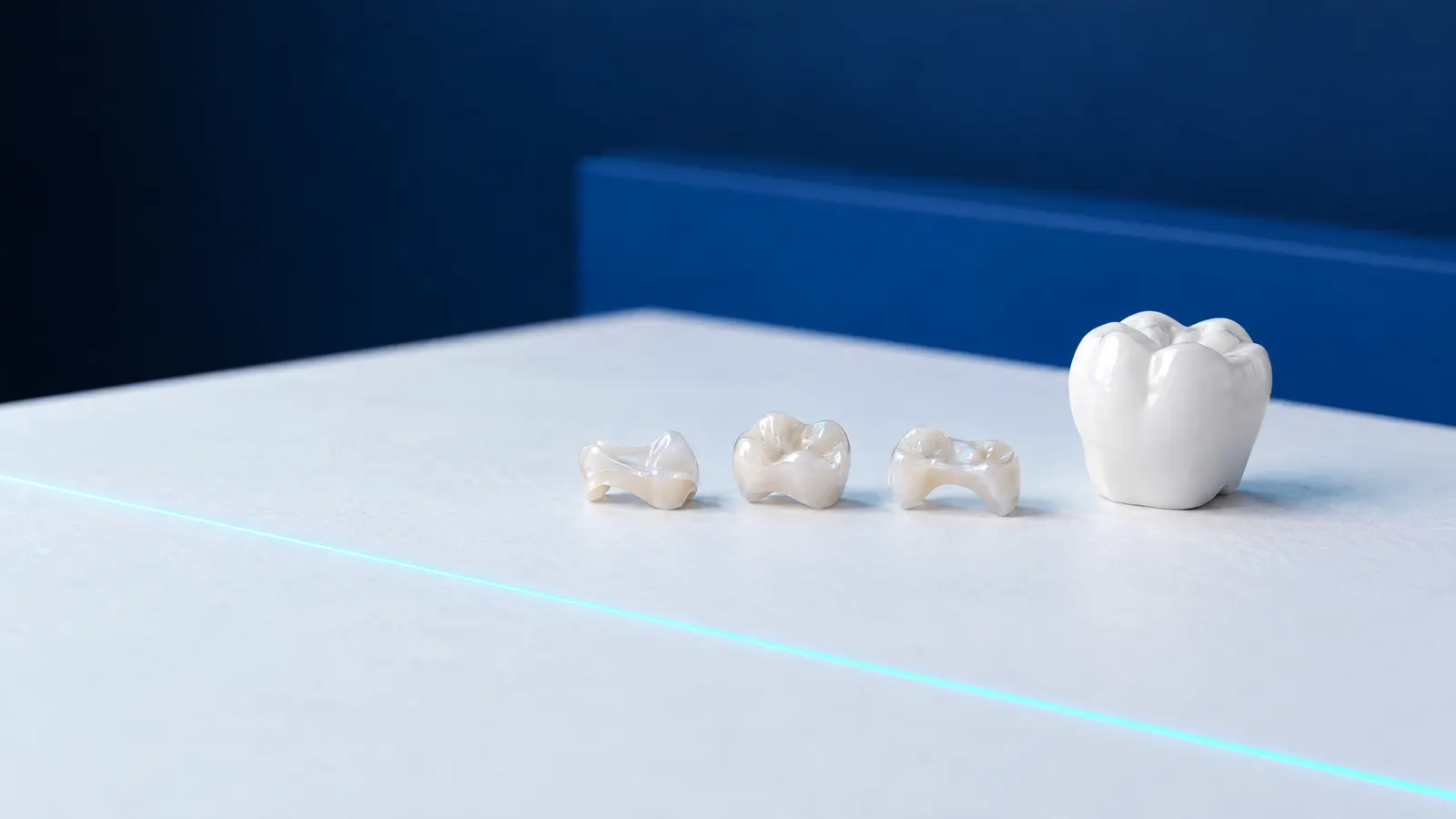
- An inlay fills a cavity inside the tooth and does not cover the cusps.
- An onlay covers the cavity and one or more cusps, which it replaces or protects.
- An overlay covers the whole chewing surface of the tooth but, unlike a crown, does not wrap around its side walls.
Inlay or filling: when does an inlay have the advantage?
An inlay or onlay has the advantage over a filling for a large cavity in a back tooth, especially when the cusps are weakened and an ordinary filling would have to rebuild several surfaces at once. For a small cavity an inlay is not needed, because a good composite filling removes only diseased tissue and is done in one visit.
Data on fillings support an inlay for large cavities. In a meta-analysis of patient data from 12 studies of composite fillings in back teeth, each additional surface of the filling increased the risk of failure by 30 to 40% (Opdam et al., 2014). An older review also found that indirect restorations in back teeth had a lower mean annual failure rate than direct fillings (Manhart et al., 2004), although composites have improved since then.
Not every comparison favours an inlay. In a review of randomised trials, laboratory-made composite inlays did not differ significantly from composite fillings after 5 or 11 years, although there were only 3 studies (Angeletaki et al., 2016).
Inlay, onlay or crown: a comparison
Inlays and onlays preserve more tissue than a crown, which requires the tooth to be ground down all the way round. In a laboratory study on models of front teeth, crown preparation removed 63 to 72% of the tooth’s crown tissue (Edelhoff and Sorensen, 2002), which is why an inlay is considered when enough sound tissue remains to put off a crown.
In studies, both options last about equally long. A review of 9 studies reported mean survival of 90.89% for inlays, 93.50% for onlays and 95.38% for crowns, with 5-year survival above 90% in all groups; a meta-analysis was not possible (Vagropoulou et al., 2018).
| Feature | Filling | Inlay or onlay | Crown |
|---|---|---|---|
| How it is made | In the mouth, in one visit | In a laboratory or milled from a block | In a dental laboratory |
| How much tissue is removed | Only diseased tissue | The cavity plus shaping for the inlay | Grinding the tooth all the way round |
| Cusps | Not covered | Onlays and overlays cover them | Covers the whole tooth |
| Number of visits | Usually 1 | Usually 2 | Usually at least 2 |
| Study data | Composite: 1.8% failures a year over 5 years | Ceramic: 92 to 95% after 5 years | Monolithic crowns: 96.8 to 98.5% after 5 years |
| Price in the clinic’s price list | 300 zł to 500 zł depending on the number of surfaces | 1 200 zł to 1 900 zł depending on the material | 2 500 zł to 3 000 zł depending on the material |
How long do inlays and onlays last?
In studies, ceramic inlays and onlays usually last many years: in a review of 14 studies, survival of glass ceramic and feldspathic ceramic restorations was 92 to 95% after 5 years and 91% after 10 years (Morimoto et al., 2016). The most common reasons for failure were fracture or chipping (4%), complications requiring root canal treatment (3%), secondary decay (1%) and debonding (1%).
In the same review, restorations in non-vital teeth, that is, after root canal treatment, did worse than in teeth with a living pulp. An older review reported mean annual failure rates in back teeth of 1.4% for gold inlays, 1.7% for CAD/CAM milled ceramic, 1.9% for ceramic and 2.9% for composite inlays (Manhart et al., 2004).
Figures from studies describe groups of patients, not a particular tooth. How long an inlay lasts also depends on hygiene, the risk of decay, biting forces and regular check-ups, at which the dentist checks the seal at the margins.
Composite, ceramic or gold inlay: materials and prices
An inlay or onlay can be made of composite, ceramic or gold, and the material affects the appearance, how it is fixed and the price. Lithium disilicate is a type of glass ceramic; in the latest review of crowns, from 2026, monolithic crowns made of this material had the highest survival after 5 years, 98.5% (Pjetursson et al., 2026), although these data concern crowns, not inlays.
In the clinic’s price list, “Inlay/Onlay kompozytowy” (composite inlay/onlay) costs 1 200 zł, “Inlay/Onlay porcelanowy” (porcelain inlay/onlay) 1 800 zł and “Inlay/Onlay/Overlay dwukrzemian litu” (lithium disilicate inlay/onlay/overlay) 1 900 zł. The dentist sets the final scope and cost at the consultation, and prices may change.
| Material | Properties | Study data | Price in the clinic’s price list |
|---|---|---|---|
| Composite | Tooth-coloured, a material similar to filling materials | 2.9% failures a year (data up to 2004) | 1 200 zł |
| Porcelain | Tooth-coloured, bonded to enamel and dentine | 92 to 95% after 5 years | 1 800 zł |
| Lithium disilicate | Glass ceramic, an overlay is also possible | Crowns of this material: 98.5% after 5 years | 1 900 zł |
| Gold | Metallic colour, cemented | 1.4% failures a year (data up to 2004) | 800 zł plus the price of gold |
How is an inlay or onlay fitted?
Fitting an inlay or onlay usually takes two visits, because in between the dental laboratory makes the restoration from an impression or scan. It can also be made with CAD/CAM technology, that is, designed by computer and milled from a ceramic block.
The usual order of stages is:
- An examination and an X-ray, on which the dentist assesses the depth of the cavity, the condition of the pulp and the thickness of the tooth walls.
- Removing decay or an old filling and shaping the cavity so that the inlay can slide in.
- An impression or intraoral scan, and choosing the colour of the material.
- Placing a temporary filling, which protects the tooth until the next visit.
- A try-in of the inlay, bonding or cementing it, and adjusting the bite.
When is an inlay or onlay not a good choice?
An inlay or onlay is not a good choice when the cavity is small, because a filling then removes less tissue and is done in one visit. Nor will it work when the tooth has lost most of its walls or a crack runs deep, because a crown or another type of restoration is then needed.
A tooth after root canal treatment needs a separate assessment. Onlays or overlays that cover the cusps can be an intermediate option between a filling and a crown for back teeth after root canal treatment, but inlays and onlays in non-vital teeth did worse in studies (Morimoto et al., 2016). The details are covered in a separate article on restoring a tooth after root canal treatment.
When the risk of decay is high, its causes are best brought under control first, because secondary decay at the margins is among the reasons both fillings and inlays fail.
How inlays and onlays are made at DentalBlue
At DentalBlue in Białystok, fillings, inlays and onlays are among the clinic’s services, and prosthodontics works in the same building, so with a large cavity the dentist can compare a filling, an inlay and a crown in a single plan. Intraoral and panoramic X-rays are taken in the clinic’s own radiology unit. A patient without pain can start with a “Wizyta bez bólu” (visit without pain, 300 zł), which ends with a written treatment plan, and a patient in pain with a “Wizyta z bólem” (visit in pain, 340 zł). The dentist sets the final scope and cost, and prices may change.
Frequently asked questions
Are inlays and onlays available on the NFZ?
No. Inlays and onlays are not on the list of dental services funded by the NFZ (Poland’s National Health Fund). On the NFZ a cavity is filled with materials from the list, in adults mainly glass ionomer cement, and in front teeth also self-curing composite (Ministry of Health regulation, consolidated text Dz.U. 2025 poz. 615, legal position as of 12 October 2026).
How does an inlay differ from a post and core?
An inlay fills a cavity in the crown of the tooth. A post and core is anchored in the canal of a tooth after root canal treatment and holds the restoration in place when too little tissue remains in the crown. A crown is then usually made on top of the post and core.
Can an inlay fall out?
It can, but this is rare: in a review of ceramic inlays and onlays, debonding affected about 1% of restorations (Morimoto et al., 2016). If an inlay comes loose, keep it and take it to the dentist, who will assess whether it can be fixed back in place.
How should I look after inlays and onlays?
In the same way as your own teeth: brushing with fluoride toothpaste twice a day, cleaning between the teeth and regular check-ups. The margins of the inlay are particularly important, because secondary decay at the margin is among the causes of failure.
How much does a gold inlay cost?
In the DentalBlue price list, the item “Wkład koronowy złoty + cena złota” (gold inlay plus the price of gold) costs 800 zł, to which the price of the gold used is added. Older studies reported 1.4% failures a year for gold inlays in back teeth (Manhart et al., 2004). The dentist sets the final cost at the consultation.
Sources
- NLM MeSH: Inlays, definition of an inlay and an onlay (2023)
- Morimoto S et al., J Dent Res: survival of ceramic inlays, onlays and overlays, meta-analysis (2016)
- Manhart J et al., Oper Dent: longevity of fillings and inlays in back teeth, review (2004)
- Angeletaki F et al., J Dent: composite inlays versus direct fillings, review (2016)
- Vagropoulou GI et al., J Oral Rehabil: inlays and onlays versus crowns, systematic review (2018)
- Opdam NJ et al., J Dent Res: longevity of composite fillings in back teeth (2014)
- Pjetursson BE et al., Int J Prosthodont: survival of tooth-supported crowns by material (2026)
- Edelhoff D, Sorensen JA, J Prosthet Dent: tooth tissue removed by crown and veneer preparation (2002)
An informational article. It does not replace a consultation, and treatment decisions are made during a visit.