How do veneers differ from bonding?
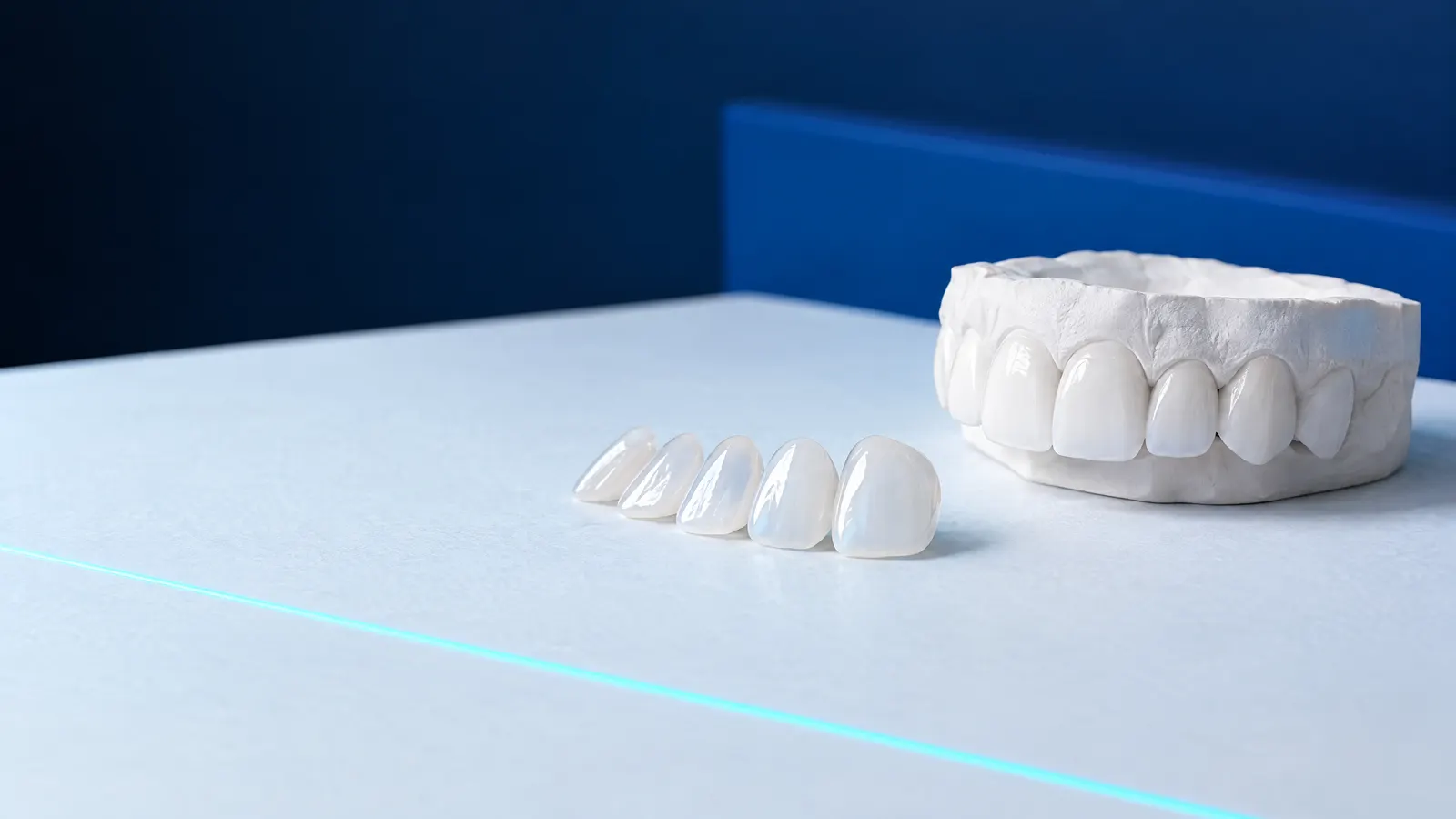
A ceramic veneer is a thin shell of porcelain or another ceramic, made in a laboratory and bonded to the front surface of the tooth. Bonding is composite, a material made of resin and filler, which the dentist applies to the tooth in layers and sculpts directly at the surgery; when it covers the whole front surface in this way it is also called a composite veneer.
Both options change the shape, colour or proportions of the front teeth, close small gaps and mask chips. They differ in how they are made, how much tissue is removed, how long they last and how easily they can be repaired. Composite can also be made indirectly, in a laboratory, but in studies composite veneers made directly at the surgery survived better than indirect ones (Lim et al., 2023).
Veneers or bonding: a side-by-side table
Ceramic veneers last longer in studies, while bonding is gentler on the tooth and easier to correct. The table sets out the main differences; which option suits particular teeth is assessed by the dentist after an examination, X-rays and an assessment of the bite.
| Criterion | Ceramic veneer | Bonding (composite veneer) |
|---|---|---|
| Where it is made | In a laboratory, from an impression or scan | Directly on the tooth, at the surgery |
| Grinding the tooth | Usually a thin layer of enamel, 3 to 30% of the tooth’s crown tissue | Often little or none |
| Survival in studies | 89% after a median of 9 years | 88% after an average of 2 to 8 years |
| Annual failure rate in one practice | 1.4% up to 5 years, 1.2% up to 10 years | 3.9% up to 5 years, 4.1% up to 10 years |
| Typical problems | Fracture or chipping of the ceramic, debonding | Surface roughness, colour change, stained margins |
| Repair | More difficult, sometimes the veneer has to be replaced | Usually with composite, directly in the mouth |
| Price in the clinic’s price list | “Licówka pełnoceramiczna” (all-ceramic veneer) 3 000 zł | “Bonding 1 zęba” (bonding, 1 tooth) 1 000 zł |
How long do porcelain veneers last?
In a review of 13 studies, 89% of porcelain veneers survived over a median follow-up of 9 years, with 94% for glass ceramic veneers and 87% for feldspathic porcelain (Morimoto et al., 2016). The most common complication was fracture or chipping of the ceramic (4%), and less often debonding, decay at the margin and staining of the margin.
The longest data come from a study of 318 glass ceramic veneers followed for up to 20 years: estimated survival was 94.4% after 5 years, 93.5% after 10 years and 82.9% after 20 years (Beier et al., 2012). That is the result for one group of patients, not a forecast for a particular tooth.
What the veneer is bonded to matters a great deal. In a study of 580 veneers, survival was 99% when the preparation stayed within the enamel, while veneers bonded to dentine or with margins in dentine failed about 10 times more often (Gurel et al., 2013).
How long do bonding and composite veneers last?
In a review of randomised trials, 88% of composite veneers survived over an average follow-up of 24 to 97 months (Lim et al., 2023). The most common problems were surface roughness, colour mismatch and staining of the margins, most of them judged clinically acceptable.
In one practice that followed 1 459 veneers for 10 years, the annual failure rate for composite was 3.9% up to 5 years and 4.1% up to 10 years, and for ceramic 1.4% and 1.2% (Mazzetti et al., 2022). Patients were not randomly assigned, so this is an indication, not a final answer.
The advantage of composite is that it can be repaired: in the same follow-up, 17.3% of all veneers had been repaired and were still in the mouth. Chipped or stained composite can usually be topped up with the same material directly in the mouth, without laboratory work.
Veneers drawbacks: what to know before deciding?
The main drawback of ceramic veneers is that they usually require irreversible grinding of the enamel. In a laboratory study, veneer preparation removed 3 to 30% of the tooth’s crown tissue, less than a crown, but that tissue cannot be recovered (Edelhoff and Sorensen, 2002). Bonding has different weaknesses, mainly to do with how the surface looks over time.
- Grinding the enamel for a ceramic veneer is irreversible, so the tooth will usually need another restoration later.
- Ceramic can fracture or come off; fracture or chipping is the most common complication in studies (Morimoto et al., 2016).
- Veneers and composite cannot be whitened: whitening changes the colour of natural teeth only, not of veneers or fillings (NHS, 2025).
- Composite loses its smoothness and shine over time, can stain and needs repair more often than ceramic.
- With grinding and clenching, the risk of damage to ceramic veneers is many times higher.
Who is not a good candidate for veneers or bonding?
The most common reason a dentist advises against veneers or recommends extra protection is bruxism, that is, grinding or clenching the teeth. In a study with 20-year follow-up, bruxism was associated with a 7.7 times higher risk of veneer failure (Beier et al., 2012), and a systematic review confirmed this for ceramic veneers on front teeth, with very low-quality evidence (de Souza Melo et al., 2018).
Bruxism does not rule out veneers absolutely, but with it veneers fracture or come off more often, so the dentist may recommend a splint or another solution. In the clinic’s price list, “Szyna relaksacyjna twarda” (hard occlusal splint) costs 1 250 zł. Veneers and bonding are also usually postponed in the situations in the list.
- Untreated bruxism or marked tooth wear from clenching.
- Too little enamel, when the preparation would end in dentine.
- A dead or extensively restored tooth; in studies, veneers on dead teeth failed more often.
- Active decay or untreated gum disease, which have to be treated first.
What is a mock-up, and why have one?
A mock-up is a trial model of the planned tooth shape, placed temporarily over the patient’s own teeth before anything is ground away. It lets you see in your mouth and in the mirror the length, width and proportions of the future veneers or bonding, and discuss changes while they can still be reversed.
A mock-up matters especially when several teeth are treated at once and the change affects the whole smile. In the clinic’s price list, the item “Mock up góra + dół” (mock-up, upper and lower) costs 1 800 zł. If whitening is also planned, it is usually done before the veneers or bonding, because the colour of the material is matched to the final colour of the natural teeth.
How much do porcelain veneers and bonding cost?
The cost of veneers and bonding depends on the number of teeth, the material, whether a mock-up is needed and any treatment beforehand, for example treating decay, professional cleaning or whitening. Ceramic veneers require laboratory work, which is why one veneer costs more than bonding one tooth.
In the clinic’s price list, “Licówka pełnoceramiczna” (all-ceramic veneer) costs 3 000 zł, “Licówka pełnocyrkonowa” (full zirconia veneer) 2 800 zł, “Bonding 1 zęba” (bonding, 1 tooth) 1 000 zł, and “Bonding 3-4 zęby” (bonding, 3 to 4 teeth) 900 zł: this is the price for the whole procedure covering 3 or 4 teeth, not per tooth. The final scope and cost are set at the consultation, and prices may change.
| Item in the clinic’s price list | Price |
|---|---|
| Licówka pełnoceramiczna (all-ceramic veneer) | 3 000 zł |
| Licówka pełnocyrkonowa (full zirconia veneer) | 2 800 zł |
| Bonding 1 zęba (bonding, 1 tooth) | 1 000 zł |
| Bonding 3-4 zęby (bonding, 3 or 4 teeth in total) | 900 zł |
| Mock up góra + dół (mock-up, upper and lower) | 1 800 zł |
| Szyna relaksacyjna twarda (hard occlusal splint) | 1 250 zł |
| Konsultacja protetyczna (prosthodontic consultation) | 300 zł |
How veneers and bonding work at DentalBlue
At DentalBlue in Białystok, veneers and bonding are part of cosmetic dentistry, which the clinic describes as conservative by design: enamel stays wherever it can stay. Treatment starts with an examination and X-rays from the clinic’s own radiology unit; a “Wizyta bez bólu” (visit without pain, 300 zł) includes a panoramic X-ray, a consultation, an examination and a written treatment plan with prices. The price list also includes a mock-up, which lets you assess the planned tooth shape before deciding. A consultation can be booked by phone.
Frequently asked questions
Do veneers ruin your teeth?
A ceramic veneer usually requires grinding away a thin layer of enamel, 3 to 30% of the crown tissue in a laboratory study (Edelhoff and Sorensen, 2002), and this cannot be undone. The veneer itself does not damage the tooth, but the tooth remains prepared for it permanently. Bonding often requires no grinding.
Do composite veneers stain?
They can. In a review of randomised trials, the most common problems with composite veneers were surface roughness, colour mismatch and staining of the margins, usually clinically acceptable (Lim et al., 2023). The composite surface can be refreshed by polishing or repair, which the dentist assesses at a check-up.
Can veneers be fitted on crooked teeth?
Veneers can mask small irregularities and gaps, but they do not move teeth. With marked crowding or an incorrect bite, a veneer would need heavier grinding, so the dentist may first suggest an orthodontic consultation.
How do you look after veneers and bonding?
Veneers and bonding are cleaned like natural teeth: with a toothbrush twice a day and with floss or an interdental brush at the margins. Composite stains more easily, so with bonding, coffee, tea and smoking matter, as does periodic polishing. For people who grind their teeth, the dentist may recommend a night splint.
Can you whiten your teeth after veneers?
Whitening changes the colour of natural teeth only, not of veneers, crowns or fillings (NHS, 2025). That is why teeth that will stay without veneers are usually whitened before the veneers are made, and the colour of the veneers is matched to the shade achieved.
Sources
- Morimoto S et al., Int J Prosthodont: survival of ceramic veneers, meta-analysis (2016)
- Beier US et al., Int J Prosthodont: glass ceramic veneers, follow-up of up to 20 years (2012)
- Gurel G et al., Int J Periodontics Restorative Dent: preparation depth and veneer survival (2013)
- de Souza Melo G et al., J Prosthet Dent: bruxism and ceramic restorations, systematic review (2018)
- Lim TW et al., J Evid Based Dent Pract: composite veneers, review of randomised trials (2023)
- Mazzetti T et al., Dent Mater: composite and ceramic veneers in practice, 10-year follow-up (2022)
- Edelhoff D, Sorensen JA, J Prosthet Dent: tooth tissue removed by crown and veneer preparation (2002)
- NHS: Teeth whitening (2025)
An informational article. It does not replace a consultation, and treatment decisions are made during a visit.