When is a dental crown needed?
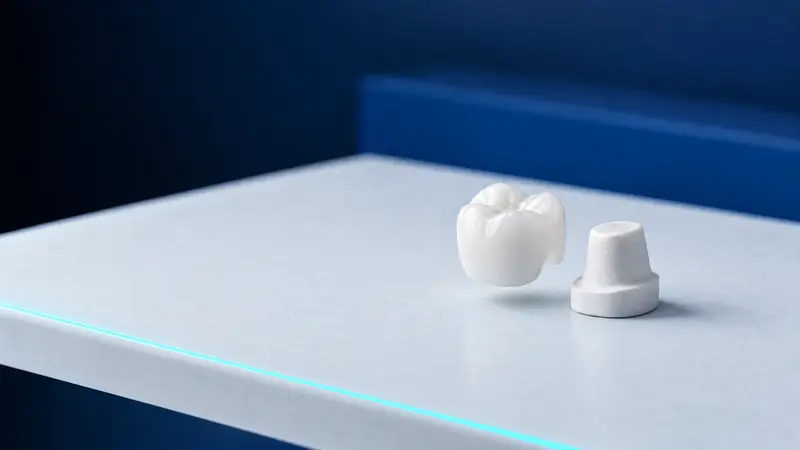
A dental crown is needed when too little of the tooth is left for a filling to rebuild it safely and protect it from cracking. A crown encircles the tooth, so it spreads biting forces over the whole crown of the tooth instead of loading the weakened walls.
The decision depends on how much healthy tissue remains and where the cavity lies. When more of the tooth is left, an onlay, a restoration that covers only some of the cusps, may be an alternative; this is described in a separate article on inlays and onlays. The most common reasons for a crown are:
- An extensive cavity that has left thin, weakened walls.
- A cracked or broken-off cusp, or a cracked tooth that can still be kept.
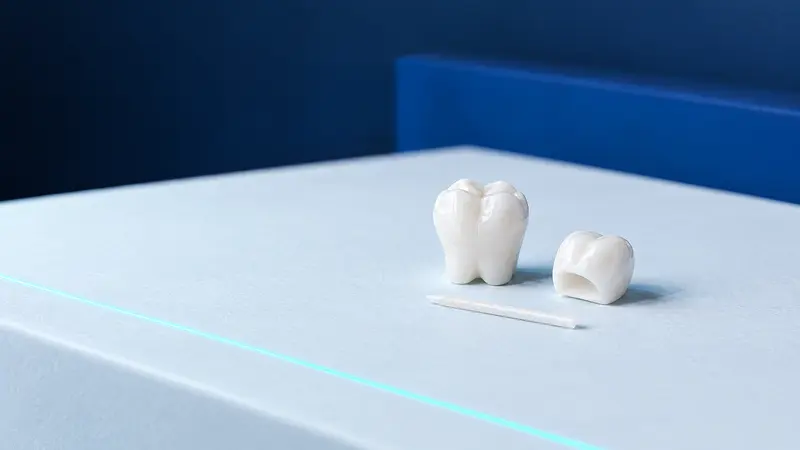
- A back tooth after root canal treatment that needs its cusps covered.
- Replacing a large, leaking filling that can no longer be redone.
- A worn or broken tooth, and also a heavily discoloured tooth that whitening will not change.
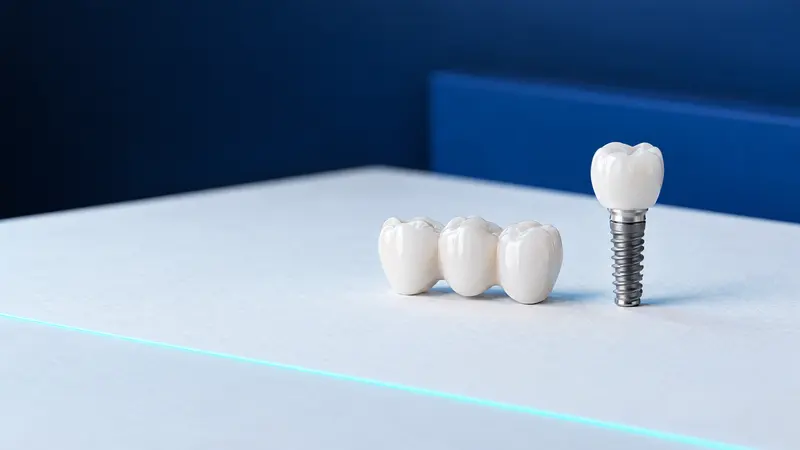
- A bridge abutment and a restoration on an implant (Cleveland Clinic, 2023).
What types of crown are there, and which lasts longest?
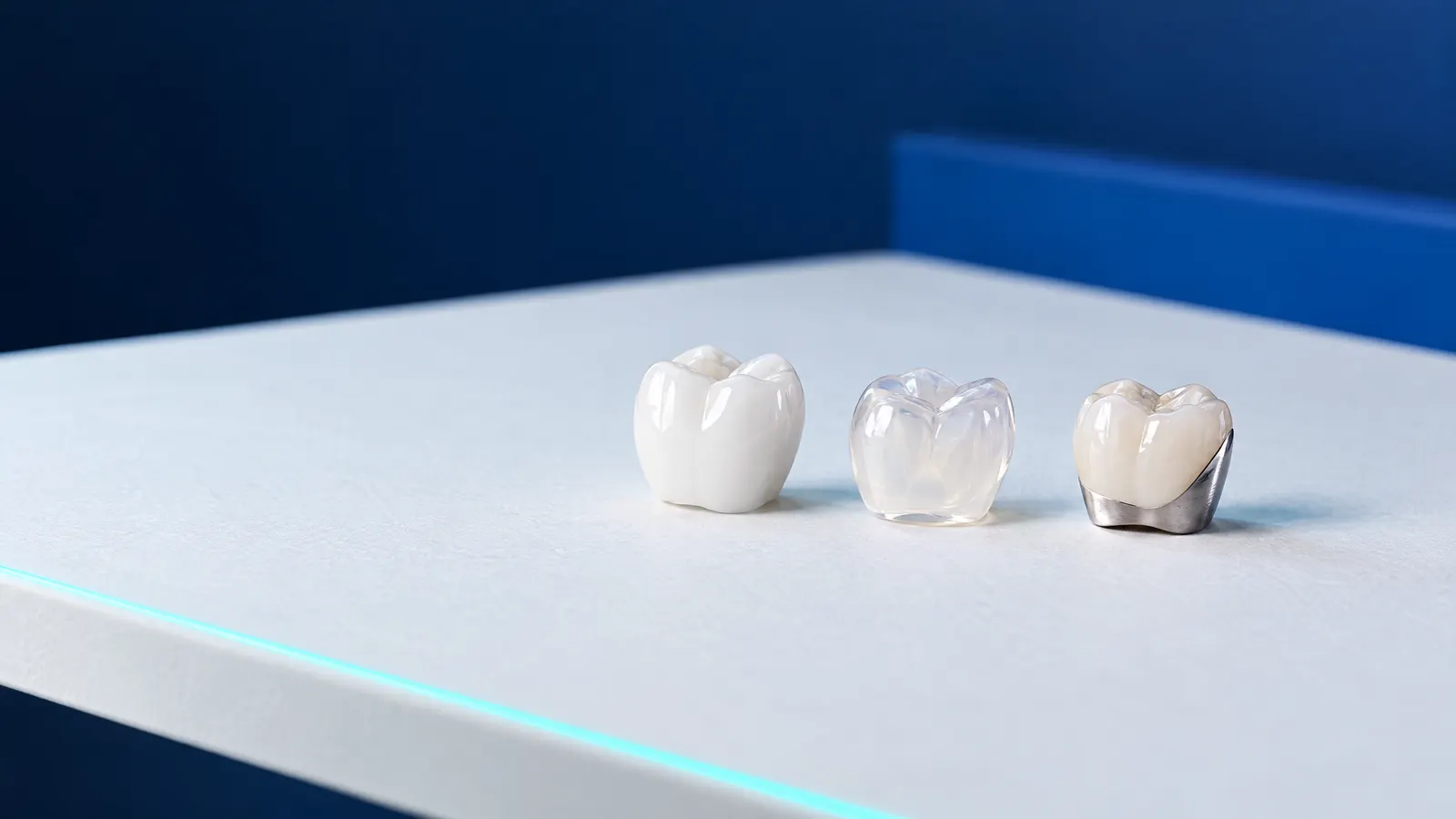
The most widely used types of crown last about equally long in studies, and the differences between them are small. The latest systematic review of 64 studies (Pjetursson et al., 2026) reports 5-year survival of 98.5% for monolithic lithium disilicate, 97.3% for veneered zirconia, 97.1% for porcelain fused to metal crowns and 96.8% for monolithic zirconia.
The table lists the types of crown in the clinic’s price list. The figures describe groups of patients in studies, not a particular tooth; feldspathic ceramic crowns did less well (90.4%), and no review with 5-year follow-up was found for composite crowns.
| Type of crown | Structure | 5-year survival in studies | Price in the clinic’s price list |
|---|---|---|---|
| Lithium disilicate crown | Glass ceramic, monolithic or veneered | 98.5% monolithic, 95.7% veneered | 3 000 zł |
| Zirconia ceramic crown | Zirconia framework covered with porcelain | 97.3% | 3 000 zł |
| Porcelain fused to metal crown | Metal framework covered with porcelain | 97.1% | 2 500 zł |
| Full zirconia crown | Solid zirconia, with no veneering layer | 96.8% | 3 000 zł |
| Composite crown | A material made of resin and filler | No review with 5-year data | 1 500 zł |
| Zirconia crown on an implant | A crown fixed on an implant, not on a tooth | 97.6% (separate review of implant crowns) | 3 500 zł |
| Temporary crown | Resin or acrylic, worn while the permanent crown is made | Not applicable | 250 zł |
Zirconia or porcelain crown: which to choose?
Zirconia or porcelain is in practice a question about how the crown is built, because in everyday speech “porcelain” is used both for a porcelain fused to metal crown and for an all-ceramic one. Studies do not point to one material that is right for every tooth, and the differences in 5-year survival lie within a few percentage points.
Monolithic crowns, made of a single material with no veneering layer, had significantly fewer fractures and ceramic chips than veneered crowns in the 2026 review (Pjetursson et al., 2026). That is why, for people who clench their teeth and for back teeth, the dentist often considers monolithic zirconia or lithium disilicate, as they have no layer that could chip off.
In front teeth, translucency and matching the colour to the neighbouring teeth matter more. The final choice depends on the position in the arch, the colour of the tooth under the crown, the space available in the bite and habits such as clenching.
How long does a dental crown last?
A dental crown can serve for many years, and studies report that after 5 years 96.8% to 98.5% of crowns made from the most widely used materials are still functioning (Pjetursson et al., 2026). For crowns on implants, a separate review reports 98.3% for porcelain fused to metal crowns and 97.6% for zirconia crowns after 5 years (Pjetursson et al., 2018).
The crown itself does not decay, but the tooth under it still can, especially at the edge of the crown, so daily cleaning of that area and check-ups determine how long it lasts (Healthdirect, 2025). A living tooth under a crown may also need root canal treatment in the future: in one study the pulp remained alive in 84.4% of teeth after 10 years, meaning roughly 1 tooth in 6 needed treatment (Cheung et al., 2005).
How is a crown fitted, visit by visit?
Fitting a laboratory-made crown usually takes two visits: at the first the dentist prepares the tooth and takes an impression or scan, and at the second fits the finished crown. Some crowns can be made and fitted on the same day, depending on the material and technology (Healthdirect, 2025).
Preparing a tooth for a crown means grinding its surface all the way round. In a laboratory study, crown preparation removed 63 to 72% of the tooth’s crown tissue, compared with 3 to 30% for veneers (Edelhoff and Sorensen, 2002), which is why a crown is used where less invasive treatment is not enough.
- Examination and X-ray: the dentist assesses the tooth, roots and gum and, if there is doubt about the pulp, plans root canal treatment first.
- Preparing the tooth under local anaesthesia, rebuilding missing walls and shaping the tooth for the crown.
- An impression or digital scan, and matching the colour to the neighbouring teeth.
- A temporary crown, which protects the prepared tooth until the next visit.
- Making the permanent crown in the dental laboratory.
- A try-in, checking the seal and the bite, and then cementing the crown permanently.
Temporary crown: how to manage with it?
A temporary crown protects the prepared tooth and the gum until the permanent crown is fitted. It is usually made of resin or acrylic, so it is less strong than the final crown and is more easily damaged or loosened (Cleveland Clinic, 2023).
During this time it is better to avoid foods that can break it or pull it off: ice cubes, hard nuts, popcorn with kernels and chewy sweets such as fudge or caramels. If the temporary crown falls out or cracks, keep it and contact the surgery so that the tooth is not left unprotected for long.
Crown after root canal treatment: when is it needed?
A crown after root canal treatment is often recommended for back teeth, because a treated tooth has lost a large part of its own tissue and cracks more easily. In the study by Aquilino and Caplan (2002), teeth without a crown after root canal treatment were lost 6 times more often than teeth with a crown.
Not every tooth after root canal treatment needs a full crown: in back teeth, covering the cusps with a crown or an onlay is usually recommended, and the choice depends on how much tissue remains. Posts, the ferrule effect and the order of rebuilding are described in a separate article on restoring a tooth after root canal treatment.
How much does a dental crown cost, and is it available on the NFZ?
The cost of a dental crown depends on the material, the laboratory work and whether the tooth first needs preparing: root canal treatment or rebuilding with a post. The NFZ (Poland’s National Health Fund) does not fund prosthetic crowns, because they are not on the list of guaranteed dental treatment services (consolidated text, Dz.U. 2025 poz. 615, legal position as of 12 October 2026).
In the clinic’s price list, “Korona porcelanowo-metalowa” (porcelain fused to metal crown) costs 2 500 zł, “Korona pełnocyrkonowa” (full zirconia crown), “Korona dwukrzemian litu” (lithium disilicate crown) and “Korona cyrkonowo-ceramiczna” (zirconia ceramic crown) 3 000 zł each, “Korona kompozytowa” (composite crown) 1 500 zł and “Korona tymczasowa” (temporary crown) 250 zł. When the tooth needs rebuilding before the crown, “Odbudowa zęba z wkładem na włóknie szklanym” (restoration with a glass fibre post) costs 1 000 zł, “Wkład prosty” (simple post) 800 zł and “Wkład złożony” (complex post) 1 000 zł.
“Zacementowanie korony” (cementing a crown) is 250 zł in the price list, and “Zdjęcie korony” (crown removal) 300 zł. The dentist sets the final scope and cost at the consultation, and prices may change.
How crowns are made at DentalBlue
At DentalBlue in Białystok, prosthodontics, meaning crowns, bridges and full reconstructions, is one of the clinic’s fields of treatment, alongside endodontics under the microscope when a tooth needs root canal treatment before the crown. X-rays, from intraoral images to CBCT scans, are taken in the clinic’s own radiology unit. A “Wizyta bez bólu” (visit without pain, 300 zł) includes a panoramic X-ray, a consultation, an examination and a written treatment plan with the prices of each stage, and a “Konsultacja protetyczna” (prosthodontic consultation) costs 300 zł. A consultation can be booked by phone.
Frequently asked questions
Does preparing a tooth for a crown hurt?
A living tooth is prepared for a crown under local anaesthesia. After the procedure the tooth may be sensitive to hot and cold for a while, and the gum tender (Cleveland Clinic, 2023). Pain that gets worse or comes on by itself needs to be checked.
How long does it take to make a dental crown?
A laboratory-made crown usually takes two visits, and in between the patient wears a temporary crown. According to Cleveland Clinic, the gap is usually 2 to 3 weeks, sometimes longer; some crowns can be made on the same day. The dentist gives the fitting date at the first visit.
What should I do if a crown has come loose or fallen off?
Keep the crown and see a dentist, because a loose crown no longer protects the tooth from bacteria and cracking. The dentist checks the tooth underneath and, if the tooth and the crown are in good condition, refits it; in the clinic’s price list “Zacementowanie korony” (cementing a crown) costs 250 zł.
Is a composite crown suitable as a permanent solution?
For permanent composite crowns there is no review of studies with 5-year follow-up of the kind that exists for ceramic crowns. That is why a composite crown tends to be used as a temporary or long-term temporary restoration, and the dentist decides whether to use it for longer.
Can decay develop under a crown?
Yes. The crown does not decay, but the tooth under it still can, most often at the edge of the crown, next to the gum (Healthdirect, 2025). That is why this area is cleaned every day with floss or an interdental brush, and at check-ups the dentist assesses the seal of the crown.
Sources
- Pjetursson BE et al., Int J Prosthodont: survival of tooth-supported crowns, systematic review (2026)
- Pjetursson BE et al., Clin Oral Implants Res: implant crowns, metal ceramic versus zirconia (2018)
- Edelhoff D, Sorensen JA, J Prosthet Dent: tooth tissue removed by crown and veneer preparation (2002)
- Cheung GS et al., Int Endod J: pulp vitality under crowns and bridge abutments (2005)
- Aquilino SA, Caplan DJ, J Prosthet Dent: crowns and tooth loss after root canal treatment (2002)
- Healthdirect Australia: Dental crown procedure (2025)
- Cleveland Clinic: Dental Crowns (2023)
- Dz.U. 2025 poz. 615: rozporządzenie MZ w sprawie świadczeń gwarantowanych z zakresu leczenia stomatologicznego (2025)
An informational article. It does not replace a consultation, and treatment decisions are made during a visit.