What is a cracked tooth?
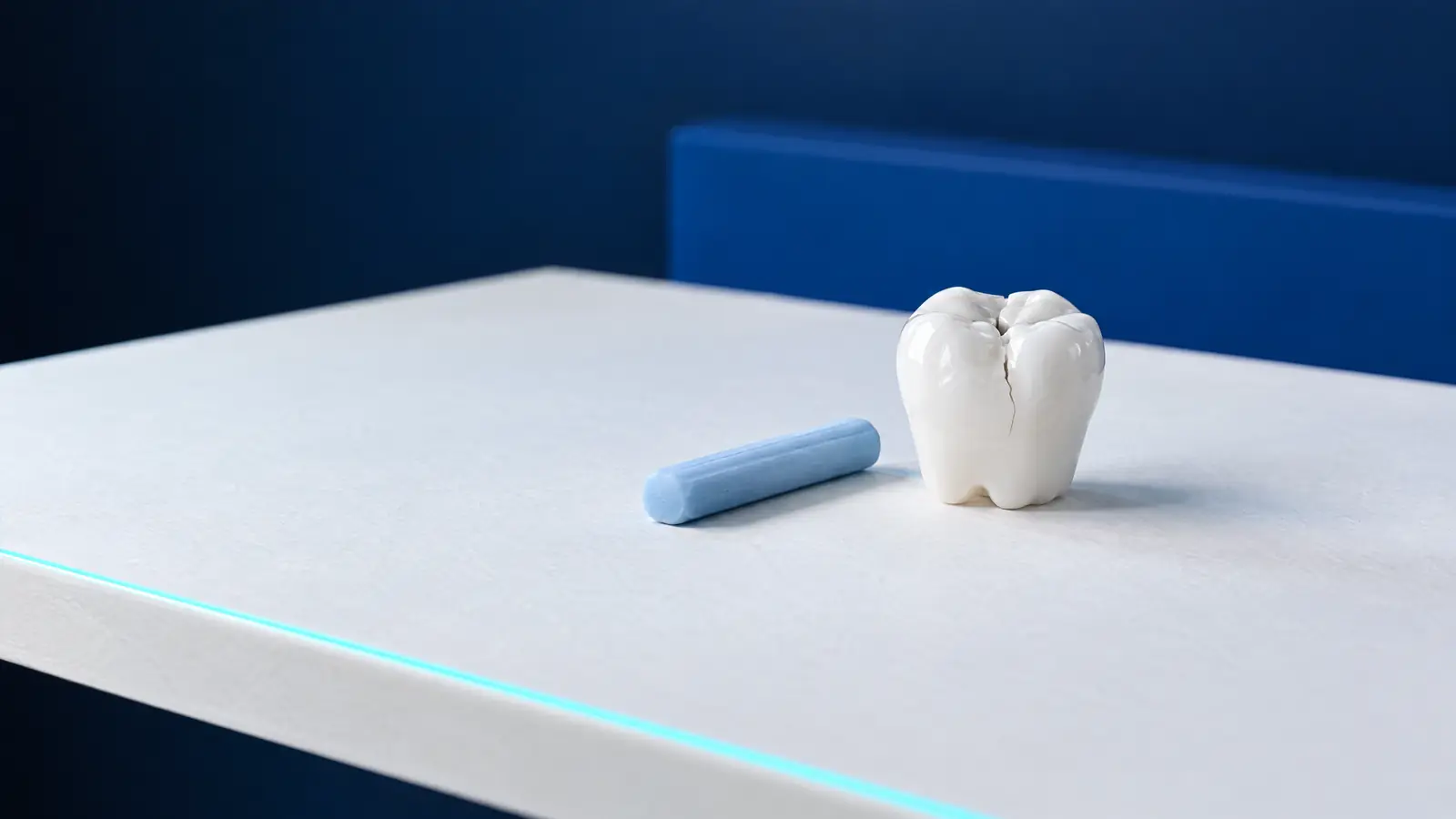
According to the European Society of Endodontology (ESE), a cracked tooth is a tooth with a crack reaching into the dentine, of unknown depth, which may extend towards the root and involve the pulp. The crack usually runs along the long axis of the tooth and may deepen over time.
A crack does not knit together like a broken bone, the American Association of Endodontists (AAE) stresses, so treatment is meant to protect it, not to heal it. The 2025 ESE position statement reports that the prevalence of visible cracks in tooth crowns reached 70% in studies; they occur most often in the upper premolars and molars and in the lower molars, especially after the age of 40.
The ESE recommends abandoning the popular term “cracked tooth syndrome”, because the symptoms of cracks are too varied to be described as a single syndrome. At the surgery, dentists speak instead of the specific type of crack and of the state of the pulp.
What types of tooth crack are there?
The AAE and the ESE distinguish five basic types of crack: craze lines in the enamel, a fractured cusp, a cracked tooth, a split tooth and a vertical root fracture. The type of crack determines the treatment and whether the tooth can be kept whole.
The table sets these categories against the typical management. The boundaries between them are not sharp: according to the ESE, an untreated cracked tooth can over time turn into a fractured cusp or a split tooth, which is why early diagnosis matters so much.
| Type of crack | What it looks like | Typical treatment | Can the tooth usually be kept? |
|---|---|---|---|
| Craze line | A thin line in the enamel only, usually painless | No treatment, sometimes treatment for cosmetic reasons | Yes |
| Fractured cusp | A crack by a cusp, often next to a filling; the fragment may break off | A filling, an onlay or a crown | Usually yes |
| Cracked tooth | A crack from the biting surface towards the root, the tooth still in one piece | Monitoring, an onlay or a crown; root canal treatment if the pulp is involved | Yes, if the crack does not extend below the gum |
| Split tooth | A tooth separated into two parts | Usually extraction, sometimes keeping part of the tooth | Not as a whole |
| Vertical root fracture | A crack in the root, often found when the gum and bone become infected | Extraction of a single-rooted tooth, sometimes removal of one root | Usually not |
Tooth hurts when biting: what are the symptoms of a cracked tooth?
The most characteristic symptom of a cracked tooth is a brief, sharp pain on biting or at the moment of releasing the bite, especially with hard food. The AAE describes this pain as erratic and coming in waves, which makes it hard to tell which tooth hurts.
Pain on biting is not, however, the most common symptom. In an American study of 2,858 living back teeth with a visible crack, 45% of the teeth had symptoms: pain with cold in 37%, pain on biting in 16% and spontaneous pain in 11% (Hilton et al., 2018). Many cracks therefore cause no discomfort at all and come to light at a check-up.
A new filling that is too high can cause similar pain on biting, as described in the article on pain after a filling. The list brings together the symptoms worth seeing a dentist about.
- Sharp pain on biting on one tooth, or at the moment of opening the mouth after biting down.
- Pain with cold in one tooth, especially one with a large filling.
- Spontaneous or night-time pain, which may mean that the crack has irritated the pulp.
- A loose fragment of tooth, or an edge you can feel with your tongue after a cusp has broken off.
- Swelling of the gum or a pimple by a tooth after root canal treatment, which can be a sign of a root fracture.
Why do teeth crack?
Teeth crack for many reasons at once: the ESE lists abnormal contacts in the bite, the structure of the tooth, previous treatment, heavy loads from a hard diet, and clenching and grinding. In a study of 2,975 cracked teeth, symptoms were more common in people who clench or grind their teeth and in molars (Hilton et al., 2017).
The risk increases with age, because dentine becomes less elastic, and in teeth weakened by large fillings. Teeth after root canal treatment are particularly prone to vertical root fracture; the ESE links it, among other things, to excessive removal of dentine and to preparing space for a post.
Increasingly, teeth without any filling crack too, as the ESE notes in studies from the past two decades. How teeth grinding affects teeth and restorations is described in a separate article on bruxism.
How does a dentist detect a crack in a tooth?
A dentist detects a crack mainly through a clinical examination, not on an X-ray. The ESE position statement lists a bite test designed to reproduce the pain, transillumination of the tooth with a fibre-optic light, staining the crack and examination under magnification, which it calls key to distinguishing a crack in the dentine from a harmless craze line in the enamel.
An X-ray often shows nothing: according to a study cited by the ESE, the crack was visible on the X-ray in only 2% of cracked teeth with a living pulp. Cone beam computed tomography (CBCT) does not detect cracks predictably either, because a typical root fracture is 50 to 100 µm wide, below the resolution of the image.
In a meta-analysis of clinical studies, CBCT identified vertical root fractures in root-treated teeth with a sensitivity of 78%, meaning that roughly one fracture in five was missed (PradeepKumar et al., 2021). Tomography does, however, help to show the bone loss around the root that accompanies a crack, which is why the ESE accepts it when the picture is unclear.
- History: when it hurts, with what food, and whether the pain comes on releasing the bite.
- A bite test on each cusp separately, using a special instrument.
- Transillumination and staining, which make the crack line visible.
- Examination under a microscope or loupes, sometimes after removing an old filling.
- Measuring the pocket next to the tooth: a narrow, deep pocket in one spot may point to a root fracture.
- Pulp vitality tests and an intraoral X-ray and, when the picture is unclear, a small field of view CBCT scan.
How is a cracked tooth treated?
Treatment of a cracked tooth depends on the type of crack and the state of the pulp. Craze lines in the enamel need no treatment, the ESE allows shallow cracks in a tooth without symptoms to be monitored at later visits, and teeth at high risk of the crack deepening, for example heavily restored teeth or the last teeth in the arch, need a restoration that covers the cusps, that is an onlay or a crown.
In a 3-year study in American dental practices, only 3% of cracked teeth fractured and the crack deepened in 12%; the most frequently chosen treatment was a full crown, and of the treated teeth 14% needed further treatment, although these teeth were still in function (Ferracane et al., 2023). The ESE notes that after a composite filling alone, later root canal treatment or repair may be needed more often than after cusp coverage.
A restoration does not always settle the pulp. In the study by Krell and Rivera (2007), about 20% of cracked teeth with reversible pulpitis that were given crowns needed root canal treatment within six months. When the pulp has irreversible pulpitis or has died, the tooth is root treated and the cusps are then covered; the ESE reports survival of such teeth of 84 to 88% over periods of 1 to 5 years.
For a split tooth the ESE recommends considering prompt extraction, and for a vertical root fracture in a single-rooted tooth extraction is recommended. In a multi-rooted tooth it is sometimes possible to remove only the fractured root together with part of the crown (hemisection). How to restore a tooth after root canal treatment so that it does not crack is described in a separate article on restoring a tooth after root canal treatment.
Can a cracked tooth be saved?
A cracked tooth can usually be saved if the crack is found before it splits the tooth or extends below the gum line. The AAE reports that most treated cracked teeth function for years, and that a crown gives the tooth the greatest protection, although it does not make success certain in every case.
According to the ESE, the outlook is worse with a deep pocket by the tooth, of 5 mm or more, several cracks at once, a crack extending into the root, a tooth at the end of the arch and an inflammatory lesion at the root. A root fracture in a tooth after root canal treatment has a poor outlook and usually ends in extraction, after which the gap is filled with an implant, a bridge or a denture.
How much does treating a cracked tooth cost, and what does the NFZ cover?
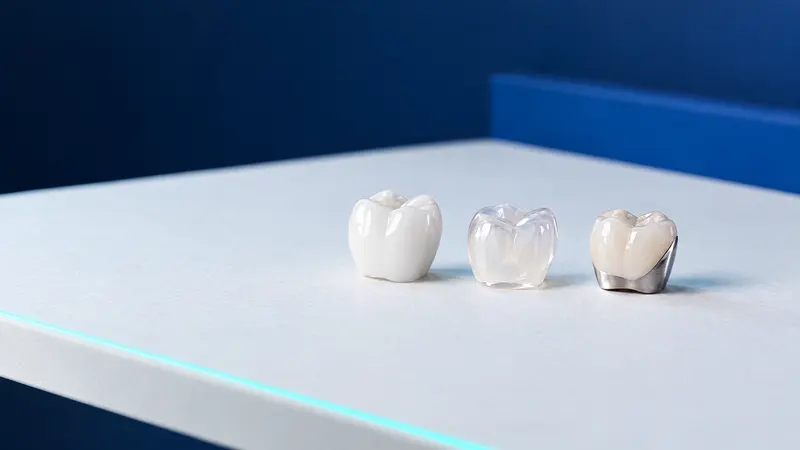
The cost of treating a cracked tooth depends on whether monitoring and a filling are enough or an onlay, a crown or root canal treatment is needed. In the clinic’s price list, “Konsultacja przy użyciu mikroskopu” (consultation under the microscope) costs 300 zł, “Usunięcie odłamu pękniętego zęba” (removal of a fractured tooth fragment) 100 zł, “Inlay/Onlay kompozytowy” (composite inlay or onlay) 1 200 zł, “Inlay/Onlay/Overlay dwukrzemian litu” (lithium disilicate inlay, onlay or overlay) 1 900 zł, “Korona pełnocyrkonowa” (full zirconia crown) 3 000 zł and “Hemisekcja” (hemisection) 400 zł.
The final scope and cost are set by the dentist after the examination, and prices may change. On the NFZ (Poland’s National Health Fund), fillings and extractions are available, and for adults root canal treatment only of incisors and canines, that is teeth 1 to 3; prosthetic crowns are not funded by the NFZ (legal position as of 18 October 2026).
How it works at DentalBlue
At DentalBlue in Białystok, a suspected crack can be assessed at a consultation under the microscope, and root canal treatment of cracked teeth is carried out under a microscope. Intraoral X-rays, panoramic X-rays and CBCT scans are taken in the clinic’s own radiology unit. The clinic makes onlays and crowns as part of its prosthodontics, so root canal treatment and the restoration can be planned together. A patient in pain can come for a “Wizyta z bólem” (visit in pain, 340 zł), which includes a panoramic X-ray, a consultation, an examination and pain relief.
Frequently asked questions
Can a cracked tooth heal by itself?
No. The AAE stresses that, unlike a broken bone, a crack in a tooth does not heal, and some cracks deepen over time. Treatment is meant to protect the tooth from cracking further, for example by covering the cusps with an onlay or a crown.
Does a cracked tooth always hurt?
No. In a study of 2,858 living back teeth with a visible crack, 45% had symptoms and the rest did not hurt (Hilton et al., 2018). A vertical root fracture also often causes only mild symptoms and is sometimes found only when the gum and bone become infected.
Are craze lines on the front teeth dangerous?
Usually not. The ESE describes craze lines confined to the enamel as superficial lines that do not weaken the tooth and become more visible with age. They need no treatment, unless a stained line is a cosmetic concern.
What should I do if a piece of tooth has broken off?
Avoid biting on that side and see a dentist. The AAE writes that a fractured cusp rarely damages the pulp and can usually be restored with a filling or a crown. If the tooth broke after a blow, what to do with the fragment is described in the article on a knocked-out tooth.
Does a night guard protect teeth from cracking?
For teeth grinding, the AAE recommends wearing a night guard as one way of reducing the risk of cracks, and with parafunctional habits the ESE recommends considering a stabilisation splint. Cracks cannot be prevented completely, however; it also helps to avoid chewing ice, popcorn kernels and pens.
Sources
- International Endodontic Journal: Patel S et al., ESE position statement on cracks and fractures in teeth (2025)
- AAE: Cracked Teeth, types of tooth crack and their treatment
- Journal of Dentistry: Hilton TJ et al., types of pain in cracked posterior teeth (2018)
- JADA: Hilton TJ et al., symptoms and characteristics of cracked teeth (2017)
- JADA: Ferracane JL et al., 3-year follow-up of cracked teeth, findings from a registry (2023)
- Journal of Endodontics: Krell KV, Rivera EM, cracked teeth with reversible pulpitis (2007)
- Journal of Endodontics: PradeepKumar AR et al., CBCT in diagnosing vertical root fractures, a meta-analysis (2021)
- ELI: Rozporządzenie MZ w sprawie świadczeń gwarantowanych z zakresu leczenia stomatologicznego, t.j. Dz.U. 2025 poz. 615
An informational article. It does not replace a consultation, and treatment decisions are made during a visit.