What is root canal treatment, and what happens inside the tooth?
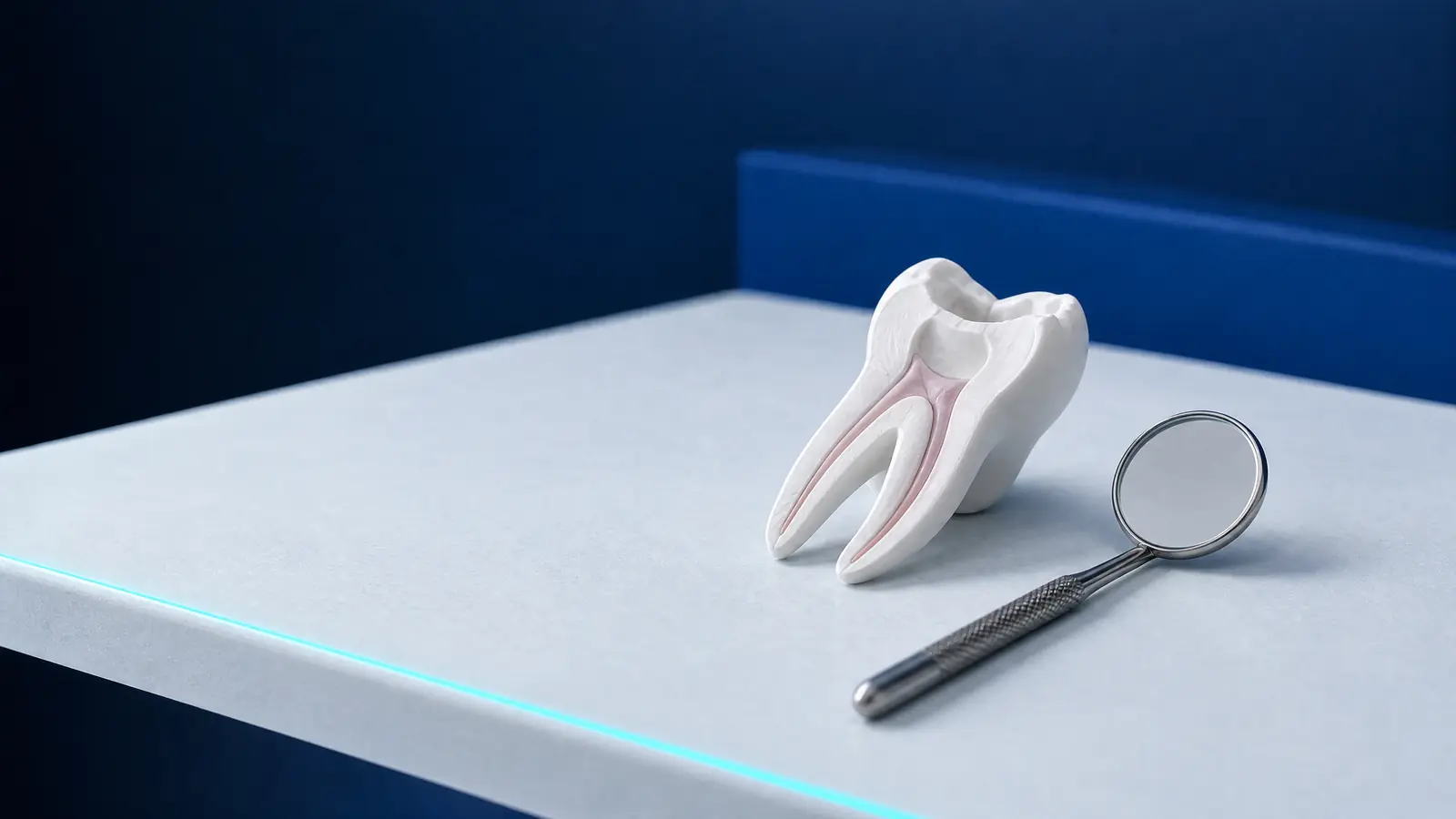
Root canal treatment, also called endodontic treatment, is the removal of diseased or dead pulp from inside the tooth, followed by cleaning and disinfecting the root canals and sealing them tightly. The American Association of Endodontists (AAE) describes the pulp as soft tissue containing blood vessels, nerves and connective tissue, lying beneath the enamel and dentine.
When bacteria from deep decay, a crack or an injury reach the pulp, it becomes inflamed and, in time, dies. The infection can spread through the tip of the root into the bone, so the aim of treatment is to remove the bacteria from the canals and cut off their way back in.
A tooth after root canal treatment no longer has living pulp, but it goes on working in the arch. The AAE explains that a fully mature tooth can function without its pulp, because it is still nourished by the tissues that surround it.
When is root canal treatment needed?
Root canal treatment is one of the treatment options for irreversible pulpitis, and once the pulp has died it is usually needed. The 2022 Cochrane review lists the main causes of these changes as decay, a crack or fracture of the crown of the tooth, and injury. In selected teeth with a living pulp, the dentist may instead consider a full pulpotomy, which removes the pulp from the pulp chamber while keeping the pulp in the canals, in line with the 2023 ESE guideline.
The diagnosis is made by the dentist on the basis of the history, tests and an X-ray, because several different conditions produce similar symptoms. How to tell reversible from irreversible inflammation is explained in the article on pulpitis, and a tooth that has stopped responding to stimuli in the article on a dead tooth. The list brings together the signs worth having examined; the first four are given by the AAE.
- Severe pain when chewing or biting on one tooth.
- Sensitivity to heat or cold that lingers after the stimulus has gone.
- Swelling or tenderness of the gum next to the tooth.
- Deep decay or darkening of one tooth.
- A fistula, that is a small pimple on the gum, or a lesion at the root tip visible on an X-ray, even when the tooth does not hurt.
How does root canal treatment work, step by step?
Root canal treatment follows a set sequence: diagnosis, anaesthesia, isolation of the tooth, access to the canals, shaping and irrigating them, filling them and sealing the tooth tightly from above. This is how the AAE and the NHS, the UK’s public health service, describe it; the differences lie mainly in whether all the stages fit into a single visit.
The guidelines of the European Society of Endodontology (ESE) require an X-ray before treatment and recommend measuring the length of the canals electronically and on an X-ray. According to the AAE, the canals are filled with gutta-percha, a rubber-like material, together with a sealing cement, and the ESE requires the quality of the filling to be checked on an X-ray.
The table sets out the stages in the order in which they usually take place. The specific plan, including the number of visits, is set by the dentist after examining the tooth.
| Stage | What happens | When during treatment |
|---|---|---|
| Diagnosis | History, vitality tests, an intraoral X-ray, sometimes a CBCT scan | Before treatment or at the first visit |
| Anaesthesia | Local anaesthesia of the area around the tooth | At the start of the visit, when needed |
| Isolation with a rubber dam | A rubber sheet cuts the tooth off from saliva and protects the airway | At every visit when the tooth is open |
| Access to the pulp chamber | Opening the tooth and locating the entrances to all the canals | First visit |
| Shaping and irrigation | Removing the pulp, widening the canals and disinfecting them with a solution | First visit, sometimes the second as well |
| Dressing in the canals | Medication in the canals and a tight temporary filling | Between visits, if the dentist plans a medicated dressing |
| Filling the canals | Gutta-percha with sealer along the full length, check X-ray | Final visit of the root canal treatment |
| Restoring the tooth | A filling, onlay or crown that seals the tooth from above | As soon as possible after treatment |
| Assessing the outcome | Examination and X-ray to see whether the lesion at the root is healing | After at least a year, according to the ESE |
What are the rubber dam and canal irrigation for?
A rubber dam is a thin latex or latex-free sheet with a hole for the tooth, which cuts the treated tooth off from saliva. In a position statement updated in 2024, the AAE calls rubber dam isolation the standard of care for every non-surgical root canal treatment, because only a dam limits contamination of the canals by bacteria from the mouth.
The sheet also protects against swallowing or inhaling small instruments and irrigating solutions, as both the AAE and the ESE stress. According to the AAE, a patient’s verbal or written consent to treatment without a rubber dam does not release the dentist from this standard.
The importance of isolation shows up in large numbers. In a Taiwanese study of 517,234 teeth after initial root canal treatment, the proportion of teeth retained after an average of 3.43 years was 90.3% with a rubber dam and 88.8% without one (Lin et al., 2014).
Irrigating the canals with a disinfecting solution is a standard part of shaping them. The authors of the 2022 Cochrane review excluded from their analysis studies without a rubber dam and without sodium hypochlorite irrigation, judging that they did not reflect the current standard of treatment.
How long does root canal treatment take, and how many visits are needed?
Root canal treatment usually takes one or two visits, according to the AAE, and the NHS describes visits lasting 1 to 2 hours, sometimes longer. On top of that come a visit to restore the tooth and a later check-up with an X-ray.
The number of visits does not decide the outcome. The 2022 Cochrane review (47 studies, 5,805 participants) found no difference in failures visible on X-ray between treatment in one visit and in several (RR 0.93, moderate-certainty evidence), and the use of painkillers was similar.
Pain within a week was reported more often after single-visit treatment (RR 1.55). The dentist chooses the approach after assessing the tooth, and with two visits the canals are protected between them by a medicated dressing under a tight temporary filling.
Treatment under the magnification of a microscope is described in a separate article on root canal treatment under a microscope, and prices by number of canals are set out in the article on the cost of root canal treatment.
How often does root canal treatment succeed?
Root canal treatment ends in complete healing in 68 to 85% of cases when strict assessment criteria are used, according to a review of 63 studies with at least a year of follow-up (Ng et al., 2007). The authors noted that results had not improved markedly in several decades.
The tooth itself stays in the mouth even more often. In a meta-analysis of tooth survival after root canal treatment, the proportion of teeth retained was 86% after 2 to 3 years, 93% after 4 to 5 years and 87% after 8 to 10 years (Ng et al., 2010).
The outlook is better when there is no inflammatory lesion at the root tip before treatment, when the canal filling has no voids and reaches to within 2 mm of the tip, and when the tooth is tightly restored from above (Ng et al., 2008). When treatment fails, the first option is usually root canal retreatment, described in a separate article.
The ESE recommends assessing the outcome after at least a year: no pain, swelling or fistula, together with a normal space around the root on the X-ray, means a good outcome. When a lesion has only become smaller, check-ups continue until it heals or for 4 years.
What happens after root canal treatment, and why is a crown often needed?
After root canal treatment the tooth may be tender for a few days, and the jaw may ache from keeping the mouth open for a long time, as the AAE describes. According to the NHS, the area around the tooth may be swollen and painful, but should improve within about two weeks. The first few days and the warning signs are described in the article on whether root canal treatment hurts.
A tooth after root canal treatment needs a tight and durable restoration, because bacteria can get back into the canals through a leaking filling. The AAE writes that whether a crown is needed depends on the position of the tooth: molars and premolars, which carry the chewing forces, usually need one, while front teeth often do not.
In a study of 203 root-treated teeth, teeth without a crown were lost 6 times more often than teeth with a crown (Aquilino and Caplan, 2002). The choice between a filling, an onlay and a crown is described in the article on restoring a tooth after root canal treatment, and a temporary filling should not stay in the tooth longer than the dentist planned.
Root canal treatment on the NFZ in Białystok and Podlaskie: what are you entitled to?
On the NFZ, Poland’s National Health Fund, adults are entitled to root canal treatment only of incisors and canines, that is teeth 1 to 3, while children and young people up to the age of 18, and women who are pregnant or in the postnatal period, are entitled to it for all teeth. The list of services does not require work under a microscope, and prosthetic crowns are not funded (Ministry of Health regulation, t.j. Dz.U. 2025 poz. 615, legal status as of 24 October 2026).
The NFZ Podlaskie Regional Branch states that since 1 July 2025 general dentistry has been funded in the province at 206 locations, and the emergency dental service at one (as of 24 October 2026). No referral is needed to see an NFZ dentist, and a patient in pain receives treatment on the day they come in.
The address and opening hours of the emergency dental service, which is open at night and on non-working days, are given in a separate article on seeing a dentist at night and at the weekend.
How root canal treatment works at DentalBlue
At DentalBlue in Białystok, root canal treatment and root canal retreatment are also carried out under a microscope. Intraoral X-rays, panoramic X-rays and CBCT scans are taken in the clinic’s own radiology unit. A patient in pain can come for a “Wizytę z bólem” (visit in pain, 340 zł), which includes a panoramic X-ray, a consultation, an examination and pain relief, and in the clinic’s price list a “Konsultacja endodontyczna” (endodontic consultation) costs 300 zł. The dentist sets the final scope and cost after the examination, and prices may change. When inflammation is too acute for local anaesthesia to work, treatment under general anaesthesia is decided at a joint dental and anaesthesiology consultation. A consultation can be booked by phone.
Frequently asked questions
Can I eat after root canal treatment?
Yes, but carefully. The AAE advises not chewing, not drinking hot or cold drinks and not smoking for the first hour after the procedure, and not biting hard food with the treated tooth until the final restoration. Teeth are brushed and flossed as normal, more gently around the treated tooth.
Is a tooth dead after root canal treatment?
The tooth no longer has living pulp, so it does not react to cold and heat, but it is still held in the bone and is used for chewing. The AAE explains that a mature tooth can function without its pulp, because the surrounding tissues nourish it. That is why its durability depends mainly on a tight restoration.
Does a tooth that has stopped hurting still need root canal treatment?
Often, yes. The AAE describes a tooth that hurt with cold and sweet things for months, then stopped, and on examination turned out to have a dead pulp. Pain going away therefore does not mean the tooth has healed; the need for treatment is decided by tests and an X-ray.
What if root canal treatment fails?
Most often the first step is root canal retreatment, which according to a review of studies ends in healing in about 77% of cases (Ng et al., 2008). When access through the crown is impossible, an apicectomy (removal of the root tip) is considered, and with a cracked root, extraction of the tooth.
When is the check-up X-ray taken after root canal treatment?
ESE guidelines recommend checking the quality of the canal filling on an X-ray straight after treatment and assessing the outcome after at least a year. If the lesion at the root tip has only become smaller, check-ups continue until it heals or for 4 years.
Sources
- Cochrane: Mergoni G et al., root canal treatment in one or several visits, CD005296 (2022)
- AAE: Root Canal Explained, how root canal treatment works
- AAE: Position Statement, Dental Dams (2024)
- International Endodontic Journal: ESE, quality guidelines for endodontic treatment (2006)
- Journal of Endodontics: Lin PY et al., rubber dam use and tooth survival after root canal treatment (2014)
- International Endodontic Journal: Ng YL et al., outcome of primary root canal treatment (2007)
- International Endodontic Journal: Ng YL et al., tooth survival after root canal treatment (2010)
- NFZ Podlaskie Regional Branch: Leczenie stomatologiczne (dental treatment), service locations from 1 July 2025
An informational article. It does not replace a consultation, and treatment decisions are made during a visit.