What is the pulp, and what causes pulpitis?
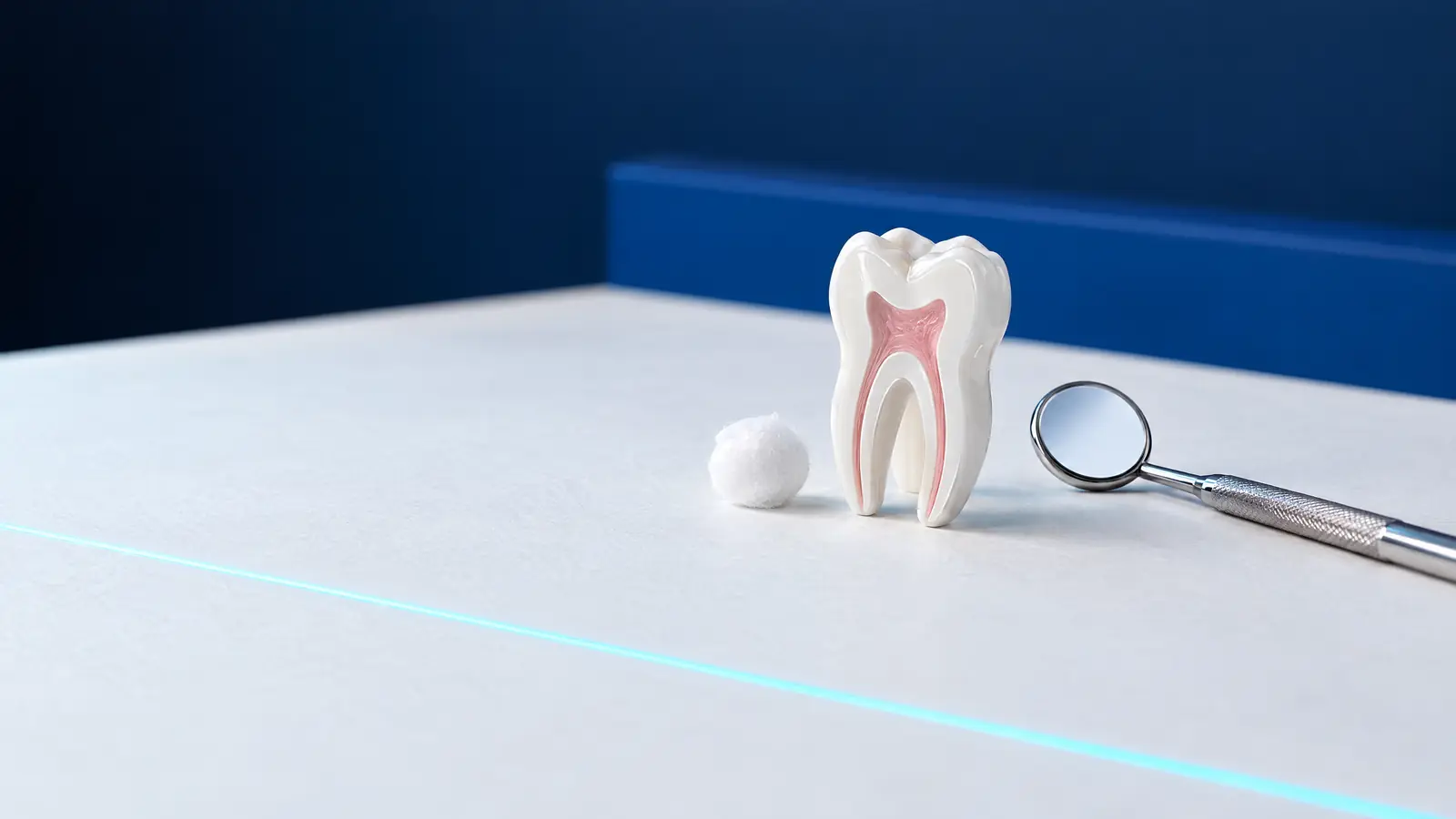
The pulp is the living tissue inside a tooth through which nerves and blood vessels run, and pulpitis is its reaction to irritation, most often by bacteria from deep decay. The American Association of Endodontists (AAE) also lists extensive fillings, and cracks and fractures that expose the pulp, among the typical causes.
The AAE stresses that pulp disease is dynamic and progressive, and that the symptoms change with the stage of the disease. It begins with inflammation that can still subside, then comes inflammation from which the pulp can no longer heal, and finally necrosis, that is, the death of the pulp.
This article covers the stage at which the pulp is still alive and responds to stimuli; a pulp that has died is described in the separate article on a dead tooth. It is at the early stage that the treatment decision matters most, because it determines whether the living pulp can be kept.
Reversible and irreversible pulpitis: what is the difference?
Reversible pulpitis is a condition in which the inflammation should resolve and the pulp return to normal once the cause is removed, while irreversible pulpitis is a condition in which the living, inflamed pulp is no longer capable of healing. These are the AAE definitions, agreed at an expert consensus conference in 2008 and still used in diagnosis.
The difference shows most clearly in how long the tooth hurts after a stimulus. According to the AAE, in reversible pulpitis pain from cold or sweet things passes within a few seconds and does not come on by itself, while in symptomatic irreversible pulpitis it often lasts 30 seconds or longer, can be spontaneous and may be felt somewhere other than the affected tooth.
There is also asymptomatic irreversible pulpitis: the tooth does not hurt and responds normally to cold, but deep decay or an injury will most probably expose the pulp. The table sets out typical pain patterns; it is a simplification, not a self-diagnosis tool, because the AAE points out that a diagnosis is not made on the basis of a single symptom.
| How the tooth hurts | Likely state of the pulp | What usually happens next |
|---|---|---|
| With cold or sweet things, passes in a few seconds, no pain on its own | Reversible pulpitis | Removing the decay, a filling and a check of the pulp |
| After cold, the pain lasts a long time, often 30 seconds or longer | Irreversible pulpitis | Pulpotomy or root canal treatment |
| On its own, throbbing, wakes you at night, worse when lying down | Symptomatic irreversible pulpitis | An urgent visit, removal of the inflamed pulp |
| No pain, but the cavity reaches close to the pulp | Possible asymptomatic irreversible pulpitis | Assessment on an X-ray and during treatment of the cavity |
| The pain has gone, the tooth does not respond to cold | Possible pulp necrosis | An examination, usually root canal treatment |
| On biting and when the tooth is tapped | The inflammation has reached the tissues around the root | Usually root canal treatment |
| Swelling makes breathing or swallowing difficult | Infection spreading beyond the tooth | Hospital emergency department (SOR) or 112 |
Throbbing toothache at night: is it pulpitis?
A throbbing toothache at night that wakes you from sleep is a typical symptom of symptomatic irreversible pulpitis. The AAE describes how the pain can get worse with a change of position, for example after lying down or bending over, and how over-the-counter painkillers often do little for it.
Such pain can be hard to pin to a particular tooth, because it radiates, and at this stage the tooth usually does not yet hurt when tapped. According to the AAE, the history and the cold test are what matter most at this point, because the inflammation has not yet reached the tissues around the root tip.
What to do straight away, before you get to the surgery, is described in a separate article on toothache and abscesses. Swelling of the face or neck that makes breathing or swallowing difficult is no longer a matter for a routine appointment: it calls for the hospital emergency department (SOR) or 112, the European emergency number.
How does a dentist assess the state of the pulp?
A dentist assesses the state of the pulp by combining the history of the pain with tests and an X-ray, because no single test is enough. The AAE likens endodontic diagnosis to a puzzle and recommends always comparing the affected tooth with the neighbouring teeth and with the tooth on the opposite side of the arch.
Cold and electric tests check the sensation of the pulp, not its blood supply, which is why the 2021 AAE position statement calls them sensibility tests. The AAE also acknowledges that clinical findings do not correspond exactly to the microscopic picture of the pulp, so when the situation is unclear the dentist may plan a reassessment rather than treatment just in case.
- History: since when it has hurt, what sets the pain off, how long it lasts, whether it comes on by itself and whether it wakes you at night.
- Cold test: a brief response that passes within 1 to 2 seconds is normal, while pain that lingers after the stimulus points to irreversible pulpitis.
- Tapping and pressure: pain on tapping means that the inflammation has reached the tissues around the root.
- A bite test and transillumination of the tooth with a strong light, which help to detect a crack.
- An intraoral X-ray (RVG) and, when the picture is unclear, cone beam computed tomography (CBCT).
Can pulpitis go away on its own?
Reversible pulpitis can subside, but usually only once the cause has been removed, for example after the decay has been treated and a well-sealed filling placed; the AAE recommends checking afterwards whether the pulp has returned to normal. Irreversible pulpitis does not go away on its own, because by definition the pulp is no longer capable of healing.
It does happen that severe pain eases or disappears after a few days or weeks. The AAE describes such a case: for months the tooth reacted with pain to cold and sweet things, then the symptoms subsided, and the examination showed pulp necrosis and an inflammatory lesion at the roots. Pain going away therefore does not mean healing, and it is still a reason for a visit.
Vital pulp therapy or root canal treatment?
Vital pulp therapy, which Polish dentists often call biological pulp treatment, covers, according to the European Society of Endodontology (ESE), all methods whose aim is to keep the pulp alive. Endodontic (root canal) treatment removes the pulp completely, and the canals are then tightly filled in its place.
The 2019 ESE position statement recommends selective removal of decay, which does not expose the pulp, in reversible pulpitis with deep decay. Where the pulp is exposed and there are signs of irreversible pulpitis, the ESE recommends removing the pulp from the canals, and as an alternative accepts full pulpotomy when the inflammation affects only the pulp in the chamber of the tooth, while noting the need for better studies. The 2021 AAE position statement states that a diagnosis of irreversible pulpitis is not automatically an indication for removing the whole pulp.
Studies report promising but uncertain results. In a meta-analysis of direct capping of pulp exposed by decay, the success rate after 2 to 3 years was 84% for MTA and 59% for calcium hydroxide, with low-quality evidence (Cushley et al., 2021). A review of studies on pulpotomy in teeth with symptoms of irreversible pulpitis reported clinical success of 97.4% after one year and 93.97% after 3 years, in studies at high risk of bias (Cushley et al., 2019).
The choice of method depends on what the dentist sees once the decay has been removed. The AAE recommends assessing the exposed pulp under the magnification of a microscope and sealing the tooth tightly straight after the procedure, and root canal treatment step by step is described in a separate article on root canal treatment under a microscope.
- Selective removal of decay: the dentist removes the decay so as not to expose the pulp and places a filling (indirect pulp capping).
- Direct pulp capping: a biological material, most often a calcium silicate cement such as MTA, is placed on the exposed pulp.
- Partial pulpotomy: only the inflamed part of the pulp in the chamber is removed, step by step, until the bleeding stops.
- Full pulpotomy: all the pulp is removed from the chamber of the tooth, down to the canal openings, while the pulp in the roots stays alive.
- Root canal treatment: the pulp is removed from the chamber and the canals, and the canals are cleaned and tightly filled.
Why does an antibiotic not treat pulpitis?
An antibiotic does not treat pulpitis, because it does not remove its source in the tooth. The 2017 AAE guidance states that studies have not shown antibiotics added to treatment to prevent or relieve the symptoms of irreversible pulpitis, and it points to cleaning the tooth as the basis of management.
Relief comes from a procedure: opening the tooth and removing the inflamed pulp or, when the tooth has a poor outlook, extracting it. The same guidance describes separately the situation in which infection spreads beyond the tooth, for example with a high temperature, feeling unwell or difficulty opening the mouth; whether a medicine is needed then is decided by the dentist after an examination.
How much does treating pulpitis cost, and what does the NFZ cover?
The cost of treating pulpitis depends on whether vital pulp therapy is enough or root canal treatment is needed, and in the second case on the number of canals in the tooth. In the clinic’s price list, the item “PACJENT Z BÓLEM (RVG, znieczulenie, opracowanie komory/kanałów, opatrunek)” (patient in pain: RVG, anaesthetic, chamber or canal preparation, dressing) costs 340 zł, “Przykrycie bezpośrednie z użyciem MTA” (direct pulp capping with MTA) 200 zł, “Leczenie obnażenia miazgi MTA/Biopulp” (treatment of an exposed pulp, MTA/Biopulp) 100 zł, “Biodentyna” (Biodentine) 240 zł and “Konsultacja endodontyczna” (endodontic consultation) 300 zł.
Root canal treatment prices by number of canals are set out in a separate article on the cost of root canal treatment. The final scope and cost are set by the dentist after the examination, and prices may change.
On the NFZ (Poland’s National Health Fund), adults have root canal treatment only of incisors and canines, that is teeth 1 to 3, while children and young people up to 18 and women who are pregnant or in the postnatal period have it for all teeth. A patient in pain receives treatment on the day they report, and no referral to a dentist is needed (legal position as of 18 October 2026).
How it works at DentalBlue
At DentalBlue in Białystok, root canal treatment, including retreatment, is carried out under a microscope, and intraoral X-rays and CBCT scans are taken in the clinic’s own radiology unit. A patient in pain can come for a “Wizyta z bólem” (visit in pain, 340 zł), which includes a panoramic X-ray, a consultation, an examination and pain relief. When the inflammation is too acute for local anaesthesia to work, treatment under general anaesthesia is decided at a joint dental and anaesthesiology consultation. The clinic is open Monday to Friday from 8:00 to 20:00 and on Saturdays from 8:00 to 16:00.
Frequently asked questions
How is pulpitis different from sensitive teeth?
Dentine hypersensitivity causes a brief pain that passes together with the stimulus, as in reversible pulpitis; the AAE notes that the symptoms of the two conditions are almost identical, although hypersensitivity is not an inflammation. Pain that lingers after the stimulus, comes on by itself or at night points to pulpitis and needs an examination.
Can pulpitis pain spread to the ear or the head?
The pain can radiate. The AAE lists referred pain, that is pain felt somewhere other than the affected tooth, among the features of symptomatic irreversible pulpitis. That is why the dentist compares how several teeth respond to cold and tapping before identifying the one that needs treatment.
How long can treatment of irreversible pulpitis wait?
There is no safe period. Irreversible pulpitis does not go away on its own, and when the pulp dies the pain may ease, although an infected canal can lead to inflammation of the tissues around the root. On the NFZ, a patient in pain receives help on the day they report, and at night and at weekends there is an emergency dental service.
Does pulpitis show on an X-ray?
The inflammation itself usually does not. According to the AAE, in reversible pulpitis an X-ray shows no significant changes around the root, and in early irreversible pulpitis changes have not yet developed. An X-ray does show the depth of decay and fillings, as well as later changes at the root tip, which is why it is combined with tests.
Does a tooth with pulpitis have to be extracted?
Usually not. The first choice is vital pulp therapy or root canal treatment, which make it possible to keep your own tooth. Extraction is considered when the tooth is too damaged, cracked in a way that cannot be restored, or treatment has a poor outlook, and the decision is made after an examination and an X-ray.
Sources
- AAE: Endodontic Diagnosis, ENDODONTICS Colleagues for Excellence (2013)
- AAE: Position Statement, Vital Pulp Therapy (2021)
- International Endodontic Journal: ESE position statement on deep caries and the exposed pulp (2019)
- International Endodontic Journal: Duncan HF, vital pulp treatment, the current state of knowledge (2022)
- International Endodontic Journal: Cushley S et al., direct pulp capping, a meta-analysis (2021)
- Journal of Dentistry: Cushley S et al., pulpotomy for symptoms of irreversible pulpitis (2019)
- AAE: Guidance on the Use of Systemic Antibiotics in Endodontics (2017)
- ELI: Rozporządzenie MZ w sprawie świadczeń gwarantowanych z zakresu leczenia stomatologicznego, t.j. Dz.U. 2025 poz. 615
An informational article. It does not replace a consultation, and treatment decisions are made during a visit.