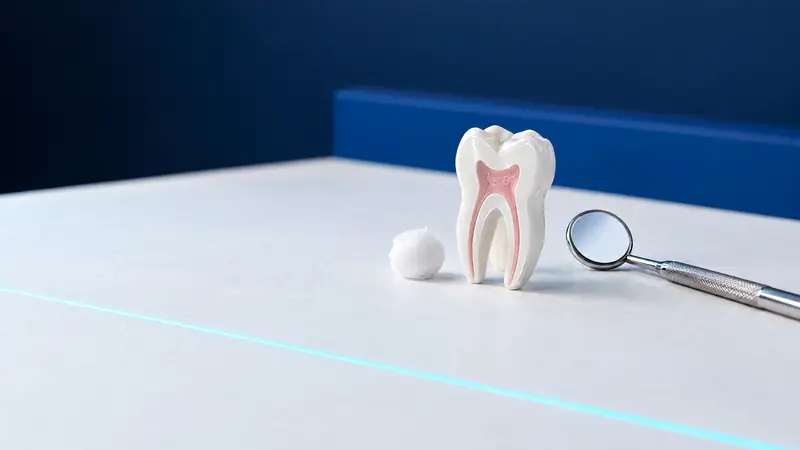
Do antibiotics treat toothache?
Antibiotics do not treat toothache: typical severe pain comes from pulp inflammation, and medicine does not remove the inflamed tissue inside the tooth. The American Dental Association (ADA) 2019 guideline strongly advises against antibiotics for adults with symptomatic irreversible pulpitis. The 2026 Scottish SDCEP guidance explicitly states not to prescribe antibiotics for pulpitis.
A 2019 Cochrane review found only one small trial: 40 people with pulpitis received an antibiotic or placebo alongside painkillers. Pain was very similar in both groups. The European Centre for Disease Prevention and Control (ECDC) also reminds readers that antibiotics are not painkillers.
Toothache is treated by removing its cause: pulp treatment or root canal treatment, or extraction if the tooth cannot be saved. Until the appointment, painkillers taken as directed in the leaflet help ease pain, as explained in the article on pulpitis.
When does a dentist prescribe antibiotics?
Dentists prescribe antibiotics mainly when infection spreads beyond the tooth or gum or causes systemic symptoms. The ADA 2019 guideline, written for adults with normal immunity, gives fever and feeling unwell as examples and stresses that dental treatment takes priority in every case.
SDCEP allows antibiotics for spreading infection, such as facial or neck swelling or limited mouth opening, systemic infection and reduced immunity. Preventive antibiotics before a procedure are a separate category, discussed later.
- An abscess with increasing facial or neck swelling.
- Fever, feeling unwell or other signs of systemic infection.
- Limited mouth opening with inflammation around an erupting wisdom tooth.
- Reduced immunity where a clinician considers antibiotics justified after risk assessment.
- Prevention before a procedure for those at highest risk, for example with an artificial heart valve.
Antibiotics for a dental abscess: when do they help?
An abscess confined to the tooth area usually needs no antibiotics if a dentist drains the pus and cleans the canals. The ADA 2019 guideline advises against additional antibiotics in adults with a localised apical abscess without systemic symptoms when immediate dental treatment is available. The American Association of Endodontists (AAE) 2017 position statement says additional antibiotics do not ease symptoms after appropriate cleaning and drainage.
Antibiotics may be indicated if infection spreads to the face or neck or causes systemic symptoms such as fever. In a person with reduced immunity, the clinician assesses the need for antibiotics individually. In each case they supplement drainage and dental treatment; infection threatening the airway is treated in hospital, as the dental abscess article explains.
Reduced swelling after antibiotics does not mean a cure: dead pulp or a deep gum pocket remains as the infection source. Without root canal treatment, periodontal treatment or extraction, the abscess may return.
When are antibiotics needed? An overview
The table covers common dental situations and the guidance of ADA, SDCEP and the European Society of Cardiology (ESC), alongside Cochrane reviews. A clinician always makes the final decision after examination, taking medical conditions, allergies and medicines into account.
| Situation | Are antibiotics usually needed? | What treats the cause or provides protection |
|---|---|---|
| Toothache, pulpitis | No | Pulp treatment, root canal treatment or extraction |
| Local dental abscess without fever or spread | Usually not | Drainage, root canal treatment or extraction |
| Abscess with facial or neck swelling or fever | Yes, alongside treatment | Drainage and removal of the cause, sometimes in hospital |
| Local wisdom tooth inflammation without spreading infection or systemic symptoms | Usually not; individual assessment if immunity is reduced | Irrigation and cleaning, extraction for recurrences |
| Dry socket after extraction | No, unless infection spreads | Socket cleaning and dressing, painkillers |
| Impacted wisdom tooth removal in a healthy person | Individual decision | Surgery and wound care; antibiotics after risk assessment |
| High endocarditis risk, procedure involving the gum | Yes, under ESC 2023 guidance | Prevention planned before the procedure |
| Joint replacement | Usually not, under ADA 2015 guidance | Oral hygiene and dental treatment |
| Dental implant placement | Sometimes a single preoperative dose | Clinician’s decision after risk assessment |
Who needs antibiotics before dental treatment?
Antibiotics before dental procedures are needed mainly by those at highest risk of infective endocarditis, infection of the heart’s inner lining and valves. The ESC 2023 guideline recommends prevention before extraction, oral surgery including implant placement and biopsy, and procedures involving gums or root tips, such as scaling and root canal treatment.
For intermediate-risk patients, such as those with rheumatic heart disease, degenerative or congenital valve disease, implanted devices such as pacemakers or hypertrophic cardiomyopathy, ESC does not recommend routine prevention but allows individual assessment. The UK NICE guideline CG64, updated in 2016, does not recommend routine prevention before dental procedures. Recommendations therefore differ between countries; agree the decision with a cardiologist.
For joint replacements, the ADA 2015 guideline generally advises against preventive antibiotics before dental procedures: studies found no link with prosthetic joint infection. A 2026 update of the Cochrane review, covering 15 trials and 2 874 participants, found that antibiotic prophylaxis at implant placement without simultaneous bone augmentation probably reduces early implant loss from 80 to 27 per 1 000 people. The review does not establish the optimal regimen, so the decision requires a clinician to weigh benefits and risks.
- People who have had infective endocarditis.
- People with an artificial valve implanted surgically or by catheter, or material used for valve repair.
- People with untreated cyanotic heart disease or congenital heart disease treated with prosthetic material; if no residual defect or valve prosthesis remains after repair, prophylaxis applies only for the first 6 months after the procedure.
- People with a ventricular assist device as destination therapy.
Are antibiotics needed after tooth extraction?
Not everyone needs antibiotics after extraction; the clinician decides individually. A 2021 Cochrane review of 23 studies and around 3 200 participants reports that antibiotics may reduce infection after impacted wisdom tooth removal by about 66%, but 19 people had to take them to prevent one infection.
The same review reports prevention of one dry socket per 46 treated people, with low-certainty evidence. In 21 of 23 studies, participants were healthy people having impacted wisdom teeth removed, so results cannot be applied to all extractions. For immunocompromised patients, the authors recommend a decision with the treating doctor.
The authors also note increasing bacterial resistance and recommend basing the decision on the patient’s health and complication risk. The article on care after tooth extraction explains wound care.
Why not take antibiotics just in case or use leftovers?
Do not take antibiotics on your own initiative: they do not treat the cause of toothache, and unnecessary use harms you and others. ECDC advises never saving them for later, using leftovers from a previous course or sharing them. Ask a pharmacist how to dispose of remaining doses.
Antibiotics have side effects, including diarrhoea, nausea and rash, according to ECDC. Every unnecessary use also promotes resistance: ECDC estimates that resistant bacterial infections kill over 35 000 people annually in the European Union, Iceland and Norway.
A clinician selects an antibiotic for the infection, your conditions, allergies and other medicines. ECDC therefore states that only a doctor who has examined you can prescribe one. Take it exactly as directed; do not stop or extend the course without consultation.
What should you tell your dentist before receiving antibiotics?
Before deciding on antibiotics, a dentist needs a full account of your health to establish whether they are needed and which medicine is safe. The list covers information to share at the start of your visit, even if it seems unrelated to teeth.
- Previous antibiotic allergies and what happened.
- Heart conditions, especially an artificial valve, previous endocarditis or congenital heart disease.
- Joint replacements and other implanted devices, such as a pacemaker.
- Conditions and medicines that reduce immunity.
- All medicines, including over-the-counter products, and pregnancy or breastfeeding.
- Antibiotics taken recently for another reason.
How it works at DentalBlue
At DentalBlue in Białystok, patients with pain or swelling can attend a “Wizytę z bólem” (visit in pain), including a panoramic X-ray, consultation, examination and pain relief, priced at 340 zł. “Nacięcie i drenaż ropnia” (abscess incision and drainage) costs 200 zł. The clinician determines the final scope and cost after examination; prices may change. The clinic’s own radiology unit takes intraoral X-rays and CBCT scans. If inflammation is too acute for local anaesthesia to work, a joint dental and anaesthesiology consultation decides on treatment under general anaesthesia.
Frequently asked questions
Can you buy dental antibiotics without a prescription?
No. ECDC advises never trying to buy antibiotics without a prescription: only a doctor who has examined the patient can prescribe them. Over-the-counter painkillers taken as directed in the leaflet help with toothache until the appointment.
Does the tooth still need treatment after antibiotics?
Yes. Antibiotics may reduce swelling and fever but do not remove dead pulp or pus, the infection source. The ADA 2019 guideline stresses treating the tooth as soon as possible in every case, through root canal treatment or extraction.
Can I stop antibiotics when my tooth stops hurting?
Do not change the course yourself. Take antibiotics exactly as prescribed; ask a doctor or pharmacist if you have side effects or doubts. Pain settling does not mean infection is cured: dental treatment removes the cause.
Are antibiotics needed before root canal treatment?
Usually not. The ESC 2023 guideline recommends preventive antibiotics before root canal treatment for people at high risk of infective endocarditis, such as those with an artificial heart valve or previous endocarditis. For other patients, root canal treatment itself removes infection.
Can a dentist prescribe antibiotics over the phone?
ECDC stresses that antibiotics should be prescribed by a doctor who has examined the patient: without examination, the spread cannot be assessed and the cause cannot be removed. Increasing swelling or fever needs a same-day appointment; breathing problems require a hospital emergency department (SOR) or 112, the emergency number.
Sources
- JADA: Lockhart PB et al., ADA guideline on antibiotics for dental pain and swelling (2019)
- SDCEP: Management of Acute Dental Problems, second edition (2026)
- Cochrane: Lodi G et al., antibiotics to prevent complications following tooth extractions, CD003811 (2021)
- Cochrane: Esposito MA et al., antibiotic prophylaxis for dental implant placement without bone augmentation, CD004152.pub5 (2026)
- European Heart Journal: ESC guidelines on infective endocarditis (2023)
- NICE: Prophylaxis against infective endocarditis, CG64 (2008, updated 2016)
- JADA: Sollecito TP et al., ADA guideline on antibiotics for joint replacements (2015)
- ECDC: Key messages, self-medication with antibiotics (2026)
An informational article. It does not replace a consultation, and treatment decisions are made during a visit.