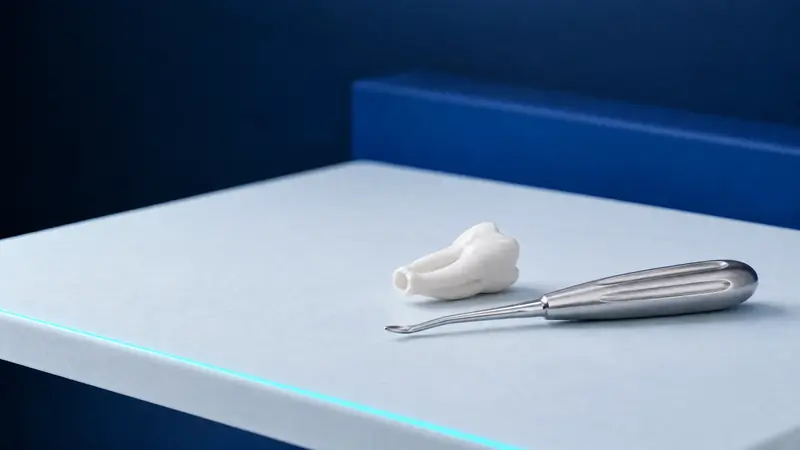
When is tooth extraction necessary?
Tooth extraction is necessary when the tooth cannot be saved by treatment or when leaving it in place harms health. A systematic review covering 4,396 extractions showed that the most common reason is tooth decay, and the second periodontal disease, that is periodontitis (gum disease) (Broers et al., 2022).
Wisdom teeth have separate indications under the British NICE guideline, and we describe them in the article on wisdom tooth removal. The share of each reason in the review by Broers et al. was as follows:
- Decay after which the tooth cannot be restored: 36.0 to 55.3% of extractions.
- Periodontitis (gum disease): 24.8 to 38.1%.
- Inflammatory changes at the root tip: 7.3 to 19.1%.
- Orthodontic indications, for example lack of space in the arch: 2.5 to 7.2%.
- The patient’s request: 3.6 to 5.9%.
- Dental trauma: 0.8 to 4.4%.
Can the tooth be saved instead of extracted?
Often, yes: before deciding on an extraction it is worth checking whether the tooth can be treated with root canal treatment, retreated or restored. A tooth with an inflamed or dead pulp can usually be kept thanks to endodontic (root canal) treatment, whose success rate under strict study criteria is given as 68 to 85% (Ng et al., 2007).
When the first root canal treatment has failed, root canal retreatment or apicoectomy (removal of the root tip) is possible. In multi-rooted teeth, removing a single root (hemisection) is sometimes enough. A tooth whose crown can no longer be rebuilt, however, usually qualifies for extraction.
Which route makes sense is decided by an examination and an X-ray. We describe the details in the articles on root canal treatment under the microscope and on root canal retreatment.
Simple or surgical extraction: how do they differ?
A simple extraction is the removal, using instruments, of a tooth that is visible in the mouth, without cutting the gum. A surgical extraction requires lifting a flap of gum, removing part of the bone or dividing the tooth into sections; it usually concerns teeth that are impacted, broken off at the gum line or have difficult roots.
The NFZ basket lists extraction of a single-rooted tooth, extraction of a multi-rooted tooth and surgical extraction as separate services. The dentist determines the type of procedure after an examination and an X-ray, and sometimes the plan changes during the procedure, for example when a weakened tooth breaks during removal.
| Feature | Simple extraction | Surgical extraction |
|---|---|---|
| Usually when | The tooth is visible, with a crown that can be gripped | The tooth is impacted, broken at the gum line or has difficult roots |
| Cutting the gum | No | Yes, a flap of gum is lifted |
| Bone removal or dividing the tooth | No | Often |
| Anaesthesia | Local | Local, general where indicated |
| Stitches | Not always needed | Usually yes, often dissolvable |
| Dry socket | 0.5 to 5% after routine extractions | About 10 times more often than after simple ones |
| NFZ | Yes, without a referral | Yes, without a referral |
What does tooth extraction involve, step by step?
Tooth extraction is preceded by an examination, an X-ray and a conversation about your health, including the medicines you take. Anticoagulant and antiplatelet drugs are not stopped on your own initiative: according to the Scottish SDCEP guidance, a simple extraction of 1 to 3 teeth is usually carried out without interrupting them, with warfarin after checking the INR, and the decision is made by the treating doctor or the dentist.
The procedure usually runs like this:
- Examination, X-ray and medical history: conditions, medicines, allergies.
- Local anaesthesia and a check that it has taken effect.
- Loosening the tooth in its socket and removing it; in a surgical extraction, first cutting the gum, removing part of the bone or dividing the tooth.
- Cleaning the socket and, if needed, placing stitches.
- Biting on a damp gauze pad for 15 to 20 minutes so that a blood clot forms in the socket.
- Going through the advice for the first few days and any follow-up appointment.
Does tooth extraction hurt?
The extraction itself should not hurt, because it is done under local anaesthesia: the patient feels pressure and movement, but not pain. Numbness of the lip or cheek usually lasts 3 to 4 hours, so until then you need to take care when eating and with hot drinks, so as not to bite or burn the numb tissues.
Pain appears once the anaesthetic wears off and, according to advice from British hospitals and dental schools, it eases, as does the swelling, within 7 to 10 days. Pain that increases instead of easing, usually 24 to 48 hours after the procedure, can be a sign of dry socket and needs a check-up at the dentist.
When local anaesthesia cannot work, for example with very acute inflammation, or when treatment in the chair is not possible because of a disability, the procedure can be done under general anaesthesia, after an anaesthesiology qualification. For anxiety, an intermediate option is inhalation sedation with nitrous oxide.
What happens after a tooth is extracted, and what can replace it?
After a tooth is extracted, the socket fills with a blood clot, then granulation tissue, and then bone gradually forms; the gum usually heals within a few weeks, while the bone remodels over months (Trombelli et al., 2008). The first 24 hours decide whether the clot stays in place: for 24 hours you do not rinse your mouth, smoke, or drink alcohol or very hot drinks, and we set out the day-by-day plan in the article on what to do after a tooth extraction.
The alveolar ridge shrinks after an extraction. A review of studies showed that within 6 months its width decreases by 29 to 63% and its height by 11 to 22%, fastest in the first 3 to 6 months (Tan et al., 2012). That is why it is worth discussing how to fill the gap before the procedure or soon after it.
A missing tooth can be replaced with an implant, a bridge or a denture, while after removal of a wisdom tooth or a tooth extracted for orthodontic reasons nothing is usually replaced. We compare implants and bridges in a separate article.
How much does tooth extraction cost?
The cost of tooth extraction depends on the type of procedure, the number of roots, the position of the tooth and the imaging needed. The table gives items from the price list of the DentalBlue clinic in Białystok; prices for removing wisdom teeth and impacted teeth are given in the article on wisdom tooth removal.
The final scope and cost are set by the dentist at the consultation, and the prices in the clinic’s price list may change.
| Item in the clinic’s price list | Price |
|---|---|
| Ekstrakcja prosta zęba stałego jednokorzeniowego (simple extraction, single-rooted permanent tooth) | 350 zł |
| Ekstrakcja prosta zęba stałego wielokorzeniowego (simple extraction, multi-rooted permanent tooth) | 500 zł |
| Ekstrakcja zęba z dłutowaniem (extraction with bone removal) | 550 zł |
| Operacyjne usunięcie korzenia (surgical removal of a root) | 500 zł |
| Hemisekcja (hemisection) | 400 zł |
| Usunięcie zęba z osoczem (extraction with plasma) | 1 000 zł |
| Usunięcie zęba mlecznego zresorbowanego (extraction of a resorbed milk tooth) | 250 zł |
| Usunięcie zęba mlecznego niezresorbowanego (extraction of an unresorbed milk tooth) | 300 zł |
| Pantomogram (panoramic X-ray) | 120 zł |
| Zdjęcie wewnątrzustne (intraoral X-ray) | 60 zł |
Is tooth extraction available on the NFZ?
Yes, tooth extraction is available on the NFZ: the basket of guaranteed services for adults includes extraction of single-rooted and multi-rooted teeth and surgical extraction, as well as incision of an abscess and suturing of a small wound (Ministry of Health regulation, consolidated text Dz.U. 2025 item 615). No referral is needed to see a dentist, and a patient who comes in with pain receives help on the same day from a dentist with an NFZ contract (§ 6).
Out of hours, a tooth can be extracted as part of NFZ emergency dental care, available on weekdays from 19:00 to 7:00 and around the clock at weekends and on public holidays. The NFZ does not fund implants or bridges; it does, however, fund acrylic dentures once every 5 years, partial ones when at least 5 teeth are missing in the arch, or complete ones. Legal position as of 12 October 2026.
How tooth extraction works at DentalBlue
DentalBlue in Białystok carries out extractions, from routine to complex procedures, under local or general anaesthesia. Panoramic X-rays, intraoral X-rays and CBCT scans are done by the clinic’s own radiology unit. General anaesthesia is available for children who cannot cooperate in the chair, patients with a disability, people allergic to local anaesthesia and for inflammation too acute for local anaesthesia to work; it starts with a combined dental and anaesthesiology consultation. The clinic also offers inhalation sedation with nitrous oxide. A visit in pain includes a panoramic X-ray, a consultation, an examination and pain relief.
Frequently asked questions
Is tooth extraction a surgical procedure?
Every extraction belongs to oral surgery, but in practice and in the NFZ basket a simple extraction is distinguished from a surgical one. A surgical extraction requires cutting the gum, removing part of the bone or dividing the tooth; a simple one does not.
How long does healing take after a tooth extraction?
Pain and swelling usually ease within 7 to 10 days, and dissolvable stitches disappear after 2 to 3 weeks. The gum heals within a few weeks, while the bone in the socket remodels over months, which matters when planning an implant.
Can a tooth be extracted when there is inflammation or an abscess?
The dentist decides after an examination, because it depends on the extent of the infection and the patient’s general condition. An abscess can be incised and drained, and acute inflammation can make local anaesthesia work less well. Swelling that makes breathing or swallowing difficult calls for the hospital emergency department (SOR) or 112, the emergency number.
Will I get a sick note after a tooth extraction?
A dentist can issue a sick note (e-ZLA, the Polish electronic sick leave certificate), because the Sickness Benefits Act lists dentists among those entitled to do so (Article 54). This is done after an examination, for a period justified by the patient’s health and type of work; the regulations do not set a number of days for any dental procedure.
Sources
- Broers DLM et al., Int Dent J: reasons for tooth extraction, a systematic review (2022)
- Tan WL et al., Clin Oral Implants Res: alveolar ridge changes after extraction, a review (2012)
- Trombelli L et al., J Clin Periodontol: extraction socket healing in humans (2008)
- Ng YL et al., Int Endod J: outcome of primary root canal treatment, a review (2007)
- Kolokythas A et al., Int J Dent: dry socket, a review (2010)
- Bristol Dental School: Advice after dental extractions and surgical procedures (undated)
- SDCEP: Management of Dental Patients Taking Anticoagulants or Antiplatelet Drugs, 2nd edition (2022)
- ELI: Rozporządzenie MZ w sprawie świadczeń gwarantowanych z zakresu leczenia stomatologicznego, t.j. Dz.U. 2025 poz. 615 (2025)
An informational article. It does not replace a consultation, and treatment decisions are made during a visit.