Why is a tooth root left in the gum?
A tooth root may remain in the gum, or more precisely in the upper or lower jawbone, in several typical situations. The 2015 British Dental Journal review opens by noting that a root tip can fracture during extraction, leaving the dentist to decide whether to leave the fragment or try to remove it.
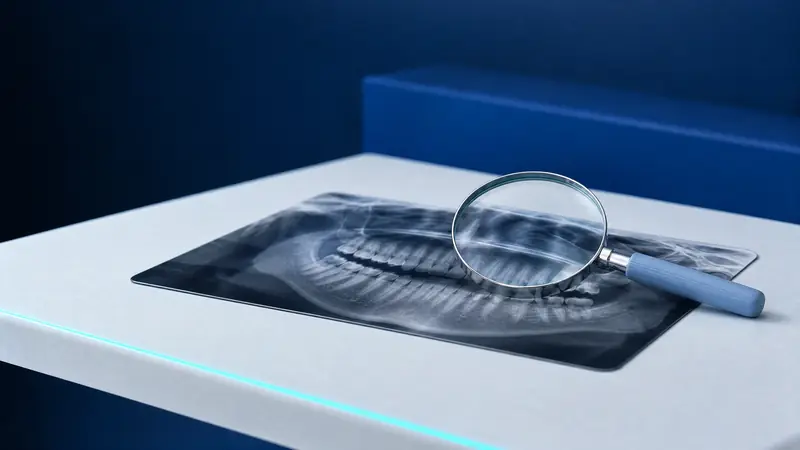
Each situation calls for a different decision, so assessment starts with an examination and imaging: usually an intraoral or panoramic X-ray, with a CBCT scan as well when the root is near a nerve or sinus.
- A fractured root tip after extraction, where a thin piece breaks off deep in the socket.
- A root without its crown, after decay or injury destroys the part of the tooth visible in the mouth.
- A root left deliberately, for example during coronectomy of a lower wisdom tooth close to a nerve.
- An old root fragment found incidentally on an X-ray taken for another reason.
Does a tooth root in the gum have to be removed?
A tooth root does not always need removing: the decision rests on balancing risks and benefits, as the British Dental Journal review explains. Infection, pain, a draining sinus or plans for an implant at that site favour removal or treatment. A small symptom-free fragment may be left if removing it risks nerve damage or opening the sinus.
If a root fragment remains in the bone after extraction, you have a right to know. The Polish Patient Rights Act provides for understandable information about your health and proposed management (art. 9 ust. 2) and access to records, including X-rays (art. 27). Leaving a fragment can be a deliberate clinical decision rather than an error.
According to the NHS, signs of infection require urgent dental care, while emergencies call for a hospital emergency department (SOR) or the emergency number 112:
- Pain and swelling of the gum or face, fever or an unpleasant taste: see a dentist urgently.
- Difficulty opening your mouth or substantial swelling inside it: SOR or 112.
- Difficulty breathing, speaking or swallowing: SOR or 112.
A root in the gum: what is usually done in each situation?
The table summarises usual management based on the reviews, guidelines and NFZ service basket cited here. The final plan depends on the image, the condition of the root and your general health.
| Situation | Usual management | Reason |
|---|---|---|
| Small symptom-free root tip after extraction | The dentist may leave it and monitor it on X-rays | Removal could damage a nerve or sinus |
| Root with an abscess, draining sinus or pain | Removal or root canal treatment | NHS: an abscess needs drainage and treatment of its cause |
| Root without a crown, with 1.5 to 2 mm of healthy tissue above the gum | Root canal treatment and restoration with a crown | A collar of tissue increases resistance to fracture |
| Root without a crown, damaged below the gum | Orthodontic extrusion, crown lengthening or removal | Without a ferrule, the restoration has a poor prognosis |
| Lower wisdom tooth root near a nerve, left deliberately | Coronectomy and X-ray monitoring | Less nerve injury in meta-analyses |
| Root-treated root beneath a denture | Retain as support for an overdenture | The NFZ funds this type of denture once every 5 years |
| Root at a planned implant site | Discuss removal before implant placement | The risk must be discussed before consent to the implant |
A root without a crown: restore or remove?
A tooth root without its crown can sometimes be restored if enough healthy tissue remains above the gum. The review by Juloski et al. (2012) states that a 1.5 to 2 mm collar of healthy tissue encircled by the crown, the ferrule effect, increases the restored tooth’s resistance to fracture; without it, the prognosis is poor.
When the root is damaged below the gum, the same review lists orthodontic extrusion, bringing the root upwards, as an option; the dentist may also consider surgical crown lengthening. A root with dead or inflamed pulp needs root canal treatment before restoration. A post and core retain the restoration rather than strengthen the root.
If the root is cracked, very short or affected by decay extending deep below the gum, removal and planning a replacement may be more appropriate. The article on restoring a root-treated tooth explains restoration in detail.
Coronectomy: when are wisdom tooth roots deliberately left?
Coronectomy removes the crown of a lower wisdom tooth while deliberately leaving roots close to the inferior alveolar nerve in the bone. Meta-analysis authors recommend it when imaging indicates a high risk of nerve injury from removing the whole tooth.
A meta-analysis of 4 comparative studies (Cervera-Espert et al., 2016) found a lower risk of sensory disturbance in the inferior alveolar nerve area (odds ratio 0.11) and dry socket after coronectomy, with no difference in pain or infection. A newer meta-analysis of 8 studies involving 1 488 teeth (Derbishi et al., 2026) also found less nerve injury (odds ratio 0.23); 1.2% of cases required another procedure to remove the roots.
Retained roots usually move slightly: according to Cervera-Espert et al., by an average of about 2 mm over 2 years. The 2020 Cochrane review found no randomised trial data allowing assessment of the main coronectomy outcomes, so the decision is individual.
A root supporting a denture: when is it worth keeping?
A root-treated root without a crown can support a complete overdenture, which fits over protected roots. The NFZ, Poland’s National Health Fund, basket includes upper and lower complete acrylic dentures of this kind, supported by roots “previously correctly treated endodontically” that “do not require removal”, once every 5 years (Ministry of Health regulation, consolidated text Dz.U. 2025 poz. 615; legal status as of 24 October 2026).
In private treatment, a root can also retain a denture through an attachment: the DentalBlue price list gives “Zatrzask dokorzeniowy” (root attachment) at 1 350 zł. The dentist sets the final scope and cost at consultation, and prices may change. The article on dentures describes the different types.
How is a tooth root removed, and what does it cost?
Tooth root removal follows the course of a surgical extraction: under local anaesthesia, often with a gum incision and removal of a small amount of bone using a drill, followed by stitches. We describe this procedure, known in Polish as dłutowanie, in a separate article.
Symptoms after root removal resemble those after other oral surgery. The University Hospitals Sussex leaflet states that pain and swelling are usually worst for the first 3 days, while soreness can take up to 2 weeks to settle fully. Advice for the following days is in the article on what to do after tooth extraction.
In upper back teeth, the root can lie right beside the floor of the maxillary sinus. The British Association of Oral Surgeons (BAOS) states that an opening between the mouth and sinus can arise when removing an upper molar or premolar, or retrieving a fractured root. It is closed with a gum flap, successfully in 95% of cases.
In the DentalBlue price list, “Operacyjne usunięcie korzenia” (surgical root removal) costs 500 zł, “Hemisekcja” (hemisection), removal of one root of a multi-rooted tooth together with the corresponding part of the crown, 400 zł, and “Badanie/konsultacja” (examination/consultation) in the surgery category 300 zł. The final scope and cost are set at consultation, and prices may change. Surgical tooth removal is in the NFZ basket, and no referral is needed to see a dentist.
How it works at DentalBlue
At DentalBlue in Białystok, the clinic’s own radiology unit images the root, from intraoral X-rays to CBCT scans. Extractions, from routine to complex, are performed under local or general anaesthesia; root canal treatment and retreatment are carried out under a microscope. General anaesthesia is available for children unable to cooperate in the chair, patients with disabilities, people allergic to local anaesthetics and inflammation too acute for local anaesthesia to work. “Wizyta bez bólu” (visit without pain) includes a panoramic X-ray, consultation, examination and a written treatment plan with prices for each stage.
Frequently asked questions
Can a tooth root work its way out of the gum?
There is no general answer; a root that becomes exposed in the mouth or irritates the gum needs a check. Studies after coronectomy of lower wisdom teeth describe root migration of about 2 mm on average over 2 years (Cervera-Espert et al., 2016). A meta-analysis by Derbishi et al. (2026) estimated the re-operation rate at 1.2%; these figures should not be applied to all retained roots.
Is a tooth root left in the gum dangerous?
An infected root can be dangerous because it can cause an abscess. The NHS advises urgent dental care for a suspected abscess, and SOR or 112 for difficulty breathing, speaking or swallowing, substantial swelling in the mouth or difficulty opening it. A dentist assesses a symptom-free root on an X-ray.
Can a crown be fitted to a root alone?
Sometimes, if the root has had root canal treatment, is not cracked and has 1.5 to 2 mm of healthy tissue above the gum. The review by Juloski et al. (2012) shows that this collar increases fracture resistance. Without it, the dentist considers orthodontic extrusion or root removal.
Does an old root need removing before an implant?
A root fragment at a planned implant site needs assessment on imaging, including CBCT, and discussion before consent to surgery. Dental Protection described a case in which the risk of a retained root was not discussed with a patient planning implants, identifying this as a weakness in consent.
Must a root be replaced after removal?
Not always, but it is worth deciding early. The review by Tan et al. (2012) reports that within 6 months of extraction the alveolar ridge loses 29 to 63% of its width and 11 to 22% of its height, fastest in the early months. An implant, bridge or denture is usually discussed before surgery.
Is tooth root removal funded by the NFZ?
Yes. The adult NFZ basket includes removal of single-rooted and multi-rooted teeth and surgical tooth removal, while the oral surgery list also includes bone removal with a flap. Local anaesthesia is a separate basket item, and no referral is required to see an NFZ-contracted dentist.
Sources
- Br Dent J: Nayyar J et al., fractured root tips and retained root fragments (2015)
- Med Oral Patol Oral Cir Bucal: Cervera-Espert J et al., lower wisdom tooth coronectomy, meta-analysis (2016)
- Cureus: Derbishi AA et al., coronectomy versus complete wisdom tooth removal, meta-analysis (2026)
- Cochrane: Bailey E et al., surgical techniques for lower wisdom tooth removal (2020)
- J Endod: Juloski J et al., ferrule effect in root-treated teeth, review (2012)
- NHS: Dental abscess (2026)
- BAOS: Oro-antral Communication, patient leaflet (2019)
- ELI: Rozporządzenie MZ w sprawie świadczeń gwarantowanych z zakresu leczenia stomatologicznego, t.j. Dz.U. 2025 poz. 615 (2025)
An informational article. It does not replace a consultation, and treatment decisions are made during a visit.