Do wisdom teeth have to be removed?
A wisdom tooth does not have to be removed just because it is impacted or might cause trouble one day. In its guidance TA1, the UK's NICE concluded that the preventive removal of impacted wisdom teeth free from disease should stop, and that the procedure should be kept for teeth that are diseased or harm their neighbours.
The wisdom tooth, or third molar, is the last to erupt and there is often not enough room for it. A meta-analysis of 49 studies covering more than 83,000 people found impacted wisdom teeth in 24.4% of those examined, more often in the lower jaw than in the upper.
NICE is preparing a new version of this guidance, with no set publication date. Until then, the 2000 version, reviewed in 2015, applies, and it lists the indications for removing a wisdom tooth:
- Decay that cannot be treated.
- Disease of the pulp or of the tissues around the root tip that cannot be treated.
- An abscess, cellulitis (diffuse inflammation of the soft tissues) or osteomyelitis.
- Resorption, meaning loss of tissue of the wisdom tooth or of the neighbouring tooth.
- A fractured tooth.
- Disease of the dental follicle, including a cyst or a tumour.
- A tooth that gets in the way of planned surgery or lies in the field of a tumour resection.
- A second or further episode of gum inflammation around a partly erupted wisdom tooth; the first episode is not an indication unless it is particularly severe.
What does an impacted wisdom tooth mean?
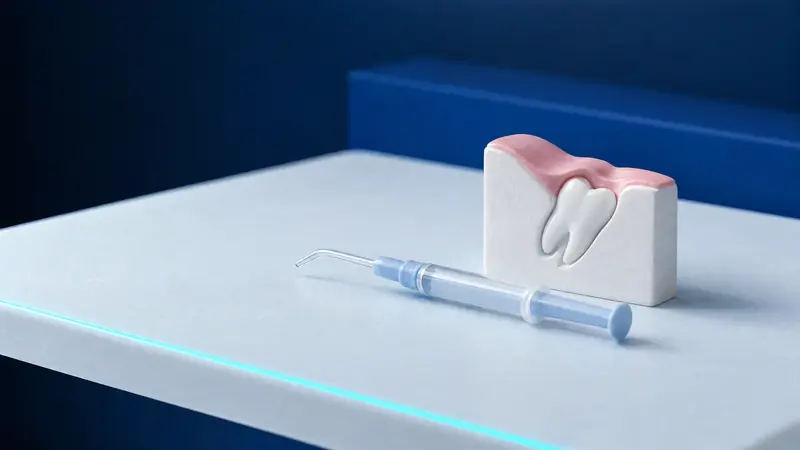
An impacted wisdom tooth is a tooth that has not fully erupted because a neighbouring tooth, bone or gum has blocked it. A partially impacted tooth has part of its crown showing through the gum, while a fully impacted one lies under the gum, in the bone.
The most common position of an impacted wisdom tooth is tilted forward, towards the second molar (mesioangular position): in the meta-analysis by Carter and Worthington it accounted for 41.2% of cases. Such a tooth can go without symptoms for years, which is why it is often only seen on a panoramic X-ray taken for another reason.
A partly erupted wisdom tooth encourages inflammation of the gum around the crown, because food debris and bacteria collect under the flap of gum. It causes pain and swelling of the gum behind the last tooth, and according to NICE a single mild episode does not yet decide that the tooth should come out.
When is a CBCT scan needed before wisdom tooth removal?
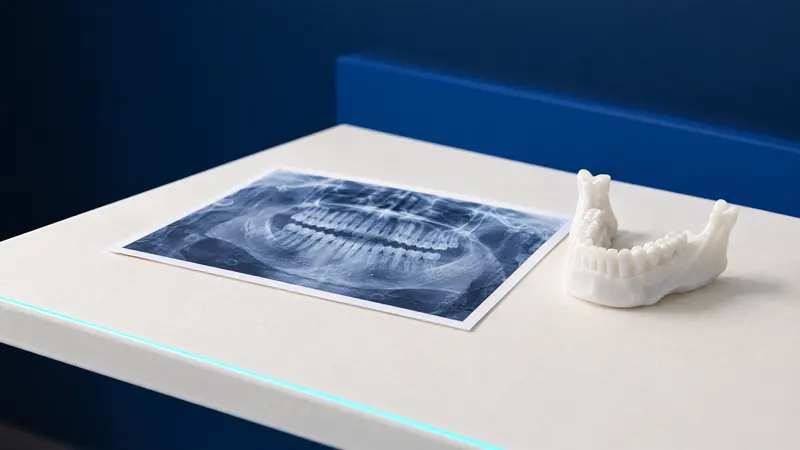
Before a wisdom tooth is removed, the basic examination is a panoramic X-ray, and cone beam computed tomography (CBCT) is needed when the two-dimensional image suggests the roots are in close contact with the mandibular canal. European recommendations (SEDENTEXCT and the 2019 EADMFR position statement) provide for CBCT only when its result may change the surgical plan, not routinely.
The mandibular canal carries the inferior alveolar nerve, which provides sensation to the lower lip and chin. Damage to this nerve after removal of a lower wisdom tooth occurs in about 0.35 to 8.4% of cases. It is usually temporary: in 96% of cases sensation returns within 4 to 8 weeks, and permanent damage affects 0 to 2% of patients.
The scan shows the course of the canal in three dimensions and allows access to the tooth to be planned. It does not, however, reduce the risk to zero, and studies indicate that the extra information from CBCT sometimes leads to more frequent decisions to remove the tooth, so whether the scan is needed is decided by the dentist.
How is a wisdom tooth removed, and does it hurt?
Wisdom tooth removal is usually done under local anaesthesia, so during the procedure you feel pressure and movement but not pain. According to the NHS, the removal itself often takes a few minutes and should not take longer than 40 minutes, and the patient usually goes home the same day.
The course depends on the position of the tooth. An erupted wisdom tooth is removed much like any other tooth, and an impacted one surgically, in several steps:
- Local anaesthesia of the area around the tooth and a check that it has worked.
- An incision in the gum to expose the crown of the impacted tooth.
- Removal of some of the bone around the tooth, if necessary.
- Taking the tooth out whole or after dividing it into 2 or 3 pieces.
- Cleaning the socket and placing stitches, usually dissolvable.
- Pressure with a gauze pad and a talk through the instructions for the first days.
Wisdom tooth removal under general anaesthesia: when does it come into question?
Wisdom tooth removal under general anaesthesia is possible, but the choice depends on the patient's health, not on fear of the procedure alone. General anaesthesia requires an anaesthesiology qualification and a break in eating and drinking, and the NHS advises not driving for 48 hours afterwards.
Indications include a disability that makes treatment in the chair impossible, an allergy to local anaesthetics, or inflammation so acute that local anaesthesia will not work. On the NFZ (Poland's National Health Fund), treatment under general anaesthesia is available only to the groups listed in § 4 of the regulation, among them people with a certificate of moderate or severe disability; an adult who is afraid of the procedure does not belong to these groups.
A middle way is inhalation sedation with nitrous oxide. The patient stays conscious and breathes unaided, and the procedure is still carried out under local anaesthesia.
How long does healing take after wisdom tooth removal?
Healing after wisdom tooth removal usually takes up to 2 weeks, and the first 2 to 3 days are the hardest. Most people return to their normal activities the next day, and after a difficult procedure or general anaesthesia they need 1 to 3 days off (NHS).
The most common complication is dry socket, the loss of the blood clot from the wound. After removal of a lower wisdom tooth it occurs in 1 to 37.5% of cases, about 10 times more often after surgical extractions than after simple ones, and in 12% of smokers compared with 2.6% of non-smokers. Detailed advice for the following days is in our article on what to do after a tooth extraction.
| Period | What to expect | What to watch out for |
|---|---|---|
| Day of the procedure | Oozing of blood, numb lip until the anaesthetic wears off | No rinsing for 24 hours, no smoking, no hot drinks |
| First 1 to 2 days | Pain once the anaesthetic wears off, swelling increasing | Soft food, warm salt water rinses from the second day |
| Days 2 to 3 | Swelling at its peak, then gradually going down | No exercise or heavy exertion for the first 48 hours |
| Day 3 onwards | Pain should ease from day to day | Pain that gets worse despite medicines needs a check-up at the dentist |
| First week | Swelling clearly goes down | Gentle brushing near the stitches from day 3 or 4 |
| Up to 2 weeks | Pain and swelling usually settle | A check-up if the symptoms do not go away |
| 4 to 8 weeks | Sensation returns after temporary nerve damage in 96% of cases | Numbness lasting longer than 6 months is regarded as permanent |
How much does wisdom tooth removal cost, and is it covered by the NFZ?
The cost of wisdom tooth removal depends above all on whether the tooth has erupted or is impacted, and whether bone has to be removed. On top of this comes imaging, and with general anaesthesia also the cost of the anaesthetic and the anaesthesiology consultations.
In the clinic's price list, the item “Ekstrakcja zęba mądrości” (wisdom tooth extraction) costs 600 zł, “Ekstrakcja zęba z dłutowaniem” (extraction with bone removal) 550 zł, “Operacyjne usunięcie zęba częściowo zatrzymanego” (surgical removal of a partially impacted tooth) 800 zł and “Operacyjne usunięcie zęba całkowicie zatrzymanego” (surgical removal of a fully impacted tooth) 1 000 zł. A panoramic X-ray costs 120 zł, and a CT scan of the upper or lower jaw 300 zł. The final scope and cost are set by the dentist at the consultation, prices may change, and the full list is in the clinic's price list.
On the NFZ, tooth extraction, including surgical extraction, is part of the package of guaranteed services (Ministry of Health regulation, consolidated text Dz.U. 2025 item 615), and no referral is needed to see a dentist. A patient who comes in with pain is entitled to help on the day they report to a dentist with an NFZ contract (§ 6). The law is stated as at 12 October 2026.
How wisdom tooth removal works at DentalBlue
DentalBlue in Białystok carries out extractions, including of impacted teeth, under local or general anaesthesia. Panoramic X-rays and CBCT scans are taken by the clinic's own radiology unit, in the same building as the procedure. General anaesthesia is available for children who are not able to cooperate, patients with disabilities, people allergic to local anaesthesia, and when inflammation is too acute for local anaesthesia to work. It starts with a joint dental and anaesthesiology consultation, and the date of the procedure is set only after it. The clinic also offers inhalation sedation with nitrous oxide.
Frequently asked questions
How many days off work after wisdom tooth removal?
According to the NHS, most people return to their normal activities the next day, and after a difficult procedure or general anaesthesia they need 1 to 3 days off. Sick leave is decided by the dentist after the procedure, taking into account how it went and the kind of work the patient does.
Do I need a referral for wisdom tooth removal?
No referral is required to see a dentist, including on the NFZ (Article 57(2)(2) of the Act on publicly funded healthcare services). With an impacted wisdom tooth, the dentist may recommend a surgical consultation or an additional X-ray before the procedure.
When can I drive after wisdom tooth removal?
The NHS advises not driving for 48 hours after general anaesthesia and for 24 hours after sedation given by injection. After a procedure under local anaesthesia alone, it is worth asking the dentist whether anything stands in the way.
Is the ‘eight’ the same as a wisdom tooth?
Yes. In Polish the wisdom tooth is commonly called the ‘eight’ (ósemka), because the third molar is the eighth tooth counting from the middle of the arch. In FDI numbering the wisdom teeth are 18, 28, 38 and 48, and they are the last permanent teeth to erupt.
Does smoking after wisdom tooth removal increase the risk of complications?
Yes. In the review by Kolokythas et al., dry socket occurred in 12% of smokers compared with 2.6% of non-smokers. NHS hospital advice calls for a complete break from smoking for at least the first 24 hours, and the NHS advises not smoking while the wound heals, because smoking increases the risk of infection.
Sources
- NICE: Guidance on the extraction of wisdom teeth, TA1 (2000, reviewed 2015)
- Carter K, Worthington S, J Dent Res: prevalence of third molar impaction, a meta-analysis (2016)
- Sarikov R, Juodzbalys G, J Oral Maxillofac Res: inferior alveolar nerve injury (2014)
- Kolokythas A et al., Int J Dent: dry socket, a review (2010)
- Matzen LH, Berkhout E, Dentomaxillofac Radiol: EADMFR position statement on CBCT before third molar removal (2019)
- NHS: Wisdom tooth removal (2024)
- Newcastle upon Tyne Hospitals NHS: Surgical removal of teeth, aftercare advice (2024)
- Dziennik Ustaw: Rozporządzenie MZ w sprawie świadczeń gwarantowanych z zakresu leczenia stomatologicznego, t.j. Dz.U. 2025 poz. 615 (2025)
An informational article. It does not replace a consultation, and treatment decisions are made during a visit.