Why does gum cover a wisdom tooth and become inflamed?
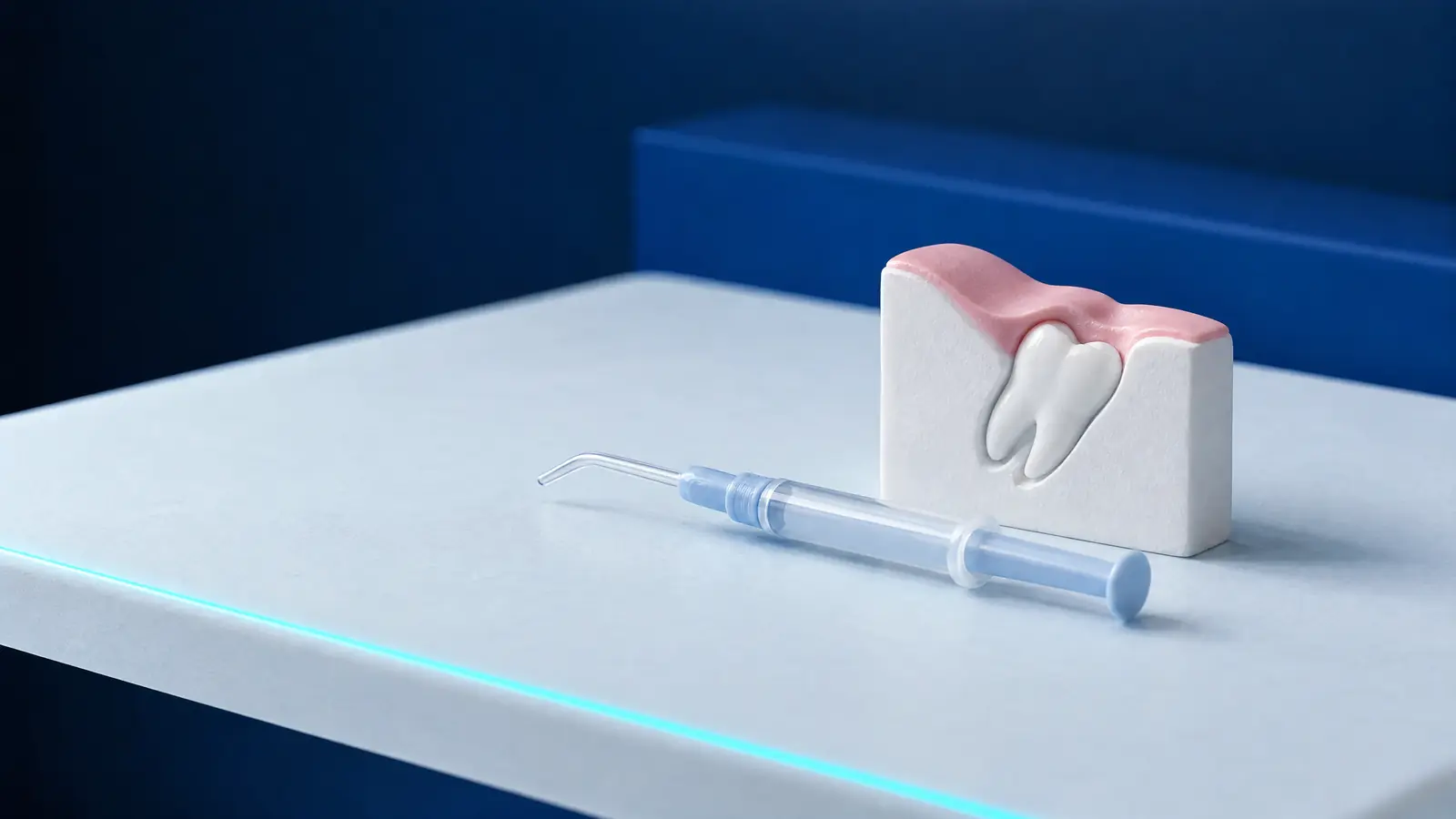
During eruption, a gum flap called an operculum remains over the tooth crown. It usually disappears once the tooth makes contact with the opposing tooth. If the wisdom tooth does not erupt properly, the flap persists, creating a narrow space that is difficult to clean and collects bacteria and food debris.
The review by Schmidt et al. (2021) describes pericoronitis as a plaque-dependent complication of eruption: the bacteria normally live in the mouth, but their accumulation under the flap causes the problem. Biting the flap with the opposing tooth, poor hygiene and trapped food aggravate inflammation.
Tooth position also affects risk. The meta-analysis by Galvão et al. (2019) found inflammation more often around vertically positioned lower wisdom teeth and less often around horizontally positioned ones.
Who is most likely to develop pericoronitis?
According to the 2021 review, pericoronitis affects around 4.92% of people, and 95% of cases involve a lower wisdom tooth. It is most common at ages 20 to 29, when wisdom teeth erupt, and rare in children and people over 40.
Inflammation is often preceded by a temporary dip in general health. In large studies cited in the review, 33% of 2311 patients and 37.9% of 2151 reported an upper respiratory infection before an episode; stress preceded inflammation in 17 to 66% of cases.
Pericoronitis symptoms: from mild to serious
A typical symptom is throbbing pain and swelling behind the last tooth, worsened by pressure and biting, which may radiate to the ear, throat or temporomandibular joint. Other common signs include a red gum flap, pus beneath it, bad breath or an unpleasant taste, and an enlarged lymph node under the jaw on the same side.
Inflammation can also be chronic, causing mild, prolonged symptoms or almost none, with occasional flare-ups. Schmidt et al. identify the chronic form as a factor predisposing to acute episodes.
The 2021 review lists warning signs of spreading infection: enlarged lymph nodes on both sides, fever, asymmetry of the face or palatal arch, feeling unwell, difficulty swallowing and painful, restricted mouth opening, called trismus. The table helps indicate how quickly to seek help.
| Symptoms | What they usually mean | What to do |
|---|---|---|
| Pain and swelling behind the last tooth, without fever | Inflammation confined to the gum flap area | See a dentist without delay |
| Pus under the flap, bad breath or unpleasant taste | Bacteria and pus collecting beneath the gum | Dental appointment for irrigation and cleaning |
| Pain when biting on the flap | The opposing tooth is biting the gum | The dentist assesses the bite and flap |
| Fever, feeling unwell, lymph nodes enlarged on both sides | Infection spreading beyond the tooth area | Urgent same-day appointment |
| Trismus, difficulty swallowing or breathing | Infection spreading into deep neck tissues | Hospital emergency department (SOR) or emergency number 112 |
When does wisdom tooth pain need an emergency department or a call to 112?
Infection beneath the flap can develop into an abscess and spread to spaces around the throat and floor of the mouth. The 2021 review describes peritonsillar abscess and Ludwig’s angina, a rapidly spreading infection of the mouth floor that can block the airway, as serious complications.
For these symptoms, the British NHS advises against driving yourself: ask someone to take you or call for help. Fever and feeling unwell without the listed symptoms require an urgent same-day dental appointment.
- Difficulty breathing, speaking or swallowing.
- Substantial swelling inside the mouth, a raised mouth floor or neck swelling below the jaw.
- Marked restriction in opening the mouth, called trismus.
- Eye swelling or pain, or sudden problems with vision.
How does a dentist treat pericoronitis?
Most cases can be managed with local treatment: the dentist irrigates beneath the flap with sterile solution or an antiseptic, gently removes plaque and debris and, if pus has collected, incises and drains the abscess. If the opposing tooth bites the flap, the bite can be adjusted, and sometimes removal of that tooth considered (Schmidt et al., 2021).
According to that review, antibiotics are needed only in severe cases with systemic symptoms or spreading infection. Nevertheless, nearly 75% of dentists in surveys reported prescribing them for pericoronitis, which the authors considered overuse. A review by Leroy et al. (2022) found not a single controlled trial assessing antibiotics for this condition.
An X-ray, usually a panoramic image, helps assess the wisdom tooth and its roots. The 2021 review recommends it particularly for severe, chronic and recurrent episodes, and when inflammation does not respond to treatment.
Does pericoronitis mean the wisdom tooth must be removed?
Not after a first mild episode. In guideline TA1, the British NICE states that a first episode of pericoronitis is not an indication for extraction unless particularly severe, while second and subsequent episodes are. NICE is preparing an updated version of the guideline.
The dentist considers whether the tooth can erupt into a proper position, how close the root lies to the nerve canal and the patient’s general health. If extraction is planned, the 2021 review authors advise against unnecessary delay, although removing a tooth during acute inflammation remains controversial.
An alternative can be removal of the flap (operculectomy) with a scalpel, laser or electrosurgery. According to the review, it causes less pain and fewer complications than extraction, but needs follow-up because excess tissue may remain. The article on wisdom tooth removal explains extraction, CBCT scans and healing.
What can you do at home for painful gums around a wisdom tooth?
Home measures ease symptoms but do not remove bacteria from beneath the flap, so they cannot replace a dental appointment. A few simple measures help while you wait.
Fever or feeling unwell without warning signs needs an urgent same-day dental appointment. Difficulty swallowing, speaking or breathing, marked trismus, substantial swelling inside the mouth or rapidly increasing neck swelling requires immediate help: go to a hospital emergency department (SOR) or call 112.
- Gently clean around the wisdom tooth with a soft toothbrush rather than avoiding it because of pain.
- Use a mouth rinse recommended by a dentist or pharmacist, following the leaflet.
- Eat soft foods and chew on the other side to avoid injuring the flap.
- Take over-the-counter pain relief according to the leaflet and do not exceed the dose.
- Do not cut into or puncture the swelling yourself.
Does the NFZ cover treatment for pericoronitis?
Yes. The basic procedures used are listed among services funded by the NFZ, Poland’s National Health Fund. Adults are entitled, among other things, to pocket irrigation with medication, abscess incision and drainage, and tooth extraction, including surgical extraction; oral surgery services also include surgical removal of an impacted tooth. The basis is the Ministry of Health regulation (consolidated text Dz.U. 2025 poz. 615), legal status as of 24 October 2026.
No referral is needed for a dentist with an NFZ contract, and people presenting with pain receive care on the day they present. Emergency dental care is available at night and weekends and includes abscess incision and tooth extraction. The article on wisdom tooth removal covers private procedure costs and healing.
How pericoronitis is treated at DentalBlue
At DentalBlue in Białystok, patients in pain can attend a “Wizytę z bólem” (visit in pain, 340 zł), including a panoramic X-ray, consultation, examination and pain relief. The clinic’s own radiology unit takes panoramic images and CBCT scans when indicated; extractions are carried out within oral surgery. The price list gives “Ekstrakcja zęba mądrości” (wisdom tooth extraction) at 600 zł, “Operacyjne usunięcie zęba częściowo zatrzymanego” (surgical removal of a partly impacted tooth) at 800 zł and “Nacięcie i drenaż ropnia” (abscess incision and drainage) at 200 zł. The final scope and cost are agreed at consultation, and prices may change. The clinic is open Monday to Friday from 8:00 to 20:00 and Saturdays from 8:00 to 16:00.
Frequently asked questions
Can pericoronitis go away on its own?
The flap over an erupting wisdom tooth often disappears once the tooth meets its opposing tooth, but acute inflammation underneath usually needs professional cleaning. According to the 2021 review, inflammation identified early and treated appropriately resolves quickly, usually without antibiotics.
Are antibiotics always needed for pericoronitis?
No. Most cases are treated locally by irrigating and cleaning beneath the flap and draining pus. The 2021 review reserves antibiotics for severe cases with fever, feeling unwell or spreading infection; the dentist decides after examining the patient.
Does pain during wisdom tooth eruption always mean pericoronitis?
Not always. The 2021 review lists many conditions with similar symptoms: decay and pulpitis, an abscess around the root, food trapped between teeth, a dry socket after extraction and temporomandibular joint disorders. The dentist therefore identifies the cause through examination, often with an X-ray.
Can an upper wisdom tooth also cause pericoronitis?
Yes, but rarely. The 2021 review reports that 95% of cases involve lower wisdom teeth, whose position makes incomplete eruption and a persistent gum flap most likely.
Why does pericoronitis keep coming back?
Because it is caused by the shape of the tissues: as long as a flap with a hard-to-clean space remains, bacteria accumulate again. NICE therefore considers second and subsequent episodes an indication for wisdom tooth removal; removing the flap is sometimes an alternative.
Sources
- International Journal of Environmental Research and Public Health: Schmidt J et al., recommendations for pericoronitis treatment and review of antibiotic use (2021)
- Archives of Oral Biology: Galvão EL et al., lower wisdom tooth position and pericoronitis, meta-analysis (2019)
- European Journal of Oral Sciences: Leroy R et al., antibiotics for periodontal abscesses and pericoronitis, systematic review (2022)
- NICE: Guidance on the extraction of wisdom teeth, TA1 (2000, reviewed 2015)
- NHS: Dental abscess, symptoms and when to call the emergency number (2026)
- NHS: Wisdom tooth removal, problems with wisdom teeth (2024)
- ELI: Rozporządzenie MZ w sprawie świadczeń gwarantowanych z zakresu leczenia stomatologicznego, t.j. Dz.U. 2025 poz. 615
An informational article. It does not replace a consultation, and treatment decisions are made during a visit.