What is gingivitis, and how does it differ from periodontitis?
Gingivitis is inflammation affecting only the gums, without destroying the bone or ligament supporting the tooth. The review by Murakami et al. (2018), prepared for the new classification of periodontal diseases, identifies its shared features as inflammation confined to the gums, substantial bacterial plaque and reversibility after biofilm removal or disruption.
In a person with an intact periodontium, the 2017 criteria base the diagnosis of gingivitis on bleeding on gentle probing at 10% of sites or more: 10 to 30% indicates localised disease, and above 30% generalised disease. Where some attachment and bone have already been lost (a reduced periodontium), additional criteria apply, so bleeding alone cannot distinguish gingivitis from periodontitis (Trombelli et al., 2018).
Periodontitis starts with gingivitis but destroys tissues around the root, and good brushing alone cannot rebuild lost bone. Murakami et al. call gingivitis a key risk factor for periodontitis, making its control fundamental to prevention. The article on periodontitis and bleeding gums explains this in detail.
What are the symptoms of gingivitis?
The most common symptom is bleeding during brushing or flossing, usually without pain, which leads many people to regard it as normal. The Cochrane review of 2017 describes gingivitis as red, swollen gums that bleed easily.
Bleeding gums are common even among young people in Poland: the national survey from 2016 to 2019 found them in 30.9% of 18-year-olds. The list brings together symptoms to mention to your dentist.
- Bleeding when brushing, flossing or biting hard food.
- Red, swollen gums, particularly at the gum line and in the triangular spaces between teeth.
- Sore gums when touched or brushed, although early inflammation often goes unnoticed.
- Bad breath that returns despite brushing.
- Enlarged gums extending over the teeth, sometimes associated with medicines or hormones.
What causes gingivitis?
The main cause is bacterial plaque accumulating at the gum line and between teeth. In studies where volunteers stopped cleaning their teeth for 9 to 28 days, the break in hygiene reliably caused gingivitis, which resolved when brushing resumed, as summarised in a 2025 systematic review.
Inflammation is aggravated by local factors that trap plaque, such as crowded teeth or poorly fitting fillings and crowns, and by systemic factors. The 2017 classification lists hormones, systemic disease and medicines among the latter. Smoking and diabetes also matter and are covered in separate articles.
What forms of gingivitis are there?
Gingivitis does not always look the same, although bacterial plaque aggravates most forms. The table pairs the common forms with their triggers or aggravating factors and usual management.
During pregnancy, hormonal changes do not cause inflammation on their own but intensify the gum response to plaque, making bleeding more likely (Murakami et al., 2018). Pregnant and postpartum women are entitled to calculus removal under the NFZ, Poland’s National Health Fund, no more often than every 6 months; the article on dental treatment in pregnancy explains more.
Drug-induced gingival enlargement is gum overgrowth as a side effect of certain medicines. The review by Trackman and Kantarci (2015) identifies the main causes as phenytoin (an antiepileptic), nifedipine (a calcium channel blocker used, among other things, for high blood pressure) and ciclosporin (an immunosuppressant), reporting changes in around half of people taking them. Do not stop such medication yourself: any change is for the prescribing doctor to decide.
Necrotising gingivitis has three typical features: pain, bleeding and ulceration of the gum papillae between teeth. According to Herrera et al. (2018), its course depends mainly on the body’s immune defences, and these changes require immediate treatment.
| Form | What triggers or aggravates it | Usual management |
|---|---|---|
| Plaque-induced gingivitis | Plaque at the gum line and between teeth | Plaque and calculus removal, better home hygiene |
| Pregnancy gingivitis | Hormones intensify the gum response to plaque | Hygiene and reviews; NFZ scaling as often as every 6 months |
| Drug-induced gingival enlargement | Certain antiepileptics, calcium channel blockers, immunosuppression | Hygiene, possible medication change by the doctor, sometimes surgery |
| Necrotising gingivitis | Bacteria when immune defences are reduced | Urgent dental appointment |
| Gingivitis with fixed braces | Brackets and wires encourage plaque accumulation | More thorough cleaning, orthodontic review |
| Inflammation around a wisdom tooth | Plaque under the flap over a partly erupted tooth | Cleaning by a dentist, sometimes tooth removal |
Gingivitis: home care that helps
The main home treatment is thorough mechanical plaque removal: plaque sustains the inflammation, and removing it allows the gums to recover. The list covers helpful habits; the article on brushing teeth properly explains technique and choosing cleaning aids.
Chlorhexidine mouthwash is for short-term use on a dentist’s advice, rather than a daily extra. The Cochrane review of 2017 (51 studies, 5345 people) found a marked plaque reduction after 4 to 6 weeks; in people with mild gingivitis, the gingival index fell by 0.21 points on a scale of 0 to 3, which the authors did not consider clinically important. There was not enough evidence to estimate the improvement in moderate or severe gingivitis. Tooth staining was common, and studies also reported taste changes and irritation of the oral lining.
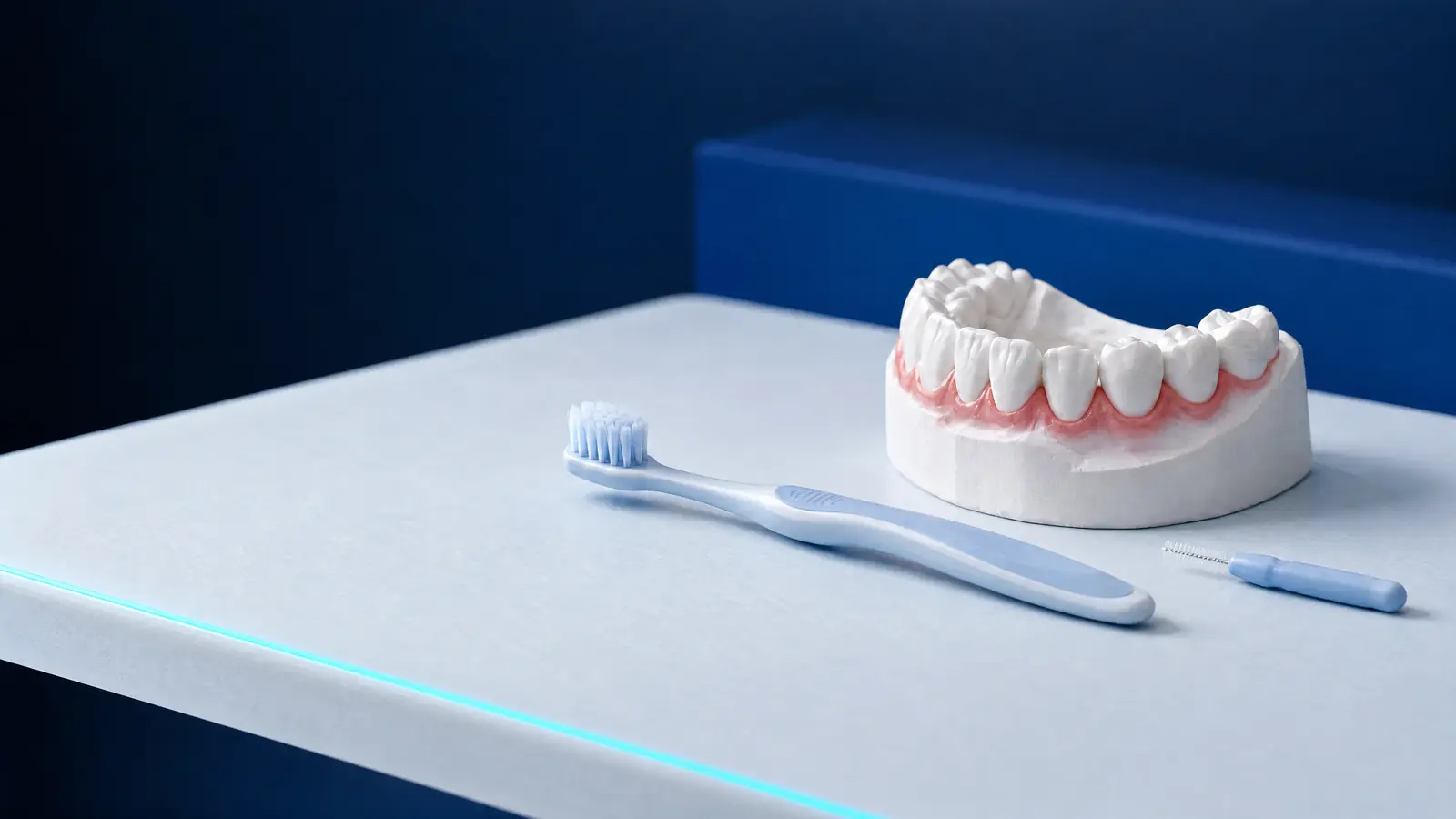
- Brush twice a day for around 2 minutes with fluoride toothpaste, including along the gum line.
- Clean between teeth daily with floss or an interdental brush sized to fit the space.
- Do not avoid bleeding areas: regular cleaning usually reduces bleeding caused by gingivitis.
- If you smoke, treat stopping as part of gum treatment.
- Mouthwash can only be an adjunct: the Cochrane review studied chlorhexidine solely as a supplement to brushing.
When should you see a dentist about gingivitis?
See a dentist if bleeding persists despite careful brushing, if gums remain swollen or painful, before a planned pregnancy and for regular check-ups. By measuring pockets around the teeth, the dentist checks whether the problem is gingivitis alone or has progressed to periodontitis.
Some symptoms need a faster response because they may indicate something other than ordinary gingivitis.
- Severe gum pain, ulcers between teeth and bad breath can indicate necrotising gingivitis: seek a same-day appointment.
- Swelling with pus or throbbing pain around one tooth, especially with fever or facial swelling, may be an abscess: seek an urgent same-day appointment.
- Difficulty breathing, speaking or swallowing, substantial swelling inside the mouth or difficulty opening it: go to a hospital emergency department (SOR) or call the emergency number 112.
How does a dentist treat gingivitis, and what does the NFZ cover?
Treatment starts with examination and oral hygiene instruction, followed by plaque and calculus removal, called scaling, often with air polishing. The dentist also corrects plaque traps, such as overhanging filling edges; a separate article describes professional cleaning step by step.
The systematic review by Farina et al. (2026) identified oral hygiene instruction as first-line treatment. Professional cleaning adds benefit alongside instruction, but does not treat gingivitis on its own in people whose home hygiene remains ineffective.
For adults, the NFZ funds an examination with hygiene instruction and calculus removal from the whole dentition once per calendar year, as well as treatment of oral mucosal lesions. Pregnant and postpartum women are entitled to calculus removal no more often than every 6 months. The basis is the Ministry of Health regulation (consolidated text Dz.U. 2025 poz. 615), legal status as of 24 October 2026.
How gingivitis is treated at DentalBlue
At DentalBlue in Białystok, gingivitis is treated within preventive care and professional cleaning. If examination indicates periodontitis, further care is provided within periodontology. The team includes dental hygienists. The clinic’s price list gives “Kompleksowa higienizacja (skaling, piaskowanie, fluoryzacja)” (comprehensive cleaning: scaling, air polishing and fluoride treatment) at 350 zł, and “Wizyta bez bólu” (visit without pain), including a panoramic X-ray, consultation, examination and written treatment plan, at 300 zł. The final scope and cost are agreed at consultation, and prices may change.
Frequently asked questions
Can gingivitis develop into periodontitis?
It can, but does not always do so. The Cochrane review of 2017 notes that, in susceptible people, gingivitis may lead to periodontitis and loss of the tissues supporting teeth. Controlling gingivitis is therefore considered fundamental to preventing periodontitis.
Why do gums bleed when flossing?
Plaque accumulates between teeth where a toothbrush cannot reach, and inflamed gums bleed when touched. Bleeding is not a reason to stop flossing: daily cleaning reverses the inflammation. If bleeding persists, a dental check-up is needed.
Can chlorhexidine be used long term?
It should not be used long term without advice. The Cochrane review of 2017 found that rinsing for 4 weeks or longer causes tooth staining; studies also reported taste changes, oral mucosal irritation and calculus build-up. Your dentist sets the duration of use.
Is gingivitis dangerous in a child?
Usually not if it is noticed. The American Academy of Pediatric Dentistry (AAPD) says gingivitis is common in children and teenagers and usually resolves with treatment and regular hygiene; hormonal changes at puberty can intensify the gum response. In Poland, bleeding gums were found in 27.4% of 12-year-olds.
Does swelling around one tooth mean gingivitis?
Not always. Swelling around one tooth, particularly with pain and pus, may indicate a periodontal abscess or infection from a dead tooth. Behind the last tooth, it may be inflammation around a wisdom tooth. These symptoms need prompt assessment because treatment differs from that for ordinary gingivitis.
Sources
- Journal of Clinical Periodontology: Trombelli L et al., plaque-induced gingivitis, case definition (2018)
- Journal of Clinical Periodontology: Murakami S et al., plaque-induced gingival conditions (2018)
- Journal of Clinical Periodontology: Farina R et al., professional plaque removal in gingivitis treatment, systematic review (2026)
- Cochrane: James P et al., chlorhexidine mouthwash as an adjunct in gingivitis treatment (2017)
- Journal of Clinical Periodontology: Herrera D et al., acute periodontal lesions, abscesses and necrotising diseases (2018)
- Journal of Dental Research: Trackman PC, Kantarci A, drug-induced gingival overgrowth (2015)
- Ministerstwo Zdrowia, WUM: Choroba próchnicowa i stan tkanek przyzębia populacji polskiej, findings from 2016 to 2019 (2021)
- ELI: Rozporządzenie MZ w sprawie świadczeń gwarantowanych z zakresu leczenia stomatologicznego, t.j. Dz.U. 2025 poz. 615
An informational article. It does not replace a consultation, and treatment decisions are made during a visit.