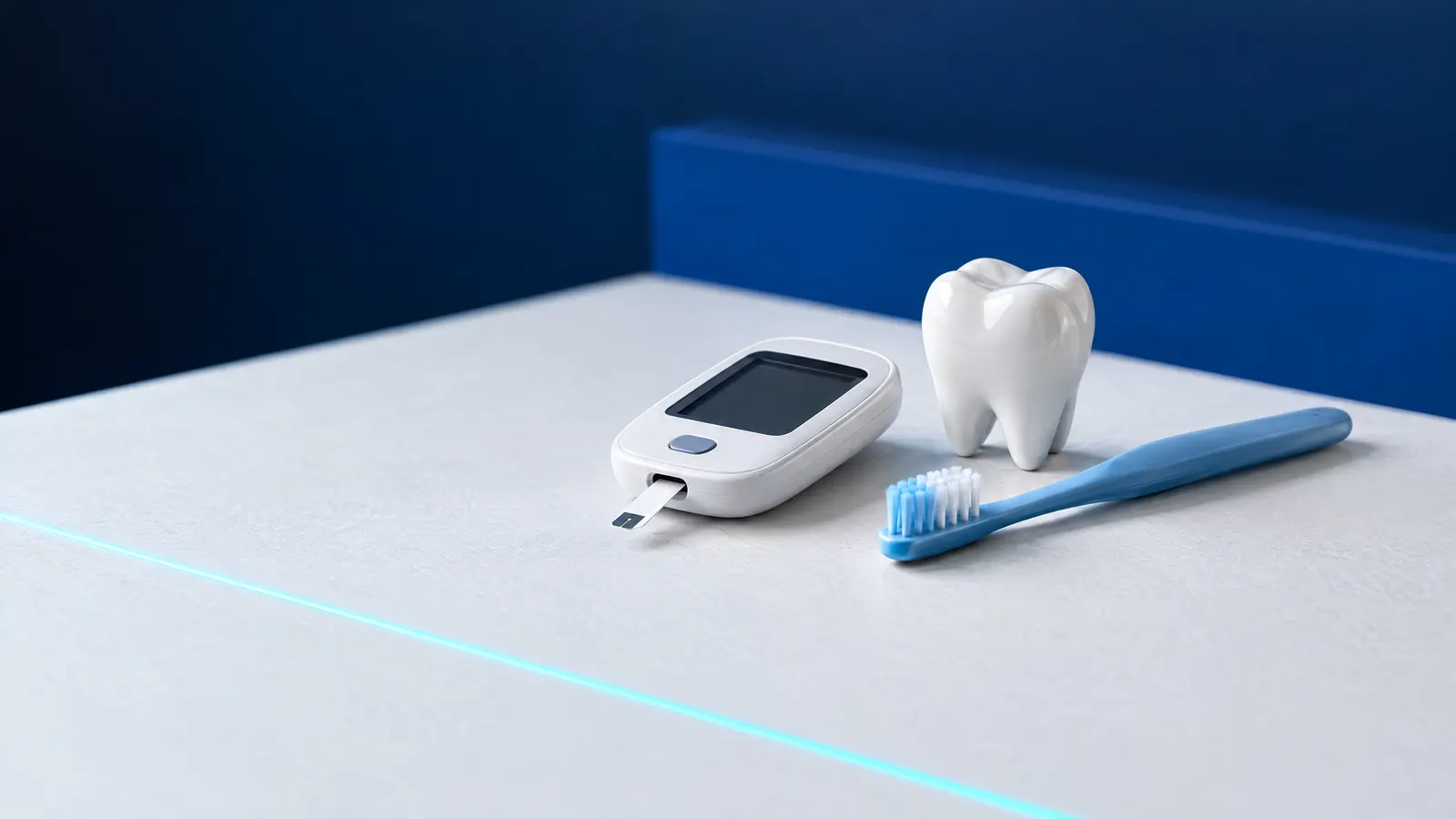
How are diabetes and teeth connected?
Diabetes and periodontal disease affect each other in both directions: diabetes, especially when poorly controlled, encourages periodontitis (gum disease), and chronic periodontitis makes blood sugar harder to control. A review published in the journal Diabetologia describes this plainly as a two-way relationship (Preshaw et al., 2012).
This concerns a great many people. According to the atlas of the International Diabetes Federation (IDF, 2025 edition), about 3.1 million adults aged 20 to 79 in Poland have diabetes, and 18.9% of them are undiagnosed. For this reason the Polish Diabetes Association (PTD), in its recommendations for 2026, states that everyone with diabetes should be asked about oral disease and examined for it.
Diabetes shows itself in the mouth through more than the gums. The US National Institute of Dental and Craniofacial Research (NIDCR) also lists dry mouth, oral thrush and slower healing, which can make gum treatment more difficult.
Diabetes and gum disease: how much higher is the risk?
People with diabetes develop periodontitis more often: the review in Diabetologia estimates that susceptibility to the disease rises roughly threefold, and a meta-analysis of prospective studies gives a relative risk of 1.86 for the disease appearing or progressing (Nascimento et al., 2018). It is therefore fair to speak of a risk roughly two to three times higher.
Periodontitis does not hurt for a long time, so it is worth knowing its warning signs. The stages of the disease and its treatment are covered in the article on periodontitis and bleeding gums; below are the symptoms that a person with diabetes should not leave until a routine check-up.
The effects are also visible in why teeth are lost. In an observation of 120 adults who had a total of 554 teeth extracted, periodontal disease was a more frequent reason for extraction in people with diabetes than in the others (Passarelli et al., 2020); these are, however, data from a single Italian hospital, so treat them as a signal rather than a rule.
- Your gums bleed when you brush or floss, or they are red or swollen.
- Your gums are receding and your teeth look longer than they used to.
- Your teeth start to feel loose, drift apart or meet differently when you bite.
- Pus, a painful swelling or an unpleasant taste that keeps coming back despite brushing appears next to a tooth.
Does treating the gums lower blood sugar? What the research says about HbA1c
Treating periodontitis lowers glycated haemoglobin (HbA1c) in people with diabetes, although the effect is moderate. A 2022 Cochrane review (35 randomised trials, 3,249 participants) reports a fall in HbA1c of 0.43 percentage points after 3 to 4 months, on moderate certainty evidence, and of 0.30 points after 6 months.
In practice this means an improvement of around 0.3 to 0.4 percentage points within 3 to 6 months. There are too few data from longer follow-up to say how lasting the effect is. The PTD puts it briefly: treating periodontal disease improves the metabolic control of diabetes.
Gum treatment does not replace diabetes treatment; it complements it. Medicines and any changes to them are decided by your doctor, while daily oral hygiene, professional cleaning and the cleaning of gum pockets are the parts the patient can genuinely influence.
- Brush your teeth twice a day with fluoride toothpaste and clean between your teeth every day with floss or an interdental brush.
- Look after your blood sugar control; the NIDCR lists keeping glucose in check among the basics of protecting the gums.
- If you smoke, treat stopping as part of your gum treatment, because smoking makes periodontal disease worse.
- Attend professional cleaning and check-ups at the intervals your dentist sets according to your risk.
Dry mouth in diabetes: where does it come from and what does it lead to?
Dry mouth (xerostomia) is common in diabetes: a review of studies reports it in 12.5 to 53.5% of people with diabetes, compared with 0 to 30% in comparison groups (López-Pintor et al., 2016). The wide range reflects different study methods, but the direction is clear.
The NIDCR explains that a dry mouth lacks saliva, and diabetes can raise the level of glucose in saliva; together these encourage oral thrush, which causes painful white patches. Dryness itself can also lead to soreness, ulcers, infections and tooth decay.
It is worth mentioning dry mouth both to your dentist and to your doctor, because it can also be a side effect of medicines. Do not stop any medicine on your own for this reason; a doctor or dentist may recommend a mouth-moisturising product and arrange more frequent check-ups.
What does diabetes change in the mouth? An overview
The table brings together the main relationships described in the sources and what they mean for everyday care of your teeth.
| Topic | What the sources report | What follows from it |
|---|---|---|
| Periodontitis | Risk roughly two to three times higher | A gum check at least once a year |
| HbA1c after gum treatment | A fall of about 0.3 to 0.4 points in 3 to 6 months | Gum treatment as a complement to diabetes care |
| Dry mouth | 12.5 to 53.5% of people with diabetes | Tell your dentist and doctor, review your medicines |
| Oral thrush | Encouraged by dryness and glucose in saliva | White, painful patches are a reason for a visit |
| Healing | Poorer diabetes control can slow it | A planned procedure is best done with good glucose control |
| Implants | With good control, results similar to people without diabetes | Assessment takes diabetes control into account |
| Dental examination | PTD: once a year for everyone with diabetes | A fixed check-up date, even without symptoms |
Diabetes and implants: can a person with diabetes have an implant?
Diabetes in itself does not usually rule out an implant; what matters is how well it is controlled. A systematic review indicates that with well-controlled diabetes implants behave much as they do in people without diabetes, while with poor control the implant integrates with the bone less well and inflammation around the implant develops more often (Naujokat et al., 2016).
There is no agreed HbA1c threshold below which an implant is considered safe, so the decision is made individually, in consultation with a diabetologist where needed. The lifespan of implants and other risk factors are discussed in the article on whether dental implants last a lifetime.
Dental treatment with diabetes: how to prepare for your visit
Dental treatment for a person with diabetes is carried out in the same way as for other patients, but a few pieces of information and habits make it easier to plan. The NIDCR’s most important advice is simple: tell your dentist that you have diabetes.
Planned surgical procedures, such as placing an implant, are best timed for a period of good blood sugar control. An acute infection, an abscess or severe pain, on the other hand, is not put off because of diabetes: the cause is treated, and blood sugar is managed alongside with your doctor.
- State your type of diabetes, how it is treated, including insulin, and all your other medicines, including those for blood pressure and blood clotting.
- Bring your most recent HbA1c result; it helps to judge how well your diabetes is controlled before a planned procedure.
- Take your diabetes medicines as your doctor has advised, and do not change them because of the visit without their decision.
- If you measure your blood sugar day to day and carry something sweet in case of a hypo, bring that to the surgery too.
- If during the visit you feel the familiar symptoms of low blood sugar, say so at once and the procedure will be stopped.
- Before treatment under general anaesthesia, the rules on eating, drinking and taking medicines are set by the anaesthesiologist at the qualification consultation.
- After a tooth extraction or gum procedure, follow the instructions and get in touch if the wound heals more slowly than the dentist said it would.
How it works at DentalBlue
At DentalBlue in Białystok, the first step is usually a visit without pain: a panoramic X-ray, a consultation, an examination and a written treatment plan with the price of each stage; in the clinic’s price list it costs 300 zł. The clinic provides periodontology and preventive care, and plans implants on a CBCT image from its own radiology unit. In the price list, a periodontal consultation costs 300 zł and complete professional cleaning (scaling, air polishing, fluoride treatment) 350 zł. The final scope and cost are set at the consultation, and prices may change. A consultation can be booked by phone.
Frequently asked questions
How often should a person with diabetes see a dentist?
At least once a year: this is what the Polish Diabetes Association recommends for everyone with diabetes. After treatment for periodontitis, maintenance visits are more frequent, usually every 3 to 12 months, and the dentist sets the exact interval according to individual risk.
Does diabetes encourage tooth decay?
Indirectly, it can. Diabetes often goes hand in hand with dry mouth, and according to the NIDCR a dry mouth encourages, among other things, tooth decay. That is why brushing twice a day with fluoride toothpaste, cleaning between the teeth and regular check-ups matter particularly with diabetes.
Can a tooth be extracted if you have diabetes?
Yes, diabetes in itself is not a reason to leave a tooth that needs removing. Poorer diabetes control can, however, slow healing, so the dentist asks about your treatment and your HbA1c result, and a planned procedure is best timed for good blood sugar control. An acute infection is not put off.
Is gum disease treatment for people with diabetes covered by the NFZ?
Partly. The NFZ, Poland’s National Health Fund, funds for adults a dental examination once per calendar year, tartar removal once a year, rinsing of gum pockets and closed curettage. The regulations provide no separate scope for people with diabetes (legal position as of 12 October 2026). No referral to a dentist is needed.
Can professional cleaning replace diabetes medication?
No. Gum treatment lowers HbA1c by an average of about 0.3 to 0.4 percentage points, but it complements diabetes treatment rather than replacing it. Decisions about diabetes medicines are made only by your doctor.
Sources
- Simpson TC et al., Cochrane: periodontal treatment for glycaemic control in diabetes (2022)
- Preshaw PM et al., Diabetologia: periodontitis and diabetes, a two-way relationship (2012)
- Nascimento GG et al., Acta Diabetol: diabetes and the risk of periodontitis, meta-analysis (2018)
- López-Pintor RM et al., J Diabetes Res: dry mouth in people with diabetes (2016)
- Polskie Towarzystwo Diabetologiczne: Zalecenia kliniczne dotyczące postępowania u osób z cukrzycą (2026)
- IDF: Diabetes Atlas, 11th edition (2025)
- NIDCR: Diabetes and oral health (2024)
- Naujokat H et al., Int J Implant Dent: implants and diabetes, systematic review (2016)
An informational article. It does not replace a consultation, and treatment decisions are made during a visit.