What does professional teeth cleaning involve?
Professional teeth cleaning is the removal of bacterial plaque, tartar and stains from the tooth surfaces, combined with hygiene instruction and usually with fluoride treatment. In the specialist literature it is called professional mechanical plaque removal (PMPR).
The European Federation of Periodontology (EFP) calls this kind of cleaning an essential part of preventing gum and periodontal disease, and its 2020 guideline recommends it as part of the first step in treating periodontitis (advanced gum disease). The procedure works, however, only together with daily cleaning of the teeth at home.
A 2026 review of studies puts it plainly: when home hygiene remains ineffective, cleaning at the surgery alone does not treat gingivitis, and a benefit appears only in combination with instruction (low-certainty evidence). Professional cleaning is therefore a starting point, not a substitute for a toothbrush.
Scaling, air polishing, polishing, fluoride: what does each step do?
Each step of professional cleaning removes something different, which is why they are not interchangeable. The order and scope are tailored to the condition of the teeth and gums; the table shows what each one is responsible for.
The most common misunderstanding is treating air polishing as the whole procedure. Without scaling, tartar stays on the teeth, and without instruction, plaque returns to the same places where it built up before, usually along the gum line and between the teeth.
| Step | What it does | Worth knowing |
|---|---|---|
| Scaling | Removes hard tartar with an ultrasonic tip or hand instruments | Neither a toothbrush nor air polishing will remove tartar |
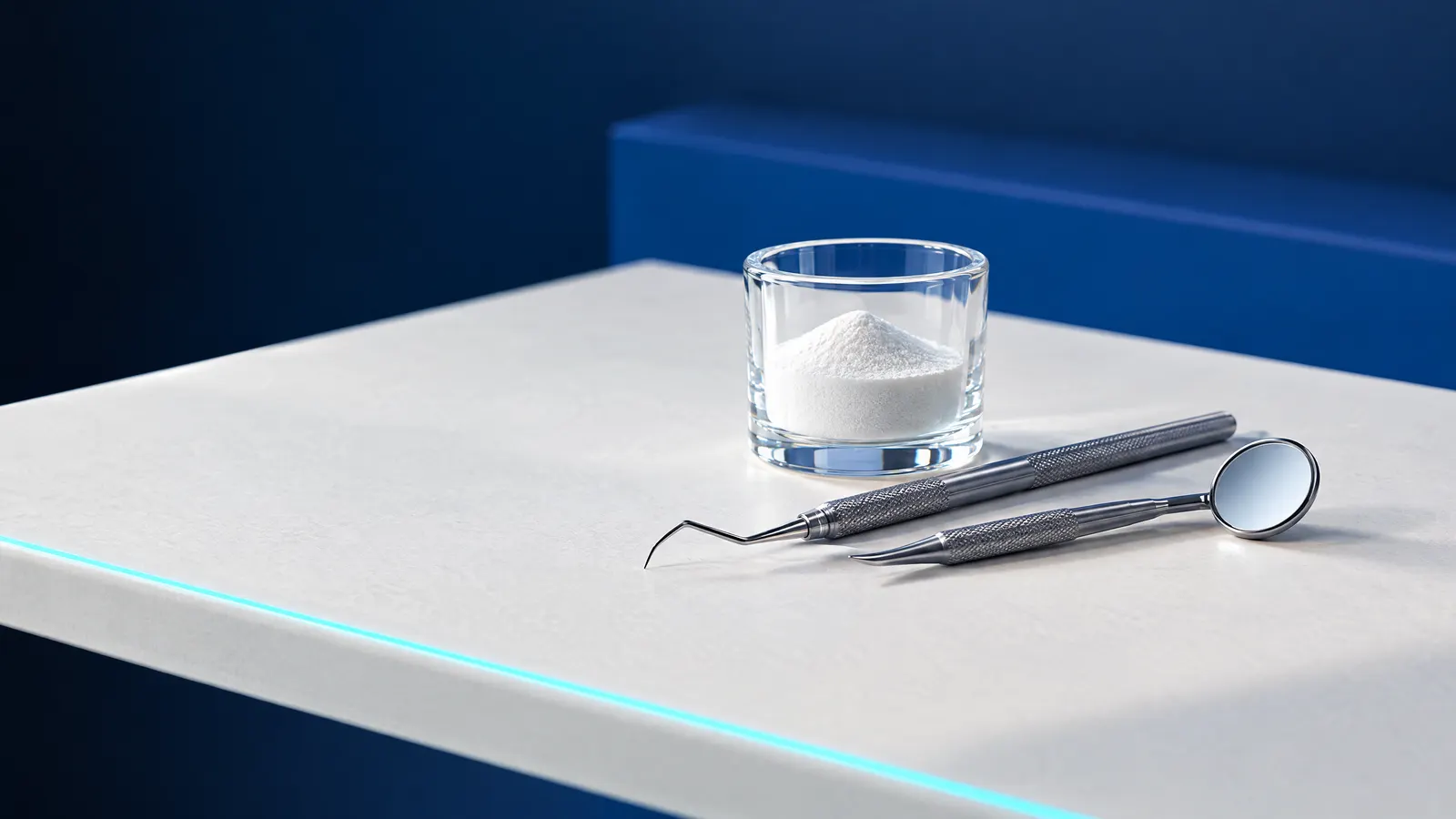
| Air polishing | A jet of air, water and fine powder removes biofilm and stains | Glycine and erythritol powders are low-abrasive |
| Polishing | A rubber cup or brush with paste picks up remaining deposits | Ultrasound with air polishing gave a similar result faster (very low certainty) |
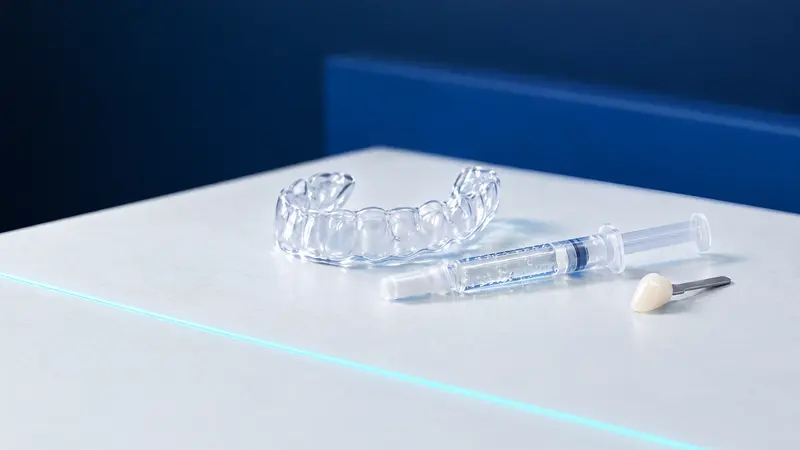
| Fluoride treatment | Fluoride varnish or gel applied to the enamel | DBOH recommends varnish twice a year for adults at increased risk of tooth decay |
| Hygiene instruction | Showing the areas missed when brushing and how to choose cleaning aids | Without effective hygiene at home, the procedure does not treat gingivitis |
How does scaling differ from air polishing?
Scaling removes tartar, that is, mineralised plaque, while air polishing removes soft biofilm and stains but does not remove hard tartar. That is why air polishing complements scaling rather than replacing it, and it is usually done afterwards.
In one study, air polishing with glycine powder, at about 5 seconds per surface, removed most of the biofilm even from shallow gum pockets, up to about 3 mm. Deeper pockets in periodontitis require different treatment, described in the article on periodontal disease.
The type of powder matters for exposed roots: in a 2016 review, powders containing sodium bicarbonate and calcium carbonate damaged the root surface considerably more than glycine, which the authors considered safe for roots and gums. In a 2022 meta-analysis, air polishing in supportive care gave results similar to hand and ultrasonic instruments, with less pain and better patient acceptance.
How often should you have your teeth professionally cleaned?
How often to have your teeth professionally cleaned depends on the condition of your gums and your risk of tooth decay, not on a single rule for everyone. A 2018 Cochrane review covered 1711 adults without severe periodontitis who saw a dentist regularly: routine scaling and polishing every 6 or every 12 months made little or no difference to gingivitis over 2 to 3 years compared with no such treatment (high certainty).
The same review recorded slightly less tartar with regular treatment, although the authors considered the clinical significance of this difference unclear, and 6-month and 12-month intervals produced the same result. The conclusion, then, is not that professional cleaning is unnecessary, but that the interval is worth tailoring to the patient. These studies do not apply to people with periodontitis.
| Situation | Interval or recommendation | Source |
|---|---|---|
| Adult without periodontal disease, regular check-ups | Set by the dentist; every 6 and every 12 months gave a similar result | Cochrane, 2018 |
| After treatment for periodontitis | Supportive visits every 3 to 12 months, according to risk | EFP S3 guideline, 2020 |
| Adult at increased risk of tooth decay | 2.26% NaF fluoride varnish twice a year | DBOH, United Kingdom |
| Pregnancy and the postnatal period | On the NFZ, tartar removal no more often than every 6 months | Ministry of Health regulation, Dz.U. 2025 poz. 615 |
Does professional teeth cleaning hurt?
Professional teeth cleaning usually does not hurt, but it can be unpleasant where the gums are inflamed or where the necks of the teeth are exposed and sensitive. Inflamed gums bleed when touched by an instrument, which is a sign of inflammation, not damage, and the bleeding usually decreases with regular cleaning at home.
If the procedure is painful, it is worth saying so straight away: with marked sensitivity or when cleaning deeper under the gum, the dentist may use local anaesthesia. In studies of supportive care, air polishing was perceived as less painful than cleaning with hand or ultrasonic instruments.
Once tartar that covered the necks of the teeth has been removed, the teeth may react to cold for a while, because periodontal treatment is one of the known causes of exposed dentine. Pain that lasts a long time or affects a single tooth needs a dental check.
Professional teeth cleaning on the NFZ: what is covered?
On the NFZ, you are entitled to removal of dental deposits, that is, scaling, once per calendar year for the whole dentition; the same limit applies to adults and to children and adolescents up to 18. Women who are pregnant or in the postnatal period are entitled to tartar removal no more often than every 6 months.
Air polishing is not on the list of guaranteed services, nor is fluoride varnishing for adults, so these steps are paid for privately. Children and adolescents are entitled on the NFZ to fluoride varnishing no more often than once a quarter. Adults are also entitled to gum pocket irrigation, closed curettage and an examination with hygiene instruction once a year.
No referral is needed to see a dentist who has an NFZ contract. The legal basis is the Minister of Health’s regulation on guaranteed dental treatment services (consolidated text, Dz.U. 2025 poz. 615), as in force on 12 October 2026; the full overview is in the article on what the NFZ covers at the dentist.
How much does professional teeth cleaning cost privately?
The cost of professional teeth cleaning depends on whether it covers both arches or one, which steps are needed and whether the examination points to periodontitis, which requires separate treatment. That is why the scope is agreed after the teeth and gums have been examined.
In the clinic’s price list, “Kompleksowa higienizacja (skaling, piaskowanie, fluoryzacja)” (complete hygiene treatment: scaling, air polishing, fluoride) costs 350 zł. “Scaling+piaskowanie 1 łuk” (scaling and air polishing, one arch) is 200 zł, “Scaling 1 łuk” (scaling, one arch) 150 zł, “Piaskowanie 1 łuk” (air polishing, one arch) 170 zł, “Fluoryzacja” (fluoride treatment) 100 zł and “Kontrola po higienizacji” (check after hygiene treatment) 50 zł. For children the price list gives “Czyszczenie zębów z fluoryzacją” (tooth cleaning with fluoride) at 250 zł. The final scope and cost are agreed at the consultation, and prices may change.
What to do after professional cleaning to make the effect last longer
Daily hygiene is what maintains the effect of professional cleaning: plaque starts to build up again immediately after the procedure, and tartar forms from plaque that has not been removed. The UK guidance Delivering better oral health (DBOH) gives simple advice for every day.
- Brush your teeth at least twice a day, including last thing before bed, with a fluoride toothpaste containing 1350 to 1500 ppm.
- After brushing, spit out the toothpaste and do not rinse your mouth with water, so as not to dilute the fluoride.
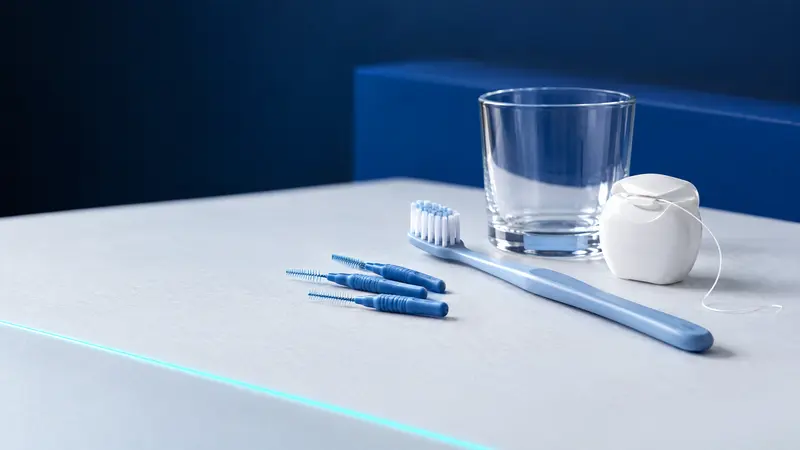
- Clean between your teeth every day: with an interdental brush where it fits, and with floss or tape in tight spaces.
- Come back for a check-up at the interval set by your dentist, and sooner if your gums start bleeding when you brush.
How professional teeth cleaning works at DentalBlue
At DentalBlue in Białystok, professional cleaning is part of preventive care, alongside fissure sealing and fluoride treatment, and the clinic’s team includes dental hygienists. Complete hygiene treatment consists of scaling, air polishing and fluoride treatment; the price list also includes items for a single arch and a check after hygiene treatment. If the examination points to periodontitis, further treatment is provided by the periodontology department, and the X-rays needed to assess the bone are taken in the clinic’s own radiology unit. The clinic is open Monday to Friday from 8:00 to 20:00 and on Saturdays from 8:00 to 16:00.
Frequently asked questions
Does air polishing damage enamel?
Studies mainly concern exposed roots, which are soft compared with enamel. Powders containing sodium bicarbonate and calcium carbonate damaged roots considerably more than glycine, which the authors considered safe for roots and gums. The type of powder is therefore chosen to suit the condition of the teeth.
Does professional cleaning whiten teeth?
Professional cleaning removes surface stains, for example from coffee, tea or tobacco, so the teeth may look lighter. It does not, however, change the colour of the tooth itself. That is what whitening is for, described in a separate article.
Can I have my teeth professionally cleaned during pregnancy?
Yes. During pregnancy and the postnatal period the NFZ funds tartar removal as often as every 6 months, and bleeding gums, which occur more easily in pregnancy, are a reason for a check-up. Details are in the article on dental treatment during pregnancy.
Can children have professional teeth cleaning too?
Yes, the scope is adapted to the child’s age and the condition of the teeth. Children and adolescents up to 18 are entitled on the NFZ to tartar removal once a year and fluoride varnishing no more often than once a quarter. In the clinic’s price list, “Czyszczenie zębów z fluoryzacją” (tooth cleaning with fluoride) for children costs 250 zł.
Sources
- Cochrane: Lamont T et al., routine scale and polish for adults (2018)
- Journal of Clinical Periodontology: Sanz M et al., EFP S3, treatment of stage I to III periodontitis (2020)
- Journal of Clinical Periodontology: Farina R et al., treatment of gingivitis, systematic review (2026)
- Journal of Periodontology: Flemmig TF et al., glycine powder air polishing in pockets (2007)
- International Journal of Dental Hygiene: Bühler J et al., air polishing powders and the root surface (2016)
- BMC Oral Health: Tan SL et al., air polishing in supportive periodontal therapy, meta-analysis (2022)
- OHID: Delivering better oral health, chapter 2, summary guidance tables (2021, updated 2025)
- ELI: Rozporządzenie MZ w sprawie świadczeń gwarantowanych z zakresu leczenia stomatologicznego, t.j. Dz.U. 2025 poz. 615
An informational article. It does not replace a consultation, and treatment decisions are made during a visit.