Where does tooth discolouration come from?
Tooth discolouration comes from two sources: pigments that settle on the surface of the tooth, or changes inside the enamel and dentine. This division into extrinsic and intrinsic discolouration determines what will remove it and what will have no effect.
Extrinsic stains come from tea, coffee, red wine, cola and tobacco, and also from metal salts, such as iron or copper; the American Dental Association (ADA) notes that poor hygiene makes them worse. Intrinsic discolouration results from processes in the tooth itself: ageing, injury, death of the pulp, medicines taken while the teeth are developing, excess fluoride or inherited defects in the structure of the enamel or dentine.
A change in the colour of one tooth means something different from the yellowing of them all. A single dark tooth is the typical picture after an injury or after the pulp has died, while discolouration affecting all the teeth is more often linked to age, habits or factors acting while the teeth were developing.
Extrinsic and intrinsic discolouration: what causes it and what removes it
The table sets the causes of discolouration described in the literature against the methods that work on them. The choice of method follows an examination, because a similar colour can have different causes.
| Cause | Type | What helps |
|---|---|---|
| Coffee, tea, red wine, cola | Extrinsic | Professional cleaning, whitening toothpaste |
| Tobacco | Extrinsic | Professional cleaning, stopping smoking |
| Chlorhexidine mouthwash | Extrinsic | Professional cleaning |
| Metal salts, for example iron | Extrinsic | Professional cleaning |
| Age: thinner enamel, dentine showing through | Intrinsic | Whitening |
| Injury or dead pulp, usually one tooth | Intrinsic | Root canal treatment, internal whitening, crown |
| Tetracyclines while the teeth are developing | Intrinsic | Prolonged whitening, veneers or crowns |
| Fluorosis | Intrinsic | Depends on severity, decided after an examination |
| Inherited defects of the enamel or dentine | Intrinsic | Restorations, for example veneers or crowns |
| Old fillings and crowns | Restorative material | Replacing the restoration; whitening does not work |
Coffee, tea and cigarette stains: how do you remove them?
Stains from coffee, tea and cigarettes are removed above all by professional cleaning at the surgery, because they are a deposit on the surface, not a change in the colour of the tooth itself. The ADA lists professional cleaning and whitening toothpastes as methods for extrinsic stains.
During hygiene treatment, scaling removes tartar, and air polishing, a jet of air, water and fine powder, removes plaque and stains from the tooth surfaces. How these procedures are carried out and how often is described in the article on hygiene treatment.
Whitening toothpaste removes more extrinsic stains than ordinary toothpaste, but a 2020 meta-analysis recorded more side effects with it (relative risk 1.74), and the quality of the evidence was rated low to moderate. According to the ADA, over-the-counter toothpastes have no significant effect on intrinsic discolouration.
Chlorhexidine, an ingredient of some antiseptic mouthwashes, clearly increases extrinsic staining: a 2017 Cochrane review showed this with rinsing for 4 to 6 weeks. Professional cleaning removes these stains, and a chlorhexidine mouthwash should not be used for longer than the dentist has advised.
Yellow teeth: when is it age, and what does whitening achieve?
Yellow teeth in adults are often an effect of age: enamel thins over the years and the yellower dentine shows through from underneath. Cleaning will not remove this yellowing, because the colour is in the structure of the tooth, but for living teeth the ADA points to whitening as the method for intrinsic discolouration.
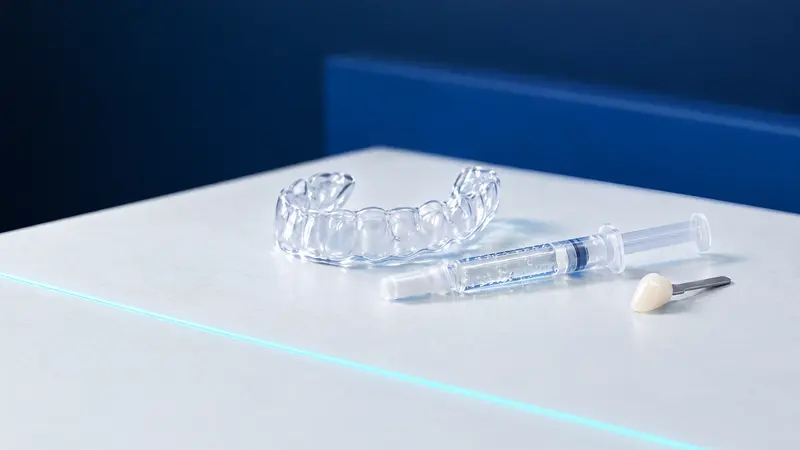
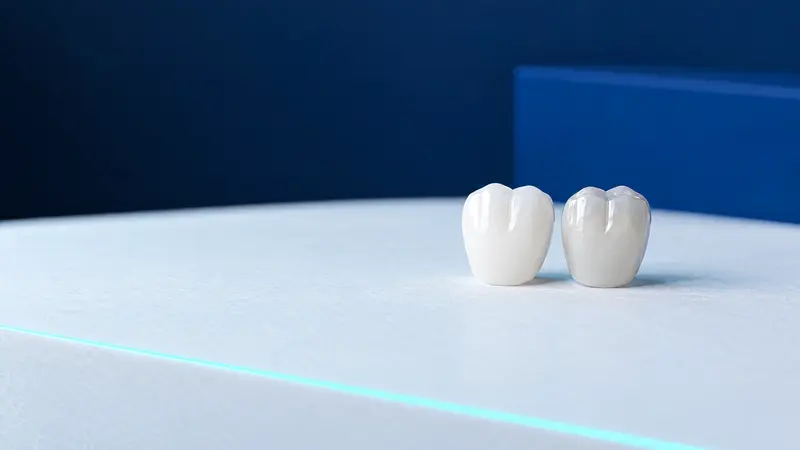
Whitening works only on natural teeth: it does not change the colour of fillings, crowns, veneers, implants or dentures, as the NHS and the ADA stress. If there are fillings in the front teeth, they may need replacing after whitening to match the new shade.
According to the NHS, the effect can last around 3 years if the dentist’s advice is followed; it usually needs refreshing. Methods, prices, the rules on peroxide concentrations and contraindications are described in the article on teeth whitening.
Grey teeth or one dark tooth: what does it mean?
A single tooth darkening to grey or brown is the typical picture after an injury or after the pulp has died. Such a tooth needs an examination, usually with an X-ray, because treatment depends on the state of the pulp and of the tissues around the root.
A dead tooth is first given root canal treatment, and its colour can then be improved by internal whitening, through an opening in the crown of the tooth. A rare complication of this method is external cervical resorption, a loss of root tissue from the outside; when whitening is not enough, a veneer or crown remains an option. The details are in the article on dead teeth.
If a grey tint affects many teeth at once, one possible cause is antibiotics from the tetracycline group taken while the teeth were developing.
Discolouration after antibiotics: tetracyclines and minocycline
Discolouration after antibiotics is described mainly in connection with tetracyclines. Drugs in this group are incorporated into tissues that are mineralising while they are being taken, including developing milk and permanent teeth; the resulting discolouration is permanent, and its colour ranges from yellow or grey to brown, depending on the dose and the type of drug.
Minocycline, a tetracycline derivative used among other things to treat acne, can also discolour the teeth of adults, giving the crowns a blue-grey or grey tint. A 2004 review puts the frequency of discolouration after tetracyclines and minocycline at 3 to 6%, noting that the literature consists mainly of case reports.
Tetracycline discolouration can be lightened by whitening, but it takes a long time: the ADA states that it may require an average of 3 to 4 months of daily overnight tray use. When the effect is insufficient, a veneer or crown is sometimes the solution.
Do not stop a prescribed antibiotic out of concern for the colour of your teeth. If you have questions about the medicine, talk to the doctor who prescribed it.
Fluorosis and white spots on teeth
Fluorosis is a change in the enamel caused by excessive fluoride intake while the teeth are forming. It ranges from faint white lines and spots to pitting, which over time takes up brown stains; that is why only a small amount of fluoride toothpaste is put on young children’s toothbrushes.
White spots also have other causes, including molar incisor hypomineralisation (MIH) and demineralisation after fixed braces. Their diagnosis and treatment are described in a separate article on white spots on teeth.
When whitening is not enough: bonding, veneers and crowns
When discolouration cannot be removed by cleaning or whitening, the colour can be covered with a restoration: a composite veneer (bonding) or a porcelain veneer, or a crown. A 2025 review in the British Dental Journal lists these methods as the next step when whitening does not give the expected result.
Each of these methods means more intervention in the tooth than whitening, and ceramic veneers and crowns usually require the tooth to be reduced. If you are also planning whitening, it is done before the restoration, because the colour of composite and ceramic will not change afterwards; the differences between veneers and bonding are described in a separate article.
In the clinic’s price list, “Kompleksowa higienizacja (skaling, piaskowanie, fluoryzacja)” (comprehensive hygiene treatment: scaling, air polishing, fluoride) costs 350 zł, “Wybielanie lampą I sesja” (lamp whitening, first session) 1 200 zł, “Wybielanie nakładkowe” (tray whitening) 1 000 zł, “Bonding 1 zęba” (bonding, one tooth) 1 000 zł, “Licówka pełnoceramiczna” (all-ceramic veneer) 3 000 zł and “Licówka pełnocyrkonowa” (full zirconia veneer) 2 800 zł. The final scope and cost are agreed at the consultation, and prices may change.
How it works at DentalBlue
At DentalBlue in Białystok, the cause of discolouration is assessed during an examination, and the scope of treatment is set out in a treatment plan. A “Wizyta bez bólu” (visit without pain) includes a panoramic X-ray, a consultation, an examination and a written treatment plan (300 zł in the clinic’s price list). The clinic provides hygiene treatment, whitening and cosmetic dentistry, including veneers, and for a dead tooth, root canal treatment under a microscope. Intraoral X-rays are taken in the clinic’s own radiology unit.
Frequently asked questions
Does whitening toothpaste remove stains?
Partly. Whitening toothpaste removes more extrinsic stains, for example from coffee, than ordinary toothpaste, but a 2020 meta-analysis recorded more side effects with it. According to the ADA, it has no significant effect on intrinsic discolouration.
Do coffee stains come back after hygiene treatment?
They can, because hygiene treatment removes the existing deposit but does not change the habits that create it. What matters is how much coffee, tea or wine you drink, whether you smoke and how thoroughly you brush. The interval between hygiene appointments is set by the dentist.
Will whitening remove tetracycline stains?
It can lighten them, but treatment is long: the ADA gives an average of 3 to 4 months of daily overnight tray use. When the effect is not enough, the dentist may suggest veneers or crowns.
Can a discoloured filling be whitened?
No. Whitening changes the colour only of natural teeth, not of fillings, crowns, veneers or dentures. A discoloured or poorly matched filling in a front tooth is replaced, and if whitening is planned, only after it, so that the colour can be matched to the new shade.
Do yellow teeth mean poor hygiene?
Not necessarily. Teeth yellow with age, because the enamel thins and the dentine shows through it more. Poor hygiene makes extrinsic stains worse, but intrinsic yellowing also occurs in people who brush their teeth carefully.
Sources
- ADA: Whitening, Oral Health Topics (2022)
- NHS: Teeth whitening (2025)
- Cochrane: James P et al., chlorhexidine mouthrinses (2017)
- Operative Dentistry: Devila A et al., whitening toothpastes, meta-analysis (2020)
- International Journal of Dermatology: Sánchez AR et al., tetracycline and minocycline discolouration (2004)
- British Dental Journal: Aljanahi M et al., tooth discolouration, part 1 (2025)
- British Dental Journal: tooth discolouration, part 2, management (2025)
- Monographs in Oral Science: DenBesten P, Li W, fluorosis (2011)
An informational article. It does not replace a consultation, and treatment decisions are made during a visit.