What is the white diet after teeth whitening, and where did it come from?
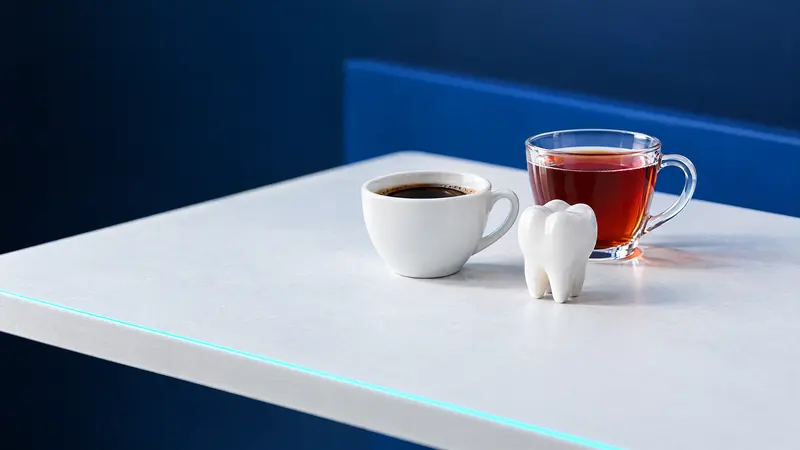
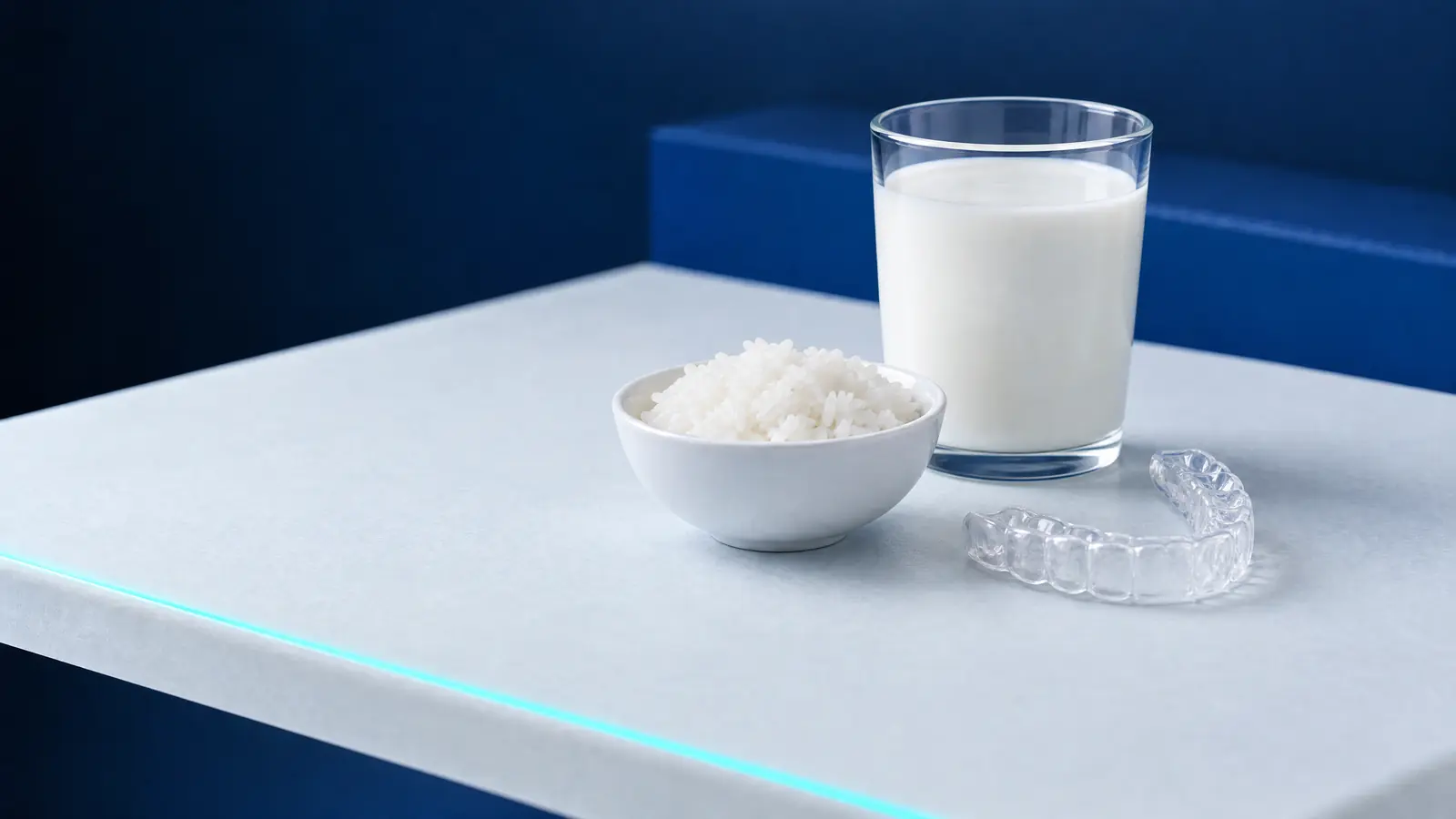
The white diet after teeth whitening is the advice to eat and drink only light-coloured products without strong colourings during treatment and shortly after it, and to avoid coffee, tea, red wine, cola, dark fruit and smoking. A review by Hardan et al. (2024) notes that such restrictions are recommended both by professional guidelines and by some manufacturers of whitening products.
The advice stems from the assumption that peroxide temporarily changes the surface of the enamel, which becomes rougher and more porous and therefore takes up colourings more easily. A review by Reis et al. (2026) points out that laboratory studies give this some basis, but studies carried out in the mouth have not confirmed it, probably because saliva reverses such surface changes.
The white diet is no substitute for hygiene. The ADA, the American Dental Association, lists coffee, tea, red wine, cola and dark fruit among the sources of extrinsic discolouration, that is stains on the surface of the tooth, and notes that frequently consuming staining products can make such discolouration worse.
Whitening methods and their safety are described in a separate article on teeth whitening. This article deals only with what to eat and drink during the treatment and after it.
What have laboratory studies shown?
Laboratory studies show that freshly whitened enamel may absorb more colouring, especially from red wine. In the study by Berger et al. (2008), samples of bovine enamel whitened with 35% hydrogen peroxide and immersed in red wine immediately, after 24 hours or after a week absorbed more colouring than unwhitened enamel, regardless of when they were immersed.
Other experiments give a less clear-cut picture. In the study by Côrtes et al. (2013), coffee and wine did not change the colour of samples kept in artificial saliva during the treatment, and differences appeared only after the whitening had ended: with wine after 7 and 30 days, with coffee after 30 days, and wine stained more strongly than coffee. Monteiro et al. (2017), for their part, found no difference between contact with wine straight after whitening and contact after an hour.
Such studies are carried out on cut fragments of teeth immersed in drinks, so they do not reproduce the effect of saliva, brushing or ordinary drinking. That is why the question of whether the white diet matters is settled by studies in patients.
Does coffee after teeth whitening spoil the result? Findings of clinical studies
Coffee after teeth whitening did not spoil the result in studies in patients. In a clinical trial by Rezende et al. (2013), 40 people whitened their teeth at home with 16% carbamide peroxide for 3 weeks; those drinking coffee also rinsed their mouths with it 4 times a day, and yet the lightening and sensitivity were the same as in the group on a diet without colourings.
Pooled analyses confirm this finding. A review by Hardan et al. (2024) included 5 clinical studies and found no differences in colour between a restricted diet and drinking wine or coffee after 1, 2 and 3 weeks of tray whitening or a month after treatment, and with in-surgery whitening, cola, coffee and tea did not change the result after a month.
The most recent network meta-analysis, by Münchow et al. (2025), included 7 clinical studies at low risk of bias and concluded that neither cola, coffee, black tea, grape juice, red wine nor a diet without any restrictions significantly affects the effectiveness of whitening compared with the white diet; the quality of the evidence was rated as moderate.
A limitation of these studies is the short follow-up: Hardan et al. note that it lasted a month at most. So it is not known exactly how diet affects colour over many years, but the influence of colourings on the result of the treatment itself proved insignificant.
How long does the white diet last, and what can you eat after teeth whitening?
The white diet has no fixed duration: the review by Hardan et al. (2024) notes that how long colourings should be avoided remains disputed. Individual advice on the product used and on how long to avoid colourings comes from the dentist carrying out the whitening.
If you want to follow the white diet, the table shows what is usually allowed, what is avoided and why. The column with the reason separates what follows from studies from simple caution.
| Product or habit | Advice for the first few days | Why |
|---|---|---|
| Water, milk, plain yoghurt, white cheese | No restrictions | They contain no colourings |
| White rice, pasta, white bread, chicken, fish | No restrictions | Light-coloured foods without strong colourings |
| Coffee and tea | Limit if your dentist has advised it | In clinical studies they did not weaken the whitening result |
| Red wine, grape juice | Limit | In laboratory studies they stained whitened enamel more strongly than coffee |
| Cola and dark fizzy drinks | Limit, drink with meals | Colourings and acids; in clinical studies no effect on the result |
| Dark fruit and strongly colouring sauces | Limit | The ADA lists them among the causes of extrinsic discolouration |
| Cigarettes | Preferably do not smoke | Smoke stains teeth, although whitening was similarly effective in smokers |
| Very cold and very hot drinks | Avoid if you have sensitivity | They can make temporary sensitivity after whitening worse |
Smoking after teeth whitening: what is known?
Smoking after teeth whitening did not take away the effect of the treatment in studies, but it encourages stains to build up again. A systematic review by Takeuchi et al. (2023) included 5 studies and found that the effectiveness of whitening and sensitivity were similar in smokers and non-smokers, although the certainty of this evidence was rated as low.
In the study by de Geus et al. (2015), the colour after tray whitening lasted for a year in both smokers and non-smokers, provided that stains from diet and smoke were removed at the surgery by professional cleaning; without it, slight darkening was visible after a year. Smoking does, however, harm the gums and healing regardless of tooth colour, as described in a separate article on smoking and teeth.
Sensitivity after whitening: what can you eat and drink?
Sensitivity after whitening is common and usually passes quickly, so in the first few days it is better to avoid very cold and very hot drinks. The American Dental Association (ADA) states that temporary, mild to moderate sensitivity can affect up to two thirds of people; with trays or strips it may appear within 2 to 3 days of starting the course and usually subsides by the fourth day after it ends.
In the study by Rezende et al. (2013), about 57% of participants had sensitivity, most often mild, and this did not depend on drinking coffee. If the discomfort does not go away after the treatment has ended, contact your dentist; ways of relieving sensitivity are described in a separate article.
How long does the whitening result last, and how can you look after it?
The result of whitening usually lasts several years: the UK’s NHS says that if you follow your dentist’s advice it can last about 3 years. Over time the colour partly returns, and in the study by de Geus et al. (2017) the teeth had darkened after 30 months in both smokers and non-smokers, which the authors did not attribute solely to stains from food, drink and smoke.
Day to day, what helps is whatever removes deposits from the surface of the teeth. The list sets out habits that help the result last longer.
- Brush your teeth twice a day with fluoride toothpaste and clean between your teeth.
- Drink coffee, tea and wine with meals rather than in small sips throughout the day.
- Have deposits and tartar removed at the surgery at intervals set by your dentist.
- Remember that crowns, veneers and fillings do not change colour with whitening.
- Decide on topping up the result together with your dentist instead of reaching for products bought online.
How it works at DentalBlue
At DentalBlue, teeth whitening is part of aesthetic dentistry, and after the procedure the dentist gives advice for the period of treatment and afterwards, depending on the method. In the clinic’s price list, “Wybielanie lampą I sesja” (lamp whitening, first session) costs 1 200 zł, “Wybielanie nakładkowe” (tray whitening) 1 000 zł and “Kompleksowa higienizacja (skaling, piaskowanie, fluoryzacja)” (comprehensive hygiene treatment: scaling, air polishing, fluoride treatment) 350 zł. The final scope and cost are set by the dentist at a consultation, and prices may change. The clinic in Białystok is open Monday to Friday from 8:00 to 20:00 and on Saturdays from 8:00 to 16:00.
Frequently asked questions
Is it worth drinking coffee through a straw after teeth whitening?
You can, but there is no evidence that it protects the result. The clinical studies pooled in the 2024 and 2025 reviews compared diets, not straws, and in none of them did coffee weaken the whitening. The UK guidance DBOH, discussing acidic drinks, regards a straw as a measure with weak support from studies.
How many hours after whitening can I drink coffee?
There is no single fixed limit. In the study by Rezende et al. (2013), patients rinsed their mouths with coffee 4 times a day throughout the treatment and achieved the same lightening as people on the white diet, and in the laboratory study by Monteiro et al. (2017), contact with wine immediately and after an hour gave the same colour.
Can I drink red wine after whitening?
In clinical studies, red wine did not change the result of the treatment. In laboratory studies, however, it stained freshly whitened enamel more strongly than coffee, so if you want to be cautious, drink it less often in the first few days. In the end, follow the advice of the person carrying out your whitening.
Does the white diet also apply to tray whitening?
The studies covered both methods. In the review by Hardan et al. (2024), staining drinks did not change the colour of the teeth with either tray whitening or in-surgery whitening during follow-up of up to a month. If your dentist has advised restrictions while you wear the trays, stick to them.
Will whitening toothpaste help the result last?
Whitening toothpaste helps remove stains from the surface of the teeth, because according to the ADA it works mainly through abrasives. It does not, however, change the colour of the tooth itself, and for everyday brushing it matters more that it contains fluoride. Deposits that brushing does not remove are removed at the surgery.
Sources
- Journal of Dentistry: Münchow EA et al., white diet during whitening, a network meta-analysis (2025)
- Dentistry Journal: Hardan L et al., is a white diet necessary during whitening, a review and meta-analysis (2024)
- Brazilian Oral Research: Reis A et al., clinical myths in tooth whitening (2026)
- Operative Dentistry: Rezende M et al., coffee during at-home tray whitening (2013)
- Journal of Applied Oral Science: Berger SB et al., susceptibility of enamel to red wine staining after whitening (2008)
- Clinical Oral Investigations: Takeuchi EV et al., smoking and the effectiveness of whitening, a review (2023)
- ADA: Oral Health Topics, Whitening (2022)
- NHS: Teeth whitening (2025)
An informational article. It does not replace a consultation, and treatment decisions are made during a visit.