Do home remedies for teeth whitening work?
Most home remedies for teeth whitening do not change the colour of the tooth itself, and some of them can damage the enamel. The American Dental Association (ADA) lists acidic fruit, vinegar, charcoal products and oil pulling among popular home methods, and notes that the few studies on them raise doubts about their effectiveness and safety.
The difference comes down to the type of discolouration. Extrinsic discolouration is a deposit on the surface of the tooth, for example from coffee, tea, wine or tobacco, which can be brushed or polished away; intrinsic discolouration lies within the enamel or dentine, and according to the ADA abrasives have no significant effect on it. Only a peroxide gel changes the colour of the tooth itself, and the table compares popular methods.
| Method | Does it whiten? | Risk |
|---|---|---|
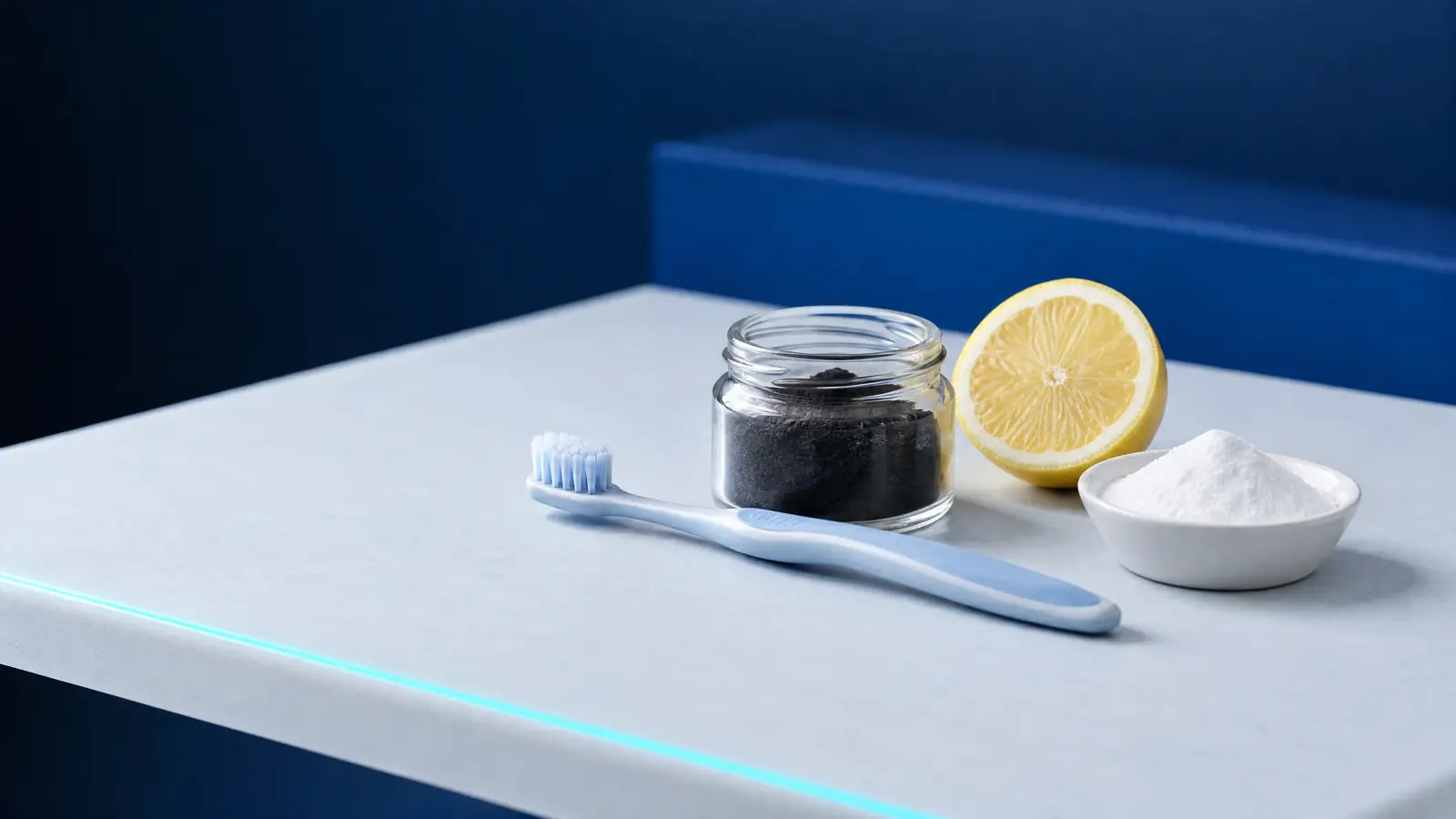
| Activated charcoal powder or toothpaste | No evidence; in laboratory studies weaker than other toothpastes | Greater abrasion of enamel and fillings |
| Baking soda toothpaste | Removes surface deposits, does not change the colour of the tooth | Low abrasivity according to reviews in JADA (2017) |
| Baking soda with strawberries or lemon | With strawberries: the weakest effect in a laboratory study | Acidic additions such as lemon promote enamel erosion |
| Lemon juice, vinegar, apple cider vinegar | Not confirmed in studies | Enamel erosion, irreversible loss of tissue |
| Oil pulling, for example with coconut oil | ADA: no documented whitening | Reported effects include lipoid pneumonia and stomach upsets |
| Strips and kits from the chemist or online | Effect depends on the formulation; without a dentist, at most 0.1% hydrogen peroxide | NHS: they work less well and can harm teeth and gums |
| Whitening toothpaste | Removes surface discolouration | More side effects than with ordinary toothpaste |
Does activated charcoal whiten teeth?
Activated charcoal for teeth has no proven whitening effect. A literature review published in JADA in 2017 (Brooks et al.) analysed 118 potentially relevant papers, and none of the studies on brushing with charcoal met the quality criteria; the authors found the clinical and laboratory data insufficient to confirm the effectiveness and safety of charcoal products and advised caution.
A systematic review of 11 laboratory studies (Tomás et al., 2023) showed that activated charcoal toothpastes whiten less than other options and have greater abrasive potential, which led the authors to regard them as less safe. A 2026 review (Kim et al.) adds that charcoal toothpastes increase the surface roughness of filling materials.
The ADA also cites an observation by Yaacob et al., in which a mixture of charcoal and table salt proved abrasive and ineffective: the teeth took on a yellow tinge because the worn enamel exposed the dentine, and deep defects formed on the front surfaces of the incisors. Brooks et al. pointed out that a third of the charcoal toothpastes analysed contained bentonite clay, and that advertisements promised effects that had not been confirmed. If you use a charcoal toothpaste, check that it contains fluoride, because it is the fluoride that protects teeth from decay.
Baking soda for teeth: is it safe?
Baking soda (sodium bicarbonate) as an ingredient in toothpaste is a mild abrasive that helps remove surface stains. Hara and Turssi explain in JADA (2017) that baking soda is inherently of low abrasivity, because it is soft compared with enamel and dentine, and that toothpastes containing it fall within the abrasivity limits set by regulatory bodies.
Li (2017) summarised laboratory and clinical studies according to which baking soda toothpastes remove stains effectively and safely, making teeth look whiter. Both reviews, however, concern toothpastes, not brushing with the powder alone, and baking soda does not change the colour of the tooth itself. The powder contains no fluoride, so it cannot replace a fluoride toothpaste.
Popular mixtures of baking soda with strawberries or lemon fare worse. In a laboratory study by Kwon et al. (2015), a mixture of strawberries and baking soda produced the smallest change in colour of all the methods compared, and the ADA sums up that researchers were unable to find any measurable improvement.
Whitening teeth with lemon and vinegar: why does it harm enamel?
Whitening teeth with lemon or vinegar is harmful, because the acid dissolves enamel rather than removing colouring from inside the tooth. The UK guidance Delivering better oral health (DBOH, updated in 2025) lists acidic fruit eaten in large amounts, the most acidic of which are lemons, oranges and grapefruit, and foods containing vinegar among the sources of acids that lead to enamel erosion.
Lost enamel cannot be restored: DBOH states that once tooth tissue has been lost, the wear is irreversible. When the enamel is thinner, more of the dentine shows through it, and the ADA describes exactly this yellow tinge of the teeth after brushing with an abrasive mixture that had worn the enamel away.
For comparison, in a laboratory study by Ren et al. (2009), orange juice reduced the surface hardness of enamel by 84%, while a gel with 6% hydrogen peroxide, applied in 5 cycles corresponding to 5 days of treatment, did not change it significantly. Enamel erosion and ways of stopping it are described in a separate article.
Oil pulling: does it brighten your smile?
Oil pulling, that is swishing oil around the mouth, for example coconut oil, has no documented whitening effect. The ADA states plainly that there are no reliable studies showing that oil pulling whitens teeth or reduces tooth decay, and for this reason it does not recommend oil pulling as an oral hygiene practice.
In its whitening overview, the ADA also mentions reported side effects of oil pulling, such as lipoid pneumonia, stomach upsets and diarrhoea. A 2026 systematic review (Shahzad et al.) found a moderate reduction in bacterial counts and an improvement in gum health after oil pulling, but with inconsistent results and without any assessment of tooth colour; oil pulling is no substitute for brushing with fluoride toothpaste.
Whitening strips and kits from the chemist: what may be sold in the EU?
Whitening strips and other products sold in the EU without the involvement of a dentist may contain at most 0.1% hydrogen peroxide, present in the product or released from it. This is laid down by Council Directive 2011/84/EU, whose rules were transferred to Annex III to Regulation (EC) No 1223/2009 on cosmetic products, which applies directly in Poland (legal status as of 24 October 2026).
Products containing more than 0.1% and up to 6% hydrogen peroxide may be sold only to dentists; in each course of treatment the first use is carried out by a dentist or under a dentist’s direct supervision, and use in people under 18 is prohibited. The rules make no provision for products stronger than 6%, and the details are given in the article on teeth whitening.
The UK’s NHS warns that whitening with a kit bought from a pharmacy or online, or at a beauty salon, works less well and can harm the teeth and gums. In a laboratory study by Brambert et al. (2015), one over-the-counter product, used in an amount 10 times greater than recommended, markedly increased enamel erosion, which is why it is not worth exceeding the manufacturer’s instructions.
What actually lightens teeth and removes discolouration?
Extrinsic discolouration is removed by professional tooth cleaning at the surgery, while the colour of the tooth itself is changed by whitening with a peroxide gel carried out with the involvement of a dentist. A 2018 Cochrane review confirmed that gels dispensed by a dentist lightened teeth compared with placebo, although the certainty of the evidence was rated as low to very low.
Whitening toothpaste removes more surface stains than ordinary toothpaste, but in the review by Devila et al. (2020) it was also associated with more side effects (relative risk 1.74), and according to the ADA it does not significantly change the intrinsic colour of the tooth. A single dark tooth, for example after an injury, needs investigation, because it may mean the pulp has died; the causes of discolouration are described in a separate article.
How it works at DentalBlue
At DentalBlue, the way to lighten the teeth is discussed after an examination of the teeth and gums, because the choice depends on the type of discolouration. Hygiene treatment, which removes deposits from the surface of the teeth, is carried out as part of prevention, and lamp and tray whitening as part of aesthetic dentistry. In the clinic’s price list, “Piaskowanie 1 łuk” (air polishing, one arch) costs 170 zł and “Wybielanie nakładkowe” (tray whitening) 1 000 zł. The final scope and cost are set by the dentist at a consultation, and prices may change. The clinic in Białystok is open Monday to Friday from 8:00 to 20:00 and on Saturdays from 8:00 to 16:00.
Frequently asked questions
Does activated charcoal toothpaste damage enamel?
In laboratory studies, charcoal toothpastes had greater abrasive potential than other toothpastes (Tomás et al., 2023), and the ADA describes deep defects after brushing with a mixture of charcoal and salt. Good clinical studies are lacking, so it is more sensible to use an ordinary fluoride toothpaste every day.
Can I brush my teeth with baking soda every day?
The 2017 reviews that found baking soda to be of low abrasivity and safe concerned toothpastes containing baking soda, not the powder alone. Baking soda on its own contains no fluoride, so it does not protect against decay; if you want to use baking soda, choose a toothpaste that contains it together with fluoride.
Are whitening strips from the chemist safe?
It depends on the product and the state of your teeth. Strips bought in the EU without a dentist’s involvement may contain or release at most 0.1% hydrogen peroxide, but this limit does not settle the safety or effectiveness of a particular product. The NHS warns that kits used outside the surgery can harm the teeth and gums, so have your teeth checked by a dentist before use and follow the instructions.
Is oil pulling harmful?
The ADA does not recommend oil pulling as a hygiene practice and mentions reported side effects such as lipoid pneumonia, stomach upsets and diarrhoea. Oil pulling neither replaces brushing with fluoride toothpaste nor whitens teeth.
Sources
- JADA: Brooks JK et al., charcoal and charcoal-based toothpastes, a literature review (2017)
- Annals of Anatomy: Tomás DBM et al., activated charcoal as a whitening agent, a review of laboratory studies (2023)
- JADA: Hara AT, Turssi CP, baking soda as an abrasive in toothpastes (2017)
- ADA: Oral Health Topics, Whitening (2022)
- ADA MouthHealthy: Oil Pulling
- OHID: Delivering better oral health, chapter 7, tooth wear (2021, updated 2025)
- Publications Office of the EU: Council Directive 2011/84/EU, tooth whitening products (2011)
- NHS: Teeth whitening (2025)
An informational article. It does not replace a consultation, and treatment decisions are made during a visit.