Do you need mouthwash?
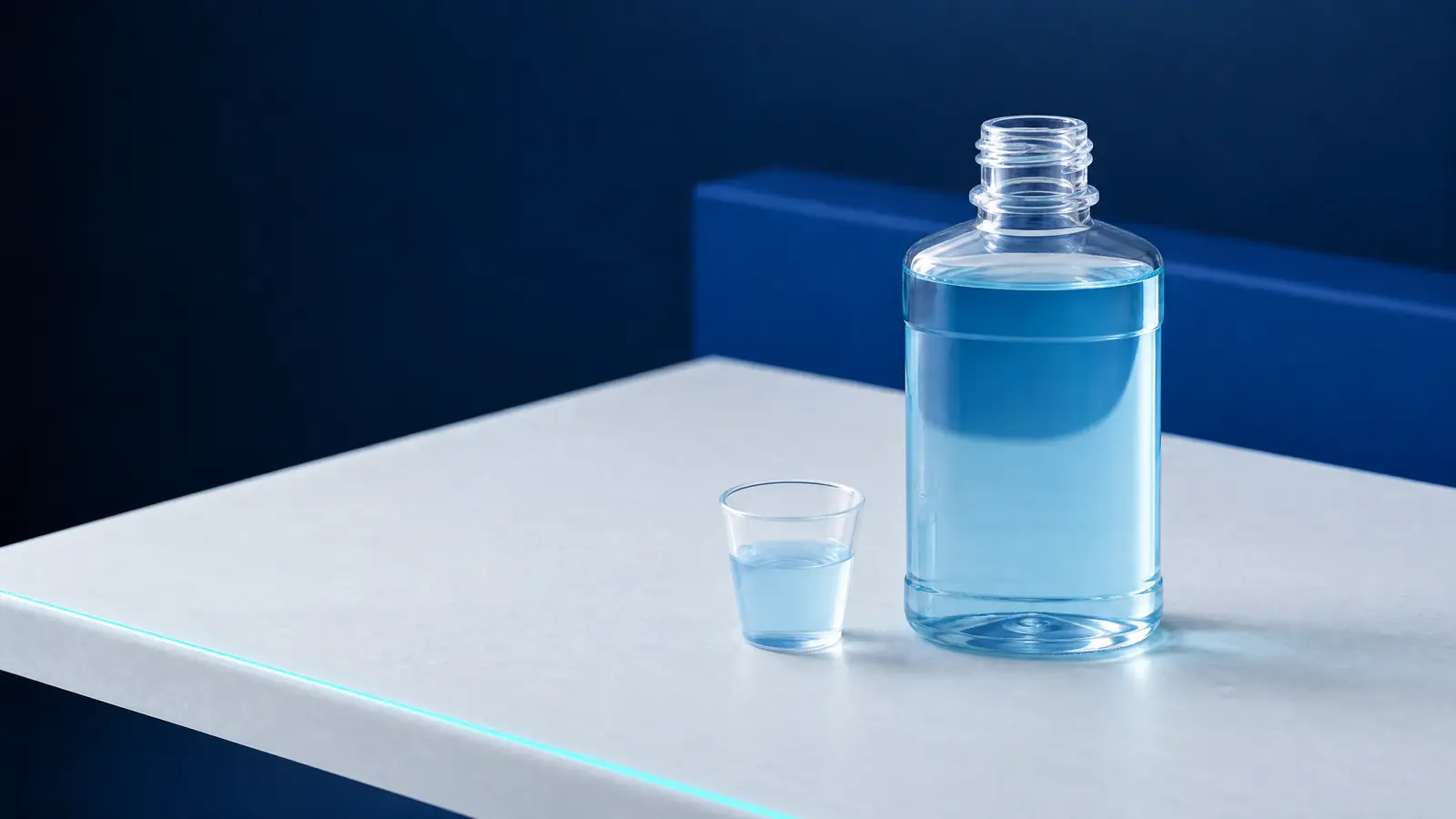
Not everyone needs mouthwash: the basis of oral hygiene remains brushing twice a day with fluoride toothpaste and cleaning between the teeth. A mouthwash can be an addition when a dentist sees a raised risk of tooth decay, gum inflammation or a temporary difficulty with brushing, for example after a procedure.
The American Dental Association (ADA) divides mouthwashes into cosmetic ones, which only freshen the breath briefly, and therapeutic ones, which contain active ingredients against plaque, gum inflammation (gingivitis) or tooth decay. This distinction is worth knowing, because a pleasant-tasting mouthwash does not necessarily contain any ingredient with a documented effect.
Nor will mouthwash replace a toothbrush when it comes to bad breath. A 2019 Cochrane review on the treatment of halitosis did not show that any method, mouthwashes included, worked clearly better than the others; the causes of bad breath are described in a separate article.
What types of mouthwash are there, and what are they for?
Types of mouthwash differ in their active ingredient, and that determines what the mouthwash is for. The ingredients are listed on the label, and the table sets out the most common ones alongside the conclusions of reviews and guidelines.
| Type of mouthwash | What it is for | Worth knowing |
|---|---|---|
| With fluoride (sodium fluoride 0.05%, 230 ppm) | Preventing tooth decay | Daily from age 8, at a different time from brushing (DBOH) |
| With chlorhexidine | Short-term plaque control, for example after a procedure | Stains the teeth after 4 weeks; for short-term use (DBOH) |
| With essential oils | An addition when the gums are inflamed | Less plaque and bleeding, low to moderate certainty evidence |
| With cetylpyridinium chloride (CPC) | An addition for gingivitis and for fresher breath | Small but significant additional effect (Haps 2008) |
| Cosmetic, freshening | Short-term breath freshening | Without an active ingredient it does not treat plaque or the gums (ADA) |
| Whitening, with hydrogen peroxide | Lightening the teeth | In the EU, products sold without a dentist: at most 0.1% hydrogen peroxide |
Fluoride mouthwash: who does it help, and when should you use it?
Fluoride mouthwash reduces tooth decay in children and adolescents who use it regularly. A 2016 Cochrane review (37 studies, 15,813 participants) showed that supervised fluoride rinsing reduced the increase in permanent tooth surfaces that were decayed, filled or lost to decay by an average of 27%, with moderate certainty evidence.
The UK prevention guidance Delivering better oral health (DBOH) provides for a mouthwash with 0.05% sodium fluoride (230 ppm fluoride) for daily use from the age of 8, as an addition to brushing twice a day. Whether you need one is assessed by a dentist according to your risk of decay; we write more about the safety of fluoride in a separate article.
Fluoride mouthwash is used at a different time from brushing, for example after lunch. The UK’s National Health Service (NHS) explains that mouthwash used straight after brushing washes away the fluoride from the toothpaste, and advises not eating or drinking for 30 minutes after a fluoride rinse.
Chlorhexidine: when does a chlorhexidine mouthwash make sense?
A chlorhexidine mouthwash makes sense as short-term support when thorough brushing is temporarily difficult, for example in the first days of healing after a procedure. DBOH states that chlorhexidine mouthwashes are effective at preventing plaque formation and reduce gingivitis in the early healing period.
A 2017 Cochrane review (51 studies, 5,345 participants) confirmed with high certainty a large reduction in plaque after 4 to 6 weeks and after 6 months of rinsing. In people with mild gingivitis, the gingival index fell by 0.21 on a scale of 0 to 3, a difference the authors considered not clinically important.
The review found no evidence that any concentration of chlorhexidine worked better than another, and there were too few data for moderate and severe gingivitis. A mouthwash does not treat the cause of the inflammation, so bleeding gums call for removal of tartar and better daily hygiene.
How long should you use chlorhexidine, and what are its side effects?
Chlorhexidine is used for a short time, usually for as long as the dentist advises, because longer rinsing brings side effects. DBOH recommends it for short-term use only, and the Cochrane review showed a clear increase in extrinsic tooth staining after just 4 to 6 weeks of rinsing, which persisted at 7 to 12 weeks and at 6 months.
The same review recorded a build-up of tartar, temporary taste disturbance, and irritation, peeling and burning of the lining of the mouth or of the tongue. The ADA adds that chlorhexidine can also stain dentures and the tongue.
Chlorhexidine can lose its effect on contact with some toothpaste ingredients. DBOH advises rinsing the mouth thoroughly with water between using toothpaste and a chlorhexidine mouthwash; a 2006 review by Kolahi and Soolari suggested a gap of more than 30 minutes, cautiously even close to 2 hours, but a study by van Strydonck et al. (2004) did not confirm a loss of effect after rinsing with water.
Essential oils and cetylpyridinium chloride: what is known?
Mouthwashes with essential oils and with cetylpyridinium chloride (CPC) reduce plaque and gum bleeding as an addition to brushing, although the effect is moderate. DBOH rates the evidence for these ingredients as low to moderate certainty and describes a significant reduction in bleeding and plaque compared with mechanical cleaning alone.
A 2019 network meta-analysis by Figuero et al. (53 publications) identified mouthwashes with essential oils, chlorhexidine and CPC as those that reduced the gingival index most strongly. A 2008 review by Haps et al. (8 publications) described a small but significant additional effect of CPC compared with brushing alone.
Such mouthwashes can help with gingivitis, but they will not cure it if the cause is tartar or poorly cleaned spaces between the teeth. The symptoms and treatment of gum inflammation are described in a separate article.
Mouthwash with alcohol and cancer: what do studies show?
Studies have not confirmed that mouthwash containing alcohol causes oral cancer, but the evidence is not clear-cut. A 2012 meta-analysis by Gandini et al. (18 studies) found no significant association: the relative risk with regular mouthwash use was 1.13, and with alcohol-containing mouthwashes 1.16, in neither case statistically significant.
A more recent 2021 meta-analysis by Hostiuc et al. (17 studies) also found no significant association between mouthwash and head and neck cancer, although with very frequent use it recorded a small, statistically significant increase in risk. A 2020 review by Ustrell-Borràs et al. concluded that it cannot be settled whether mouthwash is an independent risk factor. The ADA, in its overview of mouthwashes updated in 2026, cites a review that found no association with oral cancer, either for mouthwashes in general or for alcohol-containing ones.
If you prefer to avoid alcohol, check the ingredients on the label, because alcohol-free mouthwashes are available. The established risk factors for oral cancer remain, above all, smoking and alcohol misuse.
When should you rinse, and is mouthwash suitable for children?
Mouthwash is used at a different time from brushing, and children under 6 should not use it unless a dentist recommends it. The ADA explains that young children may swallow a large amount of the liquid. The list sums up the rules for use.
- After brushing, spit out the foam but do not rinse your mouth with water or mouthwash, so as not to dilute the fluoride from the toothpaste.
- Use fluoride mouthwash at a different time of day and do not eat or drink for 30 minutes after rinsing (NHS).
- Use chlorhexidine mouthwash only for the period your dentist specifies, and separate it from toothpaste by rinsing with water.
- DBOH provides for fluoride mouthwashes for daily use from the age of 8.
- Do not swallow mouthwash, and keep it out of the reach of children.
Mouthwashes and preventive care at DentalBlue
At DentalBlue in Białystok, periodontics and preventive care are part of the clinic’s scope, and the team includes dental hygienists. Whether you need a mouthwash, which one and for how long is decided by a dentist after examining your gums and assessing your risk of tooth decay. In the clinic’s price list, “Konsultacja periodontologiczna” (periodontal consultation) costs 300 zł, and “Płukanie kieszonek dziąsłowych” (rinsing of gum pockets) 100 zł. The final scope and cost are set at the visit, and prices may change.
Frequently asked questions
Can mouthwash replace brushing?
No. Mouthwash does not mechanically remove plaque from the surfaces of the teeth or from the spaces between them, and studies of mouthwashes concerned their use as an addition to brushing. The basis remains brushing twice a day for about 2 minutes with fluoride toothpaste.
Can chlorhexidine stains be removed?
Usually yes, because chlorhexidine causes extrinsic staining, which sits on the surface of the tooth. Such stains are removed by professional cleaning at the surgery, that is scaling, air polishing and polishing. Staining on fillings or dentures is assessed by the dentist.
Can chlorhexidine be used while breastfeeding?
According to the LactMed database of the US National Library of Medicine, use of a chlorhexidine mouthwash by a breastfeeding mother is unlikely to harm the baby. The need for rinsing and its duration are decided by the dentist, and it is worth mentioning breastfeeding before any treatment.
Should you use mouthwash before or after brushing?
The ADA regards the order mainly as a matter of preference, but notes that the manufacturer may recommend a particular order. For fluoride mouthwash, the NHS and DBOH advise a different time of day from brushing so as not to wash the fluoride from the toothpaste away, and for chlorhexidine DBOH recommends rinsing the mouth with water between toothpaste and mouthwash.
Can mouthwash be used every day?
Mouthwashes with fluoride, essential oils or CPC are designed for daily use according to the label, as an addition to brushing. The exception is chlorhexidine, which DBOH recommends only for short-term use, because with longer use it stains the teeth and can disturb taste.
Sources
- Cochrane: James P et al., chlorhexidine mouthrinse and gingival health (2017)
- Cochrane: Marinho VC et al., fluoride mouthrinses for preventing tooth decay in children and adolescents (2016)
- OHID: Delivering better oral health, chapter 5, periodontal diseases (2021, updated 2025)
- Journal of Clinical Periodontology: Figuero E et al., antiplaque agents for gingivitis, a network meta-analysis (2019)
- Annals of Agricultural and Environmental Medicine: Gandini S et al., mouthwash and oral cancer risk (2012)
- International Journal of Environmental Research and Public Health: Hostiuc S et al., mouthwash and cancer of the mouth, pharynx and larynx (2021)
- NHS: How to keep your teeth clean (2025)
- ADA: Mouthrinse (Mouthwash), Oral Health Topics (2026)
An informational article. It does not replace a consultation, and treatment decisions are made during a visit.