How many years does a dental implant last?
In long-term studies, a dental implant remains in function for at least 10 years in the vast majority of patients. A systematic review of 18 studies reports implant survival after 10 years of 96.4%, and 93.2% when patients lost to follow-up are taken into account (Howe et al., 2019).
Longer follow-ups give a similar picture. A review of 23 studies covering 7,711 implants reports 94.6% survival after an average of 13.4 years, with an average bone loss around the implant of 1.3 mm (Moraschini et al., 2015). There are far fewer studies covering several decades, so the honest answer is: an implant can serve for a very long time, but there is no promise of it.
Survival is not the same as being trouble-free. An implant that stays in the bone may along the way need treatment of the tissues around it or repair of the crown.
Are dental implants safe?
Dental implants are a method with well-documented effectiveness, and their safety depends largely on qualification: a medical history covering illnesses and medicines, an examination of the mouth and an image of the bone. Like any surgical procedure, implant placement carries risks, including swelling, bleeding, infection or irritation of the nerve in the lower jaw.
That is why the position of the implant is planned on a cone beam computed tomography (CBCT) scan, which shows the height and width of the bone, the course of the nerve canal in the lower jaw and the position of the floor of the maxillary sinus. On this basis the dentist chooses the length and diameter of the implant and assesses whether bone regeneration is needed first.
Can an implant fail to take?
An implant can fail to take, although in studies implant loss affects a few per cent over 10 years (Howe et al., 2019). “Failure to take” means that the bone has not fused with the implant surface, so osseointegration has failed and the implant remains mobile; this usually comes to light during healing, before the crown is fitted or shortly afterwards.
Bone healing is hindered by, among other things, smoking, poorly controlled diabetes and too little or poor-quality bone at the site. When an implant does not integrate, it is usually removed, and once the site has healed the dentist assesses on a new image whether the implant can be placed again.
After the procedure, swelling and tenderness for a few days are typical. Some symptoms, however, call for contacting the dentist.
- Pain that gets worse a few days after the procedure instead of easing.
- Mobility of the implant or the healing screw.
- Pus, an unpleasant taste or new swelling around the implant.
- Rapidly increasing swelling of the face with a fever needs help the same day, and difficulty breathing or swallowing means the hospital emergency department (SOR) or 112, the emergency number.
What is peri-implantitis and how common is it?
Peri-implantitis is inflammation of the tissues around an implant in which, in addition to the gum, the bone supporting the implant is gradually lost. A milder form is peri-implant mucositis, inflammation of the mucosa around the implant, which affects only the soft tissues, without bone loss.
A review of studies estimates the average prevalence of peri-implant mucositis at 43% and of peri-implantitis at 22%, with peri-implantitis ranging from 1 to 47% in individual studies, depending on the definition used (Derks and Tomasi, 2015). Prevalence increased with the time the implant had been in use.
A review prepared for the 2017 World Workshop on the classification of periodontal diseases states that peri-implantitis can start early and progresses in a non-linear, accelerating pattern. Strong evidence links it to a history of chronic periodontitis, poor plaque control and a lack of regular supportive care after treatment (Schwarz et al., 2018).
Implants and smoking, diabetes and other risk factors
Risk factors do not usually close the door to an implant, but they change the prognosis and the treatment plan. A review of 107 studies reports an implant failure rate of 6.35% in smokers versus 3.18% in non-smokers (Chrcanovic et al., 2015).
With diabetes, what counts is how well it is controlled: a systematic review indicates that with well-controlled diabetes complications are about as frequent as in healthy people, while with poorly controlled diabetes integration with the bone is worse and the risk of peri-implantitis and implant loss rises (Naujokat et al., 2016).
| Factor | What studies report | What it changes in practice |
|---|---|---|
| Smoking | Failures 6.35% in smokers versus 3.18% in non-smokers | Cutting down or quitting smoking, especially during healing |
| History of periodontitis | Strong evidence of a higher risk of peri-implantitis | Gum treatment before the implant and ongoing supportive care |
| Poor hygiene, no check-ups | Strong evidence of a higher risk of peri-implantitis | Daily cleaning and regular check-up visits |
| Well-controlled diabetes | Complications about as frequent as in healthy people | Usually not an obstacle |
| Poorly controlled diabetes | Poorer integration with the bone, more peri-implantitis | Bringing diabetes under control before the procedure, with the treating doctor |
| Antiresorptive medicines | Risk of osteonecrosis of the jaw (MRONJ) | An individual decision, depending on the medicine, the dose and the condition |
| Age 65 and over | 91.5% after 10 years versus 93.2% in the whole group | Age on its own does not rule out an implant |
Contraindications to implants: who should wait?
Contraindications to implants mainly concern a serious general condition and often mean postponing the procedure rather than a permanent ban. A 2006 review lists as absolute contraindications a recent heart attack or stroke, prosthetic heart valve surgery, immunosuppression, bleeding disorders, ongoing cancer treatment, substance dependence, psychiatric illness and intravenous bisphosphonate use (Hwang and Wang, 2006).
This division into absolute and relative is debated today, and whether and when the procedure is possible is decided by the dentist after taking the medical history, often in consultation with the treating doctor. With antiresorptive medicines, used in osteoporosis and in cancer treatment, the risk of osteonecrosis of the jaw depends on the medicine, the dose and the reason for treatment (AAOMS, 2022). That is why it is worth bringing a full list of your medicines to the consultation.
Implants are placed once bone growth has finished, so in adults. There is no upper age limit, although in an analysis that accounted for patients lost to follow-up, age 65 and over was associated with lower survival after 10 years: 91.5% versus 93.2% in the whole group (Howe et al., 2019).
What wears out: the implant or the crown?
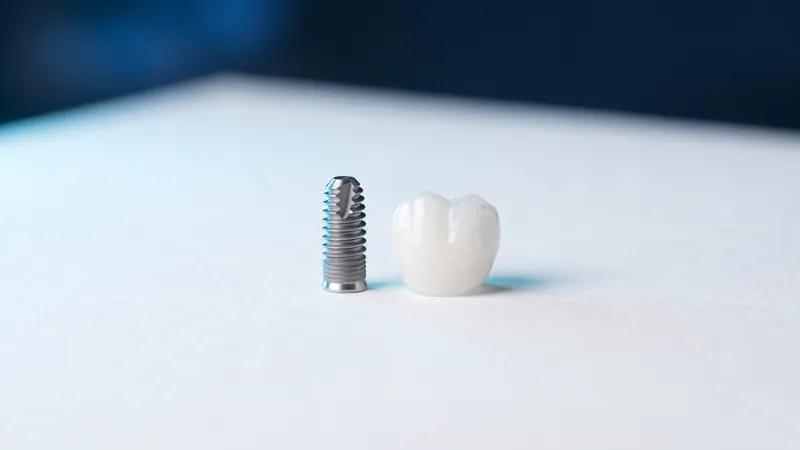
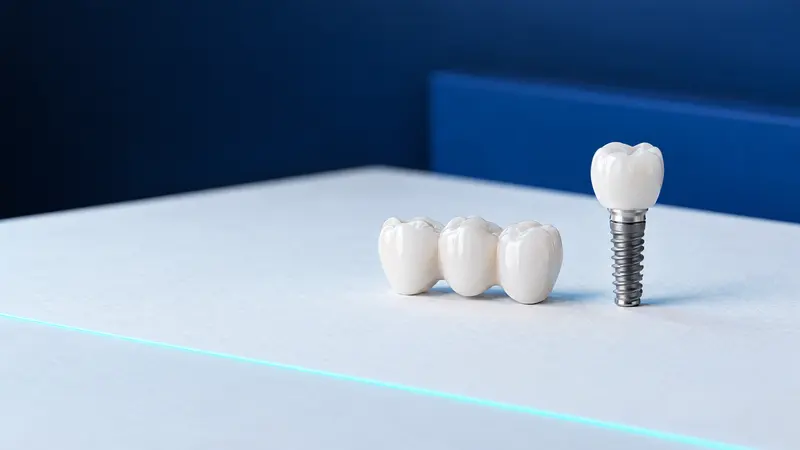
The implant and the crown wear differently. The titanium screw in the bone does not decay, whereas the crown works with every bite: the ceramic can chip and the screw holding the crown can loosen.
Repairing or replacing a crown does not mean losing the implant. It is routine prosthetic work, similar to replacing an old crown on your own tooth, which is why an implant check-up also includes checking the bite and the stability of the crown.
How do you care for an implant so it lasts as long as possible?
What happens after the procedure has a large influence on how long an implant lasts: daily hygiene and regular supportive care. A lack of such care is one of the factors that the 2018 review links to peri-implantitis on the basis of strong evidence (Schwarz et al., 2018).
- Clean the implant like your own tooth, and the spaces next to it with floss or an interdental brush.
- Come for check-ups and professional hygiene at intervals the dentist sets according to your individual risk.
- If you smoke, cut down or quit, especially during healing.
- Treat periodontitis and keep diabetes under control if you have it.
- Get in touch if the gum by the implant bleeds, swells or recedes, or if pus or mobility appears.
How it works at DentalBlue
At DentalBlue in Białystok, implants are planned on a CBCT image from the clinic's own radiology unit. Before the procedure the dentist takes a history of general illnesses and the medicines you take. Implant placement takes place under local anaesthesia or, for qualified patients, under general anaesthesia. The clinic also provides periodontology and prevention, including professional hygiene, the care an implant needs once treatment is complete. A consultation can be booked by phone.
Frequently asked questions
Does an implant have to be replaced after a few years?
There is no rule that an implant is replaced after a set time. An implant that has fused well with the bone and stays healthy remains in it, and studies report 94.6% survival after an average of 13.4 years. After some years the crown may need repair or replacement, which does not mean replacing the implant.
Can the body reject an implant like a transplant?
Not in the sense of transplant rejection. An implant contains no living cells, so it does not trigger a rejection reaction like an organ from a donor. Implant loss results from a failure to fuse with the bone or, later, from bone loss in the course of inflammation such as peri-implantitis.
Can you smoke after an implant is placed?
Smoking is linked to a higher risk of implant loss: a review of 107 studies reports 6.35% failures in smokers versus 3.18% in non-smokers (Chrcanovic et al., 2015). That is why the dentist usually advises not smoking during healing, and quitting for good benefits the implant's durability.
Can a person with osteoporosis have an implant?
Osteoporosis on its own does not usually rule out an implant. The medicines taken matter more: with antiresorptive medicines there is a risk of osteonecrosis of the jaw, depending on the medicine, the dose and the reason for treatment (AAOMS, 2022). Every such medicine must be mentioned at qualification.
Are implants funded by the NFZ?
No. Implants, crowns and bridges are not on the list of dental services funded by the NFZ (Poland's National Health Fund) for adults. The NFZ funds acrylic dentures, partial ones when at least 5 teeth are missing in an arch and complete ones, no more than once every 5 years.
Sources
- Howe MS et al., J Dent: implant survival after 10 years, meta-analysis (2019)
- Moraschini V et al., Int J Oral Maxillofac Surg: long-term implant survival (2015)
- Chrcanovic BR et al., J Dent: smoking and implant failure, meta-analysis (2015)
- Naujokat H et al., Int J Implant Dent: implants and diabetes, systematic review (2016)
- Derks J, Tomasi C, J Clin Periodontol: prevalence of peri-implant diseases (2015)
- Schwarz F et al., J Clin Periodontol: peri-implantitis, World Workshop on classification (2018)
- Hwang D, Wang HL, Implant Dent: medical contraindications to implant therapy, part I (2006)
- AAOMS: position paper on medication-related osteonecrosis of the jaw (2022)
An informational article. It does not replace a consultation, and treatment decisions are made during a visit.