What are zirconia implants, and how do they differ from titanium ones?
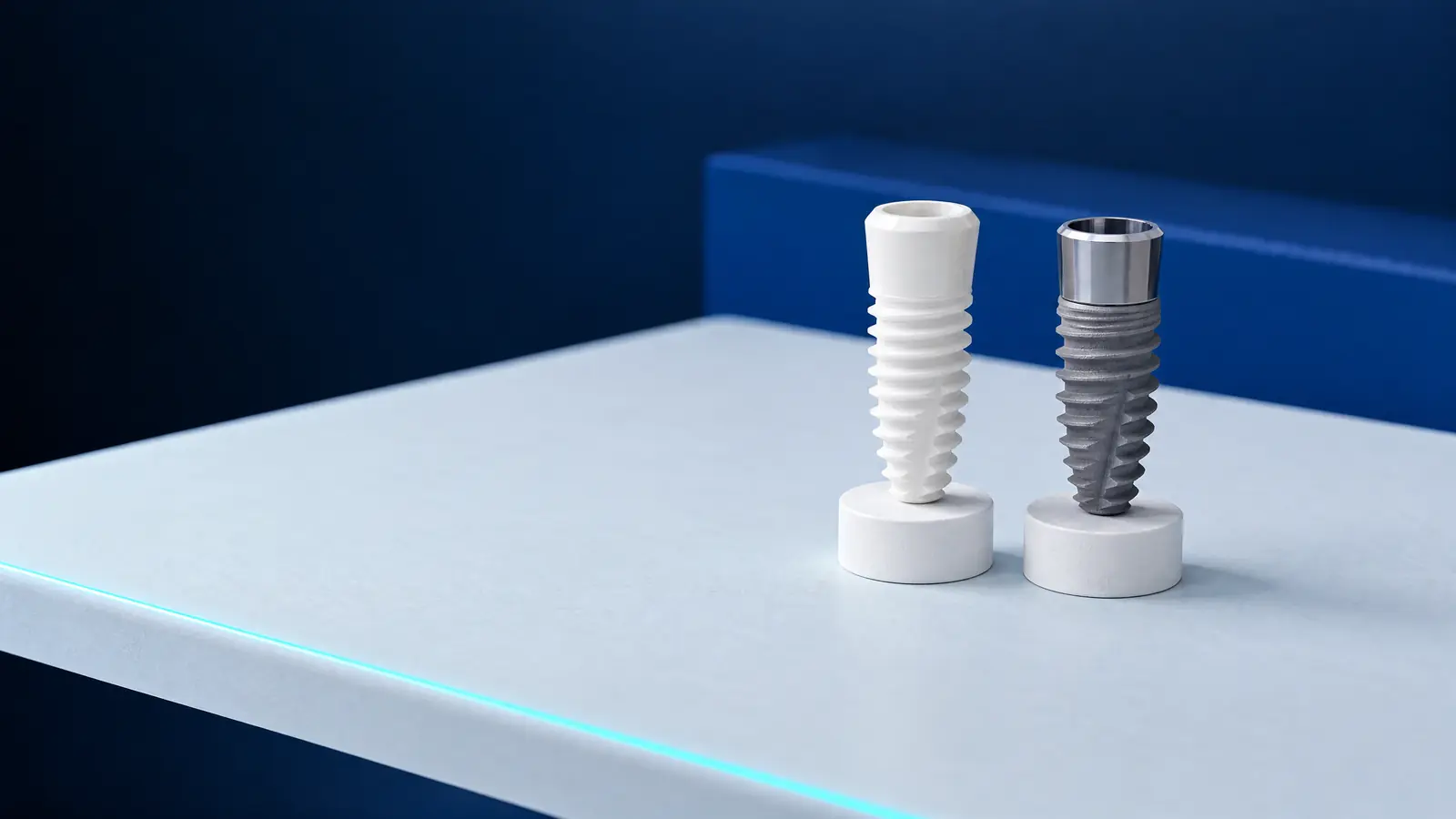
A zirconia implant is made of a ceramic based on zirconium oxide and does the same job as a titanium implant: it replaces the root of a tooth and fuses with the bone. Titanium and its alloys remain the most widely used implant material, and the review by Mohseni et al. (2023) identified the main drawback of titanium as its dark grey colour, which often shows through the mucosa around the implant and spoils the aesthetic result when the gum is thin.
Zirconium oxide ceramic lacks the dark colour of titanium, which is why ceramic implants are considered mainly for aesthetic reasons or at the request of people who want to avoid a metal implant body. The choice of material, however, is a matter for the treatment plan rather than for preference alone, because the two types have different possibilities and limitations.
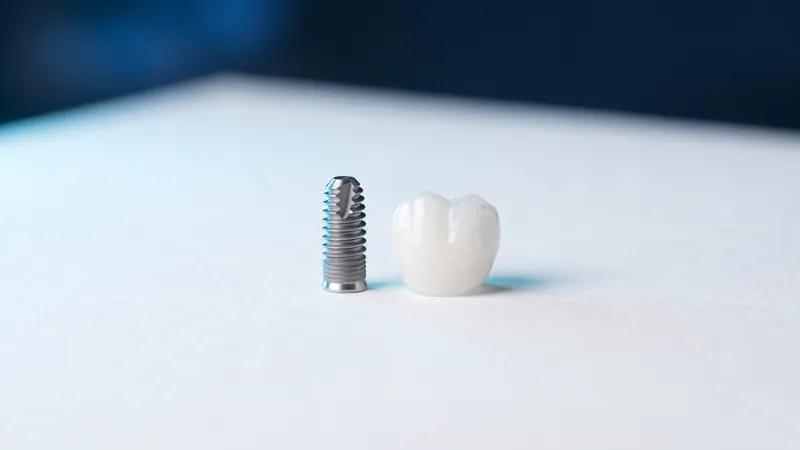
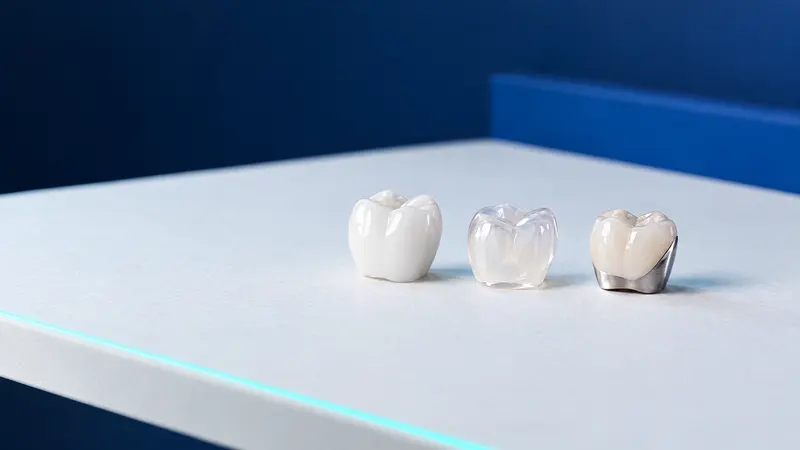
A zirconia implant should not be confused with a zirconia crown on an implant. The crown is the visible part of the tooth, and it can be fitted on a titanium implant; in the review by Pjetursson et al. (2018), zirconia crowns on implants had a 5-year survival of 97.6%, and metal-ceramic crowns 98.3%.
What do studies say about how long zirconia implants last?
Zirconia implants currently on the market show high survival in studies, but they have a shorter clinical history than titanium ones. The 2023 meta-analysis by Roehling et al. (6 studies, 277 implants, 221 patients) reported survival of 97.2% after 5 years and mean bone loss around the implant of 1.1 mm.
The 2023 review by Mohseni et al. (25 studies, 4,017 implants) estimated cumulative survival after 10 years at 95.1%, although only 7 studies lasted longer than 60 months. Of the 172 implants lost, 26 fractured, mainly narrow-diameter implants, and almost all the fractures involved models that have been withdrawn from the market.
For comparison, a meta-analysis of titanium implants (Howe et al., 2019, 18 studies) reported 10-year survival of 96.4%, and the review by Moraschini et al. (2015, 23 studies, 7,711 implants) a mean survival of 94.6% after a mean follow-up of 13.4 years. Early generations of zirconia implants did less well: a 2018 meta-analysis showed that commercially available implants had significantly better survival than models not available on the market.
In the same 2018 meta-analysis (Roehling et al., 18 studies), commercially available zirconia implants had technical complications in 1.6%, implant fractures in 0.2% and biological complications in 4.2% of cases, over follow-up of 12 to about 61 months. The authors stressed that long-term data are needed to confirm these promising results.
Zirconia or titanium implants: a point-by-point comparison
In short randomised trials, zirconia and titanium implants give similar results, but such trials are few and include few patients. In the trial by de Beus et al. (2024) in 50 people with a missing upper premolar, the change in bone level after a year was similar, and in the trial by Koller et al. (2020) no significant differences were found after 80 months, in a sample of 31 implants.
Both trials concerned single teeth: in the de Beus et al. study the implants were loaded with a lithium disilicate crown after 3 months, and in the Koller et al. study all-ceramic crowns were used. There are few data on bridges supported by zirconia implants, and the review by ArRejaie et al. (2019) on one-piece implants included a total of 6 clinical studies.
| Criterion | Titanium implant | Zirconia implant |
|---|---|---|
| Material | Titanium or titanium alloy | Ceramic based on zirconium oxide |
| Colour | Dark grey, may show through a thin gum | Light-coloured ceramic |
| Survival in meta-analyses | 96.4% after 10 years (18 studies) | 97.2% after 5 years (6 studies), an estimated 95.1% after 10 years |
| Length of follow-up | Many studies lasting more than 10 years | Few studies lasting more than 5 years |
| Design | Usually an implant with a separate abutment screwed onto it | Often one-piece, the abutment is part of the implant |
| Changing the abutment angle | Possible, abutments come in different angles | Not possible with one-piece models |
| Risk of allergy | Rare, 0.6% in a study of 1,500 patients | Ceramic body; some two-piece systems have a metal screw |
Is titanium allergy a reason to choose a zirconia implant?
Titanium allergy is rare, and its clinical significance has not been clearly established. In the study by Sicilia et al. (2008) of 1,500 patients with implants, 9 people, or 0.6%, tested positive for titanium, mainly among patients with symptoms suggesting an allergy after the procedure.
The systematic review by Javed et al. (2013) concluded that the role of titanium as a cause of allergic reactions in people with implants remains unproven. The review by Müller-Heupt et al. (2022) judged skin and laboratory tests for titanium hypersensitivity to be inconsistent, and linked the reactions to an inflammatory response to fine titanium particles rather than to classic allergy.
The symptoms described in studies and linked to titanium hypersensitivity are mainly inflammatory skin changes and gum overgrowth, and in a single case report swelling of the chin and lip area with reddening of the mucosa (Javed et al., 2013). Such symptoms, however, have many other causes, so they should be assessed by a doctor.
The 2026 review by Restelli et al. gathered reports of only 21 patients; in 17 cases the implant was removed, and the authors judged hypersensitivity to be rare but clinically relevant. If you have a documented metal allergy, mention it at the consultation, because the choice of material then needs a separate discussion, sometimes with an allergist as well.
What does the phrase “screwless implants” mean?
The phrase “screwless implants” is not a medical term and may mean different things in descriptions of services, so it is worth asking what exactly it means in a specific treatment proposal. Most often it refers to the design of the implant or to the way the crown is fixed.
One-piece implants were developed so that the abutment passing through the gum is an integral part of the implant (Mohseni et al., 2023), which means there is no screw connecting the implant to the abutment. The price for this is that the part above the gum cannot be exchanged for an abutment at a different angle.
A crown on an implant can be screwed in place or cemented onto the abutment. The review by Sailer et al. (2012) found no clear advantage for either method: more serious biological complications occurred more often with cemented crowns and technical problems with screw-retained ones, although the latter are easier to remove for repair.
When might a zirconia implant not be a good choice?
A zirconia implant has limitations arising from its material and design, which the dentist takes into account when planning. The review by ArRejaie et al. (2019) on one-piece implants considered it unresolved whether they perform better than titanium or two-piece implants.
- A small implant diameter: in the review by Mohseni et al., most fractures involved narrow implants.
- The need to grind the part above the gum: implants whose crown portion was adjusted with a drill had significantly lower survival.
- The need to change the abutment angle, which a one-piece implant does not allow.
- An expectation of long-term clinical data: the authors of meta-analyses stress the need for further randomised trials comparing the two materials.
What should you ask before choosing an implant material?
The implant material is chosen by the dentist after an examination and a CBCT scan, taking into account the position in the arch, the amount of bone, the planned restoration and your general health. The discussion should also cover how long the type of implant has been studied and what any future repair of the prosthetic parts would involve.
- What material is the implant made of, and is it one-piece or two-piece?
- How long is the clinical follow-up for this type of implant?
- Will the crown be screw-retained or cemented, and how is it repaired?
- What does the price include: the implant, the abutment, the crown and check-up visits?
- What are the options if I have a documented metal allergy?
How the implant is chosen at DentalBlue
In DentalBlue’s description of services, implantology covers titanium implants planned on a CBCT image from the clinic’s own radiology unit. The type of implant and restoration is decided by the dentist at an implant consultation, after an examination and assessment of the bone, and a documented metal allergy is worth reporting before planning. In the clinic’s price list, “Wszczepienie implantu” (implant placement) costs 3 500 zł, and “Korona cyrkonowa na implancie” (zirconia crown on an implant) 3 500 zł. The final scope and cost are set at the consultation, and prices may change.
Frequently asked questions
Are zirconia implants better than titanium ones?
Studies do not allow that conclusion. Short randomised trials give similar results for both materials, but titanium implants have far more long-term follow-up. Zirconia has the advantage of colour, and titanium a longer clinical history.
How can I find out whether I am allergic to titanium?
Tests for titanium hypersensitivity give inconsistent results: a 2022 review advised caution in interpreting them. If you have had skin reactions or other symptoms after contact with metals, describe them at the consultation; the dentist may recommend an allergy assessment.
Can a zirconia implant fracture?
It can, although this is rare. In a review of 4,017 zirconia implants, 26 fractured, mainly narrow-diameter ones, and almost all the fractures involved models withdrawn from the market. In the 2018 meta-analysis, fractures of commercially available implants occurred in 0.2%.
Is a zirconia crown on an implant the same as a zirconia implant?
No. The implant is the part placed in the bone, and the crown is the visible part of the tooth. A zirconia crown can be fitted on the abutment of a titanium implant; in a 2018 review, such crowns had a 5-year survival of 97.6%.
Are zirconia implants available on the NFZ?
No. No implants, titanium or zirconia, are among the services funded by the NFZ, Poland’s National Health Fund, so implant treatment in Poland is paid for in full by the patient (Ministry of Health regulation, consolidated text Dz.U. 2025 poz. 615, legal status as of 12 October 2026).
Does the gum look different around a zirconia implant than around a titanium one?
The results are mixed. In the trial by de Beus et al. (2024), the colour and texture of the gum were rated better with zirconia implants, and the level of the gum margin better with titanium ones. After 80 months, the Koller et al. (2020) trial found no significant differences in gum bleeding or in aesthetic assessment.
Sources
- Roehling S et al., Clin Oral Implants Res: zirconia implants after at least 5 years, a meta-analysis (2023)
- Mohseni P et al., Clin Oral Investig: clinical outcomes of zirconia implants, a meta-analysis (2023)
- Roehling S et al., Clin Oral Implants Res: zirconia implants in clinical studies, a meta-analysis (2018)
- de Beus JHW et al., Clin Oral Implants Res: zirconia and titanium implants, a randomised trial (2024)
- Sicilia A et al., Clin Oral Implants Res: titanium allergy in 1,500 patients with implants (2008)
- Müller-Heupt LK et al., Int J Implant Dent: titanium hypersensitivity testing, a review (2022)
- Howe MS et al., J Dent: implant survival after 10 years, a meta-analysis (2019)
- Sailer I et al., Clin Oral Implants Res: cemented and screw-retained crowns on implants, a review (2012)
An informational article. It does not replace a consultation, and treatment decisions are made during a visit.