How does an implant differ from a bridge?
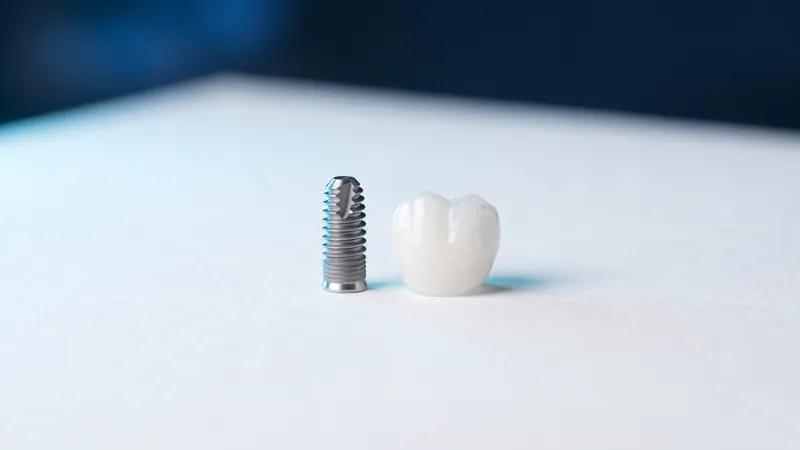
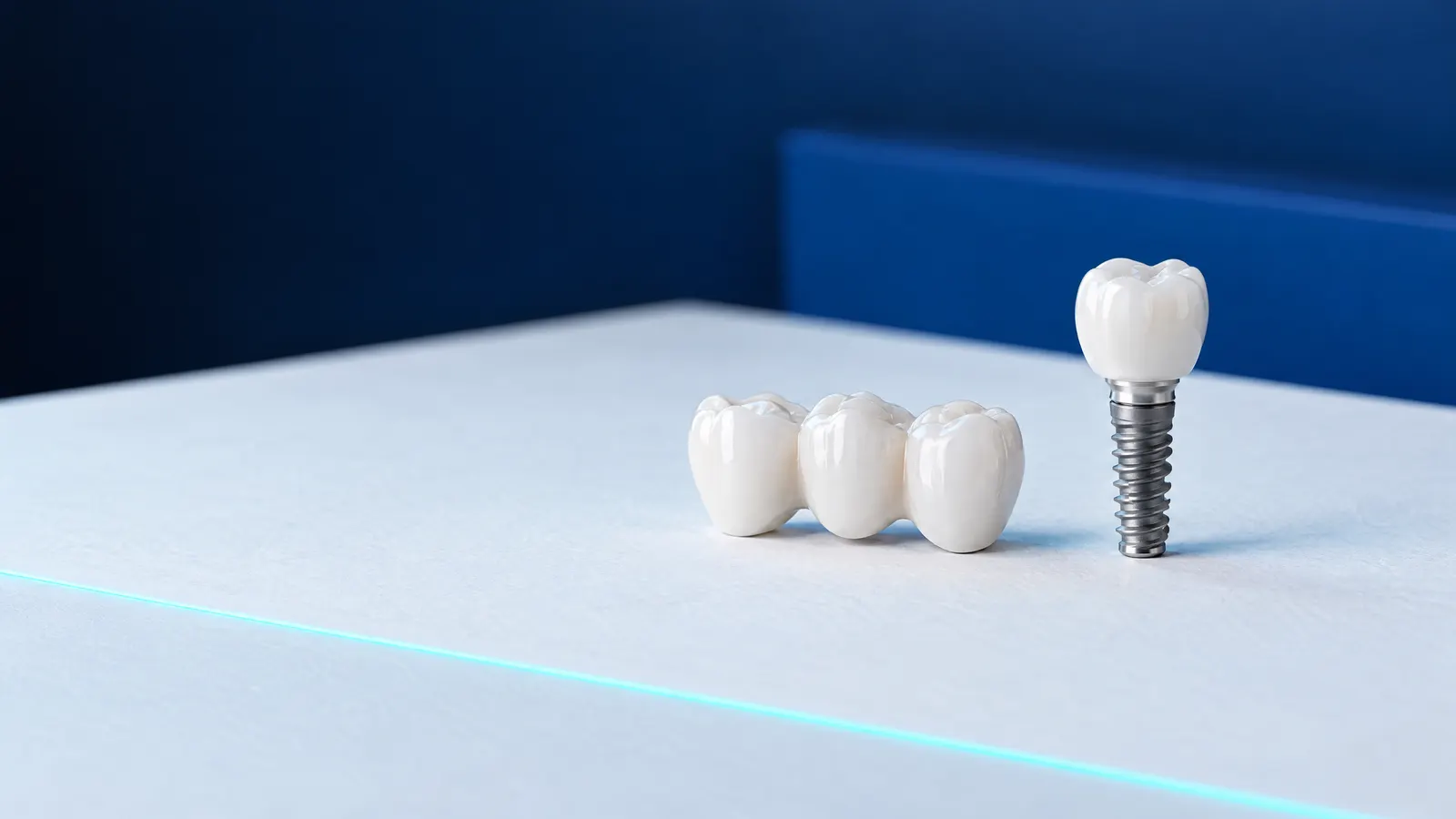
An implant and a bridge differ in what the new tooth rests on. An implant is a titanium screw placed in the bone where the root is missing, with a crown fixed to it, and the neighbouring teeth remain untouched. A dental bridge is a structure of joined crowns: the missing tooth, called the pontic, is suspended between crowns fitted on the ground-down neighbouring teeth, called the abutments.
There are also intermediate solutions. An adhesive bridge is bonded to the inner surface of the neighbouring tooth with minimal preparation of the enamel, and an implant-supported bridge rests not on teeth but on implants, which makes sense when several adjacent teeth are missing.
Implant or bridge: a point-by-point comparison
An implant has the advantage where the neighbouring teeth are healthy, and a bridge where they need crowns anyway or where an implant is not possible. The table concerns replacing one missing tooth; the final choice depends on the examination, the images and the condition of the teeth around the gap.
| Criterion | Implant with a crown | Bridge on your own teeth |
|---|---|---|
| Neighbouring teeth | Not ground down | Ground down for crowns, even when healthy |
| Bone in the gap | An adequate amount needed, sometimes bone regeneration | The amount of bone in the gap is not a condition |
| Treatment time | Usually several months of healing before the final crown | A few visits, with no bone healing period |
| Survival after 10 years in studies | 89.4% of implant crowns | 89.2% of tooth-supported bridges |
| Typical complications | Chipped ceramic, a loosened screw, inflammation around the implant | Decay and death of the pulp in the abutment teeth |
| Hygiene | As for your own tooth, plus checks of the tissues around the implant | Cleaning under the pontic with floss or an interdental brush |
| What affects the cost | The implant, the crown, the CBCT scan, any bone regeneration | Number of bridge units, material, treatment of the abutments |
| NFZ for adults | Not funded | Not funded |
Which is better, an implant or a bridge, according to studies?
Studies do not point to a single winner: a single implant crown and a conventional bridge have similar survival after 10 years. A systematic review of studies with at least 5 years of follow-up estimated survival at 89.4% for implant crowns and 89.2% for tooth-supported bridges; cantilever bridges, with the pontic attached on one side only, did less well, at 80.3% (Pjetursson et al., 2007).
What differs is the type of problem. With bridges the most common complications were biological, namely decay and death of the pulp in the abutment teeth, while implant restorations more often had technical complications: chipped ceramic, loosening of the abutment or screw and debonding of the crown.
More recent reviews of implants alone, without the crown, report 96.4% survival after 10 years (Howe et al., 2019) and 94.6% after an average of 13.4 years (Moraschini et al., 2015). These figures describe groups of patients, not a specific tooth, and the result is influenced by the condition of the abutments, the amount of bone, hygiene, smoking and regular check-ups.
When is a bridge a sensible choice?
A bridge is a sensible choice especially when the teeth next to the gap need crowns anyway. If they have large fillings or have had root canal treatment, preparing them for a bridge does not take away healthy tissue but gives them a restoration they need.
An implant has the advantage when the neighbouring teeth are healthy and unrestored, because a bridge would require grinding away enamel that cannot be replaced. In practice the choice is often decided by several circumstances at once.
- The neighbouring teeth have extensive fillings or have had root canal treatment and need crowns.
- There is little bone in the gap, and the patient does not want to or cannot undergo bone regeneration.
- General health or the medicines taken argue against a surgical procedure, which the dentist assesses from the medical history.
- Time matters, and several months of implant healing are hard to accept in the given situation.
How long does treatment take with an implant, and with a bridge?
A bridge is made faster because it does not require bone healing: after the abutments are prepared and an impression or scan is taken, the laboratory makes the structure, and until then the patient wears a temporary restoration. Treatment is usually completed in a few visits.
An implant needs time to fuse with the bone, which is called osseointegration. This usually takes several months, most often 2 to 6, and longer when bone has to be regenerated first. According to the ITI definition, loading an implant with a crown within a week of the procedure is called immediate, and after more than 2 months conventional (Weber et al., 2009).
A Cochrane review found no convincing difference in failures between immediate, early and conventional loading (Esposito et al., 2013). Whether the time to the crown can be shortened at a given site depends on the quality of the bone and the stability of the implant after placement.
What is an adhesive bridge?
An adhesive bridge is a light bridge whose pontic is bonded by a wing to the inner surface of the neighbouring tooth, without grinding it down for a full crown. It is used mainly when a single tooth is missing at the front of the mouth, where biting forces are lower than at the molars.
An adhesive bridge can be a solution for young people whose bone is still growing, as implants are placed only once growth has finished. Whether the neighbouring tooth is suitable is assessed by the dentist on the basis of a bite examination and an X-ray.
One missing tooth: what if not an implant or a bridge?
A single missing tooth can also be replaced with a partial denture. A denture is removable and rests on the gum and teeth, so it gives less stability than a fixed restoration, but it requires no grinding down and no surgery.
Leaving a gap without a plan is not neutral for the bite. Over time the neighbouring teeth can tilt into the empty space, the opposing tooth can drift towards it, and the bone where the tooth was extracted gradually shrinks, which later makes implant placement harder.
Under the NFZ (Poland's National Health Fund), adults are not funded for implants, crowns or bridges. The NFZ funds acrylic dentures, partial ones when at least 5 teeth are missing in an arch and complete ones, no more than once every 5 years, so there is no funded replacement for one missing tooth (Ministry of Health regulation, Dz.U. 2025 item 615, law as at 12 October 2026).
How much does an implant cost, and how much a dental bridge?
The cost of an implant depends on whether the implant with a crown is enough or bone regeneration is needed, and the cost of a bridge on the number of units (crowns and pontics), the material and whether the abutment teeth need treatment first. When comparing, it is worth counting the whole treatment, not a single item.
According to the clinic's price list, the two basic implant items alone, placement and a zirconia crown on the implant, come to 7 000 zł together, excluding the consultation, the CBCT scan, uncovering and any bone regeneration. Crowns on your own teeth are priced individually. The zirconia bridge items are in the implantology category; the dentist explains at the consultation exactly what they cover in a specific plan.
The dentist presents the final scope and cost in a written plan after the examination and images, and prices in the clinic's price list may change.
| Item in the clinic's price list | Price |
|---|---|
| Konsultacja implantologiczna (implant consultation) | 300 zł |
| Konsultacja protetyczna (prosthetic consultation) | 300 zł |
| Tomografia komputerowa, szczęka lub żuchwa (CBCT scan, upper or lower jaw) | 300 zł |
| Wszczepienie implantu (implant placement) | 3 500 zł |
| Odsłonięcie implantu, 1 implant (implant uncovering, one implant) | 300 zł |
| Korona cyrkonowa na implancie (zirconia crown on an implant) | 3 500 zł |
| Korona pełnocyrkonowa (full zirconia crown) | 3 000 zł |
| Most 3pkt na cyrkonie (three-unit zirconia bridge, implantology category) | 10 000 zł |
| Most 4 pkt na cyrkonie (four-unit zirconia bridge, implantology category) | 14 000 zł |
| Most adhezyjny cyrkonowy AET (adhesive zirconia bridge) | 2 500 zł |
| Most adhezyjny kompozytowy AET (adhesive composite bridge) | 1 700 zł |
How it works at DentalBlue
At DentalBlue in Białystok, implants are planned on a CBCT image from the clinic's own radiology unit, which shows the height and width of the bone at the gap. The clinic provides both implantology and prosthetics, meaning crowns and bridges, including adhesive bridges. Implant placement and bone regeneration are carried out under local anaesthesia or, for qualified patients, under general anaesthesia. A first visit without pain ends with a written treatment plan. A consultation can be booked by phone.
Frequently asked questions
Which is cheaper, an implant or a bridge?
It depends on the situation. A three-unit bridge is two crowns on the abutments plus a pontic, an implant is a surgical procedure plus one crown, and extra costs can come with either path: bone regeneration for an implant, root canal treatment or rebuilding of the abutments for a bridge. A comparison only makes sense on a specific treatment plan.
Does an implant-supported bridge work when several teeth are missing?
When several adjacent teeth are missing, a bridge can rest on implants instead of teeth, so an implant does not have to be placed for every missing tooth. A review of studies reported 86.7% survival after 10 years for bridges supported only by implants (Pjetursson et al., 2007). The number of implants is decided on the CBCT scan.
Can decay develop under a bridge?
Yes. In studies, decay and death of the pulp in the abutment teeth were the most common biological complications of conventional bridges (Pjetursson et al., 2007). The crown margins and the space under the pontic need cleaning every day with floss that has a stiffened end or with an interdental brush.
Can a bridge be replaced with an implant?
It can, but abutment teeth that were ground down earlier will not regain their enamel, so after the bridge is removed they still need crowns. Replacement usually makes sense when the bridge has to come off for another reason, for example decay in an abutment. Whether an implant can be placed depends on the bone, assessed on a CBCT scan.
Can an implant be placed straight after a tooth is extracted?
In selected situations, yes: the implant is placed in the socket on the same day, and in good conditions a temporary crown is fixed to it. The 2023 ITI consensus regards this protocol for a single tooth in the front of the upper jaw as predictable in favourable conditions (Morton et al., 2023).
Sources
- Pjetursson BE et al., Clin Oral Implants Res: tooth-supported bridges versus implant crowns and bridges, systematic review (2007)
- Howe MS et al., J Dent: implant survival after 10 years, meta-analysis (2019)
- Moraschini V et al., Int J Oral Maxillofac Surg: long-term implant survival (2015)
- Morton D et al., Clin Oral Implants Res: ITI consensus, implant placement and loading protocols (2023)
- Weber HP et al., IJOMI: ITI consensus, definitions of implant loading (2009)
- Esposito M et al., Cochrane: timing of loading implants with a crown (2013)
- Dz.U. 2025 poz. 615: rozporządzenie MZ w sprawie świadczeń gwarantowanych z zakresu leczenia stomatologicznego (2025)
An informational article. It does not replace a consultation, and treatment decisions are made during a visit.