What is a sinus lift (maxillary sinus floor elevation)?
Maxillary sinus floor elevation, also called a sinus lift, is a surgical procedure that creates room for an implant at the back of the upper jaw when too little bone is left between the mouth and the sinus. The dentist separates the thin membrane lining the floor of the sinus from the bone, lifts it and fills the space created with bone or a bone substitute material. Over time this material remodels into bone in which an implant can be placed.
Bone grafting is a broader term. It covers any rebuilding of missing bone before an implant is placed or together with it: widening or heightening the alveolar ridge (augmentation), filling the socket straight after a tooth is extracted (socket preservation) and sinus floor elevation itself. Each of these procedures has different indications and a different healing time.
Why is bone missing after a tooth extraction?
The bone of the alveolar ridge exists to hold the teeth, so after an extraction it begins to shrink. A 2012 review of studies reports that within 6 months of a tooth extraction the ridge loses 29 to 63% of its width and 11 to 22% of its height, and that this happens fastest in the first 3 to 6 months.
In the upper jaw there is a second factor: the maxillary sinus lies just above the roots of the premolars and molars. After these teeth are lost, the bone under the sinus floor can be thin from the outset, and over time more of it is lost from the mouth side as well. That is why this is the site where the question of a sinus lift comes up most often.
Bone is also lost by people with advanced gum disease (periodontitis), after chronic inflammation around the roots and after years of wearing a removable denture over a toothless stretch of the jaw. How much bone is left at a given site only becomes clear on imaging.
How does a CBCT scan show whether there is enough bone?
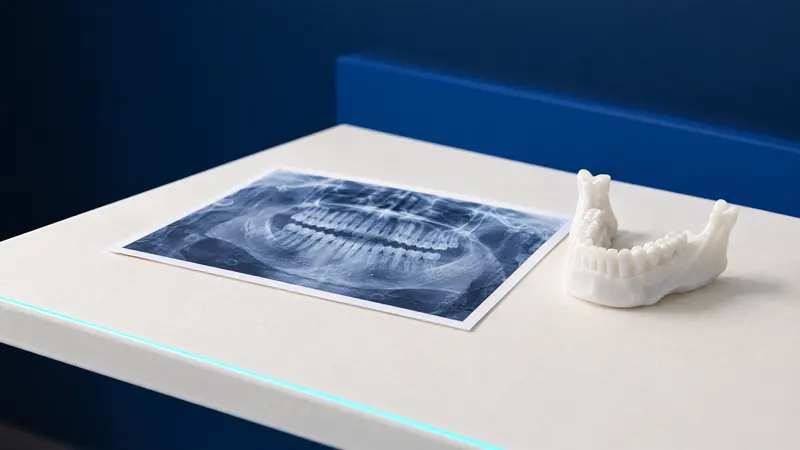
The amount of bone available for an implant is assessed on cone beam computed tomography (CBCT), because a panoramic X-ray shows the jaw flat and does not measure the width of the ridge. On the CBCT image the dentist reads the height of bone below the sinus floor, the width of the ridge, the shape of the sinus and any septa inside it, and then plans the length and diameter of the implant.
According to a European Commission review, the radiation dose from a small or medium field CBCT scan ranges from 11 to 674 µSv, with a median of 61 µSv. The median corresponds to roughly 9 days of the natural background radiation that an average resident of Poland receives.
The measurement sets the path that follows. With enough bone, the implant is placed without any rebuilding. With 4 to 9 mm of bone below the sinus, a 2014 Cochrane review compared short implants (5 to 8.5 mm) with sinus floor elevation: one year after loading it found no difference in implant loss, but there were more complications after a sinus lift. With even less bone height, rebuilding the bone is what remains.
Closed or open sinus lift: how do the techniques differ?
A closed and an open sinus lift differ in the route of access to the sinus. In the closed (transcrestal) technique the sinus floor is lifted from below, through the same opening in which the implant will sit, so the procedure is smaller and is often combined with placing the implant. In the open technique the dentist makes a small window in the side wall of the sinus, through which the membrane is lifted and the material introduced, which allows more bone to be rebuilt.
Research does not point to any one technique as more effective than the others. A Cochrane review comparing different ways of elevating the sinus floor found no evidence that any of them reduces the risk of losing the implant or the prosthetic restoration. The choice depends on the amount of bone, the anatomy of the sinus and the overall reconstruction plan.
| Procedure | What it involves | When it is considered | What studies report |
|---|---|---|---|
| Closed sinus lift | Lifting the sinus floor through the opening prepared for the implant | When more bone remains below the sinus | 92.8% of implants in place after 3 years (Tan, 2008) |
| Open sinus lift | A window in the side wall of the sinus, lifting the membrane, filling | When there is little bone below the sinus | 90.1% of implants after 3 years, 98.3% with rough-surface implants and a membrane |
| Ridge augmentation | Widening or heightening the ridge with bone or a biomaterial | When the ridge is too narrow or too low | Healing takes several months, depending on the material |
| Socket preservation | Filling the socket with material straight after extraction | When the implant is to be placed later | Less bone loss after 6 months, very uncertain evidence |
How long does bone rebuilding before an implant take?
Bone rebuilding before an implant usually takes several months, because the graft has to remodel into the patient’s own bone before it can bear a load. For grafts in the sinus, a 2017 meta-analysis found more new bone after more than 4.5 months of healing, and no further gain between a period of 4.5 to 9 months (6.2 on average) and a period of 9 to 13.5 months, which supports a time of about 6 months.
For augmentation outside the sinus there is no single figure that can honestly be given, because the time depends on the type and amount of material. When the bone allows the implant to be anchored stably, the dentist may place it during the sinus floor elevation itself, and the two healing processes then run in parallel. The exact schedule follows from the treatment plan agreed after the scan.
| Stage | Typical time | Source or note |
|---|---|---|
| Bone loss after extraction | Fastest in the first 3 to 6 months | Systematic review, Tan et al., 2012 |
| Maturing of the graft in the sinus | About 6 months | Meta-analysis, Danesh-Sani et al., 2017 |
| Ridge augmentation | Several months | Depends on the material; the time is set by the treatment plan |
| Socket preservation | Bone assessed after at least 6 months | As assessed by the studies in the Cochrane review, 2021 |
| Implant healing before loading | Traditionally 3 to 8 months | Cochrane review, 2013; shorter in selected situations |
Does a sinus lift hurt, and what are the risks?
Sinus floor elevation is carried out under local anaesthesia, which switches off the sensation of pain during the procedure, and for patients qualified for general anaesthesia the procedure can be done while they are asleep. Swelling and discomfort may persist for a few days afterwards, and the dentist gives instructions that need to be followed during healing.
Like any surgical procedure, a sinus lift carries a risk of complications, such as a tear in the sinus membrane during the procedure, infection of the graft, sinusitis or loss of part of the material. The Cochrane review recorded more complications after sinus floor elevation than after placing short implants, and a 2008 review describes the method as predictable, with a low rate of surgical complications.
Figures on implant survival are worth reading carefully. The same 2008 review reports 90.1% of implants still in place after 3 years, but counting by patient rather than by implant, 16.6% of people lost at least one implant over that time. These are research data, not a forecast for an individual, because the result depends on general health, smoking and oral hygiene.
- Contact the practice that carried out the procedure if swelling or pain increases after a few days instead of easing.
- Fever, or pus coming from the wound or from the nose on the side of the procedure, needs urgent assessment.
- Bleeding that does not stop despite pressure is also a reason to phone the same day.
- Difficulty breathing or swallowing and rapidly increasing swelling of the face are reasons to go to the hospital emergency department (SOR) or call 112, the emergency number.
How much do a bone graft and a sinus lift cost?
The cost of bone rebuilding depends on the technique, the amount of material, whether a membrane is used, the number of implants and whether the procedure is done under local or general anaesthesia. That is why some of these items in the clinic’s price list have a minimum price rather than a fixed one.
In the clinic’s price list, the item “Zachowanie zębodołu” (socket preservation) is priced from 800 zł, “Augmentacja wyrostka” (ridge augmentation) from 2 000 zł, and “Fibryna bogatopłytkowa, 2 próbki” (platelet-rich fibrin, 2 samples) costs 800 zł. An implant consultation is 300 zł, a CT scan of the upper or lower jaw 300 zł, and placing an implant 3 500 zł. Sinus floor elevation has no separate item in the published price list, so the final scope and cost are set at the consultation, and prices may change.
Implants and bone rebuilding for implants are not on the list of guaranteed dental services, so the NFZ (Poland’s National Health Fund) does not fund them. The full list of items is in the clinic’s price list.
How it works at DentalBlue
DentalBlue has its own radiology unit, where CBCT scans, panoramic X-rays and sinus X-rays are taken, so the bone is measured on site. Implants are planned on the CBCT image from this unit. Surgical procedures, including bone rebuilding, are carried out under local or general anaesthesia, and general anaesthesia is preceded by a joint dental and anaesthesiology consultation. A “Wizyta bez bólu” (visit without pain) includes a panoramic X-ray, a consultation, an examination and a written treatment plan in stages. A consultation can be booked by phone.
Frequently asked questions
Can an implant be placed at the same time as a sinus lift?
Yes, if the bone below the sinus allows the implant to be anchored stably; the implant and the graft then heal at the same time. With very little bone, the sinus floor is elevated first and the implant placed a few months later. A 2014 Cochrane review found no advantage for either option in terms of implant loss.
Where does the bone graft material come from?
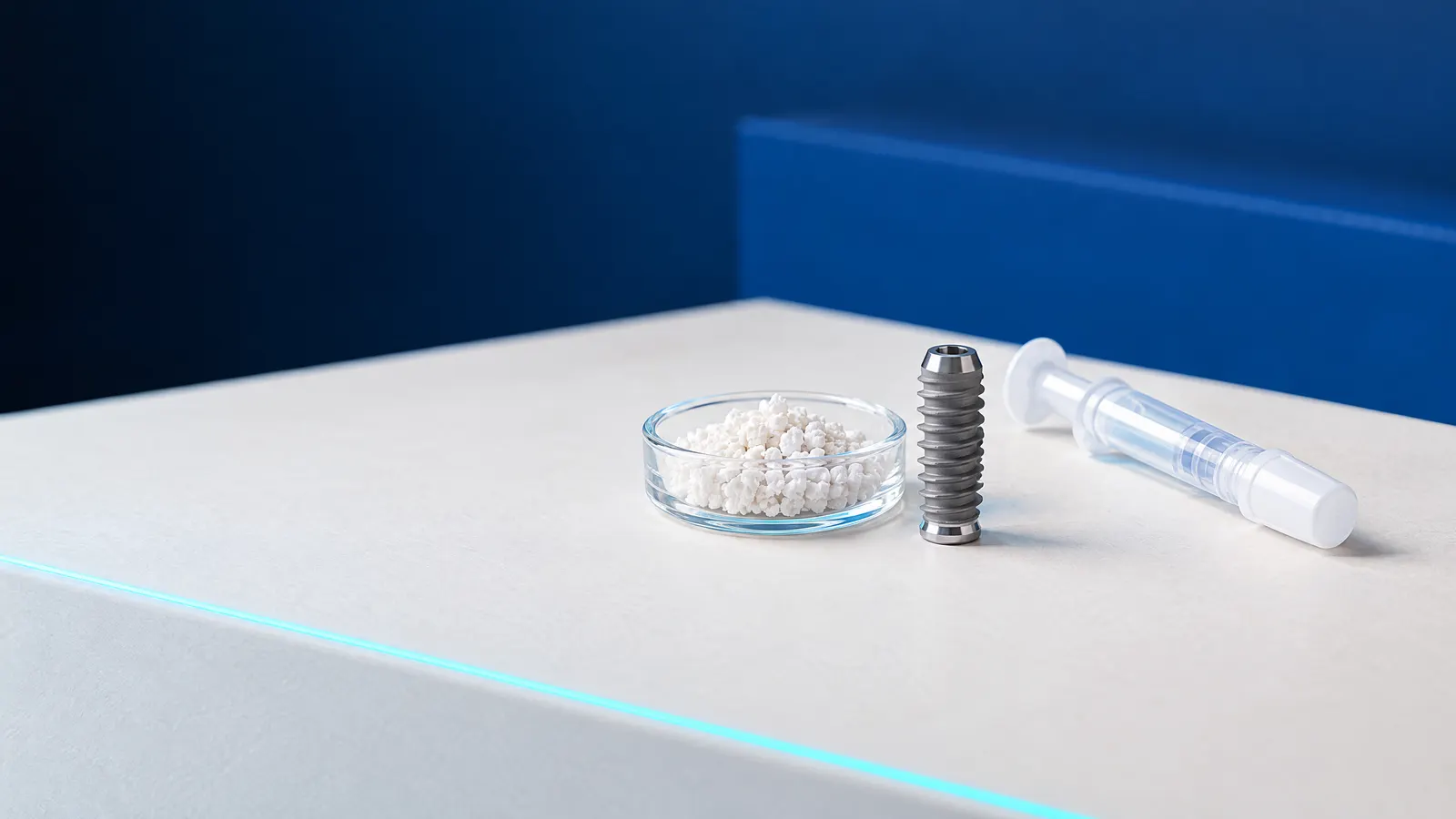
It can be the patient’s own bone, bone from a tissue bank, material of animal origin or a synthetic material. A 2017 meta-analysis found the most new bone with the patient’s own bone, but considered bone substitutes a good alternative, because they do not require bone to be taken from another part of the body.
Is platelet-rich fibrin necessary for a bone graft?
It is not mandatory. Platelet-rich fibrin is prepared from the patient’s blood and used as an addition to the graft. A 2014 Cochrane review found insufficient evidence that a related preparation, platelet-rich plasma, added to a sinus graft reduces the risk of implant loss. Whether to use it is decided by the dentist in the treatment plan.
Does the socket need preserving straight after a tooth extraction?
Not always. Socket preservation is considered when an implant is to be placed later and bone loss could make the procedure more difficult. A 2021 Cochrane review indicates that it may reduce the loss of ridge width and height after 6 months, but the certainty of this evidence is very low.
Is sinus floor elevation funded by the NFZ?
No. Neither implants nor bone rebuilding for implants are on the list of guaranteed dental services, so they are paid for privately. On the NFZ, however, a tooth can be extracted, including surgically.
Sources
- PubMed: Pjetursson et al., lateral window sinus floor elevation, systematic review, J Clin Periodontol (2008)
- PubMed: Tan et al., transcrestal sinus floor elevation, systematic review, J Clin Periodontol (2008)
- PubMed: Tan et al., dimensional changes of the ridge after tooth extraction, Clin Oral Implants Res (2012)
- PubMed: Danesh-Sani et al., graft materials and healing time in sinus augmentation, J Periodontal Res (2017)
- Cochrane: Esposito et al., interventions for augmenting the maxillary sinus (2014)
- Cochrane: Atieh et al., alveolar ridge preservation techniques (2021)
- Cochrane: Esposito et al., timing of implant loading (2013)
- European Commission: Radiation Protection 172, CBCT in dentistry (2012)
An informational article. It does not replace a consultation, and treatment decisions are made during a visit.