What is a dental bridge, and what does it look like?
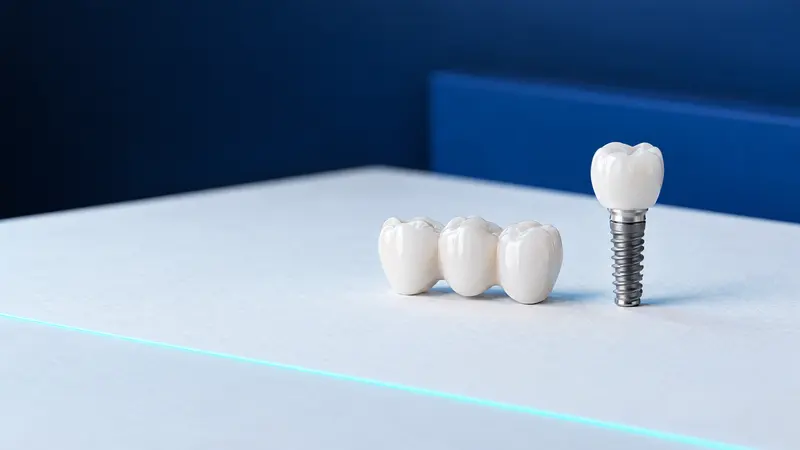
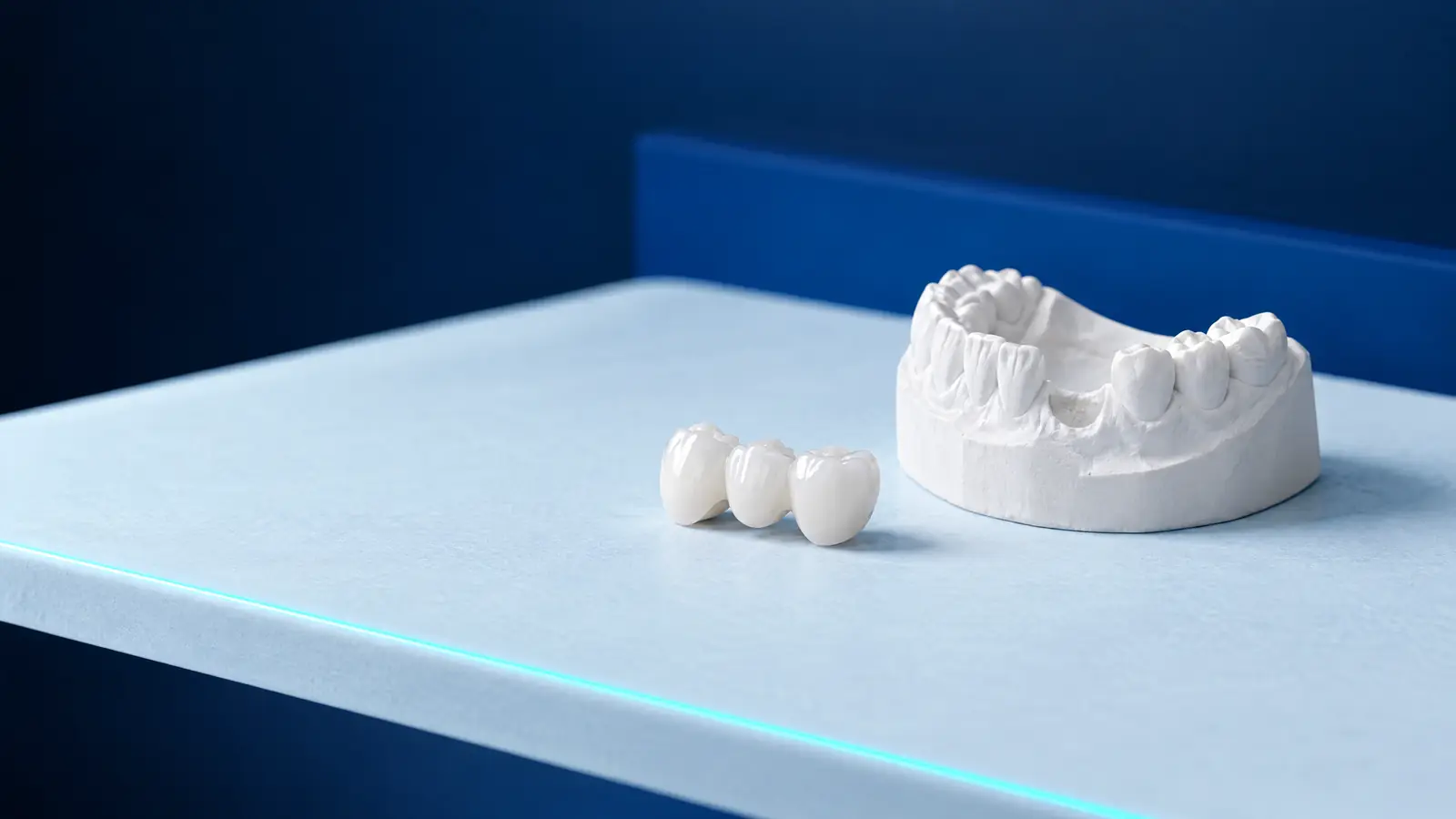
A dental bridge is a fixed replacement for one or more missing teeth, which the patient wears all the time and does not take out. A bridge consists of crowns placed on the teeth on both sides of the gap, called abutments, and an artificial tooth joined to them, called the pontic, which fills the gap above the gum.
Healthdirect, the Australian government’s health information service, describes bridges made most often of porcelain fused to metal, of zirconia or of gold alloys, as well as resin bridges on a metal framework and bridges on implants. From the outside a bridge looks like a row of joined teeth, and its shape and colour are matched to the neighbouring teeth.
Whether a bridge or an implant would be better in a given situation is discussed in a separate article on choosing between an implant and a bridge. This article is about the bridge itself: its types, how it is made, how long it lasts and how to look after it.
What types of bridge are there, and how many teeth can a bridge replace?
Bridges differ above all in what supports them: two teeth on both sides of the gap, teeth on one side only, wings bonded to the neighbouring teeth, or implants. According to Cleveland Clinic, a bridge most often replaces 1 to 3 teeth in a row, and in some situations up to 4, and it lists a bridge on implants as an option when 3 or more teeth in a row are missing.
A bridge on your own teeth requires healthy, stable teeth on both sides of the gap, because they carry the chewing forces for the missing tooth. The figures in the table come from the systematic review by Pjetursson et al. (2007) and, for adhesive bridges, from the review by Thoma et al. (2017).
| Type of bridge | What supports it | When it is used | Worth knowing |
|---|---|---|---|
| Conventional bridge | Crowns on the teeth on both sides of the gap | 1 to several missing teeth, healthy teeth next to the gap | 89.2% after 10 years in studies; the abutments have to be ground down |
| Cantilever bridge | Crowns on teeth on one side of the gap only | When there is no tooth on the other side of the gap | 80.3% after 10 years; regarded as a second choice |
| Adhesive bridge | A wing bonded to the back surface of a tooth | Usually one missing front tooth | Minimal preparation of the tooth; the most common problem is debonding |
| Bridge on implants | Implants placed in the bone | Several missing teeth next to each other | 86.7% after 10 years; technical faults are more frequent |
Porcelain or zirconia bridge: which material?
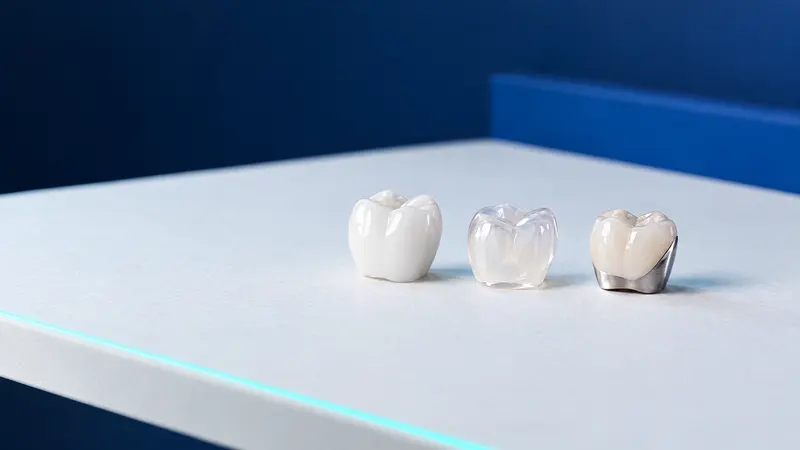
Choosing between a porcelain and a zirconia bridge in practice means choosing between a porcelain fused to metal bridge, zirconia veneered with porcelain and monolithic zirconia, because in everyday speech different ceramic structures are all called “porcelain”. A 2026 systematic review of tooth-supported bridges (Romandini et al.) reports 5-year survival of 92.9% for veneered zirconia, 91.3% for porcelain fused to metal bridges and 87.9% for monolithic zirconia, and the differences between them were not statistically significant.
Lithium disilicate bridges fared worse, at 82.5% after 5 years, and the authors write that the high rate of fractures rules out weaker ceramics for multi-unit bridges. Chipping of the ceramic was common, but least common in monolithic zirconia, while all-ceramic bridges developed decay at the margin and lost retention more often than porcelain fused to metal ones.
After 5 years, 71.0% of bridges were in function without any complication. The material is chosen by the dentist together with the patient, taking into account the position in the arch, the length of the bridge, the colour of the teeth and habits such as clenching.
How is a dental bridge fitted, visit by visit?
Fitting a bridge on your own teeth takes at least two visits: at the first the dentist prepares the abutments and takes an impression or a scan, and at the second fits the finished bridge. Healthdirect stresses that decay and gum disease have to be treated first, and the dentist checks whether the teeth that are to support the bridge are strong enough.
Between visits the patient wears a temporary bridge. According to Cleveland Clinic, making a bridge in the laboratory usually takes 2 to 4 weeks, and grinding down the abutments is irreversible, because enamel that has been removed cannot be restored. A bridge on implants takes longer, because the implants first have to fuse with the bone.
- Examination and X-ray: assessment of the abutments, their roots, the gums and the bone and, if needed, treatment of decay or root canal treatment of the abutments.
- Grinding the abutments down under local anaesthesia and shaping them for the crowns.
- An impression or a digital scan, shade selection and a record of the bite.
- A temporary bridge, which protects the prepared teeth and fills the gap.
- Try-in of the finished bridge: checking the fit of the margins, the contact with the gum and the bite.
- Cementing the bridge and instruction on cleaning under the pontic.
How long does a bridge on teeth last according to studies?
In studies a bridge on teeth usually lasts many years: the systematic review by Pjetursson et al. (2007) reports survival of conventional bridges of 93.8% after 5 years and 89.2% after 10 years. Cantilever bridges fared worse, at 91.4% after 5 and 80.3% after 10 years, which is why the authors recommend them as a second choice.
Survival is not the same as being free of trouble. In the review by Tan et al. (2004), 89.1% of bridges were still in the mouth after 10 years, but only 71.1% had no complications at all. Over that period the risk of losing a bridge to decay was 2.6% and to periodontitis 0.7%. Separately, the authors give the risk of technical complications: debonding (loss of retention) 6.4%, abutment fracture 2.1% and material complications 3.2%.
These figures describe groups of patients in studies, not a particular bridge. How long a bridge lasts depends on the condition of the abutments, hygiene under the pontic, the bite and regular check-ups.
How do you clean a bridge and the area under the pontic?
A bridge is cleaned every day like your own teeth, with fluoride toothpaste, and in addition the space under the pontic has to be cleaned, because the crowns of a bridge are joined together and ordinary floss cannot be passed between them. Healthdirect recommends floss with a stiffened end (superfloss), a floss threader or interdental brushes for this.
It is worth having the cleaning method shown to you at the surgery when the bridge is fitted, because the width of the space under the pontic varies. Cleveland Clinic recommends cleaning under the bridge every day, and Healthdirect reminds patients about regular check-ups.
- Brush the bridge and the abutment teeth twice a day with fluoride toothpaste, paying particular attention to the edge of the crowns and the gum.
- Once a day, pass floss with a stiffened end, or floss on a threader, under the pontic and slide it along its underside.
- Where the space is wider, use an interdental brush in a size chosen at the surgery.
- Come in if the bridge moves, a crack is visible in it, or the gum under the pontic bleeds or hurts.
What problems occur with a bridge, and when does it need replacing?
The most common problems with a bridge concern the abutment teeth rather than the structure itself. The review by Pjetursson et al. (2007) identifies decay of the abutments and the death of their pulp as the most common complications of conventional bridges, and Healthdirect writes that bridges usually fail because of decay in the teeth next to them or because the cement gives way.
A living tooth under a bridge may in time need root canal treatment. In the study by Cheung et al. (2005), the pulp remained alive after 10 years in 70.8% of bridge abutment teeth, compared with 84.4% of teeth under single crowns.
A bridge is usually replaced when decay develops under a crown that cannot be treated without removing the bridge, when an abutment or the structure fractures, or when a loosened bridge cannot be refitted with a tight seal. Whether recementing is enough or a new bridge is needed is decided by the dentist after an X-ray and an examination of the abutments.
How much does a dental bridge cost, and is it available on the NFZ?
The cost of a dental bridge depends on the number of units, that is crowns and pontics, on the material and on whether the abutments first need treatment, for example root canal treatment. The clinic’s price list does not give a total price for a conventional bridge on your own teeth: the scope and cost of such a bridge are set by the dentist at a prosthodontic consultation, which costs 300 zł in the price list.
In the clinic’s price list, “Most adhezyjny cyrkonowy AET” (adhesive zirconia bridge) costs 2 500 zł and “Most adhezyjny kompozytowy AET” (adhesive composite bridge) 1 700 zł. The items “Most 3pkt na cyrkonie” (three-unit zirconia bridge, 10 000 zł) and “Most 4 pkt na cyrkonie” (four-unit zirconia bridge, 14 000 zł) are in the implantology category; what they cover in a particular plan is explained by the dentist at the consultation. “Zacementowanie mostu” (bridge recementation) is 320 zł, and “Zdjęcie mostu za każdy punkt” (bridge removal, per unit) 300 zł. Prices may change.
Bridges are not among the services funded by the NFZ, neither for adults nor for children: the regulation on guaranteed dental services does not list them in any annex. Of prosthetic replacements, adults have acrylic dentures on the NFZ, partial ones when at least 5 teeth are missing in an arch and complete ones, no more than once every 5 years (legal position as of 18 October 2026).
How it works at DentalBlue
At DentalBlue in Białystok, bridges, including adhesive bridges, are made as part of prosthodontics, alongside crowns and full restorations. X-rays of the abutments, from an intraoral X-ray to a CBCT scan, are taken in the clinic’s own radiology unit, and when an abutment first needs root canal treatment, the clinic carries it out under a microscope. Implants for a bridge on implants are planned on a CBCT image. A “Wizyta bez bólu” (visit without pain, 300 zł) ends with a written treatment plan with the prices of each stage. A consultation can be booked by phone.
Frequently asked questions
How long does it take to make a dental bridge?
A bridge on your own teeth usually needs two visits, and between them the patient wears a temporary bridge. According to Cleveland Clinic, the laboratory usually makes the bridge within 2 to 4 weeks. A bridge on implants takes longer, because the implants first have to fuse with the bone.
Does grinding teeth down for a bridge hurt?
Living teeth are prepared for a bridge under local anaesthesia; this is how Cleveland Clinic describes preparing the abutments. Pain that increases after the procedure or comes on by itself needs a check, because it may mean irritation of the abutment’s pulp; in studies the pulp of bridge abutments died more often than under single crowns.
Is an adhesive bridge durable?
In a review of 29 studies (Thoma et al., 2017), adhesive bridges were in function in 91.4% of cases after 5 years and in 82.9% after 10 years. The most common problem was debonding, in 15% of cases within 5 years. Bridges with a zirconia framework, bonded to one tooth and in the front of the mouth fared better.
A bridge or a partial denture when several teeth are missing?
A bridge is fixed and supported by teeth or implants, while a partial denture is removable and rests on the gum and the teeth. Healthdirect lists a partial denture and implants as alternatives to a bridge. The choice depends on the number and position of the gaps and on the condition of the teeth that would support the bridge.
What should I do if my bridge has come loose?
See a dentist and do not try to glue the bridge back yourself. A loose bridge no longer protects the abutments with a tight seal, and according to Healthdirect decay and the cement giving way are the most common reasons for failure. The dentist assesses the abutments and decides whether the bridge can be refitted; in the clinic’s price list, “Zacementowanie mostu” (bridge recementation) costs 320 zł.
Sources
- Healthdirect Australia: Dental bridge (2025)
- Cleveland Clinic: Dental Bridges (2023)
- Clinical Oral Implants Research: Pjetursson BE et al., tooth-supported and implant-supported bridges, a systematic review (2007)
- Clinical Oral Implants Research: Tan K et al., survival and complications of bridges, a systematic review (2004)
- International Journal of Prosthodontics: Romandini P et al., porcelain fused to metal and all-ceramic bridges, a meta-analysis (2026)
- Clinical Oral Implants Research: Thoma DS et al., adhesive bridges, a systematic review (2017)
- International Endodontic Journal: Cheung GS et al., pulp vitality under crowns and bridge abutments (2005)
- ELI: Rozporządzenie MZ w sprawie świadczeń gwarantowanych z zakresu leczenia stomatologicznego, t.j. Dz.U. 2025 poz. 615
An informational article. It does not replace a consultation, and treatment decisions are made during a visit.