Why do you wear a retainer after braces?
A retainer is worn after braces so that the teeth do not return to where they were before treatment. The British Orthodontic Society (BOS) regards retainers as essential and considers that they should be recommended to every patient after orthodontic treatment.
The risk of relapse is highest in the first months after the braces come off. The BOS explains that the bone and gums around teeth that have been moved need at least a year to stabilise in their new arrangement, and that the risk of relapse does not disappear after that either.
So retention does not end after a year. In its patient leaflet, the BOS points out that the alignment of the teeth can change throughout life, because this is part of natural ageing. That is why a retainer is not an extra to treatment but its final and longest stage.
Do teeth move after braces without a retainer?
Yes, teeth can move after braces, and the risk rises when retention stops. The most frequently quoted data come from a long-term follow-up by Little and colleagues, who examined patients treated with tooth extractions long after they had stopped wearing retainers.
In a group of 31 people examined 20 years after retention ended, crowding of the lower front teeth increased over time, and only 10% of patients had clinically acceptable alignment of the lower incisors.
These figures need to be read with care. This is an old, small study of people who stopped wearing a retainer, not a relapse rate among patients who do wear one. It does show, however, why recommendations have shifted towards long-term retention.
Fixed or removable retainer: how do they differ?
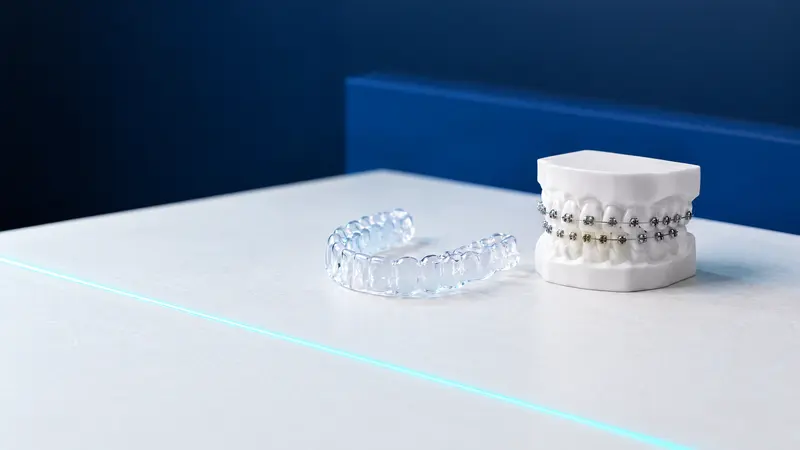
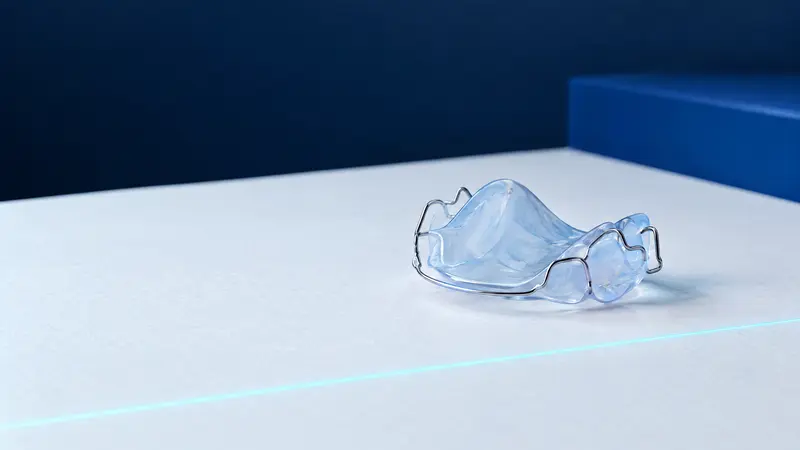
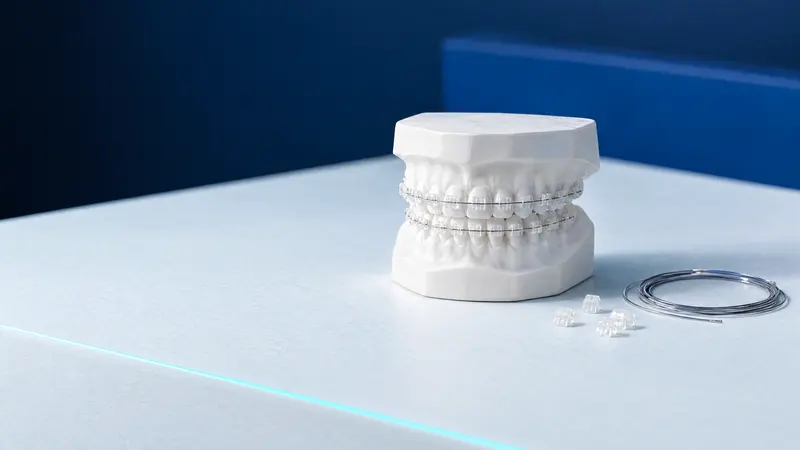
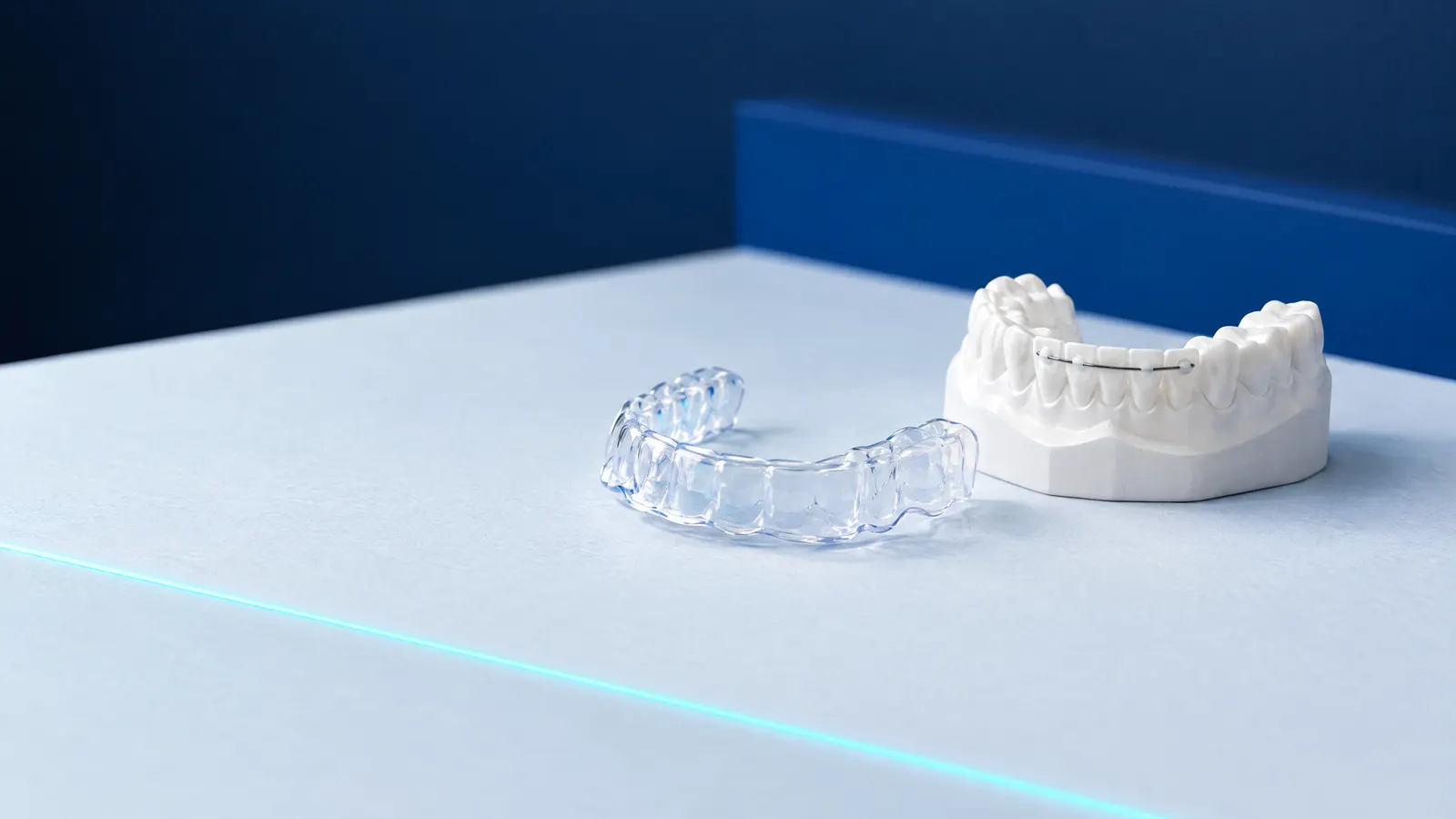
A fixed retainer is a thin wire or glass fibre strip bonded to the inner surface of the front teeth, while a removable retainer is one the patient puts in and takes out themselves. A removable retainer takes the form of a clear plastic tray or a retention plate made of acrylic and wire, known as a Hawley retainer.
A 2023 Cochrane review (47 studies, 4 377 participants) rated the certainty of the evidence as low or very low and did not identify any type of retainer as better than the others. The differences seen in studies concern breakages, comfort and the gums more than holding the teeth in place, and the clear tray and the Hawley retainer held the teeth similarly.
| Feature | Fixed retainer | Removable retainer |
|---|---|---|
| Where it sits | Bonded to the tongue side of the front teeth | A tray or plate the patient puts in |
| Wear | Works all the time, nothing to remember | Works only while it is in the mouth |
| Holding the teeth | Slightly better in studies | Difference under 1 mm, not clinically significant |
| Breakages | Comes unstuck from at least 1 tooth in 12 to 50% of people | Cracking, wear, loss |
| Gums | The area around the wire is harder to clean | Better gum health in studies |
| Comfort | Less noticeable day to day | More often discomfort and, at first, difficulty speaking |
| Check-ups | Regular checks of the bonding | Checks of the fit, repair or replacement |
How long should you wear a retainer, and for how many hours a day?
A retainer is worn long term, and for many patients a removable retainer stays in at night with no end date. The American Association of Orthodontists (AAO) writes that a retainer is fitted straight after active treatment ends, then gradually reduced to night-time wear, and that many people wear it every night for the rest of their lives if they want to keep their teeth straight.
The BOS describes two approaches to a removable retainer: wearing it round the clock at first and later only at night, or wearing it only at night from the start. Research has not settled the question: in the only study comparing the two schedules with a Hawley retainer (52 people), the stability of the teeth was similar.
A fixed retainer has no predetermined removal date. The orthodontist sets the schedule for wear and check-ups, and that advice is guidance on how to limit tooth movement, not a guarantee that the teeth will not shift.
When the retainer is fitted, it helps to be clear on a few points:
- How many hours a day to wear a removable retainer in the first months.
- When it is possible to move to wearing the retainer only at night.
- How often to come for retention check-ups and what is checked at them.
- Whom to call if the retainer cracks, comes unstuck or stops fitting.
What should you do if a fixed retainer comes loose or your teeth start to move?
If a fixed retainer comes unstuck from even one tooth, book an appointment with an orthodontist as soon as possible. The BOS points out that a tooth where the bond has failed can start to move, which is why a fixed retainer needs regular check-ups and a breakage should be reported straight away.
Debonding is common. A systematic review of 20 studies reports that multistrand wire retainers failed in 12 to 50% of patients and glass fibre retainers in 11 to 71%; failure here usually means coming unstuck from at least one tooth, not losing the whole retainer.
In a randomised trial of 60 patients, a lower fixed retainer lasted a year without failure in 50% of people, and a lower removable tray in 80%. The fixed retainer, on the other hand, held the alignment of the lower incisors better, so neither type wins on every count.
- Your tongue feels a gap between the wire and a tooth, or the wire sticks out and scratches.
- A tooth next to the retainer feels loose or has changed position.
- The removable retainer is tight, does not go fully in, or has cracked.
- The removable retainer has been lost or has gone unworn for weeks.
- A gap appears between the front teeth, or the teeth start to overlap.
How should you care for the retainer and your teeth during retention?
With a fixed retainer, the most important thing is careful cleaning around the wire, because the BOS considers a high standard of hygiene necessary to avoid gum problems. Plaque easily builds up under the wire, so floss with a stiffened end or interdental brushes chosen at a hygiene visit are useful.
A removable retainer is cleaned according to the orthodontist’s instructions and kept in its case, not wrapped in a napkin that makes it easy to throw away. Retention does not replace dental check-ups and hygiene treatment, and a regular visit makes it possible to spot debonding before a tooth has time to move.
Is a retainer covered by the NFZ?
The NFZ (Poland’s National Health Fund) funds retention only to a limited extent: the regulation on guaranteed dental services covers check-ups during the retention period after treatment with a removable appliance on the NFZ, up to the age of 13, no more than 12 times per calendar year. A fixed retainer is not on the list of services, and fixed braces are excluded from the basket of services.
Other patients, including all adults, pay for a retainer and retention check-ups privately. This description reflects the legal position as of 12 October 2026.
How much does a retainer cost?
The cost of a retainer depends on its type and the number of arches, and over time also on repairs and replacement, because the BOS warns that removable retainers need repair or replacement from time to time, which usually has to be paid for. That is why, when planning treatment, it is worth asking whether retention is included in its cost.
In the clinic’s price list, the items related to retention are as follows. The final scope and cost are set at an orthodontic consultation, which costs 300 zł, and prices may change.
| Item in the clinic’s price list | Price list category | Price |
|---|---|---|
| Retainer stały 1 łuk (fixed retainer, 1 arch) | Orthodontics | 600 zł |
| Płytka retencyjna 1 łuk (retention plate, 1 arch) | Orthodontics | 700 zł |
| Retainer | Clear Aligner | 500 zł |
| Osamu retainer | Clear Aligner | 460 zł |
| Płytka retencyjna termoformowalna (thermoformed retention plate) | Clear Aligner | 450 zł |
| Usunięcie retainer (retainer removal) | Conservative dentistry | 500 zł |
| Zdjęcie retainera z innego gabinetu (removal of a retainer fitted at another practice) | Orthodontics | 300 zł |
How it works at DentalBlue
At DentalBlue in Białystok, orthodontic treatment includes fixed braces and Clear Aligner trays, planned digitally on the basis of cephalometric analysis from the clinic’s own radiology unit. The price list includes both fixed and removable retainers, as well as the removal of a retainer fitted at another practice. The clinic is open Monday to Friday from 8:00 to 20:00 and on Saturdays from 8:00 to 16:00, and conversations are possible in Polish, English, Ukrainian and Russian. A consultation can be booked by phone.
Frequently asked questions
Can other people see a fixed retainer?
No. A fixed retainer is bonded to the inner surface of the front teeth, on the tongue side, so it is usually not visible when you smile or talk. You can, however, feel it with your tongue, especially in the first days after it is fitted.
Can a fixed retainer be removed?
Yes, a fixed retainer is removed by a dentist or orthodontist; in the clinic’s price list, the item “Usunięcie retainer” (retainer removal) costs 500 zł. Removing the wire does not end the need for retention, because the BOS recommends long-term retention, so what to replace it with is usually discussed, for example a removable retainer.
Does a retainer hurt or affect speech?
A retainer should not hurt, but a removable one can be less comfortable at first. The Cochrane review and a 2018 study describe more frequent discomfort and temporary difficulty speaking with clear trays than with a fixed retainer. Pressure in one spot, rubbing or a crack is a reason for a check-up.
What if I have not worn my retainer for several months?
Book a check-up with an orthodontist and do not force in a tray that will not go in. If the teeth have already moved, the old retainer may no longer fit, and the orthodontist will assess whether a new retainer is enough or whether the alignment of the teeth needs correcting.
Does a retainer need replacing?
A removable retainer wears out and, according to the BOS, needs repair or replacement from time to time. A fixed retainer has no set replacement date, but if it repeatedly comes unstuck or the wire becomes bent, the orthodontist may suggest a new one.
Sources
- British Orthodontic Society: frequently asked patient questions, retention (2022)
- British Orthodontic Society: Orthodontic Treatment, patient leaflet (2019)
- AAO: Are Retainers Necessary? (2025, updated 2026)
- Cochrane: Martin, Littlewood et al., retention after orthodontic treatment (2023)
- Am J Orthod Dentofacial Orthop: Little, Riedel, Artun, incisor alignment 20 years after retention (1988)
- J Dent: Iliadi et al., failures of fixed retainers, systematic review (2015)
- Eur J Orthod: Forde et al., fixed retainer versus clear tray, randomised trial (2018)
- ELI: Rozporządzenie MZ w sprawie świadczeń gwarantowanych z zakresu leczenia stomatologicznego, t.j. Dz.U. 2025 poz. 615
An informational article. It does not replace a consultation, and treatment decisions are made during a visit.