Is it too late for braces?
There is no particular age at which it becomes too late for braces: the AAO states plainly that being older is no obstacle to orthodontic treatment. Whether and how to treat depends on the condition of the teeth, gums and bone, not on the date of birth.
Questions about braces after 40 or after 50 therefore have the same answer: age is not a contraindication. In older patients, however, the plan more often begins with treatment of the gums or restoration of the teeth, and only then includes braces.
Adults most often see an orthodontist because of crowded or shifting teeth, or a bite that bothers them. The first consultation should answer three questions: what can be improved, what this requires of the teeth and gums, and how long it will take.
How does orthodontic treatment in adults differ from treatment in teenagers?
Orthodontic treatment in adults works on the same principle as in teenagers, but it is planned on a set of teeth with years of use behind it: fillings, crowns, missing teeth and often changes in the periodontium, the tissues that support the teeth. In an adult it is also impossible to make use of jaw growth, which in children helps to correct some problems.
The AAO explains that an adult’s teeth are more firmly set in the bone, so moving them may take more time and force. An adult patient decides on treatment themselves and is responsible for their own oral hygiene and for wearing aligners consistently, which matters when choosing the method.
Assessing whether an adult is suitable for braces and comparing aligners with fixed braces is covered in a separate article. Here we focus on what is different in adults: the length of treatment, the gums, the types of braces, the risks and retention.
Adult orthodontics: how long does treatment take?
Orthodontic treatment in adults usually takes about as long as in teenagers: a meta-analysis of 11 studies (Abbing et al., 2020) covering 1 380 adults and 2 969 teenagers found no significant difference in the length of comprehensive treatment with fixed braces. The mean difference was 0.8 months and was not statistically significant.
The exception in this analysis was aligning canines displaced towards the palate, which in adults took on average 3.8 months longer. The authors rated the quality of the evidence as low, which is why the AAO still cautiously writes that treatment in adults may take longer.
The British Orthodontic Society (BOS) states that treatment with fixed braces usually lasts 18 to 24 months, and in its patient leaflet gives the full range of 6 to 30 months. Very complex problems may need more time, and the length of treatment for a particular person is given in the plan after diagnosis.
Gums and bone: when can an adult start treatment with braces?
An adult can start treatment with braces when the gums and bone are stable, and in the case of periodontitis (gum disease) only once it has been treated. The European Federation of Periodontology (EFP) guidelines for advanced periodontitis recommend orthodontic treatment after the goals of periodontal therapy have been reached, that is, when there are no deep pockets that bleed on examination.
After regenerative periodontal procedures, the EFP suggests starting orthodontic treatment 1 to 6 months later. During treatment the condition of the periodontium should ideally be checked at every orthodontic visit, and if inflammation returns, tooth movement is paused.
The BOS warns that teeth moved beyond the outline of the bone may lose some of their gum, that is, recession develops. That is why an adult patient usually starts with an assessment of the periodontium and professional cleaning, and bleeding gums are treated before braces are fitted.
Metal, ceramic, lingual or aligners: which braces for adults?
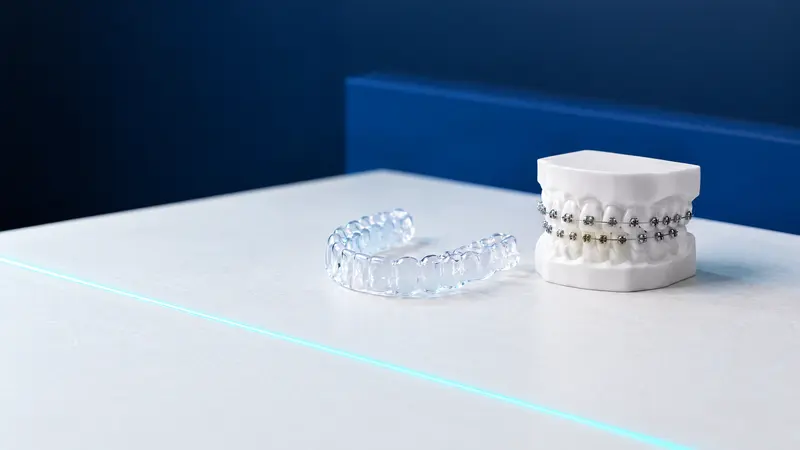
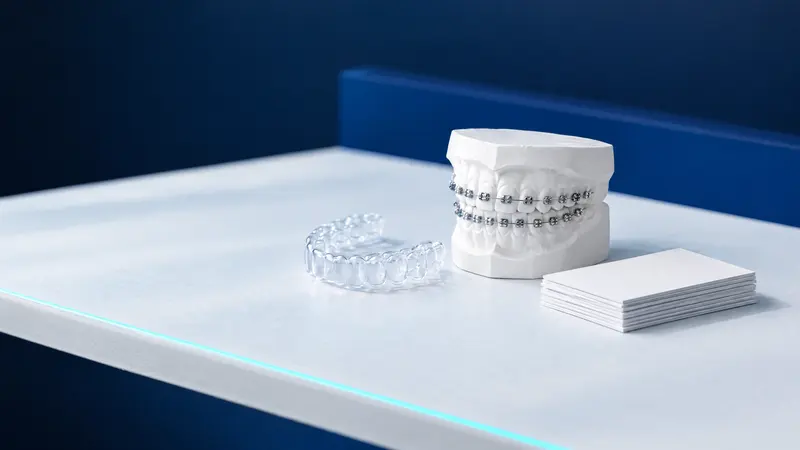
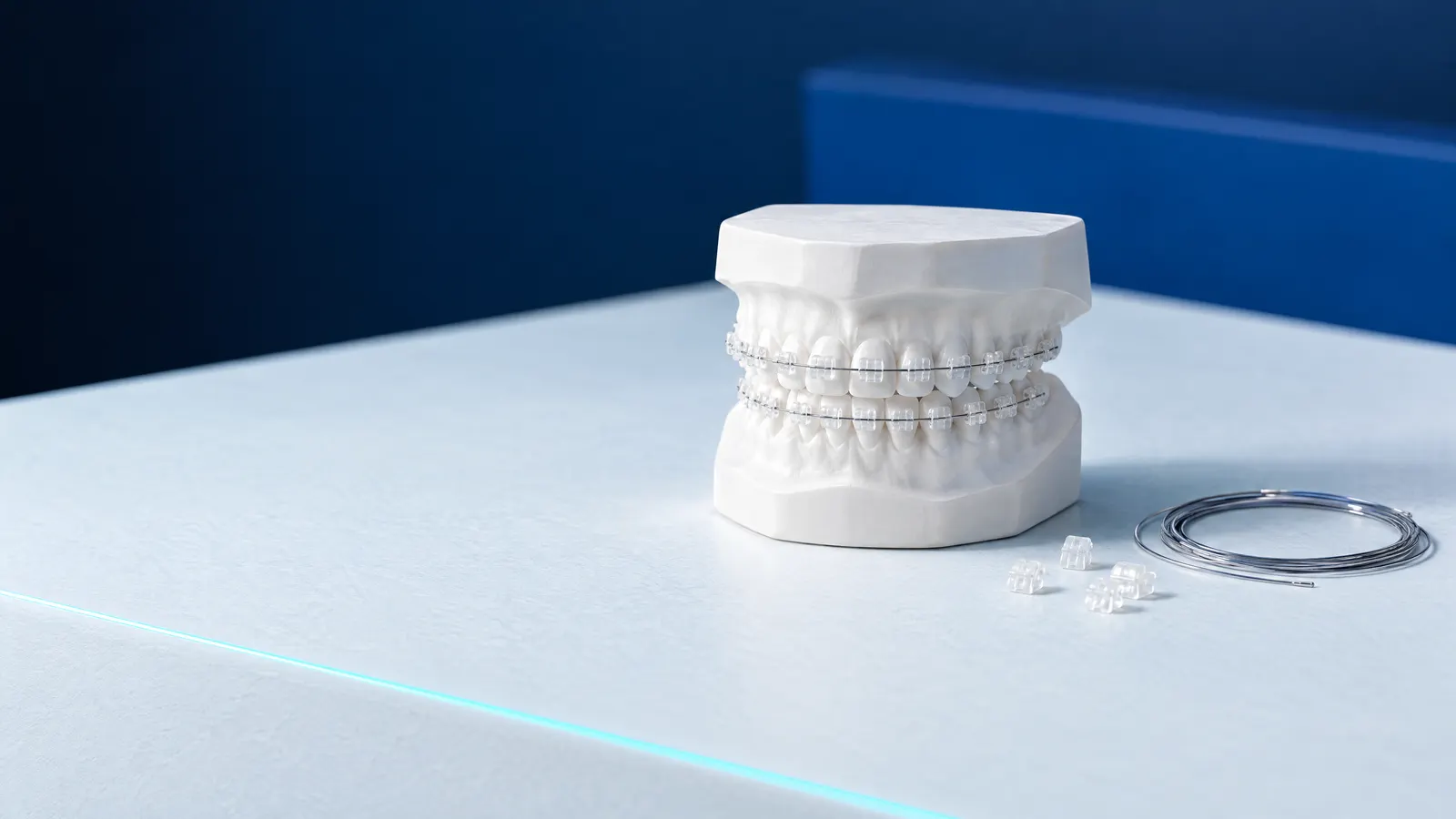
An adult can be treated with fixed braces with metal brackets, ceramic brackets or brackets bonded on the tongue side of the teeth (lingual braces), or with aligners, and these types differ in visibility, comfort, price and the range of problems they treat well. The table is based on information from the BOS; not every practice offers every type of brace.
According to the BOS, ceramic braces cost noticeably more than metal ones, and lingual braces considerably more, because they need laboratory work and longer appointments. The BOS also notes that manufacturers’ claims of better results from particular brackets are in many cases not supported by research.
Aligners and fixed braces are not interchangeable for every bite problem. What reviews of studies say about them is covered in the article on aligners and fixed braces.
| Type of braces | What they look like | What to bear in mind |
|---|---|---|
| Metal | Steel brackets and an archwire on the front surface of the teeth | The classic fixed brace against which the others are compared |
| Ceramic | Tooth-coloured brackets, less visible | Can be just as effective; the brackets break more easily and can stain |
| Ceramic on the lower teeth | Ceramic brackets with a deep bite | Sometimes advised against, as they can damage the opposing teeth |
| Self-ligating | Brackets with a clip that holds the archwire | Quicker archwire changes, no evidence of a better result |
| Lingual | Brackets on the tongue side, invisible from the outside | Speaking is harder at first, the tongue can get sore, harder to clean |
| Aligners | Clear trays that the patient puts in and takes out | Work only when worn; the range of problems depends on the diagnosis |
Do fixed braces hurt in adults, and what are the risks?
Fixed braces usually do not cause constant pain, but according to the BOS the teeth are tender for 3 to 5 days after the braces are fitted and after each adjustment. The BOS also reminds patients that during treatment the teeth are more vulnerable to decay and gum disease, so regular check-ups with the dentist need to continue.
The risks are reduced by careful brushing around the brackets, cleaning between the teeth, regular check-ups with the orthodontist and dentist, and reporting breakages straight away rather than waiting for the next appointment. The most common problems during treatment are:
- White spots on the enamel around the brackets, that is, early demineralisation, which in studies appears in a considerable proportion of patients with fixed braces.
- Gum recession, when teeth are moved beyond the outline of the bone.
- A bracket coming unstuck or an archwire breaking, which requires an extra visit.
- Recurrence of periodontitis in people previously treated for gum disease.
- Teeth moving back to their old positions if retention is stopped after treatment.
Retention in adults: how long should you wear a retainer?
Retention after orthodontic treatment in adults lasts a long time, most often with no set end: the AAO states that many patients wear a retainer every night for the rest of their lives if they want to keep the result. The BOS points out that the position of the teeth changes throughout life and that this is part of normal ageing.
For people who have been treated for periodontitis, the EFP guidelines explicitly call for lifelong orthodontic retention and lifelong periodontal care. This is a recommendation, not a promise of an unchanging result: a retainer protects the position of the teeth only when it is worn or stays bonded and undamaged.
The type of retainer, fixed or removable, is chosen by the orthodontist to suit the bite problem, the patient’s oral hygiene and way of life. The details are covered in the article on retainers after braces.
How much do fixed braces cost for adults, and does the NFZ fund them?
Fixed braces for adults are not funded by the NFZ (Poland’s National Health Fund): in orthodontics the NFZ covers only removable appliances for children up to the age of 12, and fixed braces are expressly excluded from the list of services (law as at 12 October 2026). An adult is therefore treated privately, and the cost depends on diagnosis, the type of braces, the number of arches, the length of treatment and retention.
In the clinic’s price list an orthodontic consultation costs 300 zł, a treatment plan with cephalometric analysis 380 zł, and a check-up visit for fixed braces 270 zł with metal braces on one arch and 350 zł with two. One aligner (the item “Clean aligner- szyna”) costs 900 zł, a fixed retainer for 1 arch 600 zł, and the orthodontics category also includes the item “Angel Unlimited” at 8 000 zł, with a check-up visit at 1 000 zł.
The price of complete fixed braces follows from the plan and is set at the consultation. The final scope and cost are set after diagnosis, and prices may change; a stage-by-stage breakdown of costs is given in the article on how much braces cost.
How orthodontic treatment for adults works at DentalBlue
At DentalBlue in Białystok, adults are treated orthodontically with Clear Aligner trays or fixed braces, and the plan is prepared digitally on the basis of cephalometric analysis. The cephalometric X-ray, the panoramic X-ray and, where indicated, cone beam computed tomography (CBCT) are taken in the clinic’s own radiology unit. The clinic also provides periodontology and professional cleaning, so the gums can be assessed on site before braces. A consultation can be booked by phone.
Frequently asked questions
Do braces make sense after the age of 50?
Yes, if the teeth, gums and bone are in good condition or have been treated beforehand. The AAO stresses that being older does not rule out orthodontic treatment. In people who have had periodontitis, treatment starts only once the inflammation is under control, and the EFP guidelines then recommend lifelong retention.
How often are check-up visits with fixed braces?
According to the BOS, check-up visits with fixed braces usually take place every 4 to 10 weeks. At these visits the orthodontist assesses progress, changes or bends the archwire and checks oral hygiene. For adults who have been treated for periodontitis, the EFP also recommends a periodontal check, ideally at every orthodontic visit.
Do ceramic brackets stain?
They can. The BOS states that ceramic brackets can stain, break more easily and are slightly harder to remove than metal ones, and treatment with them may take longer. At the same time, the BOS considers that ceramic braces can be just as effective as metal ones.
Do you need to see a dentist during treatment with braces?
Yes. The BOS points out that during orthodontic treatment the teeth are more vulnerable, so check-ups with the dentist should continue alongside visits to the orthodontist. The orthodontist monitors the braces and tooth movement, and the dentist the enamel, fillings and gums.
Are lingual braces a good choice for an adult?
They can be, when invisibility of the braces matters most. The BOS describes lingual braces as invisible from the outside and capable of good results, but at first they make speaking harder, can irritate the tongue and are harder to clean. They also cost considerably more than metal braces.
Sources
- AAO: Adult Orthodontics (2026)
- Progress in Orthodontics: Abbing A et al., length of orthodontic treatment in adults and adolescents, meta-analysis (2020)
- British Orthodontic Society: Conventional Fixed Braces (2023)
- British Orthodontic Society: FAQs, frequently asked patient questions (2022)
- British Orthodontic Society: Orthodontic Treatment, patient leaflet (2019)
- J Clin Periodontol: Herrera D et al., EFP S3 guideline for stage IV periodontitis (2022)
- AAO: Are Retainers Necessary? (2026)
- Dz.U. 2025 poz. 615: Rozporządzenie MZ w sprawie świadczeń z zakresu leczenia stomatologicznego, consolidated text, Annex 6 (2025)
An informational article. It does not replace a consultation, and treatment decisions are made during a visit.