What types of orthodontic appliance are there?
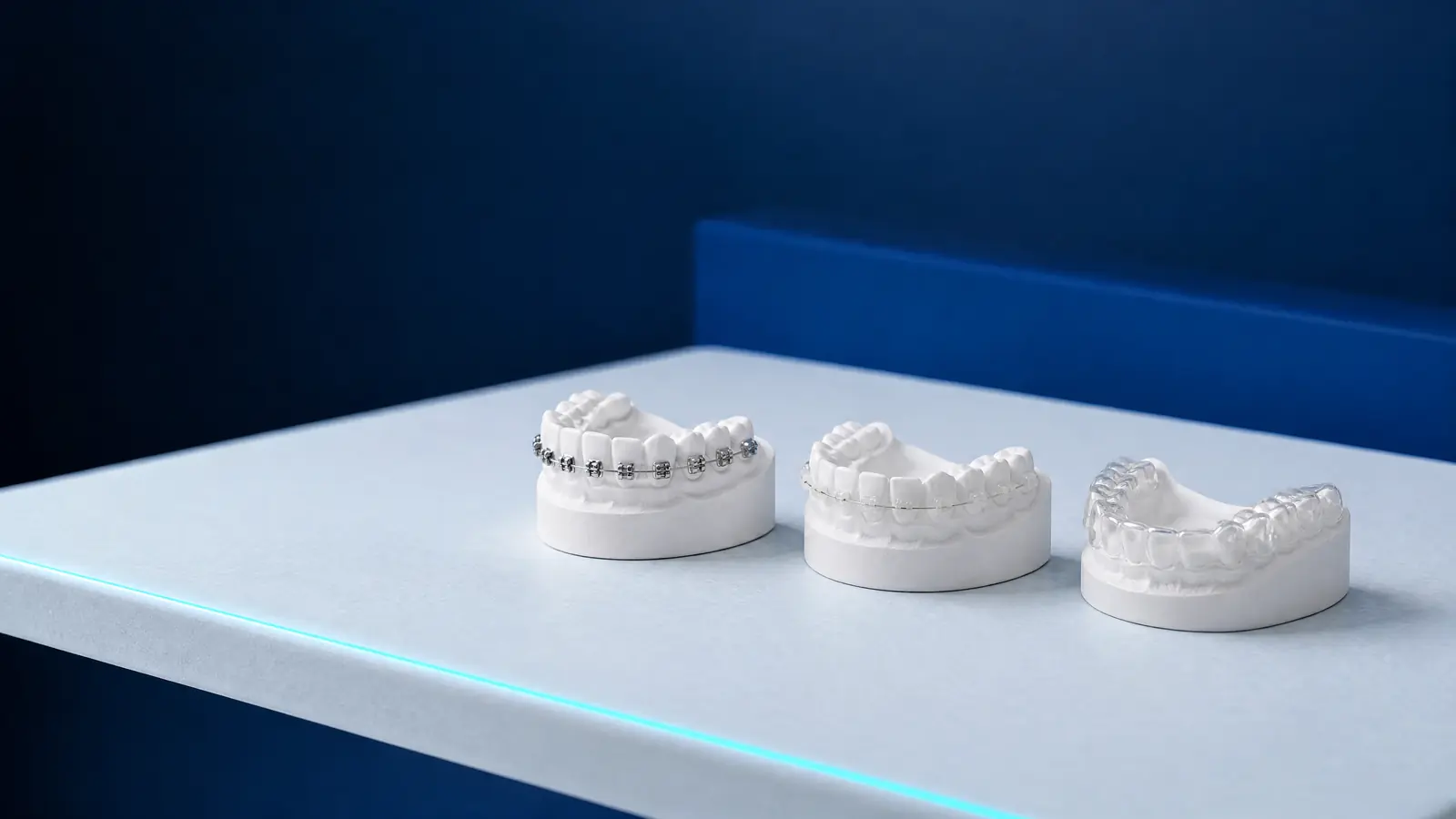
Orthodontic appliances are first divided into fixed braces, bonded to the teeth throughout treatment, and removable appliances. The British Orthodontic Society (BOS) includes simple plates, functional appliances and aligners in the removable category.
Fixed braces consist of brackets bonded to the teeth and an archwire, the wire that runs through them and moves the teeth. Fixed braces differ in bracket material (steel, ceramic or sapphire), how the archwire is held (elastic rings or a clip in self-ligating brackets) and the side of the tooth they are bonded to: facing the lips or facing the tongue.
Discreet or aesthetic braces are everyday terms for options less visible than metal braces: ceramic and sapphire brackets, lingual braces and aligners. The BOS adds that ceramic brackets can also be used with a tooth-coloured archwire.
Types of braces compared in a table
The table compares appearance, the main advantages and drawbacks, and what research or the BOS says about each type of appliance. The sections that follow give details and sources, and the orthodontist decides which to use after diagnostic assessment.
| Type of appliance | Appearance | Advantages and drawbacks | What research says |
|---|---|---|---|
| Metal | Steel brackets and an archwire on the front surface of the teeth | Most commonly used; visible, causes artefacts on head MRI | Reference treatment in comparative studies |
| Ceramic | Hard ceramic brackets in a tooth-like colour | Less visible; fractures more easily, may stain, more expensive | BOS: can be as effective as metal |
| Sapphire | Transparent brackets made from a single aluminium oxide crystal | Clearer than ordinary ceramic; brittle like all ceramics | Discussed with ceramic braces, without separate BOS recommendations |
| Self-ligating | Brackets with a clip holding the archwire without elastic rings | Quicker archwire changes at appointments | Reviews: no shorter treatment or less pain |
| Lingual | Brackets on the tongue side, invisible from outside | Speech and cleaning are harder, the tongue may hurt, higher cost | Low-quality evidence, more discomfort initially |
| Removable and functional | A removable plate or an appliance acting on both arches | Mainly for growing children; works when worn | Cochrane: early functional appliance treatment reduces incisor injuries |
| Aligners | Transparent trays usually changed weekly | Removed for meals; must be worn for 22 hours a day | Review of reviews: suitable for mild and moderate problems |
Metal or ceramic braces: how do they differ?
Metal and ceramic braces move teeth in the same way, but differ in bracket material. The BOS describes stainless steel brackets as the most common type of fixed brace, and says ceramic brackets can be just as effective at moving teeth.
Ceramic brackets do have drawbacks, however. According to the BOS, they fracture more easily than metal ones, can become stained by food over time, and create more resistance to the archwire sliding through them, so treatment may take longer. The BOS describes the overall cost of ceramic brace treatment as considerably higher.
The BOS also notes that ceramic brackets are sometimes discouraged on lower teeth in a deep bite, because the hard material can damage the opposing teeth. They are slightly more difficult to remove than metal brackets, although in most cases they do not damage healthy teeth.
The difference also matters for magnetic resonance imaging. A systematic review of 18 studies (Dobai et al., 2022) found that stainless steel brackets and archwires cause clinically significant artefacts on head images, whereas ceramic and plastic brackets do not. Heating and debonding of brace components during the scan did not pose a hazard.
What are sapphire braces, and how do they differ from ceramic braces?
Sapphire braces are a type of ceramic brace whose brackets are made from a single aluminium oxide crystal rather than small grains sintered together. As early as 1988, Swartz described in the “Journal of Clinical Orthodontics” how ceramic brackets are made from aluminium oxide, and those made from a single crystal are noticeably clearer than polycrystalline ones.
The same paper points out that ceramics are inherently brittle. Sapphire brackets therefore share most of the advantages and drawbacks of ceramic brackets. The BOS does not list them as a separate group in its patient information, but discusses them together with ceramic brackets.
In practice, choosing between sapphire brackets and ordinary ceramics is mainly a matter of appearance. The way they work, check-ups and retention after treatment are the same as with any fixed brace.
Do self-ligating braces work faster and hurt less?
Self-ligating braces do not work faster or hurt less than conventional fixed braces, according to reviews of studies. Self-ligating brackets have a built-in clip that holds the archwire instead of elastic rings. The BOS stresses that there is no evidence of a better treatment result, although there is evidence of quicker archwire changes.
A systematic review of 16 studies (Chen et al., 2010) found no differences in treatment time or the final bite. The only confirmed advantages were shorter chairside time and slightly less proclination of the lower incisors, by 1.5 degrees. A meta-analysis by Fleming and Johal (2010) found no advantage for either bracket type in pain experienced.
A more recent meta-analysis of 30 randomised trials and 9 split-mouth studies comparing two methods in the same mouth (Maizeray et al., 2021) found no differences for the vast majority of outcomes assessed, including treatment time and the number of appointments. The authors concluded that most manufacturers’ claims were not supported.
A 2021 Cochrane review on treating crowding in children also found no difference in crowding reduction between self-ligating and conventional brackets in individual studies.
Lingual braces: who are they for, and what are the drawbacks?
Lingual braces are bonded to the inner surfaces of the teeth, making them invisible from outside, and the BOS considers them capable of achieving good results. The trade-offs for being hidden are discomfort at the start of treatment and a higher cost.
A meta-analysis of 11 clinical studies involving 407 patients (Papageorgiou et al., 2016) found that lingual braces were associated with more oral discomfort and greater difficulty speaking and eating than braces on the lip side. The authors rated the quality of the evidence as low.
A review of 8 studies (Ata-Ali et al., 2016) found significantly more tongue pain, speech difficulties and hygiene problems with lingual braces, with no difference in the risk of tooth decay. The BOS adds that treatment costs considerably more because the appliance requires extra laboratory work and longer appointments.
Removable appliances, functional appliances and aligners: when are they used instead of brackets?
A removable appliance, meaning a removable plate, is used mainly in children. A functional appliance, such as Twin Block, acts on both arches at once and changes the bite, according to the BOS. Both work only when the child wears them.
A 2018 Cochrane review (27 studies) found that early functional appliance treatment in children with protruding upper incisors reduced new injuries to those teeth (19% versus 30%), but offered no other advantages over a single course of treatment in adolescence. Twin Block did not differ from other appliances in correcting incisor protrusion.
In the standard children’s orthodontic package of the NFZ, Poland’s National Health Fund, removable appliances are funded up to a child’s 12th birthday, without fixed braces. Fixed braces can be funded in a separate orthodontic care programme for children with congenital craniofacial defects, for patients who meet its criteria (legal status as of 24 October 2026). Appliances used during growth also include upper jaw expanders such as Hyrax.
Clear aligners are transparent trays that the AAO recommends wearing for at least 22 hours a day. A 2022 review of systematic reviews considered them effective for mild and moderate problems. A separate article on clear aligners explains how they work and their limitations.
How do you choose a type of orthodontic appliance?
An orthodontic appliance is chosen primarily to suit the bite problem and treatment plan, with appearance and budget considered afterwards. Before deciding, it is worth discussing the points below with your orthodontist.
- What problem needs treating, and whether the chosen appliance provides good control of the tooth movements required.
- How much visible braces would bother you at work, at school or when socialising.
- Whether you will be able to keep the area around the brackets clean, especially with lingual braces.
- What the total treatment cost will be, as the BOS says ceramic brackets and lingual braces cost more than metal braces.
- Whether you are planning a head MRI or play a contact sport, for which the BOS recommends a mouthguard over braces.
- If choosing a removable appliance or aligners, whether you can wear them for the number of hours required by the plan.
Which appliances are included in orthodontics at DentalBlue?
At DentalBlue, orthodontics includes fixed and removable appliances and Clear Aligner trays, planned digitally using cephalometric analysis from the clinic’s own radiology unit. In the clinic’s price list, “Aparat częściowy 2×4” (partial 2×4 brace) costs 1 700 zł, “Aparat wyjmowany” (removable appliance) 1 150 zł, “Twinblock” (Twin Block appliance) 1 500 zł, and “Aparat Hyrax” (Hyrax appliance) 1 500 zł.
For fixed braces, “Wizyta kontrolna przy 1 łuku metalowym” (check-up for metal braces on one arch) costs 270 zł and “Wizyta kontrolna przy 2 łukach metalowych” (check-up for metal braces on two arches) 350 zł. The final scope and cost are agreed at an orthodontic consultation, which costs 300 zł, and prices may change.
Frequently asked questions
Which braces are least visible?
Lingual braces, bonded to the tongue side of the teeth, are invisible from outside, and the AAO describes aligners as almost invisible trays. Among brackets bonded to the lip side, sapphire brackets are clearer than polycrystalline ceramic ones. Each of these options has limitations, as described in the table above.
Can you have an MRI with metal braces?
Usually yes, but tell the radiology unit about your braces beforehand. A review of 18 studies (Dobai et al., 2022) considered heating and debonding of brace components during scanning harmless, but steel brackets and archwires affected head images. For some archwires, the authors suggest removal or protection of the oral lining. Wire retainers caused no significant artefacts.
What are the coloured elastic rings on brace brackets for?
The coloured elastics are small rings that most commonly hold the archwire in the brackets, according to the BOS. In self-ligating brackets, a built-in clip holds the archwire, and the BOS notes that some bracket types are not designed to take these elastics.
How long does fixed brace treatment take?
According to the BOS, fixed brace treatment usually takes 18 to 24 months, while its leaflet gives a wider range of 6 to 30 months. A meta-analysis of 22 studies (Tsichlaki et al., 2016) calculated an average of 19.9 months. Reviews of self-ligating brackets show that the bracket type alone does not shorten treatment.
Can you have fixed braces on just one arch?
Yes, fixed braces can cover one arch or only some teeth, as with a partial 2×4 brace. In a study of 170 patients (Scheurer et al., 1996), pain did not differ between a 2×4 brace, a full brace on one arch and braces on both arches. The extent of the appliance depends on the problem and treatment plan.
Sources
- British Orthodontic Society: Conventional Fixed Braces (2026)
- British Orthodontic Society: FAQs, patients’ frequently asked questions (2026)
- Am J Orthod Dentofacial Orthop: Chen SS et al., self-ligating brackets, systematic review (2010)
- Angle Orthodontist: Fleming PS, Johal A, self-ligating brackets, systematic review (2010)
- International Orthodontics: Maizeray R et al., conventional and self-ligating brackets, network meta-analysis (2021)
- European Journal of Oral Sciences: Papageorgiou SN et al., lingual versus labial braces, meta-analysis (2016)
- BMC Oral Health: Dobai A et al., orthodontic appliances and magnetic resonance imaging, systematic review (2022)
- Journal of Clinical Orthodontics: Swartz ML, ceramic brackets (1988)
An informational article. It does not replace a consultation, and treatment decisions are made during a visit.