What is a Hyrax expander and how does it work?
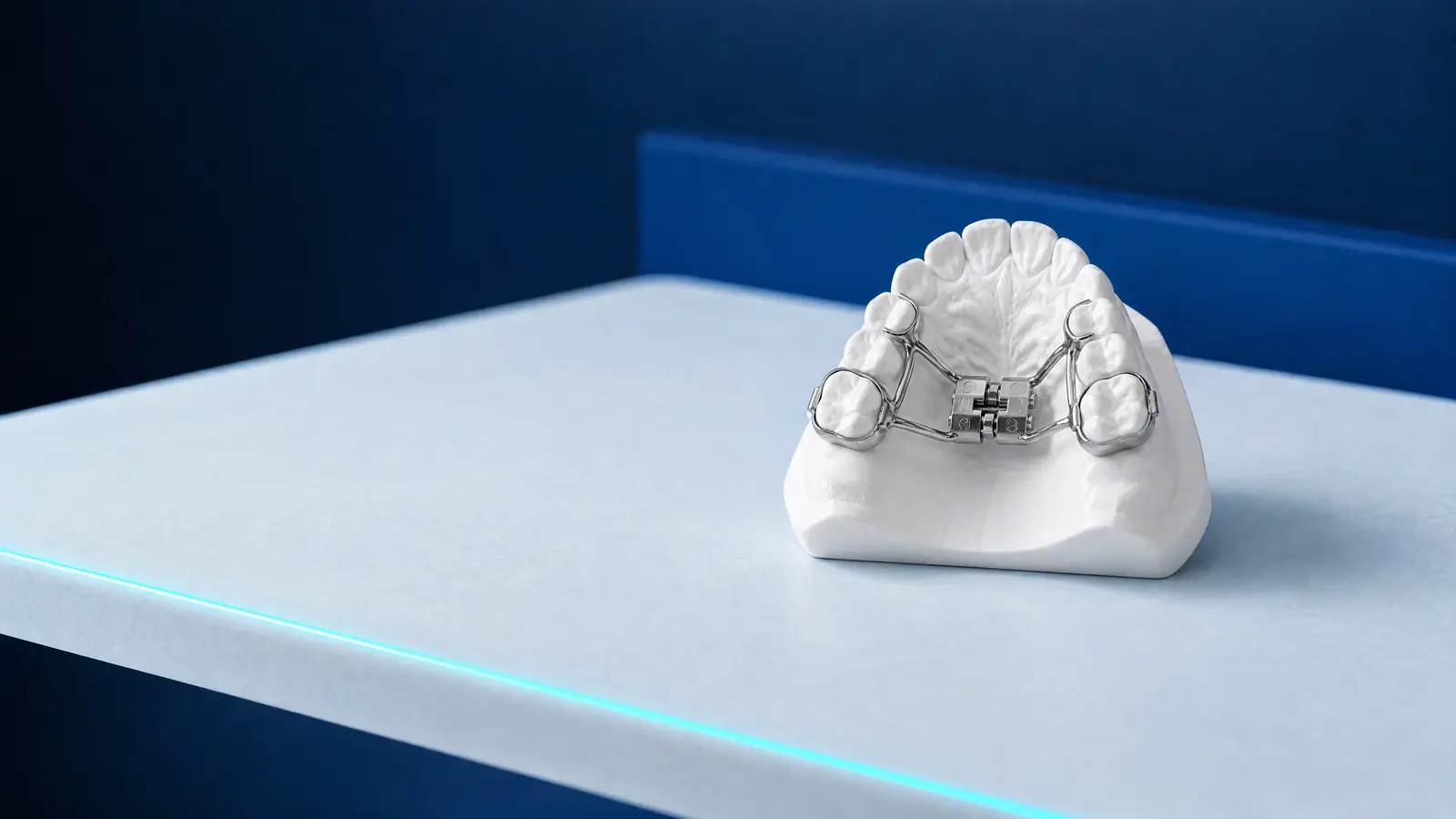
The Hyrax is a fixed palatal expander, an appliance for rapid maxillary expansion (RME). It consists of metal bands cemented to the back teeth and connected to a screw in the centre of the palate, which is turned with a special key.
Each turn of the screw separates the two halves of the upper jaw where they meet in the centre of the palate, at the midpalatal suture. The NHS North Cumbria leaflet describes 4 metal bands connected to a framework with a screw in the middle. Until the suture fuses, it is possible to widen the bone rather than simply tip the teeth outwards.
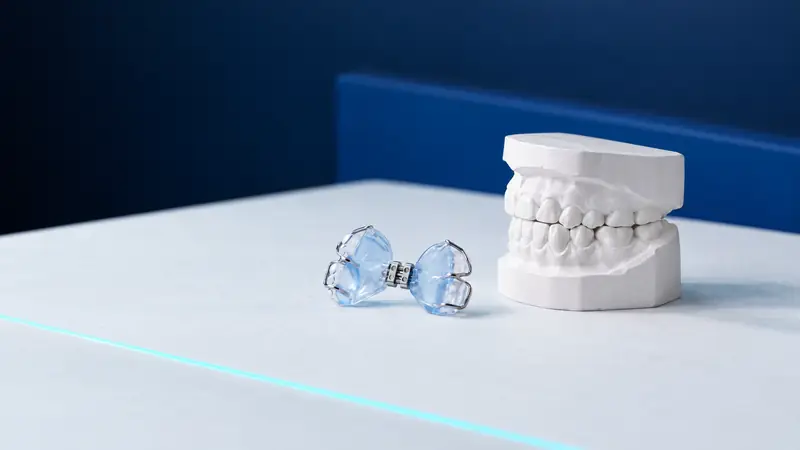
Hyrax is not the only way to widen the dental arch. For children aged 7 to 11, the strongest evidence in the 2021 Cochrane review concerns the quad-helix appliance and removable expansion plates. The choice depends on age, the type of malocclusion and whether the problem involves the bone or just the teeth, which an orthodontist assesses.
When does an orthodontist recommend expanding a child’s upper jaw?
The main indication for expanding a child’s upper jaw is a posterior crossbite: the upper back teeth bite inside the lower ones because the upper jaw is too narrow. According to the 2021 Cochrane review, around 4% of children and adolescents in Europe have this type of bite.
The American Academy of Pediatric Dentistry (AAPD, 2024) guidelines note that a crossbite on one side most often reflects narrowing on both sides of the upper jaw, with the lower jaw shifting sideways as the mouth closes. According to the AAPD, early correction of a crossbite with this shift markedly improves function and largely eliminates lower-jaw asymmetry.
The NHS Lothian leaflet from Edinburgh also lists crowding, when teeth lack space, and where the upper arch is set back, Hyrax is sometimes combined with a facemask worn in the evening and overnight. A separate article on malocclusion describes its types and prevalence in Poland.
The Cochrane review of 31 randomised trials involving 1 410 children and adolescents concludes that Hyrax probably corrects posterior crossbite effectively compared with observation alone. In adolescents aged 12 to 16, Hyrax and the Haas appliance worked similarly, and no difference was demonstrated between Hyrax and a tooth-and-bone-borne expander.
Up to what age can a Hyrax expander widen the upper jaw?
A Hyrax expander widens bone until the midpalatal suture fuses; the AAPD states that palatal expanders can be used up to suture fusion. Age is only a guide, as the suture matures at a different rate in each person.
Angelieri et al. (2013) described five stages of suture maturation on CBCT scans, from A to E. They usually observed stages A and B, with no signs of fusion, up to age 13, stage C mainly between 11 and 17, and complete fusion after age 11 only in girls; among boys aged 14 to 17, 3 of 13 had fusion in the palatine part.
In adults the suture is usually fused, although not always. In a study of 78 adults aged 18 to 66, 12% had an unfused suture, and neither sex nor age predicted this (Angelieri et al., 2017). Decisions for older adolescents and adults therefore follow individual assessment, sometimes including CBCT.
If the suture is fused, miniscrew-assisted expansion (MARPE) or surgically assisted expansion is considered. A systematic review by Kapetanović et al. (2021) reports a mean MARPE success rate of 92.5% in people aged 16 and over, but with very low-quality evidence and adverse effects such as tooth tipping and thinning of the bone on the cheek side.
One variant is the Hybrid Hyrax, supported by both palatal miniscrews and teeth. Wilmes et al. (2010) describe it as effective particularly when the front teeth are unsuitable for anchoring the appliance.
How long is a Hyrax worn? Treatment stages in a table
A Hyrax expander is usually worn for several months: a few weeks of activation followed by around 3 months of retention, during which it remains in the mouth but the screw is no longer turned. This is how NHS leaflets from Edinburgh and North Cumbria describe treatment; the orthodontist sets the exact plan.
A systematic review by Barone et al. (2023) reports that the active expansion phase usually lasts around 2 to 4 weeks. In studies of adults treated with MARPE, mean expansion times ranged from 20 to 126 days (Kapetanović et al., 2021).
| Stage | Typical duration | What happens |
|---|---|---|
| Consultation and investigations | Before fitting | Bite examination, X-rays including cephalometry, sometimes CBCT, and treatment planning |
| Fitting the appliance | Fitting appointment | The bands and screw are cemented to the back teeth |
| Activation | Usually around 2 to 4 weeks | A parent turns the screw according to the orthodontist’s plan, with check-ups during this phase |
| Gap between the central incisors | First days or weeks of activation | A visible sign of the suture separating; it closes over time |
| Retention | Around 3 months | The screw is locked, the appliance stays in place and bone rebuilds in the suture |
| Removing the appliance | According to the treatment plan | Further planned treatment, for example fixed braces, and maintenance of the result |
How is a Hyrax activated, and what needs the orthodontist’s guidance?
A Hyrax expander must be activated only according to the orthodontist’s plan: how many times a day, for how many days and until which date. In the NHS Lothian leaflet, the clinician completes these fields individually for each patient. The key must not be turned beyond that date, as the screw could come out of the appliance.
Activation schedules in studies ranged from a quarter-turn to three quarter-turns a day (Barone et al., 2023 review). This describes research, not instructions: the orthodontist chooses the rate according to the malocclusion, age and appliance type.
- Insert the key fully into the screw hole and move it in the direction of the arrow, towards the back of the mouth, with the child’s head tilted back.
- The screw may initially be stiff; the NHS Lothian leaflet says this is expected and turning becomes easier over time.
- Severe pain or other worrying symptoms are a reason to stop turning and phone the practice.
- Report a loose or broken appliance immediately rather than waiting for the next appointment; over a weekend, stop turning until you can contact the practice.
Why does a gap appear between the front teeth during expansion?
A gap between the upper central incisors (diastema) appears during expansion because the two halves of the upper jaw separate, taking the incisors with them. The NHS Lothian leaflet describes it as a normal sign visible in the first few days, growing until screw activation ends.
The gap closes later. According to the NHS North Cumbria leaflet, it often appears within the first 2 weeks and disappears: during retention, the incisors gradually move closer together, and the orthodontist closes any remaining spaces in further treatment.
This temporary gap differs from a gap between an adult’s central incisors or one associated with the lip frenulum, discussed in a separate article on diastema.
Does a Hyrax hurt, and how do you eat, speak and care for your teeth?
A Hyrax expander usually causes pressure or pain in the first days of activation, which then eases. A systematic review of 10 studies by Barone et al. (2023) finds pain to be a common effect of expansion that diminishes over time; in one study, 98% of patients reported some pain, greatest during the first six turns.
Pain is felt mainly in the teeth supporting the appliance: 88.9% of patients identified these in one study in the review, with the front teeth, nose and head less often affected. The NHS North Cumbria leaflet allows an ordinary painkiller, such as one used for headaches, taken according to its leaflet, and orthodontic wax for rubbing against the lips and cheeks.
- Speech may change for a few days; reading aloud at home helps.
- Initially, soft food in small pieces works well. Avoid hard, sticky and chewy foods, and cut apples and carrots into pieces.
- Between meals, water or milk are preferable; avoid fizzy drinks, juices and sports drinks.
- Brush teeth twice a day with fluoride toothpaste and after meals, and clean around the bands and screw with an interdental or single-tufted brush.
- While wearing the appliance, avoid playing wind instruments and biting nails or pens.
How much does a Hyrax cost, and is it funded by the NFZ?
The cost of a Hyrax expander depends on its type and on the investigations and appointments needed before and after treatment. In DentalBlue’s price list, “Aparat Hyrax” (Hyrax expander) costs 1 500 zł, “Hybrid Hyrax” (hybrid Hyrax expander) 4 500 zł and “Miniimplant ortodontyczny” (orthodontic miniscrew) 700 zł.
Investigations are needed before fitting: in the same price list, “Konsultacja ortodontyczna” (orthodontic consultation) costs 300 zł, “Cefalometria” (cephalometric X-ray) 120 zł and “Plan leczenia z analizą cefalometryczną” (treatment plan with cephalometric analysis) 380 zł. The final scope and cost are agreed at consultation, and prices may change; a separate article on brace costs explains the components of total treatment cost.
The list of children’s orthodontic services funded by the NFZ, Poland’s National Health Fund, in Annex 6 to the regulation on guaranteed dental services (t.j. Dz.U. 2025 poz. 615), covers removable appliances until the 12th birthday and does not list fixed appliances; Hyrax is fixed (legal status as of 24 October 2026).
Hyrax treatment at DentalBlue
At DentalBlue in Białystok, orthodontic treatment, including fixed appliances, is planned digitally using cephalometric analysis. The clinic’s own radiology unit performs cephalometric X-rays, panoramic X-rays and CBCT scans, so upper-jaw imaging can be done on site if the orthodontist considers it necessary.
The orthodontic price list includes “Aparat Hyrax”, “Hybrid Hyrax” and “Miniimplant ortodontyczny”. The first step is a “Konsultacja ortodontyczna”, during which the clinician examines the bite and determines which images are needed for the treatment plan.
Frequently asked questions
Is a Hyrax the same as an expansion plate?
No. An expansion plate is removable: the child puts it in and takes it out, whereas Hyrax is cemented to the teeth and separates the midpalatal suture over a few weeks. The 2021 Cochrane review confirms the effectiveness of plates in children aged 7 to 11; the orthodontist assesses which appliance suits the malocclusion.
Can a Hyrax cause a nosebleed?
It can happen. The NHS North Cumbria leaflet advises sitting down, leaning forward and pinching the nose just above the nostrils for 10 to 15 minutes while breathing through the mouth. If the bleeding lasts longer, is heavy, or comes with weakness, dizziness or difficulty breathing, the NHS advises going urgently to a hospital emergency department (SOR) or calling 112. Once the bleeding has stopped, contact the orthodontist.
Can a crossbite return after Hyrax removal?
Some of the effect may relapse, which is why the appliance stays in place for around 3 months of retention after activation, followed by a plan to maintain the result. A 2023 systematic review by Zeng et al. describes some skeletal and dental relapse over time after MARPE expansion too.
Are fixed braces needed after a Hyrax?
Not always; this depends on the whole treatment plan. The NHS Lothian leaflet says that part of a fixed brace is often fitted after expansion to align the teeth, sometimes only after 3 months of retention and removal of the expander.
Does Hyrax help a child who breathes through their mouth?
The NHS Lothian leaflet also lists upper-jaw expansion for difficulty breathing through the nose, but the cause of mouth breathing must be established first. A separate article on mouth breathing in children explains when the problem concerns the nose and tonsils and when it concerns the bite.
Sources
- Cochrane: Ugolini A et al., Orthodontic treatment for posterior crossbites (2021)
- AAPD: Management of the Developing Dentition and Occlusion in Pediatric Dentistry (2024 revision)
- Angelieri F et al., International Journal of Oral and Maxillofacial Surgery: adult midpalatal suture on CBCT (2017)
- Kapetanović A et al., European Journal of Orthodontics: MARPE effectiveness in older adolescents and adults (2021)
- Barone M et al., Children: pain during rapid maxillary expansion, systematic review (2023)
- NHS Lothian, Edinburgh Dental Institute: Rapid Maxillary Expansion, patient information (2025)
- NHS North Cumbria Integrated Care: Orthodontics, rapid maxillary expansion (2025)
- NHS: Nosebleed (2023)
An informational article. It does not replace a consultation, and treatment decisions are made during a visit.