Why does a child breathe through their mouth?
A child most often breathes through their mouth because too little air can pass through the nose. A 2021 meta-analysis lists enlarged adenoids and palatine tonsils, nasal polyps, a deviated nasal septum, enlarged nasal turbinates and sinusitis, as well as respiratory allergies, among the causes.
Cleveland Clinic adds the common cold and chronic sinusitis, which block the nose. In children, it highlights swollen or infected tonsils that obstruct the airways.
Mouth breathing also has symptoms that are easy to overlook. Cleveland Clinic lists bad breath, drooling during sleep, dry mouth, hoarseness, snoring and persistent tiredness; in children, it also mentions changes in facial shape and upper and lower teeth that no longer fit together.
Some children continue mouth breathing even after nasal airflow returns because it has become a habit. The American Speech-Language-Hearing Association (ASHA) links an open mouth at rest not only to nasal obstruction but also to prolonged dummy or thumb sucking beyond age 3.
How common is mouth breathing in children? Polish data
Mouth breathing affects at least one child in ten, and Polish data suggest almost one in five during sleep. A population study conducted from 2011 to 2015 in three medium-sized Polish towns involved 4 837 children aged around 7.
In that study, questionnaire responses indicated habitual mouth breathing during sleep in 18.7% of children and habitual snoring in 6.0%. As many as 79.3% of children who snored also breathed through their mouths; both were more common in boys and unrelated to body weight.
Children who snored and breathed through their mouths had sinus and ear infections more often and received antibiotics more frequently. ASHA’s summary puts chronic mouth breathing at 10.1% to 15.9% of children, depending on the definition and study population.
Sleeping with an open mouth and snoring: when might it signal apnoea?
A child who sleeps with their mouth open and snores regularly should be assessed by a paediatrician, because snoring can be a symptom of obstructive sleep apnoea. The American Academy of Pediatrics (AAP) guidelines from 2012 recommend asking about snoring in all children and performing a sleep study (polysomnography) if snoring occurs with other symptoms.
The American Academy of Pediatric Dentistry (AAPD) guidelines from 2024 list symptoms from the history and examination that may indicate childhood sleep apnoea. Parents may notice some at night and others during the day:
- Snoring and pauses in breathing noticed by family members.
- Restless sleep.
- Daytime sleepiness, irritability or difficulties with behaviour and concentration.
- Bedwetting.
- A nasal, muffled voice, a persistently blocked nose and enlarged tonsils visible in the throat.
- Growth problems noticed by the paediatrician.
Mouth breathing and the bite: what do studies show, and what are the limits?
Mouth breathing may contribute to some bite problems, but is neither their only nor their main cause. The AAPD says impaired nasal breathing may contribute to a longer lower face, an open bite, an increased overjet and a narrow palate.
A 2021 meta-analysis of 10 studies compared cephalometric X-rays of mouth-breathing and nose-breathing children. In mouth breathers, the upper and lower jaws were rotated backwards and downwards, the occlusal plane was steeper, the upper incisors more proclined and the airways narrower. The authors rated certainty for most findings as moderate.
These studies are observational, so they show an association rather than prove causation. The AAPD also notes that habits and dental and facial development are associated, rather than linked by a simple cause-and-effect relationship.
Clinical descriptions use the term adenoid face. The authors of the 2021 meta-analysis describe lips that do not close fully, a narrow V-shaped dental arch, an elongated front part of the face and a backward-rotated lower jaw.
Enlarged tonsils and the bite: does removal change facial development?
Removing enlarged tonsils or adenoids may partly change the direction of dental and facial development, but the evidence is uncertain. A 2017 systematic review of 16 prospective studies involving 461 children and control participants described changes after adenoid or palatine tonsil removal.
Consistent findings were incisor inclination moving towards normal, more horizontal lower-jaw growth, widening of the upper dental arch and fewer posterior crossbites. Findings for overjet and overbite were inconsistent, and the authors rated the risk of bias as high.
An ENT specialist, rather than an orthodontist, decides whether tonsils or adenoids should be removed, primarily on the basis of breathing. The AAP guidelines recommend adenotonsillectomy as first-line treatment for children with sleep apnoea and enlarged tonsils and adenoids.
Who should assess a child who breathes through their mouth?
Start with a paediatrician or GP, who will examine the nose and throat and refer your child if needed. Cleveland Clinic recommends asking the paediatrician to check the child’s nose and airways, and directing treatment at whatever is making nasal breathing difficult.
A dentist may also notice the problem at a routine check-up. The AAPD lists assessment of habits, open bite and airway problems among the aims of examination even in the primary dentition; a dentist who identifies them refers the child to a doctor.
The AAPD stresses that cooperation between medical and dental professionals helps children who breathe through their mouths. ASHA describes a team in which a speech and language therapist works with the orthodontist and dentist. The table shows which symptoms usually lead to which specialist.
| Symptom | Possible cause | Specialist |
|---|---|---|
| Snoring, pauses in breathing during sleep | Enlarged tonsils or adenoids, obstructive sleep apnoea | Paediatrician, then ENT specialist |
| Persistently blocked nose, sneezing, seasonal runny nose | Allergic rhinitis | Paediatrician or allergy specialist |
| Nasal voice, frequent ear infections | Enlarged adenoids | ENT specialist |
| Narrow upper jaw, crossbite, proclined upper incisors | A bite problem that mouth breathing may worsen | Orthodontist |
| Open mouth at rest, tongue between the teeth | A habit or dysfunction of the lip and tongue muscles | Speech and language therapist working with an orthodontist |
| Daytime sleepiness and irritability | Poor sleep due to sleep-disordered breathing | Paediatrician |
What can an orthodontist do? Upper-jaw expansion in a mouth-breathing child
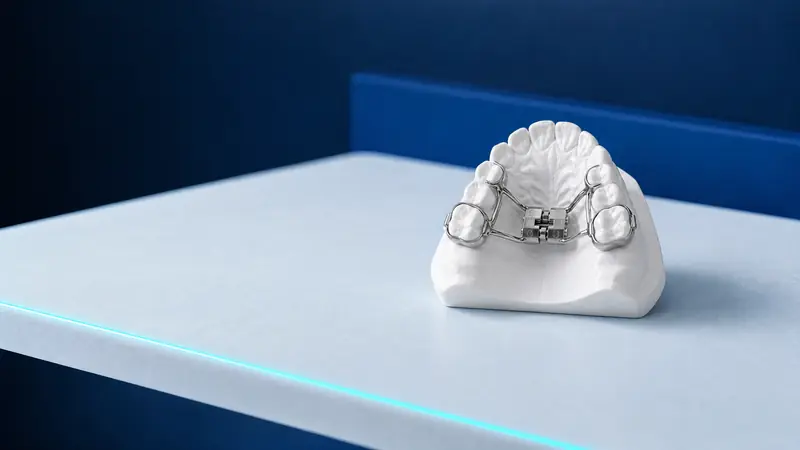
An orthodontist can widen an excessively narrow upper jaw, which also improves breathing during sleep in some children, but this does not replace treatment of the nose and tonsils. ASHA lists upper-jaw expansion as a way orthodontists support nasal breathing.
A 2017 meta-analysis of 17 studies involved 314 children with a mean age of 7.6, a narrow, high-arched palate and sleep apnoea, treated with rapid maxillary expansion. Their apnoea-hypopnoea index (AHI) fell on average from 8.9 to 2.7 per hour, a 70% reduction, but apnoea resolved completely in 25.6% of children in whom this could be assessed.
Improvement was greater in children whose tonsils had been removed or were small (73% to 95%) than in those with large tonsils (61%). The authors stress the need for randomised studies and longer follow-up, because childhood apnoea can also ease with age.
Exercises for the lip and tongue muscles (myofunctional therapy) are provided by a speech and language therapist, but ASHA notes that more research is needed into their long-term effect on sleep apnoea. A separate article explains how an upper-jaw expansion appliance works and how long it is worn.
A child’s orthodontic consultation at DentalBlue
At DentalBlue in Białystok, the orthodontist assesses the child’s bite, and X-rays, including cephalometric and panoramic images, are taken in the clinic’s own radiology unit. Treatment is planned digitally using cephalometric analysis. In the price list, “Konsultacja ortodontyczna” (orthodontic consultation) costs 300 zł, “Cefalometria” (cephalometric X-ray) 120 zł and “Aparat Hyrax” (Hyrax appliance) 1 500 zł. Assessment of the nose and tonsils is the responsibility of a paediatrician or ENT specialist. The final scope and cost are agreed at the consultation, and prices may change.
Frequently asked questions
What is an adenoid face?
This is a descriptive term for the facial appearance of some children with chronic nasal obstruction. The 2021 meta-analysis lists incompletely closed lips, a narrow dental arch, an elongated front part of the face and a backward-rotated lower jaw. The AAPD lists adenoid face among signs that may accompany sleep apnoea.
Do children who breathe through their mouths become ill more often?
They did in the Polish study of 4 837 children. Children who habitually breathed through their mouths or snored had sinus and ear infections more often and took antibiotics more frequently. The study shows an association, not a cause, but recurrent infections are a reason to see a doctor.
Does mouth breathing in children go away on its own?
Sometimes, when its cause resolves, such as a cold. Enlarged tonsils or adenoids, allergies or an established habit usually require medical assessment. If your child snores, has pauses in breathing or is sleepy during the day, see a paediatrician without delaying the visit.
Will an orthodontic appliance cure mouth breathing?
An appliance alone usually does not remove the cause if this is a blocked nose or large tonsils. Expanding a narrow upper jaw improved breathing during sleep in the 2017 meta-analysis, but worked better in children with small tonsils. Treatment usually involves both an ENT specialist and an orthodontist.
Does snoring damage a child’s teeth?
Snoring itself does not damage teeth, but often accompanies mouth breathing, which the AAPD associates with a narrow palate and open bite. Cleveland Clinic also lists dry mouth and bad breath. A child who snores should first be assessed by a paediatrician.
Does mouth breathing affect a child’s speech?
It may be associated with it. ASHA describes more frequent distortion of the s and z sounds, often as an interdental lisp, and open bite when the mouth stays open at rest and the tongue position is abnormal. A speech and language therapist assesses speech, and an orthodontist the bite.
Sources
- AAPD: Management of the Developing Dentition and Occlusion in Pediatric Dentistry (2024)
- BMC Oral Health: Zhao Z et al., effects of mouth breathing on facial development in children, meta-analysis (2021)
- International Journal of Pediatric Otorhinolaryngology: Kukwa W et al., infections in children who snore and mouth-breathe, Poland (2018)
- European Journal of Orthodontics: Becking BE et al., tonsil removal and dental and facial development, meta-analysis (2017)
- Laryngoscope: Camacho M et al., rapid maxillary expansion for childhood sleep apnoea, meta-analysis (2017)
- Pediatrics (AAP): Marcus CL et al., diagnosis and management of obstructive sleep apnoea in children (2012)
- ASHA: Orofacial Myofunctional Disorders, Practice Portal
- Cleveland Clinic: Mouth Breathing (2025)
An informational article. It does not replace a consultation, and treatment decisions are made during a visit.