How do a dummy and thumb sucking affect the bite?
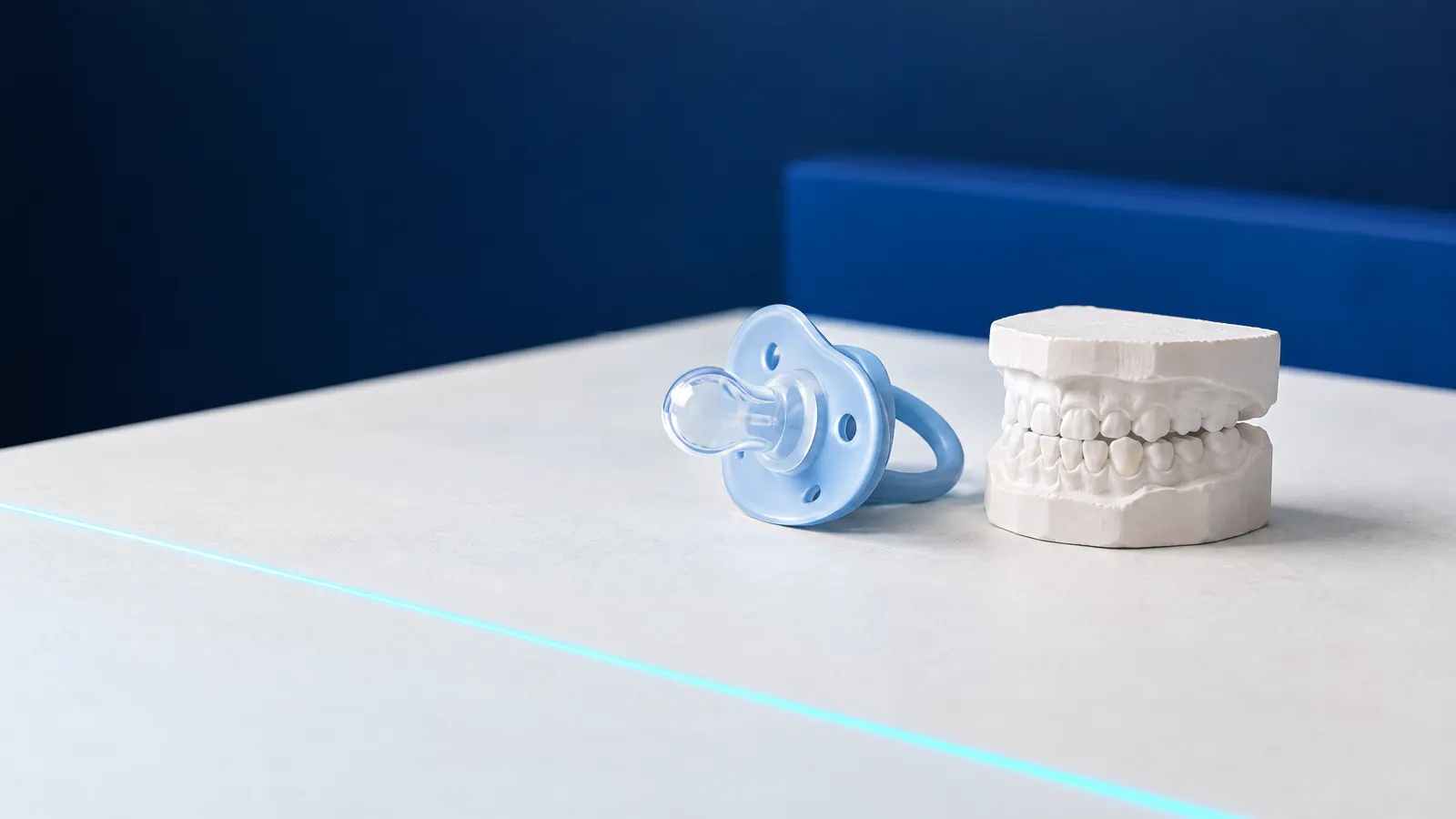
A dummy and thumb sucking affect the bite when the habit goes on for a long time. The American Academy of Pediatric Dentistry (AAPD) links prolonged non-nutritive sucking, meaning sucking unrelated to feeding, to anterior open bite and posterior crossbite, and notes that the changes can persist even after the habit has stopped.
Anterior open bite means that when the back teeth are clenched, the upper and lower incisors do not meet and a gap remains between them. In a posterior crossbite, the upper side teeth close inside the lower ones. With finger sucking, the AAPD also describes the upper incisors tipping forwards.
In infancy these habits are natural. The AAPD writes that their effect on the mouth during this period raises little concern, and what matters above all is how long they last: a meta-analysis of 15 studies showed that the longer a child sucks, the greater the risk of a bite problem.
Dummy or thumb: which does more harm to the teeth?
A dummy and a thumb affect the teeth in similar but not identical ways. In a 2016 meta-analysis, children who sucked a dummy had posterior crossbite more often than children who sucked a finger (relative risk 1.42; 7 studies, 5 560 children), and excessive protrusion of the upper incisors less often.
The American Dental Association (ADA) points to two practical differences. A dummy can be easier to give up than a thumb, and a child who just rests a thumb in the mouth does less harm to the teeth than one who sucks it vigorously.
In practice, the difference between a dummy and a thumb matters less than how long the habit lasts. With both, the risk of a bite problem rises the longer the child sucks, and for both the AAPD sets the same goal: ending the habit by 36 months of age.
| Feature | Dummy | Thumb or fingers |
|---|---|---|
| Anterior open bite | Possible with prolonged sucking | Possible with prolonged sucking |
| Posterior crossbite | More common than with finger sucking | Less common than with a dummy |
| Protruding upper incisors | Less common than with finger sucking | More common, the AAPD describes incisors tipping forwards |
| Giving it up | Often easier, according to the ADA | Harder, because a finger is always at hand |
| Recommended age to stop | According to the AAPD, by 36 months of age | AAPD: by 36 months; AAP: before the permanent incisors |
Until what age is a dummy fine? What the guidelines say
The dummy is best given up at around the age of 3: the AAPD recommends that dental visits help parents end the sucking habit by 36 months of age or earlier. The American Academy of Pediatrics (AAP) writes that intensive sucking after the age of 2 to 4 can affect the shape of the mouth and the position of the teeth.
The ADA states that children usually stop sucking between the ages of 2 and 4, or by the time the permanent front teeth are due to come through. This is an important threshold, because according to the AAP, if a child stops sucking a dummy or thumb before the permanent incisors come through, there is a good chance the bite will correct itself. The permanent central incisors usually appear at around 6 to 7 years of age.
| Child’s age | What the guidelines say | What it means in practice |
|---|---|---|
| First 3 to 4 weeks | AAP: when breastfeeding, wait before offering a dummy | A dummy once breastfeeding is established |
| First year | AAP: a dummy at sleep time is among the SIDS recommendations | A dummy when falling asleep is not a mistake |
| From 2 to 4 years | ADA and AAP: most children stop sucking | Time for gentle weaning |
| By 36 months | AAPD: end the sucking habit | The goal for both dummy and thumb |
| Around 6 to 7 years | The permanent central incisors come through | A habit that persists is a reason for a check-up |
| By 7 years at the latest | AAO: first orthodontic check-up | Assessment of the bite even without a visible problem |
A dummy in the first year: sleep and breastfeeding
In the first year of life, a dummy has a justification that has nothing to do with the teeth: the AAP lists offering a dummy at sleep time among the recommendations that reduce the risk of sudden infant death syndrome (SIDS), even if the dummy falls out after the baby is asleep. The data come mainly from case-control studies, which show an association but do not prove cause, which is why it is said that a dummy may reduce this risk.
When breastfeeding, the AAP advises waiting before offering a dummy until feeding is well established, which usually takes 3 to 4 weeks. A 2016 Cochrane review (1 302 infants) did not show that a dummy reduces the proportion of children exclusively or partially breastfed up to 4 months of age.
The sleep recommendation covers the first year, while the dental recommendation is about giving up the dummy at around the age of 3, so the two do not contradict each other.
How do you wean a child off a dummy and stop thumb sucking?
Weaning off a dummy and stopping thumb sucking work better with praise than with punishment. The AAP advises ignoring the habit at first, because most children give it up on their own, and considers harsh words, ridicule and punishment ineffective.
Popular ways of giving up the dummy, such as gradually limiting it to sleep time or swapping it for a present, have not been tested in research; they are parenting tips, not methods of proven effectiveness. For finger sucking, a 2015 Cochrane review (6 studies, 252 children) found low-quality evidence that both reinforcement-based methods and orthodontic appliances fitted to the palate help.
The AAP suggests a few simple steps:
- Praise the child for time without the dummy or thumb, instead of commenting on every bout of sucking.
- Keep a sticker chart together and reward each new day without the habit with a small treat.
- Remind gently, without shaming, especially in front of other people.
- When the child sucks out of boredom, offer something to do with their hands or play together.
- If a method makes the child frightened or tense, stop it and come back to the subject later.
When should a child see a dentist or orthodontist?
A child who sucks a thumb or a dummy should see a paediatric dentist when changes are visible in the position of the teeth or the shape of the palate; that is the AAP’s advice. An orthodontist should look at the bite by the age of 7 at the latest, as the American Association of Orthodontists (AAO) recommends, even without a visible problem.
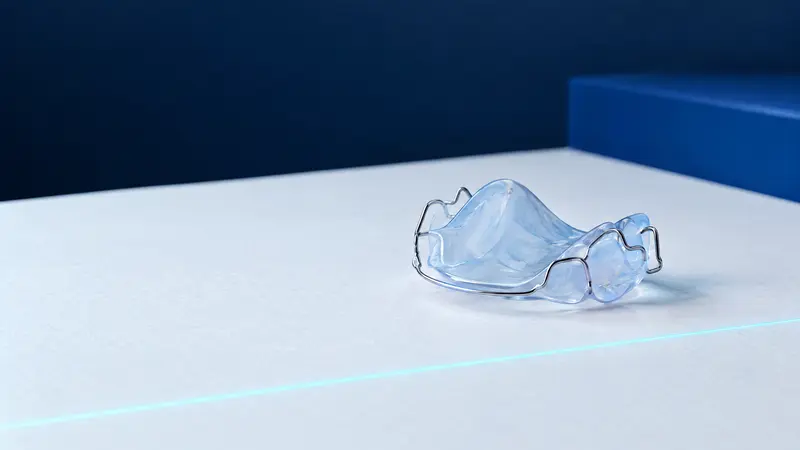
On the NFZ (Poland’s National Health Fund), treatment with a removable appliance is available to children up to the age of 12. The AAP mentions that when the habit has already changed the palate or the position of the teeth, appliances fitted in the mouth are also used, and the decision to use one is made by a doctor after an examination. The stages of orthodontics for children and the types of appliance are described in a separate article. Signs that a visit is due:
- Front teeth that do not meet when the back teeth are clenched.
- Upper incisors that clearly stick out.
- A lower jaw that shifts to one side when the mouth closes, or upper side teeth that close inside the lower ones.
- A sucking habit that is still going on when the permanent incisors start to come through.
Will an open bite in a child correct itself?
An open bite in a child can correct itself if the sucking habit ends early enough. The AAP states that if a child stops sucking before the permanent front teeth come through, there is a good chance the bite will correct itself.
There is no guarantee, however. The AAPD notes that the changes can persist after the habit has stopped, so a child who has stopped sucking but whose gap between the teeth is not getting smaller should be seen by a dentist or orthodontist. They will assess whether observation is enough or whether treatment is needed.
How it works at DentalBlue
DentalBlue in Białystok provides paediatric dentistry, preventive care and orthodontics. At a familiarisation visit, which costs 250 zł in the clinic’s price list, the dentist looks at the child’s teeth, and parents can ask about habits such as a dummy or thumb sucking. Orthodontic treatment is planned digitally on the basis of cephalometric analysis from the clinic’s own radiology unit, and an orthodontic consultation costs 300 zł. The final scope and cost are agreed at the visit, and prices may change. An appointment can be booked by phone.
Frequently asked questions
Does just keeping a thumb in the mouth harm the teeth?
It does less harm than sucking. The ADA notes that passively resting a thumb in the mouth is less harmful to the teeth than vigorous sucking. Even so, it is worth gradually phasing out the habit before the permanent incisors come through.
What if a child is still sucking a thumb at school age?
Then it is worth having the child seen by a dentist or orthodontist, because the permanent incisors come through at around 6 to 7 years of age. The Cochrane review describes reinforcement-based methods and appliances fitted to the palate as possibly helpful for finger sucking; the orthodontist decides on an appliance after an examination.
Does punishing a child help stop thumb sucking?
No. The American Academy of Pediatrics considers harsh words, ridicule and punishment ineffective and recommends praise, small rewards and gentle reminders. If a method makes the child frightened or tense, the AAP advises stopping it.
What kind of dummy is safe for a baby?
The AAP recommends a one-piece dummy with a shield at least about 3.8 cm wide. A dummy is never tied to the cot or to the baby’s neck or hand.
Is thumb sucking in a baby a cause for concern?
Usually not. The AAPD writes that the effect of finger sucking on the mouth in infancy raises little concern, and the risk of a bite problem rises with how long the habit lasts. What matters more, then, is whether the habit continues after the age of 3.
Sources
- AAPD: Management of the Developing Dentition and Occlusion in Pediatric Dentistry (2024)
- AAPD: Perinatal and Infant Oral Health Care (2025)
- AAP HealthyChildren: Pacifiers and Thumb Sucking (2026)
- AAP HealthyChildren: A Parent’s Guide to Safe Sleep (2026)
- ADA MouthHealthy: Thumbsucking
- JADA: Doğramacı, Rossi-Fedele, non-nutritive sucking and malocclusion, meta-analysis (2016)
- Cochrane: Borrie et al., interventions to stop finger sucking in children (2015)
- Cochrane: Jaafar et al., dummy use and breastfeeding (2016)
An informational article. It does not replace a consultation, and treatment decisions are made during a visit.