Do you need teeth removed for braces?
Tooth extraction for braces is not routine: teeth are removed when a non-extraction plan would not produce a good, stable result. In a study of 2 184 consecutive patients at the University of North Carolina orthodontic clinic (Jackson et al., 2017), extractions involved 37.4% of those treated in 2000 and just under 25% from 2006 onwards.
Extraction rates have changed over time. A review of records from the same clinic (Proffit, 1994) showed that the proportion treated with extractions was 30% in 1953, reached 76% in 1968 and fell to 28% in 1993. The author considered that many patients with Class I crowding could be treated well either with or without premolar extraction.
The British Orthodontic Society (BOS) notes, however, that in many cases there is no satisfactory alternative to extraction, and assurances that treatment can be carried out without removing teeth should be treated with great caution. The plan is tailored to the individual patient.
When does an orthodontist recommend removing teeth?
An orthodontist most often recommends removing teeth for severe crowding, markedly protruding front teeth and some Class II malocclusions. In the study by Jackson et al. (2017), extractions were more likely with greater crowding and upper incisor protrusion, a smaller overbite and the presence of Class II malocclusion.
The American Academy of Pediatric Dentistry (AAPD) cautions that neither baby nor permanent teeth should be extracted to relieve crowding without a full space analysis and short-term and long-term treatment plans. The list brings together situations in which extraction may be considered.
- Severe crowding, when there is not enough room in the arch for one or more teeth.
- Protruding front teeth in both arches and prominent lips.
- Class II malocclusion treated by dental compensation without jaw surgery, by retracting the upper front teeth.
- Individual situations in which the plan involves removing a tooth other than a premolar.
Premolar extraction for braces: which teeth are most often removed?
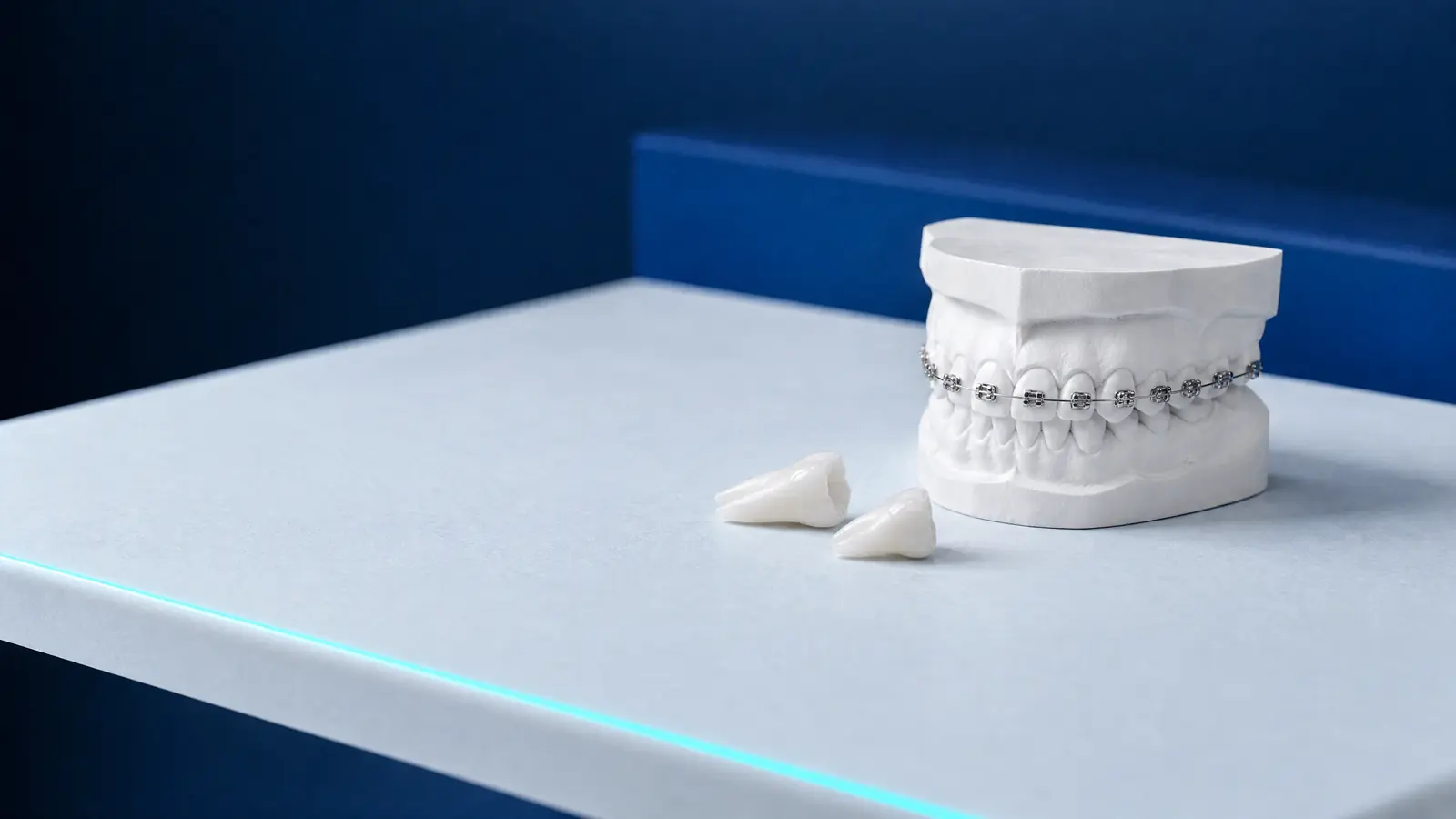
The teeth most often removed for braces are the first premolars, the fourth teeth from the centre. In the study by Jackson et al. (2017), extraction of all four first premolars involved 8.9 to 16.5% of patients treated each year. Proffit (1994) found that extractions of other teeth for individual reasons remained at around 15% over 40 years.
The BOS patient leaflet says teeth for orthodontic treatment are usually removed by the patient’s own dentist. According to the BOS, orthodontic treatment can include tooth extractions and, very rarely, jaw surgery.
In children, removing lower baby canines is sometimes considered to create space for permanent incisors. A 2021 Cochrane review cites one study in which, after a year, crowding in the extraction group was on average 4.76 mm less than in the untreated group, but at the cost of a shorter arch. The certainty of the evidence was very low. The AAPD describes a loss of arch length of up to 2.7 mm after removal of lower baby canines.
Removing wisdom teeth is not a way to make space for front teeth: in the same Cochrane review, removing wisdom teeth did not reduce crowding more than leaving them in place.
Does tooth extraction for braces change the facial profile?
The effect of tooth extraction for braces on the facial profile depends on the initial position of the teeth and lips and on the planned tooth movement. A systematic review by Leonardi et al. (2010), involving patients with protruding teeth in both arches who had mostly finished growing, found upper lip retraction of 2 to 3.2 mm and lower lip retraction of 2 to 4.5 mm after removing four premolars.
In this group, the authors considered that lip protrusion predictably decreases after this treatment, but the changes are small and do not fundamentally alter the profile; a “dished-in” profile should not be expected in these patients. They also noted that soft tissue responses vary greatly between individuals.
Concerns about facial appearance have influenced practice: Proffit (1994) listed them among the reasons for the decline in extractions in the late 20th century. The AAPD notes that insufficient arch space is always assessed together with facial aesthetics, the skeletal pattern and soft tissues.
Does extraction before braces harm the jaw joints?
Research does not suggest that extraction before braces causes temporomandibular disorders. A meta-analysis by Kim et al. (2002), covering 31 studies including comparisons of extraction and non-extraction treatment, found no increase in these disorders with conventional orthodontic treatment, although substantial differences between studies prevented a definitive conclusion.
The US National Institute of Dental and Craniofacial Research (NIDCR) states in its current information that research does not support the belief that a bad bite or orthodontic treatment, such as braces, causes temporomandibular disorders. If your jaw already hurts or clicks before treatment, it is worth mentioning this at the first consultation.
Braces without tooth extraction: what are the alternatives?
Braces without tooth extraction are possible when the missing space can be created in another way: by reducing enamel, widening the arch or moving the back teeth backwards. Each method has limitations, and the table compares them with extraction.
A review of 8 clinical studies (Gómez-Aguirre et al., 2022) found no increase in decay, demineralisation or gum changes after interproximal enamel reduction, and treatment using it was shorter than extraction treatment. A 2025 review of 11 studies on moving upper molars backwards with aligners reports movement of 0.67 to 2.54 mm, so this creates only a limited amount of space.
| Method | When it is used | Trade-offs |
|---|---|---|
| Enamel reduction (IPR) | Mild or moderate lack of space | Space gained is limited by enamel thickness |
| Arch expansion | A narrow upper jaw; best studied in children aged 7 to 11 | Aligners widen the arch less predictably than they perform other movements |
| Moving back teeth backwards | When space can be gained at the back of the arch | 0.67 to 2.54 mm in aligner studies; sometimes with a mini-implant |
| Non-extraction compromise | When the patient does not consent to tooth removal | Some treatment goals may not be achieved |
| Tooth extraction | Severe crowding, protruding teeth, selected Class II malocclusions | Longer treatment than with enamel reduction; braces close the gaps |
Does premolar extraction prevent teeth moving back?
Removing teeth does not protect against recurrent crowding, so retention is needed after extraction treatment just as it is after non-extraction treatment. In a follow-up study by Little et al. (1981), two-thirds of 65 patients treated with first premolar extractions had unsatisfactory lower front tooth alignment at least 10 years after retention ended.
The authors found no pretreatment features that could predict whose teeth would move. Proffit (1994) notes that frequent extractions in the 1960s reflected the search for a more lasting result, but later data showed that removing teeth does not ensure this. The article on retainers after braces describes the types of retention.
What should you ask before consenting to tooth extraction for braces?
Before consenting to tooth extraction for braces, the patient, including a teenager who has turned 16, and a parent acting as their legal representative have the right to clear information about proposed and possible treatment methods and the foreseeable consequences of undergoing or forgoing them. This is provided by art. 9 of the Polish Act on Patients’ Rights and the Patient Ombudsman (Rzecznik Praw Pacjenta), while art. 16 gives the right to consent or refuse after receiving this information (legal status as of 24 October 2026).
The questions below can help structure the conversation. It is worth having the answers before the procedure, because an extracted tooth cannot be restored.
- Why does the plan involve extraction, and what problem is it intended to solve?
- Which teeth will be removed, who will perform the procedure, and at what stage of treatment?
- Which non-extraction options were considered, and why were they not chosen?
- How will extraction affect lip position and the profile in this particular case?
- How long will closing the gaps take, and which appliance will be needed?
- What will happen to the treatment result if I do not agree to tooth removal?
How extraction treatment is planned at DentalBlue
At DentalBlue, orthodontic treatment is planned digitally using cephalometric analysis. Panoramic X-rays, cephalometric X-rays and, when indicated, CBCT scans are taken in the clinic’s own radiology unit. The clinic also provides oral surgery, including tooth extractions.
In the price list, “Ekstrakcja prosta zęba stałego jednokorzeniowego” (simple extraction of a single-rooted permanent tooth) costs 350 zł, “Ekstrakcja prosta zęba stałego wielokorzeniowego” (simple extraction of a multi-rooted permanent tooth) 500 zł, and “Miniimplant ortodontyczny” (orthodontic mini-implant) 700 zł. The final scope and cost are agreed at a consultation, and prices may change.
Frequently asked questions
Will the gap left by an extracted tooth stay forever?
Not if extraction is part of an orthodontic plan: the appliance uses that space to align the remaining teeth and close the gap. The time needed to close gaps depends on the bite problem and appliance type. A 2022 review found that extraction treatment took longer than treatment with enamel reduction.
Can you refuse tooth extraction for braces?
Yes. The Polish Act on Patients’ Rights gives you the right to refuse consent to a proposed service after receiving information about its consequences. The BOS notes, however, that there is no satisfactory alternative to extraction in many cases, so a non-extraction plan may involve a compromise in the result. It is worth asking for a comparison of both options.
Can early removal of baby teeth avoid extracting permanent teeth?
There is no certain evidence for this. The AAPD says some studies find that early treatment of Class II malocclusion does not reduce the need for premolar extraction, although other papers disagree. Removing lower baby canines can reduce incisor crowding but can also shorten the arch by up to 2.7 mm, which is why space analysis comes before the decision.
Is tooth extraction for braces covered by the NFZ?
Tooth extraction, including surgical extraction, is among the services funded by the NFZ, Poland’s National Health Fund, for adults and children. For those under 18, this also includes surgical removal of tooth buds for orthodontic reasons. The standard children’s orthodontic package does not fund fixed braces; separate rules apply in the orthodontic care programme for children with congenital craniofacial defects (legal status as of 24 October 2026).
Can you use aligners instead of fixed braces in extraction treatment?
It is sometimes possible, but results are poorer. A review of 15 studies (Alhafi et al., 2025) found no difference between aligners and fixed braces in non-extraction treatment. In extraction cases, however, fixed braces produced a better-quality result through better control of tooth movement.
Sources
- Am J Orthod Dentofacial Orthop: Jackson TH et al., extraction rates in orthodontic treatment in the 21st century (2017)
- Angle Orthodontist: Proffit WR, forty years of extractions at a university clinic (1994)
- Angle Orthodontist: Leonardi R et al., soft tissues after premolar extraction, systematic review (2010)
- NIDCR: TMD (Temporomandibular Disorders) (2026)
- British Orthodontic Society: FAQs, patients’ frequently asked questions (2026)
- AAPD: Management of the Developing Dentition and Occlusion in Pediatric Dentistry (2024)
- Am J Orthod: Little RM et al., stability of lower incisor alignment after premolar extraction (1981)
- Dz.U. 2024 poz. 581: Ustawa o prawach pacjenta i Rzeczniku Praw Pacjenta, consolidated text (2024)
An informational article. It does not replace a consultation, and treatment decisions are made during a visit.