What happens if a missing tooth is not replaced?
After tooth loss, the bone at the gap and the position of surrounding teeth change. The systematic review by Tan et al. (2012) reports that within 6 months of extraction the alveolar ridge loses 29 to 63% of its width and 11 to 22% of its height, with the fastest changes in the first 3 to 6 months.
Teeth that have lost their opposing partner also change. A study by Craddock et al. (2007) of 100 people with an unopposed posterior tooth found overeruption in 92% of cases, averaging 1.68 mm and reaching almost 4 mm, compared with an average of 0.24 mm in controls. Overeruption was greater in the upper jaw than the lower.
The same team described tilting and rotation of teeth next to a gap, with the extent varying widely between individuals (Craddock et al., 2007). Substantial movement may take up the space later needed for an implant, bridge or denture.
Does every missing tooth need replacing?
Not every missing tooth needs replacing, particularly at the end of the arch. The shortened dental arch concept holds that missing back teeth do not always require a denture. A meta-analysis by Fueki et al. (2017), including 516 participants, found no difference in oral health-related quality of life between a shortened arch and replacement with a partial denture at either 6 or 12 months.
A gap at the front, visible when smiling, or in the middle of the arch, where neighbouring teeth may tilt, is different. The decision also depends on whether the opposing tooth is beginning to overerupt and whether the remaining teeth allow comfortable chewing.
Leaving a gap is a treatment decision, not the absence of one: it requires monitoring for movement of surrounding teeth and reassessment if biting problems develop.
How can missing teeth be replaced? Options by number of missing teeth
Replacement options depend mainly on how many teeth are missing and where. The table lists typical solutions; separate articles on implants, bridges and dentures explain each in detail.
| Number of missing teeth | Possible options | Points to consider |
|---|---|---|
| One tooth, with teeth on both sides of the gap | Implant with a crown, bridge, adhesive bridge | A conventional bridge requires grinding down neighbouring teeth |
| One tooth at the end of the arch | Implant with a crown or leaving the gap | A gap may be acceptable with a shortened arch |
| Several adjacent teeth | Tooth- or implant-supported bridge, metal partial denture | Implant number is determined using a CBCT scan |
| Several gaps in different parts of the arch | Metal partial or combination denture, several bridges | Removable dentures require careful abutment tooth hygiene |
| At least 5 teeth in one arch | Also an NFZ-funded acrylic partial denture | NFZ: acrylic dentures only, once every 5 years |
| All teeth in an arch | Complete denture, implant denture, fixed implant bridge | A 2-implant denture as the minimum standard in the lower jaw |
One missing tooth: what are the options?
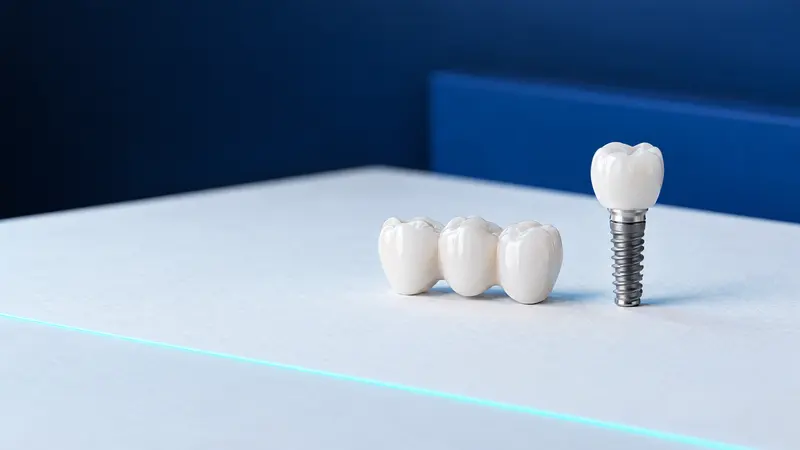
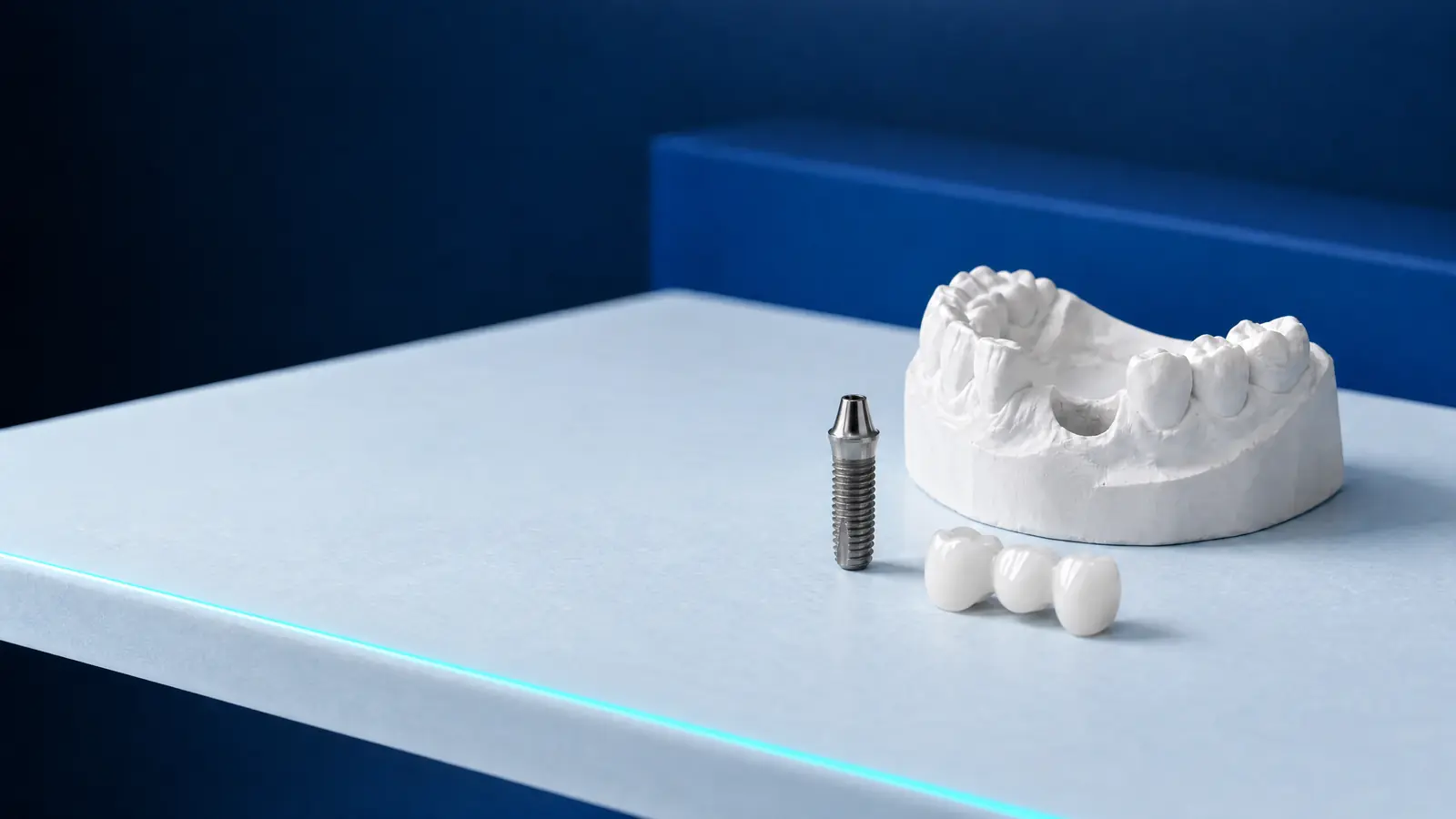
One missing tooth is usually replaced with an implant and crown or a bridge; a front gap can also be replaced with an adhesive bridge bonded to neighbouring teeth. An implant avoids grinding down neighbours but involves surgery and healing, while a conventional bridge requires preparing abutment teeth. The article on choosing an implant or bridge compares both approaches, with lifespan and cost data.
During healing or while awaiting an implant, a gap can be concealed temporarily, for example with an immediate denture or a splint with an added tooth. In the clinic’s price list, “Proteza natychmiastowa” (immediate denture) costs 2 000 zł and “Szyna termoplastyczna z dostawieniem zęba” (thermoplastic splint with an added tooth) 1 200 zł.
Several missing teeth: what can be done?
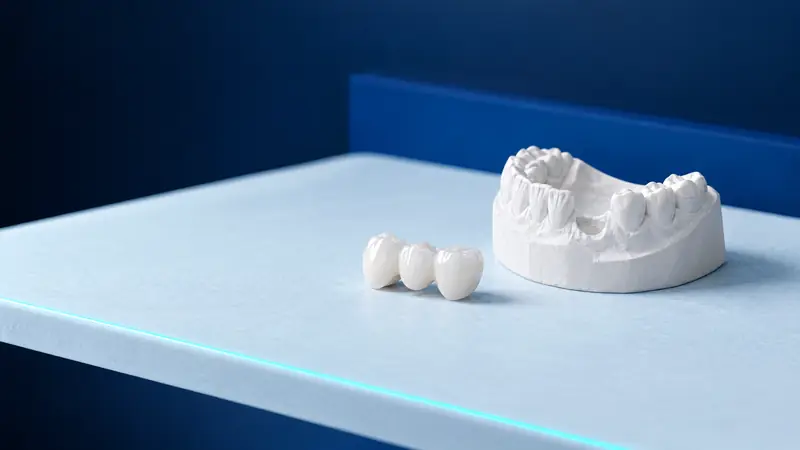
When several teeth are missing, the choice depends on whether teeth bound the gap on both sides or it extends to the end of the arch, and on the condition of the teeth that would support the replacement. Gaps bounded by healthy teeth can be filled with a bridge; several adjacent missing teeth can also be replaced with an implant bridge.
With several gaps or no teeth at the end of the arch, the dentist considers a partial denture, for example a cast metal framework denture with clasps or attachments. The NFZ, Poland’s National Health Fund, funds an acrylic partial denture when at least 5 teeth are missing in an arch, but it rests mainly on the gum; the article on metal partial dentures explains the differences.
For multiple missing teeth, options are often combined, for example a bridge in one part of the arch and a partial denture elsewhere, or implants for some gaps. The dentist sets the sequence in the treatment plan: treatment of decay, root canals and periodontal disease first, then prosthetic replacement.
All teeth missing: complete dentures or implants?
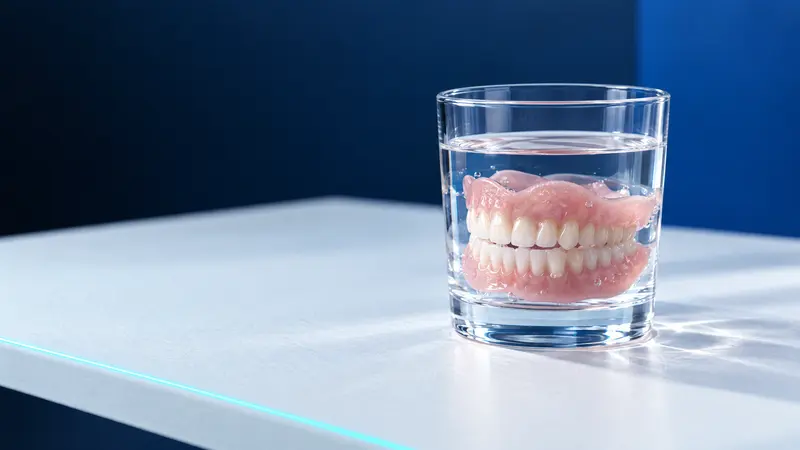
When all teeth in an arch are missing, there are three options: a gum-supported complete denture, a removable implant-retained overdenture, or a fixed implant bridge. The 2002 McGill consensus regarded a two-implant overdenture as the first choice for a toothless lower jaw; the 2009 York consensus called it the minimum standard that should suffice for most people (Thomason et al., 2012).
Complete tooth loss is declining markedly in Poland. According to the latest national oral health survey, the proportion of people aged 65 to 74 with no teeth fell from 40.8% in 2009 to 18.8% in 2019, while the proportion with at least 20 teeth rose from 8.0% to 27.1% over that period.
In Podlaskie province, 70 people in this age group were examined in 2019: 19, or 27.1%, had no teeth, and 5, or 7.1%, had at least 20 teeth. This is a small sample, so the regional result needs cautious interpretation.
What determines the choice of replacement?
Several factors jointly determine how missing teeth are replaced; the dentist discusses them at a prosthodontic consultation. The main ones are:
- The quantity and quality of bone at the gap, assessed with a panoramic X-ray and, before an implant, a CBCT scan.
- The condition of neighbouring teeth: healthy teeth would need grinding down for a bridge, while teeth with large fillings or crowns may serve as abutments.
- The condition of the gums and periodontal tissues, treated before any prosthetic replacement.
- General health, medicines and smoking, which affect healing and implant success.
- Treatment time, including healing for implants and laboratory work for bridges or dentures.
- Budget and funding, as the NFZ funds only acrylic dentures.
- Expectations for appearance and comfort, including whether the replacement should be fixed or removable.
What does the NFZ fund for missing teeth in Białystok and the region?
For adults with missing teeth, the NFZ funds only acrylic dentures: partial dentures with wrought clasps for 5 to 8 or more than 8 missing teeth in one arch, and upper or lower complete dentures, each no more than once every 5 years. The package also includes a complete denture supported by protected roots with properly completed root canal treatment, and repair and relining every 2 years (legal status as of 24 October 2026).
The regulation does not provide implants, crowns, bridges or metal partial dentures; the 5-year limit does not apply after surgical removal of cancer of the facial skeleton. According to the Podlaskie regional branch of the NFZ, 25 service locations in the province provide dental prosthetics under contract with the fund. The NFZ “Gdzie się leczyć” (where to get treatment) search tool lists them, and the Patient Information Helpline provides information on 800 190 590 (as of 24 October 2026).
One location in the region provides prosthetics for patients after treatment for facial skeleton cancers: the Specialist Dental Treatment Centre of the Medical University of Białystok at ul. Jerzego Waszyngtona 15A.
How it works at DentalBlue
At DentalBlue in Białystok, prosthodontics, surgery and implantology, endodontics, orthodontics and paediatric dentistry work at one address, so a replacement plan can include abutment treatment, extractions or implants from the outset. The clinic’s own radiology unit takes panoramic X-rays and CBCT scans. “Wizyta bez bólu” (visit without pain, 300 zł) includes a panoramic X-ray, consultation, examination and written treatment plan; “Konsultacja protetyczna” (prosthodontic consultation) costs 300 zł. Prices may change. A consultation can be booked by phone.
Frequently asked questions
How soon after extraction should a tooth be replaced?
There is no single deadline, but bone changes fastest in the first 3 to 6 months after extraction (Tan et al., 2012). It is therefore worth discussing a replacement plan soon after extraction; the article on implants after tooth extraction explains whether an implant can be placed immediately.
Does a missing first molar need replacing?
Often, but not always. The tooth opposite a first-molar gap may overerupt: Craddock et al. (2007) found overeruption in 92% of unopposed teeth. With a shortened dental arch, the dentist may consider the gap acceptable if the surrounding teeth are stable.
How much does replacing missing teeth cost?
It depends on the option. In DentalBlue’s price list, “Wszczepienie implantu” (implant placement) and “Korona cyrkonowa na implancie” (zirconia crown on an implant) each cost 3 500 zł, “Proteza szkieletowa” (metal partial denture) 3 500 zł, and “Proteza akrylowa całkowita/częściowa” (complete/partial acrylic denture) 2 500 zł or 2 000 zł. The dentist sets the final scope and cost at the consultation, and prices may change.
Where in Białystok can I get an NFZ-funded denture?
An acrylic denture is provided through the NFZ by a facility with a dental prosthetics contract. The Podlaskie regional branch of the NFZ lists 25 such locations in the province; “Gdzie się leczyć” shows them after selecting a district or town. The NFZ funds only acrylic dentures (as of 24 October 2026).
Sources
- Clinical Oral Implants Research: Tan WL et al., ridge changes after extraction, systematic review (2012)
- Journal of Prosthodontics: Craddock HL et al., overeruption of unopposed teeth, part 1 (2007)
- Journal of Prosthodontics: Craddock HL et al., movement of teeth adjacent to a gap, part 2 (2007)
- Journal of Oral Rehabilitation: Fueki K et al., shortened dental arch and quality of life, meta-analysis (2017)
- Journal of Dentistry: Thomason JM et al., two-implant overdentures, McGill and York consensuses (2012)
- Ministerstwo Zdrowia, WUM: Choroba próchnicowa i stan tkanek przyzębia populacji polskiej, summary of surveys from 2016 to 2019 (2021)
- ELI: Rozporządzenie MZ w sprawie świadczeń gwarantowanych z zakresu leczenia stomatologicznego, t.j. Dz.U. 2025 poz. 615
- Podlaski Oddział Wojewódzki NFZ: dental treatment, service locations from 1 July 2025
An informational article. It does not replace a consultation, and treatment decisions are made during a visit.