What is an implant-supported denture (overdenture)?
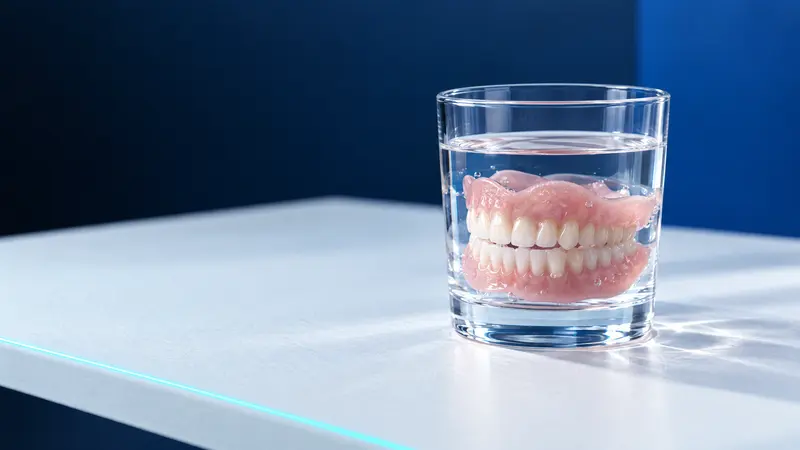
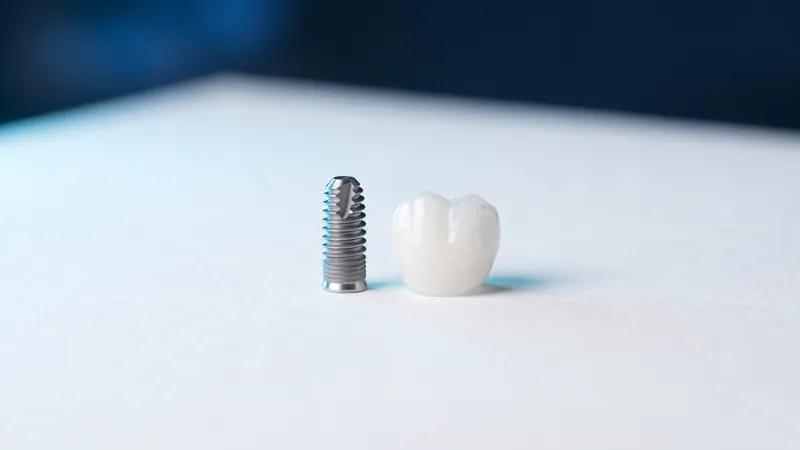
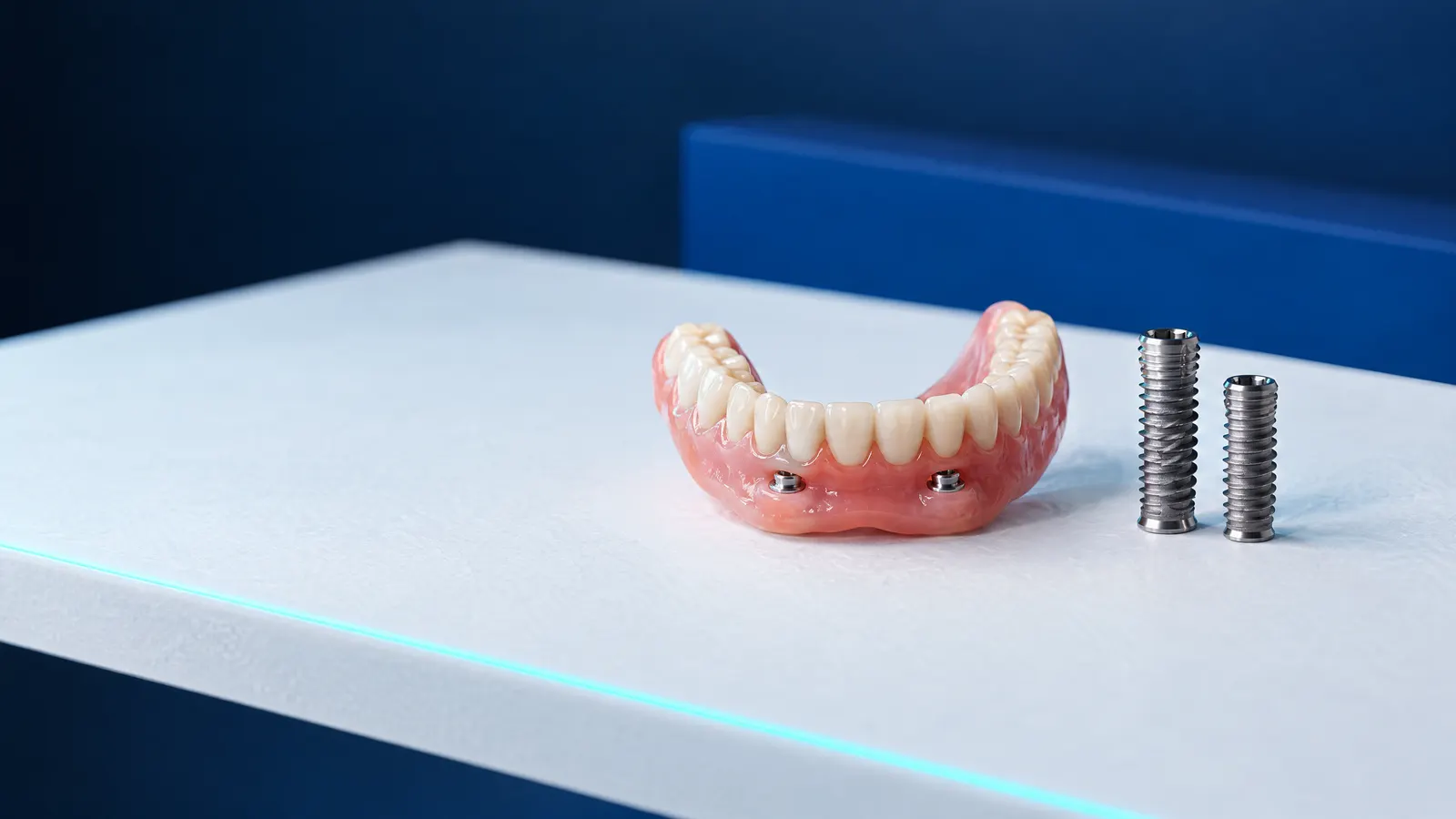
An implant-supported denture, also called an implant overdenture, is a complete denture that rests on the gum but is held in place by implants placed in the bone. The connection is made by attachments, for example ball or cylindrical ones, by a bar joining the implants or by telescopic crowns. The patient takes the denture out themselves, just like an ordinary denture, and only the implants with the attachment parts stay in the mouth.
A denture on attachments supported by implants has to be distinguished from fixed teeth on implants, that is, a full-arch bridge screwed or cemented onto implants. The patient does not take such a restoration out; only the dentist removes it. Both options require an assessment of the bone on a CT scan beforehand and a procedure to place the implants.
Why is a denture on two implants the standard in the lower jaw?
A denture on two implants is the standard in a toothless lower jaw because in studies it gives clearly better results than an ordinary complete denture. The McGill consensus (Montreal, 2002) stated that a conventional denture is no longer the most appropriate first-choice treatment for a toothless lower jaw, and that the first choice should be a denture on two implants.
The York consensus (2009) confirmed that satisfaction and quality of life are significantly higher with a lower implant-supported denture than with a conventional denture. Its authors stressed that a denture on two implants is not the gold standard of implant dentistry but a minimum standard, which should be enough for most people (Thomason et al., 2012).
For the patient this makes a practical difference: a lower complete denture has a small supporting area and moves easily, while attachments on implants hold it in place during eating and speaking. An upper complete denture has wider support, because it also covers the palate.
A denture on 2 or on 4 implants?
In the lower jaw, a denture on 2 implants is usually enough, while the upper jaw needs more. In a 10-year randomised study of 60 patients with a lower denture on 2 or 4 implants, no differences were found in the condition of the tissues around the implants, the bone, satisfaction or the number of maintenance visits, and the authors recommended 2 implants on grounds of cost (Meijer et al., 2009).
A meta-analysis of 54 studies did, however, show a general trend: the fewer the implants, the more often an implant was lost, including when 2 and 4 implants under a lower denture were compared (Kern et al., 2016). There is no consensus for the upper jaw, and a review of studies indicates that usually at least 4 implants are needed, preferably joined by a bar (Raghoebar et al., 2014). The dentist sets the final number of implants on the basis of a CT scan.
| Situation | Typical number of implants | What studies say |
|---|---|---|
| Lower denture (lower jaw) | 2 | McGill and York consensus: the minimum standard of care |
| Lower denture on 4 implants | 4 | After 10 years, no clinical differences compared with 2 implants |
| Upper denture (upper jaw) | Usually at least 4, preferably with a bar | Fewer than 4 implants: 7.22 vs 2.31 losses per 100 implant years |
| Fixed full-arch bridge | Set individually on a CT scan | In the lower jaw, fewer implants lost with 5 or more than with 4 |
Implant-supported denture or fixed teeth on implants?
In studies, patients rate an implant-supported denture and a fixed bridge on implants similarly. A systematic review of 13 studies found no significant differences in quality of life and satisfaction, with a slight advantage for fixed bridges in most studies, but the results on chewing, speech and appearance were conflicting (Yao et al., 2018).
In the meta-analysis by Kern et al. (2016), implants under fixed restorations were lost less often than under removable dentures: 0.23 versus 0.35 losses per 100 years of implant function. These figures describe groups of patients, and in practice the choice is decided by the amount of bone, the number of implants that can be placed, ease of cleaning and budget.
| Criterion | Implant-supported denture | Fixed bridge on implants |
|---|---|---|
| Who takes it out | The patient, for cleaning | Only the dentist, at a check-up |
| Hygiene | Denture washed outside the mouth, attachments cleaned in the mouth | Cleaning under the bridge with an interdental brush or floss |
| Typical number of implants | Lower jaw usually 2, upper jaw usually at least 4 | Set on a CT scan, usually more than for a lower denture |
| Parts needing servicing | Attachment inserts, denture relining | Screws, chipped veneering |
| Item in the clinic’s price list | On 2 implants 10 000 zł, on 4 implants 16 000 zł | No single item, cost set in the treatment plan |
How does treatment with an implant-supported denture work?
Treatment with an implant-supported denture starts with an examination and cone beam computed tomography (CBCT), which shows the height and width of the bone where the implants are planned. Implants are usually placed under local anaesthesia and then fuse with the bone, which usually takes a few months, most often 2 to 6.
The dentist decides when the denture can be clipped onto the implants, based on the stability of the implants and the quality of the bone in the particular case. The successive stages are described in detail in the article on implants step by step.
- Consultation, examination and a CBCT scan with a plan for positioning the implants.
- Placing the implants; during healing the patient usually wears their existing denture or a temporary one.
- Uncovering the implants, if they were covered by gum, and fitting the attachment parts or the bar.
- Impressions and making a new denture, or adapting the existing one if the dentist considers this possible.
- Fitting the denture, learning to put it in and clean it, then follow-up visits.
What needs servicing in an implant-supported denture?
An implant-supported denture needs regular maintenance, because its retentive parts wear. In a review of 45 studies, loss of retention due to wear of the attachment inserts was the most common reason for maintenance visits, requiring the part to be activated or replaced, and plastic inserts wore faster than metal ones (Wakam et al., 2022).
Guidelines set no fixed interval for replacing inserts or relining: the frequency depends on the attachment system and on the patient, and the dentist assesses it at the check-up. The gum and bone under the denture change over time, so the denture may need relining even when the implants are in good condition.
The tissues around implants can become inflamed, just like the gum around teeth, so daily hygiene and check-ups are part of the treatment, not an extra. Risk factors and the lifespan of the implants themselves are covered in a separate article on whether implants last a lifetime.
- Wash the denture every day outside the mouth, following the dentist’s instructions.
- Clean the implants and the attachment parts in the mouth with a soft toothbrush.
- Come in when the denture starts to feel looser or presses, or when the gum around an implant bleeds.
- Attend check-ups at the intervals set by the dentist.
How much does an implant-supported denture cost, and does the NFZ fund it?
The cost of an implant-supported denture depends on the number of implants, the type of attachments or bar, the need for bone grafting and whether a new denture is made. In the clinic’s price list, “Proteza na 2 implantach” (denture on 2 implants) costs 10 000 zł and “Proteza na 4 implantach” (denture on 4 implants) 16 000 zł. These prices do not include the implants: “Wszczepienie implantu” (implant placement) is a separate item at 3 500 zł per implant, and the dentist explains the full scope of a particular plan at the consultation.
Implants and implant-supported dentures are not among the services funded by the NFZ (Poland’s National Health Fund); adults are entitled only to an acrylic denture once every 5 years (Ministry of Health regulation, consolidated text Dz.U. 2025 poz. 615, legal position as of 12 October 2026). The dentist sets the final scope and cost, and prices may change.
| Item in the clinic’s price list | Price |
|---|---|
| Konsultacja implantologiczna (implant consultation) | 300 zł |
| Tomografia komputerowa, szczęka lub żuchwa (CT scan, upper or lower jaw) | 300 zł |
| Wszczepienie implantu (placing an implant) | 3 500 zł |
| Proteza na 2 implantach (denture on 2 implants) | 10 000 zł |
| Proteza na 4 implantach (denture on 4 implants) | 16 000 zł |
| Zatrzask osiowy Rhein (Rhein axial attachment) | 800 zł |
| Podścielenie protezy (denture relining) | 450 zł |
| Proteza akrylowa całkowita (complete acrylic denture, for comparison) | 2 500 zł |
How implant-supported dentures are planned at DentalBlue
At DentalBlue in Białystok, implants are planned on a CBCT image from the clinic’s own radiology unit, and implantology and prosthodontics work at one address, so placing the implants and making the denture are carried out under a single plan. Surgical procedures are performed under local anaesthesia or, for patients who qualify, under general anaesthesia. The first step can be a “Wizyta bez bólu” (visit without pain, 300 zł) with a written treatment plan. The dentist sets the final scope and cost, and prices may change.
Frequently asked questions
How long does treatment with an implant-supported denture take?
Usually a few months, because the implants have to fuse with the bone, which most often takes 2 to 6 months, and longer when bone has to be rebuilt first. During this time the patient usually wears their existing denture or a temporary one. The dentist sets the timetable after the CT scan.
Can an implant-supported denture be deducted from tax?
As a rule, no. An exception may apply to people with an orzeczenie o niepełnosprawności (a Polish disability certificate), when the restoration is related to the disability and documented. In a ruling of 14 April 2026, the Director of the National Tax Information service (KIS) accepted the deduction of a lower denture on two implants for a person with a severe disability; the ruling protects only the applicant. It is worth asking a tax adviser.
Should an implant-supported denture be taken out at night?
Guidelines from the American College of Prosthodontists state that a denture should not stay in the mouth overnight without a particular reason. The rules for a specific design, including how to store and clean it, are given by the dentist when the denture is fitted.
Does an implant-supported denture need relining?
It may. An implant-supported denture still rests partly on the gum, and randomised studies record relining among the usual maintenance tasks, alongside replacing attachment inserts. The dentist decides whether and when it is needed at the check-up.
Is a CT scan needed for an implant-supported denture?
Yes. When implants are planned, a CBCT scan shows the amount of bone and the course of important structures, such as the nerve canal in the lower jaw and the sinuses in the upper jaw. In the clinic’s price list, a CT scan of the upper or lower jaw costs 300 zł, and of both arches 350 zł.
Sources
- Thomason JM et al., J Dent: the two-implant overdenture as a standard, McGill and York consensus statements (2012)
- Meijer HJ et al., Clin Oral Implants Res: lower overdenture on 2 or 4 implants, 10-year study (2009)
- Kern JS et al., Clin Oral Implants Res: implant loss under dentures and bridges in edentulous jaws, meta-analysis (2016)
- Raghoebar GM et al., Eur J Oral Implantol: upper implant overdentures, how many implants (2014)
- Yao CJ et al., Clin Oral Implants Res: implant overdenture versus fixed bridge, patient-reported outcomes (2018)
- Wakam R et al., Materials: wear and maintenance of implant overdenture attachments, review (2022)
- Dz.U. 2025 poz. 615: rozporządzenie MZ w sprawie świadczeń z zakresu leczenia stomatologicznego, tekst jednolity (2025)
- Inforlex: interpretacja KIS 0112-KDSL1-2.4011.105.2026.2.JN, proteza na implantach w uldze rehabilitacyjnej (2026)
An informational article. It does not replace a consultation, and treatment decisions are made during a visit.