How does All-on-4 work?
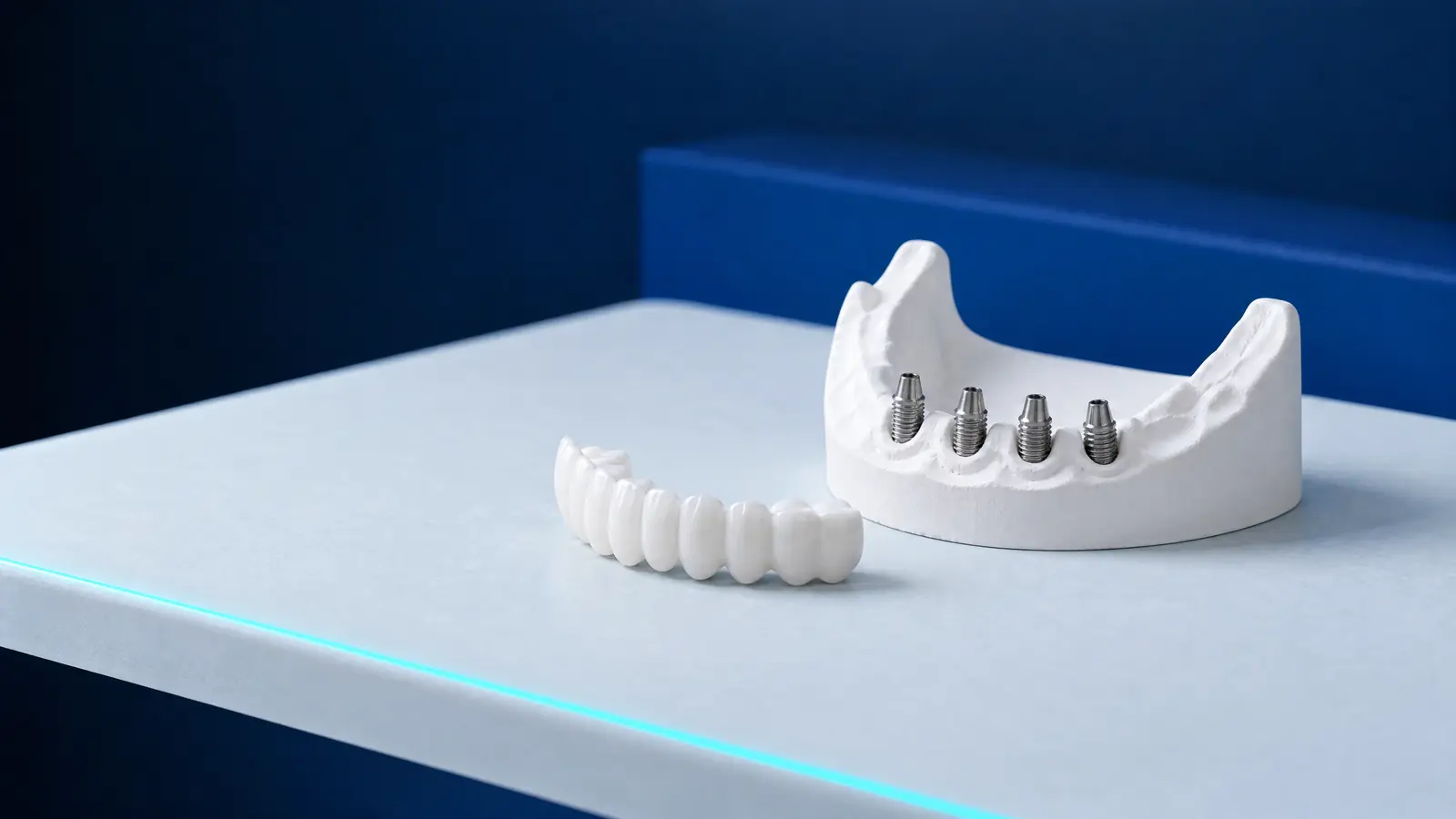
All-on-4 (also written all-on-four) is a way of treating edentulism, that is the loss of all the teeth in an arch, with a fixed bridge supported by four implants. The two front implants are placed upright and the two back ones at an angle, which according to a 2015 review can take the place of a maxillary sinus lift or a bone graft.
The concept was described in 2003 by Maló and colleagues. In 44 patients with a toothless lower jaw, a temporary acrylic bridge was fixed on four implants within 2 hours of surgery; after 6 months implant survival ranged from 96.7 to 98.2%, and no bridge was lost.
The term “All-on-6” means the same type of restoration supported by six implants. Fixed teeth on implants are not taken out by the patient: the bridge is screwed or cemented to the implants, and only the dentist can remove it.
Who can have fixed teeth on 4 implants?
Fixed teeth on implants are an option for people who have lost all the teeth in the upper or lower jaw, or whose remaining teeth in the arch cannot be saved. The review by Kwon et al. (2014) points out that teeth with a good prognosis should not be extracted just so that a full-arch bridge can be made.
Edentulism still affects many older people, including in Podlaskie province. In the most recent nationwide oral health monitoring survey (carried out in 2019; the latest available as of 24 October 2026), 18.8% of people aged 65 to 74 had no teeth at all, and in Podlaskie 19 of the 70 people examined, or 27.1%.
In the same survey, 7.1% of the older people examined in Podlaskie had at least 20 of their own teeth, compared with 27.1% nationwide, although the regional sample was small. Whether All-on-4 is possible is decided by the dentist after an examination, a medical history and a CT scan, taking into account, among other things, the factors below.
- The amount and quality of bone in the front part of the upper or lower jaw, shown by cone beam computed tomography (CBCT).
- General health conditions and medicines, especially the high doses of antiresorptive drugs used in patients with bone metastases, which carry a high risk of complications.
- Smoking: in a meta-analysis of 107 studies, 6.35% of implants placed in smokers and 3.18% of implants placed in non-smokers were lost (Chrcanovic et al., 2015).
- Radiotherapy to the head and neck, after which the risk of losing an implant is almost twice as high (odds ratio 1.97, Schiegnitz et al., 2022).
- Willingness to clean the bridge every day and to attend regular check-ups for as long as it is in use.
How does All-on-4 treatment work, step by step?
All-on-4 treatment begins with a consultation and a CBCT scan, on which the dentist measures the height and width of the bone and checks the position of the maxillary sinuses and of the nerve canal in the lower jaw. The position and angle of the implants are planned on this image, and the patient receives a written treatment plan.
The temporary bridge is often fixed on the day of surgery: in the review by Patzelt et al. (2014), 1,201 bridges were fitted within 48 hours of implant placement. The condition for this is good primary stability, meaning that the implants are firmly anchored in the bone; when it is lacking, the dentist may decide to let the implants heal without load.
The final bridge is made after healing. A Cochrane review (Esposito et al., 2013) states that implants are traditionally left unloaded for 3 to 8 months, and it found no convincing difference in implant loss between immediate, early and conventional loading.
- Implant consultation, examination, medical history and a CBCT scan.
- Extraction of the teeth that cannot be saved, if any are still in the arch.
- Placement of four or more implants under local anaesthesia or, for patients who qualify, under general anaesthesia.
- Fitting of a temporary bridge, if the implants are stable enough.
- Several months of healing, with check-up visits.
- Making and fixing the final bridge, followed by regular check-ups and professional hygiene visits.
How long do teeth on 4 implants last according to studies?
In studies, teeth on 4 implants show high survival in the first years, but long-term data are scarce. The review by Patzelt et al. (2014) reported implant survival of 99.0% and bridge survival of 99.9% after 36 months, with mean bone loss of 1.3 mm; 74% of the implants that were lost failed in the first 12 months.
A 2025 overview of reviews by Figueiredo et al. (8 systematic reviews) reported cumulative implant survival of 94.8 to 99.3% and found no evidence that All-on-4 does worse than treatment with more implants. Most of the reviews assessed, however, had a high risk of bias.
In a meta-analysis of 44 studies, tilted implants did not fail significantly more often than upright ones (1.63% compared with 1.81%), although in the upper jaw alone the difference was significant in favour of upright implants (Chrcanovic et al., 2015). A review prepared for the 2018 ITI consensus (Polido et al., 93 studies) found no difference in survival between fewer than 5 and at least 5 implants per arch.
The most common technical problem is a fractured bridge. In the review by Patzelt et al. this mainly affected all-acrylic bridges, and in the review by Huber et al. (2026) metal-ceramic bridges fractured less often (7.27 to 18.2%) than metal-acrylic ones (7.3 to 36.7%).
Fixed bridge on implants, denture on implants or conventional denture?
A fixed bridge on implants, a denture on implants and a conventional complete denture differ in who takes them out, what supports them and how much maintenance they need. A review of 13 studies found no significant differences in quality of life or satisfaction between dentures on implants and fixed bridges, with a slight advantage for bridges in most of the studies (Yao et al., 2018).
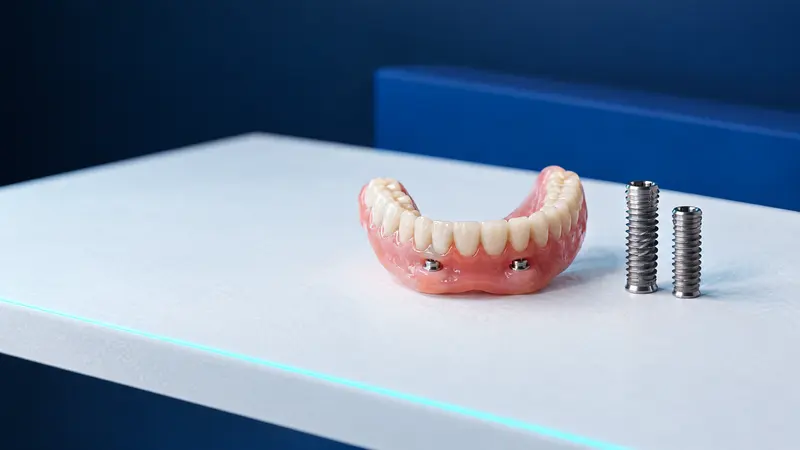
A denture on implants, which the patient takes out to clean, usually needs fewer implants, and in a toothless lower jaw two is the standard. The details of this option, including maintenance of the attachments, are described in a separate article on dentures on implants.
| Criterion | Fixed bridge on 4 to 6 implants | Denture on implants | Complete denture |
|---|---|---|---|
| Who takes it out | Only the dentist | The patient, for cleaning | The patient, for cleaning |
| What supports it | Implants only | Implants and the gum | The gum, and in the upper jaw also the palate |
| Typical number of implants | Usually 4 to 6, decided on CBCT | Lower jaw usually 2, upper jaw usually at least 4 | No implants |
| Hygiene | Cleaning under the bridge in the mouth | Denture cleaned outside the mouth, attachments in the mouth | Denture cleaned outside the mouth |
| Typical maintenance | Repairing fractures, checking screws | Replacing attachment inserts, relining | Relining, repairs |
| Item in the clinic’s price list | No single item, priced from the plan | On 2 implants 10 000 zł, on 4 implants 16 000 zł | Acrylic complete denture 2 500 zł |
| NFZ (Poland’s National Health Fund) | Not funded | Not funded | Acrylic denture once every 5 years; no limit after craniofacial tumour surgery |
How much does All-on-4 cost, and what does the price depend on?
The cost of All-on-4 depends on the number of implants, the material of the temporary and the final bridge, whether teeth need to be extracted and the extent of diagnostic tests. The clinic’s price list has no “All on 4” item: the plan, either a fixed bridge on the whole arch or a denture on implants, is set by the dentist at an implant consultation on the basis of a CT scan.
In the clinic’s price list, “Wszczepienie implantu” (implant placement) costs 3 500 zł per implant, “Konsultacja implantologiczna” (implant consultation) 300 zł, and a CT scan of the upper or lower jaw 300 zł. A fixed full-arch bridge has no single item, so its price follows from the individual plan; the final scope and cost are set at the consultation, and prices may change.
Implants are not among the services funded by the NFZ, in Białystok and throughout Podlaskie province as elsewhere; adults are entitled to an acrylic denture no more than once every 5 years, although this limit does not apply to people who have had tumours in the craniofacial region surgically removed (Ministry of Health regulation, consolidated text Dz.U. 2025 poz. 615, legal status as of 12 October 2026). A full breakdown of costs is given in a separate article on implant prices.
How do you look after a fixed bridge on implants?
A fixed bridge on implants needs cleaning in the mouth every day, because plaque builds up under the bridge and around the implants just as it does on natural teeth. According to the review by Derks and Tomasi (2015), the mean prevalence of inflammation of the tissues around implants (peri-implantitis) was 22%, and of inflammation of the mucosa around implants (peri-implant mucositis) 43%.
The 2023 guidelines of the European Federation of Periodontology (EFP) recommend that, once the implants are loaded, patients receive structured supportive care with periodic assessment of the tissues around them. The intervals between visits are set individually by the dentist.
Full-arch bridges also need technical maintenance. In the review by Sailer et al. (2012), technical complications within 5 years affected 62.9% of cemented bridges and 54.1% of screw-retained ones, and screw-retained bridges are easier to remove for repair.
- Clean under the bridge and next to the implants with an interdental brush, bridge floss or a water flosser, as you were shown.
- Come for check-ups and hygiene visits at the intervals set by the dentist.
- Get in touch if the gum around an implant bleeds, swells or discharges pus, if the bridge moves or if a piece of it breaks off.
- If you smoke, ask the dentist for help with stopping, because smoking increases the risk of losing implants.
How full-arch treatment works at DentalBlue
At DentalBlue in Białystok, implants are planned on a CBCT image from the clinic’s own radiology unit, and surgery and implantology work at one address alongside prosthodontics. At an implant consultation (300 zł), the dentist assesses the bone and decides whether a fixed bridge on the whole arch or a denture on implants is indicated in the particular case. Implants are placed under local anaesthesia or, for patients who qualify, under general anaesthesia. The final scope and cost are set at the consultation, and prices may change.
Frequently asked questions
Can All-on-4 be done in the upper jaw, or only in the lower jaw?
It can be done in both arches. The review by Patzelt et al. (2014) found no significant differences in results between the upper and the lower jaw, but in the meta-analysis of tilted implants it was precisely in the upper jaw that upright implants did better. The dentist decides the number and position of the implants on the CT scan.
All-on-4 or All-on-6: how many implants are needed?
A review prepared for the 2018 ITI consensus found no difference in implant or bridge survival between fewer than 5 and at least 5 implants per arch. The number depends on the amount and quality of bone and on the distribution of forces, assessed on a CBCT scan.
How long does All-on-4 treatment take until the final bridge?
Usually several months. The temporary bridge is sometimes fixed on the day of surgery, but the final one is made after the implants have healed; a Cochrane review states that implants are traditionally left unloaded for 3 to 8 months. The dentist sets the schedule after the CT scan.
Do all the remaining teeth have to be removed for All-on-4?
Not always. The review by Kwon et al. (2014) points out that teeth with a good prognosis should not be extracted just so that a full-arch bridge can be made. When healthy teeth remain in the arch, the dentist also considers bridges or crowns on single implants.
Does the NFZ fund All-on-4 implants?
No. Implants and bridges on implants are not part of the NFZ’s basket of guaranteed dental services. People with no teeth are entitled to an acrylic denture no more than once every 5 years, and this limit does not apply to people who have had craniofacial tumours surgically removed (Dz.U. 2025 poz. 615, legal status as of 12 October 2026).
Sources
- Maló P et al., Clin Implant Dent Relat Res: the All-on-Four concept in the toothless lower jaw (2003)
- Patzelt SB et al., Clin Implant Dent Relat Res: All-on-Four, a systematic review (2014)
- Figueiredo CE et al., Oral Maxillofac Surg: All-on-Four, an overview of systematic reviews (2025)
- Daudt Polido W et al., Clin Oral Implants Res: number of implants for a full-arch bridge (2018)
- Chrcanovic BR et al., J Dent: tilted and axial implants, a meta-analysis (2015)
- Kwon T et al., J Dent: full-arch bridges on implants, survival after 5 and 10 years (2014)
- Huber BR et al., Dent J: All-on-Four, clinical management and complications, a review (2026)
- WUM (Medical University of Warsaw) for the Ministry of Health: Choroba próchnicowa i stan tkanek przyzębia populacji polskiej (dental caries and periodontal status of the Polish population), surveys from 2016 to 2019 (2021)
An informational article. It does not replace a consultation, and treatment decisions are made during a visit.