What can replace a tooth while the extraction site heals?
While the site heals after extraction, the gap can be filled with an immediate denture, a retainer with an added tooth, a temporary bridge supported by neighbouring teeth or a temporary crown on an implant placed straight away. Priest’s review (2006) divides these options into three groups: removable, tooth-supported and implant-supported restorations.
A temporary restoration restores appearance, helps with speaking and eating and maintains space for the future crown, especially when the gap is between natural teeth. The review by Siadat et al. (2017) stresses its particular aesthetic importance at the front of the upper jaw, where a missing tooth shows when you smile.
A temporary tooth is best planned before extraction, alongside the definitive restoration: an implant, a bridge or a denture. When an implant can be placed after extraction is explained in a separate article on implants after tooth extraction.
Temporary teeth after extraction: an overview
Each temporary option has different indications, wearing times and limitations. The table compares the most common options, based on the reviews by Priest (2006) and Siadat et al. (2017) and ADA guidance; the dentist decides which to use after an examination.
| Option | When it is suitable | How long it is worn | Points to watch |
|---|---|---|---|
| Immediate partial denture | One or several missing teeth, including before an implant | Until the definitive restoration, often several months | Becomes loose as the bone remodels |
| Immediate complete denture | Removal of all remaining teeth in an arch | Until healing is complete, followed by relining or a new denture | Needs check-ups and adjustments in the first year |
| Retainer with an added tooth | A single missing tooth, particularly at the front | Usually until the implant crown is fitted | Covers neighbouring teeth and needs daily cleaning |
| Tooth bonded to its neighbours or temporary bridge | When removing a restoration is inconvenient | Weeks to months | Can debond and does not suit every bite |
| Immediate implant with a temporary crown | Intact socket walls and no acute infection | Until the definitive crown is fitted after the implant has integrated | Requires assessment with a CBCT scan |
Immediate dentures: how are they made and how long do you wait?
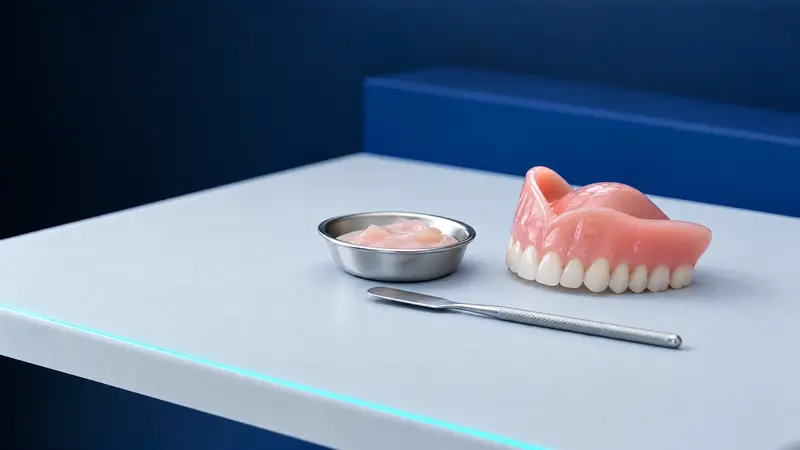
An immediate denture is made before the tooth is removed, so there is no wait for it on the day of extraction. The ADA explains that the dentist takes measurements and makes models of the jaws at an earlier appointment, and fits the denture on the same day the teeth are removed, so the patient does not go without teeth during healing.
How many days before extraction the impression needs to be taken depends on the type of denture and the laboratory’s work; the dentist specifies the timing in the treatment plan. An immediate partial denture replaces one or several teeth and rests on the gum and the remaining teeth, while a complete one is made when all the remaining teeth in an arch are being removed.
An immediate denture has a timing advantage over a conventional denture: according to the ADA, the latter is made only after the tissues have healed, which may take several months. In the clinic’s price list, “Proteza natychmiastowa” (immediate denture) costs 2 000 zł; the final scope and cost are agreed at the consultation, and prices may change.
Why does an immediate denture need adjustments and relining?
An immediate denture needs adjustments because the bone and gum change shape after extraction, and a denture made while the teeth were still present no longer fits closely. A review of studies reports that within 6 months of extraction the ridge loses 29 to 63% of its width and 11 to 22% of its height, with the fastest changes in the first 3 to 6 months (Tan et al., 2012).
The ADA notes that an immediate denture may need relining or remaking once the jaw has healed, and the NHS states that immediate dentures often need adjusting or replacing within a year of fitting. In the clinic’s price list, “Podścielenie protezy” (denture relining) costs 450 zł; the article on denture relining explains when a denture becomes loose and what can help.
- The first few days: the dentist usually checks that the denture is not pressing on the healing gum.
- The first few months: the denture may become loose as the ridge changes shape most rapidly.
- After healing: relining, a new denture or the definitive restoration, for example on an implant.
A retainer with an added tooth: who is an Essix appliance for?
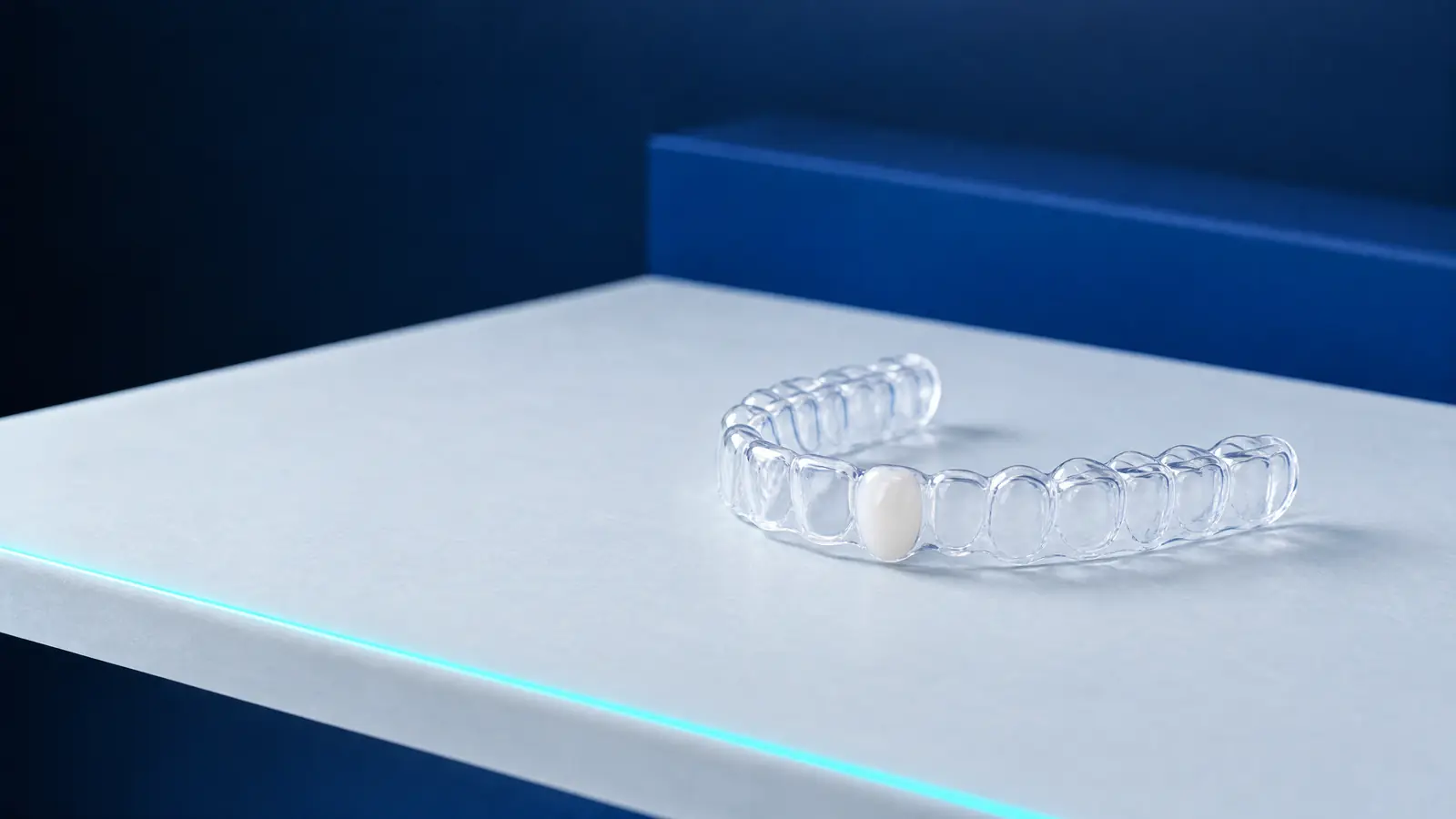
A retainer with an added tooth is a clear, thermoformed appliance that fits over the teeth, with a tooth-coloured replacement in the gap. Moskowitz et al. (1997) described these Essix appliances as temporary replacements for front teeth before and after implant placement and, following earlier orthodontic treatment, as a way to maintain the new tooth positions.
The retainer covers neighbouring teeth, so it needs cleaning every day, as do the teeth it fits over. Priest (2006) lists it among removable temporary options alongside partial dentures; the dentist explains whether to remove it for meals when the retainer is fitted.
In the clinic’s price list, “Szyna termoplastyczna z dostawieniem zęba” (thermoplastic retainer with an added tooth) costs 1 200 zł. The final scope and cost are agreed at the consultation, and prices may change.
A temporary bridge or bonded tooth: when are they options?
A temporary tooth can also be bonded to the neighbouring teeth, so it does not need to be taken out. Priest (2006) includes in this group bonding the patient’s own extracted tooth crown or a denture tooth, fibre-reinforced or metal-reinforced adhesive bridges, wire-supported bridges and temporary acrylic bridges.
These options are usually suitable at the front of the mouth when the neighbouring teeth are healthy and the bite leaves room for the attachment. A bonded tooth can debond, and if an implant is to be placed later, the dentist needs access to the site, so this type of restoration is planned alongside the timing of implant placement.
An adhesive bridge can also be a definitive restoration rather than a temporary one, as discussed in the article on choosing between an implant and a bridge. Priest notes that the type of temporary restoration affects appearance during healing but is unlikely to determine the appearance of the definitive restoration.
An immediate implant with a temporary crown: when is it possible?
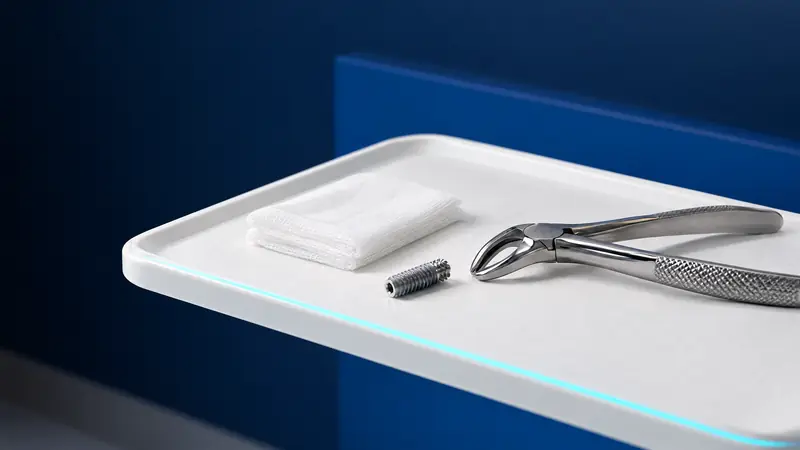
An immediate implant with a temporary crown means placing the implant on the day the tooth is removed and fitting a temporary crown to it straight away. In a systematic review of 63 studies of single teeth in the aesthetic region of the upper jaw, survival of these implants was 99.2% after one year, 97.5% after 3 years and 95.8% after 5 years (Wittneben et al., 2023).
This option does, however, require conditions that the dentist assesses on a CBCT scan and during the procedure, including intact socket walls, enough bone and no acute infection; the article on implants after tooth extraction gives the details. If these conditions are not met, a removable or bonded option is chosen.
In the clinic’s price list, “Implantacja natychmiastowa z koroną tymczasową druk 3D” (immediate implant placement with a 3D-printed temporary crown) costs 5 000 zł. What this item includes and the cost of further treatment, including the definitive crown, need to be confirmed at the consultation; prices may change.
How long do you wear a temporary tooth, and how do you choose?
A temporary tooth is usually worn until the definitive restoration is fitted, which depends on the pace of healing and the type of treatment. A Cochrane review states that implants are traditionally left unloaded for 3 to 8 months (Esposito et al., 2013), while according to the ADA a conventional denture is made after the tissues have healed, which may take several months.
Priest (2006) proposes eight criteria to consider when choosing a temporary restoration, with the patient’s expectations about appearance often decisive. The list shows what is worth discussing with the dentist.
- Appearance: how natural the temporary tooth will look when you smile.
- Everyday comfort when wearing it, speaking and eating.
- Time needed to make it and the number of visits required to fit it.
- Cost of the laboratory work.
- Space in the bite for an attachment or denture plate.
- Ease of removal, which matters when the dentist needs access to the implant site.
- Durability throughout the planned period of wear.
- Ease of adjustment as the gum and bone change shape.
How it works at DentalBlue
At DentalBlue in Białystok, implants are planned using CBCT images from the clinic’s own radiology unit, allowing the dentist to decide before extraction whether an immediate implant with a temporary crown is an option. The price list also includes “Proteza natychmiastowa”, “Szyna termoplastyczna z dostawieniem zęba” and “EXPRESS + modele” (EXPRESS plus models, 1 400 zł); the dentist explains at the consultation which option suits the particular gap. Extractions are carried out under local anaesthesia or, for patients assessed as suitable, general anaesthesia. “Wizyta bez bólu” (visit without pain, 300 zł) includes a panoramic X-ray, a consultation, an examination and a written treatment plan.
Frequently asked questions
How much does an immediate denture cost?
In the clinic’s price list, “Proteza natychmiastowa” costs 2 000 zł. Later adjustments and relining may add to the cost, because the bone changes shape after extraction; “Podścielenie protezy” costs 450 zł. The final scope and cost are agreed at the consultation, and prices may change.
Is an immediate denture covered by the NFZ?
The NFZ, Poland’s National Health Fund, funds acrylic partial dentures for adults missing 5 to 8 or more than 8 teeth in an arch, as well as complete dentures, once every 5 years. There is no separate “immediate denture” service on the list, and dentures for single missing teeth are not funded (legal status as of 24 October 2026).
Can you eat with an immediate denture from the first day?
Usually yes, but for the first few days it is better to choose soft foods and avoid biting into hard pieces with the front teeth, because the gum under the denture is healing. The NHS states that getting used to a denture can take several weeks. The dentist adjusts areas causing pressure or rubbing at a follow-up appointment.
Can you leave a gap until you get an implant?
You can if the gap does not interfere with eating or speaking, but the review by Siadat et al. (2017) indicates that a temporary restoration also helps maintain space for the future crown when the gap is between natural teeth. At the front of the mouth a missing tooth is visible, so many patients choose a temporary option.
What is a flipper?
A flipper is an informal English term, also used in Polish, for a small, removable temporary denture replacing one or several teeth. It serves the same purpose as an immediate partial denture: filling the gap during healing or until an implant or bridge is fitted.
Sources
- ADA MouthHealthy: Dentures, types of denture and immediate dentures (2026)
- NHS: Dentures (false teeth) (2025)
- Priest G, J Esthet Restor Dent: types of temporary restoration for a single implant (2006)
- Siadat H et al., J Prosthodont: temporary restorations in implant treatment, a review (2017)
- Moskowitz EM et al., N Y State Dent J: Essix appliances as temporary replacements for front teeth (1997)
- Wittneben JG et al., Clin Oral Implants Res: immediate implants with immediate crowns in the anterior region, a meta-analysis (2023)
- Tan WL et al., Clin Oral Implants Res: ridge changes after extraction, a review (2012)
- Esposito M et al., Cochrane: timing of implant loading (2013)
An informational article. It does not replace a consultation, and treatment decisions are made during a visit.