Why do dentures lose their grip over time?
Dentures become loose as their supporting tissues change: the NHS explains that dentures may loosen when the gums and jawbone shrink or change shape with age. The denture base itself stays the same, leaving a gap between it and the gum.
Changes are fastest after tooth extraction. The systematic review by Tan et al. (2012) reports that within 6 months of extraction the ridge loses 29 to 63% of its width and 11 to 22% of its height, with the greatest changes in the first 3 to 6 months. The NHS therefore notes that an immediate denture often needs adjustment or replacement within a year.
A loose denture affects more than comfort. The American Dental Association (ADA) says a poorly fitting denture may contribute to mouth sores and, with prolonged wear, to bone loss.
The NHS lists signs that warrant a dental appointment:
- Clicking during speech.
- Slipping or a feeling that the denture no longer fits.
- Pain caused by the denture.
- A worn or damaged denture.
- Very red or bleeding gums, or new bad breath, which may indicate gum disease, a fungal infection or tooth decay.
What does denture relining involve?
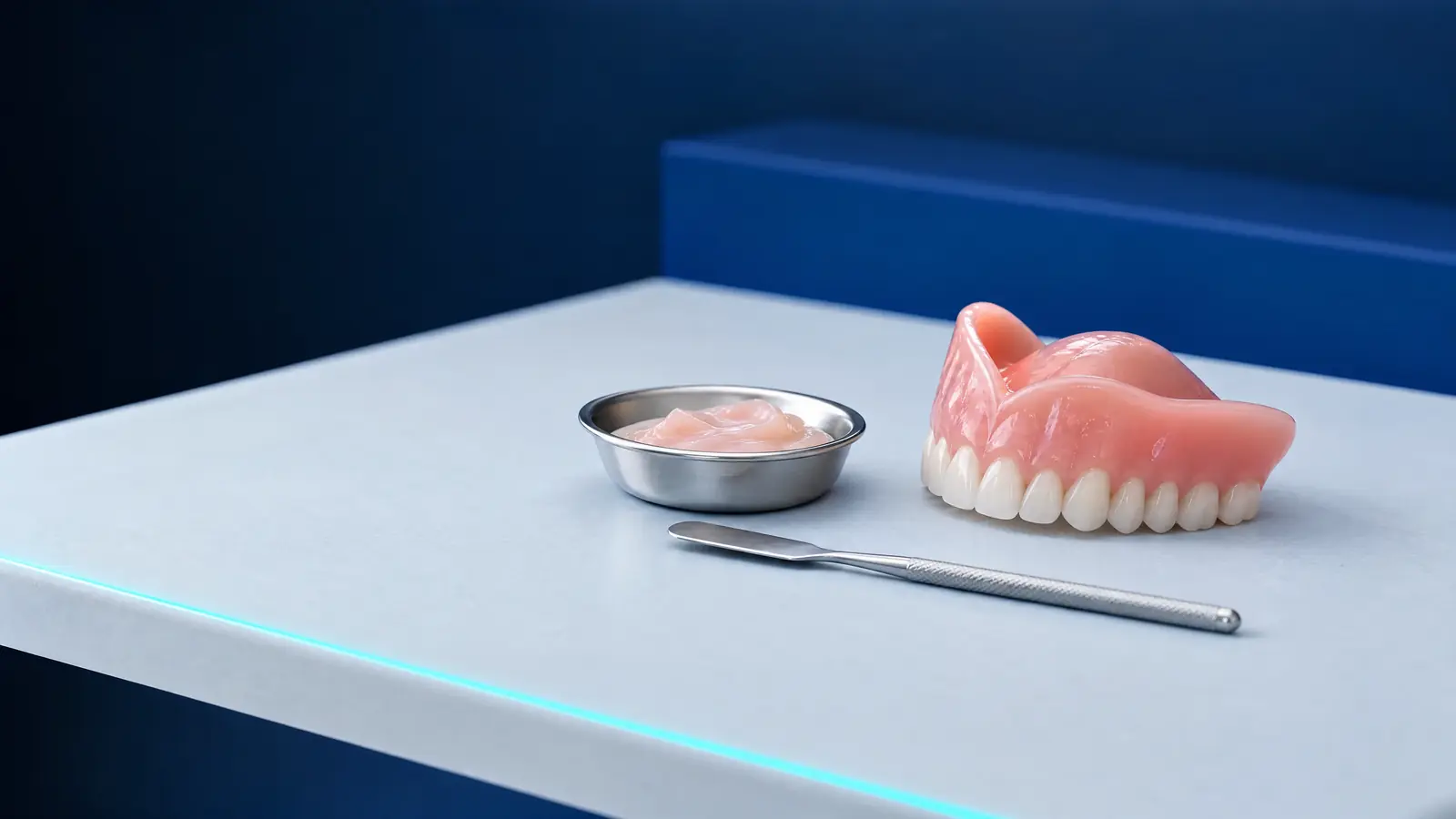
Relining adds a new layer of resin to the gum-facing surface of the denture base to restore its fit to the changed supporting tissues. A denture can be relined directly at the surgery during an appointment, or indirectly: the dentist takes an impression inside the denture and a laboratory makes the new layer.
Polish regulations describe the NFZ service as complete indirect relining of one denture, including border moulding, separately for the upper and lower jaws, once every 2 years (legal status as of 24 October 2026).
There is no fixed relining interval for everyone. Cleveland Clinic suggests every 1 to 2 years or whenever the fit changes; in practice, the dentist decides when after assessing how the denture rests on the gum.
Soft or hard relining: what is the difference?
A hard reline uses resin similar to the denture base, while a soft reline uses a flexible acrylic- or silicone-based material. The systematic review by Hasegawa et al. (2024) found that soft relining improves patient satisfaction, quality of life and chewing ability, and often relieves pain in complete denture wearers.
The same review shows limitations: soft material lasts less long than hard material and is more readily colonised by microorganisms with prolonged use. The authors advise caution with long-term use, so soft relining is considered particularly when pain relief matters, and its condition needs regular checks.
A denture is rubbing: what should you do about a sore?
A denture sore is a painful abrasion or ulcer where the base presses too hard on the mucosa, and it should not simply be endured. The NHS advises seeing a dentist if a denture causes pain, slips or no longer fits; the dentist adjusts the pressure point or assesses whether relining is needed.
Redness under the entire base usually indicates a different problem: denture stomatitis. The review by Gendreau and Loewy (2011) reports prevalence among denture wearers from 15% to over 70%, and lists poor denture hygiene, wearing dentures day and night, denture plaque and the yeast Candida albicans as causes; a poorly fitting denture adds mucosal irritation.
The ADA, citing the American College of Prosthodontists (ACP), lists chronic irritation beneath the base, including ulcers and treatment-resistant inflammation, as a reason to assess the denture for replacement. A mouth lesion that does not heal despite denture adjustment needs re-examination.
Is denture adhesive safe?
Denture adhesive may help when used as directed, but does not replace a good fit. According to the ADA, citing ACP recommendations, adhesives may help people with dry mouth, among others, but are not a remedy for poorly fitting dentures and may serve only as a temporary solution.
The ACP recommends using only as much adhesive as needed, meaning 3 to 4 pea-sized amounts per denture, and removing residues from the denture and mouth daily. Some adhesives contain zinc, and overuse can cause excess zinc in the body; as a precaution, the ACP recommends avoiding zinc-containing adhesives.
Warning signs include being unable to eat without adhesive, a denture that does not stay in place by itself, or needing to apply adhesive more than once a day. The ACP regards these as reasons to assess the denture for replacement.
Slipping, rubbing or broken dentures: what causes this and what helps?
The table lists common denture problems, frequent causes and what usually helps. The dentist decides on the solution in each case after examining the denture and mucosa.
| Problem | Common cause | What usually helps |
|---|---|---|
| Denture slips or rocks | Bone and gum shrinkage beneath the base | Relining or a new denture after dental assessment |
| Pressure and a sore in one spot | Excessive base pressure on the mucosa | Adjustment by a dentist |
| Redness beneath the entire base | Denture stomatitis, often involving yeasts | Denture hygiene, removal at night, treatment prescribed by the dentist |
| Adhesive needed several times daily | Denture no longer fits the supporting tissues | Fit assessment, relining or a new denture |
| Cracked base or broken-off tooth | Dropping the denture or material wear | Laboratory repair, sometimes with reinforcement |
| Another natural tooth has been removed | A change in the denture’s supporting teeth | Adding a tooth or making a new denture |
Can a broken denture be repaired?
A broken denture can often be repaired. The NHS advises bringing all broken pieces to the dentist so they can assess whether repair is possible; the NFZ funds extensive denture repair with an impression once every 2 years.
The base can be reinforced during repair. In a Finnish study of 51 fractured dentures repaired with a glass-fibre insert, 88% did not subsequently need further repair at the reinforced site over follow-up from 4 months to over 4 years; the authors stress correct positioning of the reinforcement (Narva et al., 2001).
When another tooth is extracted, an artificial tooth can often be added to a partial denture. However, if the denture is cracked, unstable and no longer fits, the ACP regards this as a reason to assess whether a new one would be preferable.
When is a new denture needed instead of relining?
A new denture is needed when relining or repair cannot restore its stability and fit. The ACP’s 2015 position statement, reaffirmed in 2018 and cited by the ADA, recommends assessment for replacement if at least one of the following applies:
The NFZ allows a new acrylic denture no more than once every 5 years; this restriction does not apply after surgical removal of cancer in the facial skeleton. Cleveland Clinic gives an average denture lifespan of 7 to 10 years, but this is a guide rather than a compulsory replacement deadline.
- Chronic irritation beneath the base, such as ulcers or yeast-associated inflammation persisting despite treatment.
- A denture that does not stay in place by itself and needs adhesive for eating or comfortable social interaction, or adhesive applied more than once daily.
- The patient is unwilling or unable to wear the denture.
- An unstable denture that does not fit or work with the remaining teeth, or is discoloured, cracked, broken or missing teeth.
- Changes in the teeth supporting a partial denture or overdenture.
- More than 5 years have passed since the denture was made.
How it works at DentalBlue
In DentalBlue’s price list in Białystok, “Podścielenie protezy” (denture relining) costs 450 zł, “Naprawa protezy” (denture repair) 500 zł, “Dostawienie zęba do protezy” (adding a tooth to a denture) 600 zł and “Siatka wzmacniająca protezę” (denture reinforcement mesh) 500 zł. Before relining, the dentist assesses the fit and mucosa; if an X-ray is needed, the clinic’s own radiology unit takes it. The dentist sets the final scope and cost, and prices may change. An appointment can be booked by phone.
Frequently asked questions
How long does denture relining take?
It depends on the method. Direct relining is done at the surgery during an appointment, while indirect relining requires an impression and laboratory work, so the denture goes to the technician for a time. The surgery agrees a collection date when taking the impression.
Will my denture stay in place well after relining?
Retention usually improves because the base fits the tissues again, but the result depends on the gum and bone beneath it. If the denture still does not stay in place by itself after relining, the ACP recommends assessing whether a new denture or another option, such as an implant denture, is needed.
Can dentures cause a fungal infection?
Dentures favour inflammation of the mucosa beneath the base, in which the yeast Candida albicans plays an important role. The review by Gendreau and Loewy (2011) indicates that without disinfection and regular denture cleaning, inflammation returns after antifungal treatment ends. Treatment is prescribed by a dentist.
Is denture relining available through the NFZ?
Yes, within the limits set by the regulations: the NFZ funds complete indirect relining of one denture every 2 years, separately for the upper and lower jaws, and extensive denture repair with an impression every 2 years. The service is provided by a facility with an NFZ prosthetics contract (legal status as of 24 October 2026).
Can you sleep with dentures in?
Usually not. The NHS advises against wearing dentures at night unless your dentist recommends it. The review by Gendreau and Loewy (2011) lists wearing dentures day and night among the causes of denture stomatitis.
Sources
- NHS: Dentures (2025)
- American Dental Association: Dentures, Oral Health Topics (2023)
- Cleveland Clinic: Dentures (2023)
- Clinical Oral Implants Research: Tan WL et al., ridge changes after extraction, systematic review (2012)
- Journal of Prosthodontic Research: Hasegawa Y et al., soft relining of complete dentures, systematic review (2024)
- Journal of Prosthodontics: Gendreau L, Loewy ZG, epidemiology and causes of denture stomatitis (2011)
- International Journal of Prosthodontics: Narva KK et al., denture repairs with glass-fibre reinforcement (2001)
- ELI: Rozporządzenie MZ w sprawie świadczeń gwarantowanych z zakresu leczenia stomatologicznego, t.j. Dz.U. 2025 poz. 615
An informational article. It does not replace a consultation, and treatment decisions are made during a visit.