Can you have dental treatment in pregnancy?
Dental treatment in pregnancy is safe and advisable when it is needed: prevention, diagnosis and restorative treatment are safe throughout pregnancy. That is the position of the US expert consensus statement (revised edition, 2026), prepared in collaboration with the American College of Obstetricians and Gynecologists (ACOG) and the American Dental Association (ADA).
The Polish working group on dental prevention in pregnant women (2018) writes in similar terms: the literature points to the safety of treatment in pregnancy, including local anaesthesia and radiological diagnosis. The risk lies rather in delay, because, as the US statement puts it, a severe dental infection can spread to the whole body.
At every visit, say that you are pregnant, which week you are in and what medicines you take. The choice of anaesthetic, of any medicines and of your position in the chair depends on this.
When to have dental treatment in pregnancy: which trimester?
For planned procedures Polish experts point to the second trimester, that is, weeks 14 to 27 of pregnancy, while acute conditions such as pain or an abscess are treated at any point in pregnancy. The first trimester is the time for assessing the teeth and making a plan, because drowsiness, nausea and vomiting are more troublesome then.
The working group recommends at least two visits during pregnancy and, after the birth, a check-up every 6 months if no treatment is needed. The table sets out this schedule.
| Period | What the experts recommend |
|---|---|
| First trimester (up to week 12 or 13) | Assessment of the teeth and gums, decay risk and treatment needs; education |
| Months 3 to 4 of pregnancy | The first of at least two visits in pregnancy |
| Second trimester (weeks 14 to 27) | A convenient period for procedures, if they are needed |
| Month 8 of pregnancy | The second check-up visit |
| After the birth | A check-up every 6 months if no treatment is needed |
| Any stage of pregnancy | Treatment of acute conditions: pain, abscess, injury |
Dental anaesthetic in pregnancy: is it safe?
Local anaesthesia at the dentist's is safe in pregnancy according to the ADA and the 2026 consensus statement: anaesthetics with adrenaline, such as lidocaine, mepivacaine, bupivacaine or prilocaine, can be used in pregnancy. For articaine, the 2026 statement recommends avoiding it and consulting the doctor managing the pregnancy.
The choice of agent and the amount are decided by the dentist, who knows that the patient is pregnant. The Polish working group also lists local anaesthesia among the procedures that are safe in pregnancy, so pregnancy is not a reason to have teeth treated without anaesthesia.
Sedation and general anaesthesia are a different matter. The 2026 statement recommends leaving out nitrous oxide (laughing gas) in pregnancy, and before intravenous sedation or general anaesthesia it recommends consulting the doctor managing the pregnancy and, in the third trimester, limiting exposure to less than 3 hours.
Dental X-rays in pregnancy: can you have one?
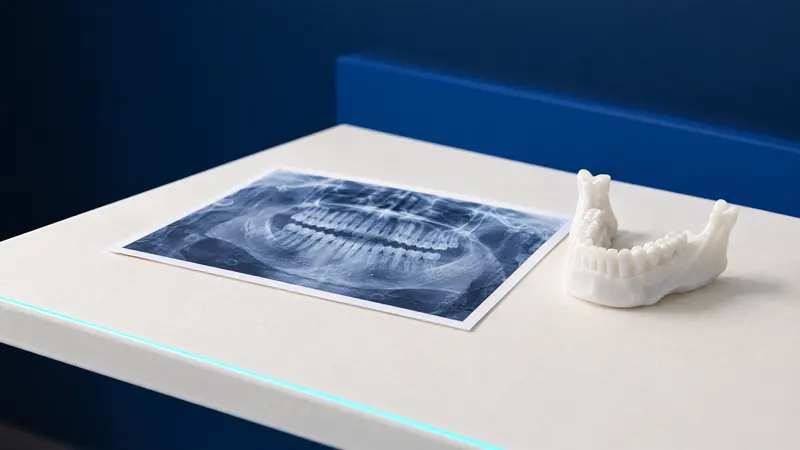
A dental X-ray in pregnancy can be taken when it is needed for diagnosis or treatment: the ADA considers dental X-rays safe at every stage of pregnancy. The consensus statement recommends taking them when they are clinically justified, for example during root canal treatment or when an abscess is suspected.
The doses are small. A single intraoral X-ray is typically below 1.5 µSv, and a panoramic X-ray (pantomogram) from 2.7 to 24.3 µSv. For comparison, a person living in Poland receives 2.55 mSv a year from natural sources, or about 7 µSv a day, so a dental X-ray corresponds to less than one day of background radiation, and a typical panoramic X-ray (14 to 24 µSv) to 2 to 3.5 days.
Cone beam computed tomography (CBCT) gives higher doses, typically from 11 to 674 µSv for small and medium fields of view, and the doctor assesses the need for it in pregnancy individually. One rule applies to all X-rays: only those whose result changes the treatment are taken.
Root canal treatment and tooth extraction in pregnancy
Root canal treatment and tooth extraction in pregnancy are carried out when they are needed, because the consensus statement recommends providing care for acute conditions at every stage of pregnancy. For root canal treatment and fillings a rubber dam, a rubber sheet that isolates the tooth, is recommended.
In late pregnancy, position in the chair matters: head higher than the feet, a semi-reclined position and frequent changes of position. A small cushion under the right hip or a slight turn onto the left side prevents dizziness and nausea caused by a drop in blood pressure.
Painkillers and antibiotics are chosen by a doctor who knows about the pregnancy, because for some of them the choice depends on the week of pregnancy. Toothache and swelling are a reason for a visit, and in the situations listed below a reason for urgent help.
- Difficulty breathing, speaking or swallowing: a hospital emergency department (SOR) or the emergency number 112.
- Swelling around the eye or sudden problems with vision: SOR or 112.
- Large swelling in the mouth or difficulty opening the mouth: SOR or 112.
- Fever with rapidly increasing swelling of the face or neck: same-day dental care.
Gums in pregnancy: why do they bleed and what can you do?
Gums bleed more often in pregnancy because hormonal changes intensify the gums' reaction to plaque bacteria. The NHS describes swollen, sore and bleeding gums as common in pregnancy, and untreated gingivitis can progress to periodontal disease.
Hormones can also cause a pregnancy granuloma: a round growth on the gum, usually attached to it by a thin stalk. The ADA also notes an association between periodontitis and premature birth, low birth weight and pre-eclampsia; this is an association, not a proven cause, but it is a good reason to treat the gums in pregnancy.
- Brush your teeth twice a day with fluoride toothpaste; in pregnancy Polish experts recommend 1450 ppm toothpaste.
- Use a soft toothbrush and brush gently, with circular movements.
- Clean between your teeth every day with floss or an interdental brush.
- Choose alcohol-free mouthwashes.
- Have tartar removed at the surgery; in pregnancy the NFZ funds this no more often than once every 6 months.
The dentist in pregnancy on the NFZ: what extra are you entitled to?
Women who are pregnant or in the postnatal period have a wider scope of dental treatment on the NFZ (Poland's National Health Fund) than other adults: root canal treatment of all teeth, tartar removal every 6 months and check-ups as often as once a quarter. Entitlement is confirmed by the pregnancy record card (karta przebiegu ciąży).
The regulation does not define how long the postnatal period lasts; it is usually taken to be about 6 weeks after the birth. No referral is needed to see a dentist with an NFZ contract, and a patient who comes in with pain is entitled to help on the same day. Legal position as of 12 October 2026.
| Service | Adults, general scope | In pregnancy and the postnatal period |
|---|---|---|
| Check-up | Up to 3 times per calendar year | No more often than once a quarter |
| Tartar removal | Once per calendar year | No more often than once every 6 months |
| Root canal treatment | Incisors and canines only (teeth 1 to 3) | All teeth |
| Surgical periodontal dressing | Outside the general scope | Funded |
| Confirmation of entitlement | As for any insured person | Pregnancy record card |
| Referral to a dentist | Not needed | Not needed |
| Coming in with pain | Help on the same day | Help on the same day |
How it works at DentalBlue
At DentalBlue in Białystok, the X-rays needed for treatment, from an intraoral X-ray to a panoramic X-ray, are taken in the clinic's own radiology unit, and root canal treatment is carried out under a microscope. It is worth mentioning the pregnancy when booking, so that the dentist can plan the visit with it in mind.
In the clinic's price list a visit with pain (panoramic X-ray, consultation, examination and pain relief) costs 340 zł, an intraoral X-ray 60 zł and complete hygiene treatment 350 zł. The final scope and cost are set at the visit, and prices may change. The clinic is open Monday to Friday from 8:00 to 20:00 and on Saturdays from 8:00 to 16:00.
Frequently asked questions
Can you have a filling in pregnancy?
Yes. According to the ADA and the 2026 consensus statement, restorative treatment, including fillings, is safe throughout pregnancy. The consensus statement recommends avoiding amalgam in pregnancy, and in the European Union dental amalgam has, as a rule, been banned since 1 January 2025.
Can you have nitrous oxide at the dentist's in pregnancy?
The 2026 consensus statement recommends avoiding nitrous oxide in pregnancy and, if sedation is needed, consulting the doctor managing the pregnancy. The ADA considers local anaesthesia with adrenaline-containing agents acceptable in pregnancy.
How should you look after your teeth if you are vomiting in pregnancy?
After vomiting, rinse your mouth with water to wash away the acid. The US statement also suggests rinsing with a solution of a teaspoon of baking soda in a glass of water. Frequent vomiting can cause enamel erosion, so it is worth telling your dentist about it.
Which painkiller for toothache in pregnancy?
It is best not to choose a painkiller on your own in pregnancy, because the choice depends on the week of pregnancy and your health. Ask the doctor managing your pregnancy, your dentist or a pharmacist. Treat toothache as a reason for a visit, because a painkiller suppresses the symptom rather than treating the cause.
Do a mother's teeth in pregnancy affect the child's teeth?
Indirectly, yes. According to the consensus statement, most infants and young children acquire decay-causing bacteria from their mothers, and treating decay and good hygiene in pregnancy can delay the colonisation of the child's mouth by these bacteria.
Sources
- National Maternal and Child Oral Health Resource Center: Oral Health Care During Pregnancy, A National Consensus Statement, revised edition (2026)
- ADA: Oral Health Topics, Pregnancy (2025)
- Nowa Stomatologia: Pels E et al., Profilaktyka stomatologiczna i postępowanie lecznicze u kobiet w ciąży, stanowisko grupy roboczej (2018)
- NHS: 13 weeks pregnant, Best Start in Life (undated)
- Dz.U. 2025 poz. 615: Rozporządzenie MZ w sprawie świadczeń z zakresu leczenia stomatologicznego, consolidated text (2025)
- European Commission: Radiation Protection 172, Cone beam CT for dental and maxillofacial radiology (2012)
- Państwowa Agencja Atomistyki: Raport roczny (2025)
- European Union: Regulation (EU) 2024/1849 on mercury, ban on dental amalgam (2024)
An informational article. It does not replace a consultation, and treatment decisions are made during a visit.