Can a tooth broken at the gum line be saved?
A tooth broken at the gum line can often be saved, but this usually requires more than one procedure, and sometimes the honest answer is to remove the root. The International Association of Dental Traumatology (IADT) guidelines describe crown-root fractures as usually extending below the gum margin and list several treatment options (Bourguignon et al., 2020).
The IADT’s list includes orthodontic or surgical extrusion, root canal treatment and restoration, leaving the root below the gum, intentional replantation, extraction and transplantation of the patient’s own tooth. According to the IADT, the choice depends partly on the patient’s age and expected cooperation, and in practice also on root length, the course of the fracture and gum health.
The same problem affects a tooth destroyed by decay down to the gum line and a root-treated tooth whose crown has broken off. The principles of assessment are similar, although after an injury the dentist must also check for loosening of the tooth or a bone fracture.
A tooth has broken at the gum line: what should you do straight away?
If a tooth breaks at the gum line, see a dentist as soon as possible, ideally the same day, and avoid biting on that side until then. IADT guidelines provide for the dentist to stabilise a loose fragment temporarily by bonding it to neighbouring teeth or to the stable part of the tooth until a treatment plan is agreed.
Under the NFZ, Poland’s National Health Fund, a patient presenting with pain is entitled to help on the day they seek it; emergency dental care operates at night and on non-working days (Ministry of Health regulation, t.j. Dz.U. 2025 poz. 615, § 6, legal status as of 24 October 2026). Emergency care covers pain relief and protecting the tooth, rather than full restoration.
- Keep the broken fragment if you find it, and show it to the dentist.
- Do not try to remove a loose fragment yourself or attach it with household glue.
- Eat soft foods and clean the area gently with a soft toothbrush.
- Go to a hospital emergency department (SOR) or call the emergency number 112 if a head injury is followed by vomiting, loss of consciousness, breathing difficulty or bleeding that does not stop after 15 to 20 minutes of pressure.
Why does a band of healthy tissue above the gum matter?
A band of healthy tooth tissue above the gum, which the crown encircles like a ring (the ferrule), determines whether the restoration can withstand chewing. A 2012 literature review reports that a 1.5 to 2 mm ferrule increases fracture resistance, an incomplete ferrule is better than none, and a poor clinical outcome is very likely if no method can achieve a ferrule (Juloski et al.).
The gum and bone impose a second limit. There must be room between the bone edge and crown margin for the tissues that attach to the tooth; a 2021 review gives a figure of about 2.04 mm for this zone and recommends retaining at least 3 to 4 mm between the bone crest and crown margin (Cordaro et al.).
If the fracture extends close to the bone, a crown cannot end on healthy tissue without disturbing these structures. The tooth must then either be moved out of the bone or the surrounding bone lowered; the article on restoring a tooth after root canal treatment discusses the ferrule effect in more detail.
How does a dentist assess a tooth broken down to the gum?
The dentist assesses a tooth broken down to the gum through an examination and imaging, because the course of a fracture below the gum usually cannot be seen with the naked eye. For crown-root fractures, IADT guidelines recommend a parallel intraoral X-ray, two additional views at different angles and an occlusal X-ray. They allow cone beam computed tomography (CBCT) when the fracture’s course, its relationship to the bone and the crown-to-root length ratio need to be seen.
- Checking the fragment’s mobility and whether tapping the tooth causes pain.
- Testing how the pulp responds to stimuli; a lack of response immediately after an injury does not confirm pulp necrosis and needs further assessment.
- Measuring the fracture’s depth below the gum and its distance from the bone edge.
- Assessing root length, because a short root limits extrusion and crown lengthening.
- Examining the bite, neighbouring teeth and gums, particularly in the area visible when smiling.
What treatment options are available? An overview
Treatments for a tooth broken at the gum line differ in duration, number of procedures and how much tissue must be sacrificed. The table brings together the common options based on IADT guidelines and reviews; the dentist makes the choice after an examination and imaging.
| Option | When it may be considered | What it involves |
|---|---|---|
| Post and crown without gum surgery | Enough healthy tissue remains above the gum for a ferrule | Usually root canal treatment, a post, and temporary and final crowns |
| Surgical crown lengthening | Fracture just below the gum, long root, usually outside the smile zone | Reshaping the gum and bone, healing, then a crown |
| Orthodontic extrusion | Deeper fracture, healthy root of sufficient length | Moving the root out using an orthodontic appliance over several weeks, followed by retention |
| Surgical extrusion | Single-rooted tooth with a favourable shape | Moving the root within its socket in one procedure, followed by splinting |
| Leaving the root below the gum | The tooth cannot be restored and preserving bone is worthwhile | Trimming the root below the gum and replacing the missing tooth |
| Tooth extraction | Fracture too deep, root too short or cracked | Extraction followed by an implant, bridge or denture |
Clinical crown lengthening: what does it involve and what are its drawbacks?
Surgical clinical crown lengthening exposes part of the tooth hidden below the gum by reshaping the gum and usually the bone edge too. In a 2016 systematic review, the crown was on average 1.4 to 3.3 mm longer after 6 months, but during healing the gum could partly grow back over the exposed tooth tissue, mainly in the first 3 months after surgery (Pilalas et al.).
The final crown is therefore usually made only after healing, with a temporary crown protecting the tooth until then. The review by Cordaro et al. (2021) notes that enough bone must be removed to expose at least 4 mm of healthy tooth tissue, which can markedly worsen the crown-to-root length ratio and weaken the support of neighbouring teeth too.
For this reason, the same review advises against lengthening the crown of a single tooth in the visible smile zone, where the change in gum line would show. A separate article describes the cosmetic procedure with the same name used for short teeth in a gummy smile.
Orthodontic or surgical extrusion: how do they differ?
Orthodontic extrusion slowly moves the root out of the bone using an orthodontic appliance so that the fracture margin ends up above the gum. A 2012 literature review recommends considering it rather than surgical crown lengthening for teeth that have lost their crowns (Juloski et al.), because it does not require bone removal around neighbouring teeth.
According to the review by Cordaro et al. (2021), orthodontic extrusion takes an average of 4 to 6 weeks, after which the tooth must be held in its new position for 4 weeks to 6 months. Some dentists cut the gingival fibres weekly, and gum reshaping may be needed at the end. Contraindications include fusion of the root to the bone, a short root and untreated periodontitis or a lesion at the root tip.
Surgical extrusion involves moving the root upwards within the same socket in one procedure and stabilising it with a splint, usually for 1 to 3 weeks. In a review of 243 teeth treated this way, tooth loss occurred in 5% and non-progressive root resorption in 30%, with no randomised studies available (Elkhadem et al., 2014). The method is contraindicated in multi-rooted teeth with an unfavourable shape.
Post, crown or root removal: how is the decision made?
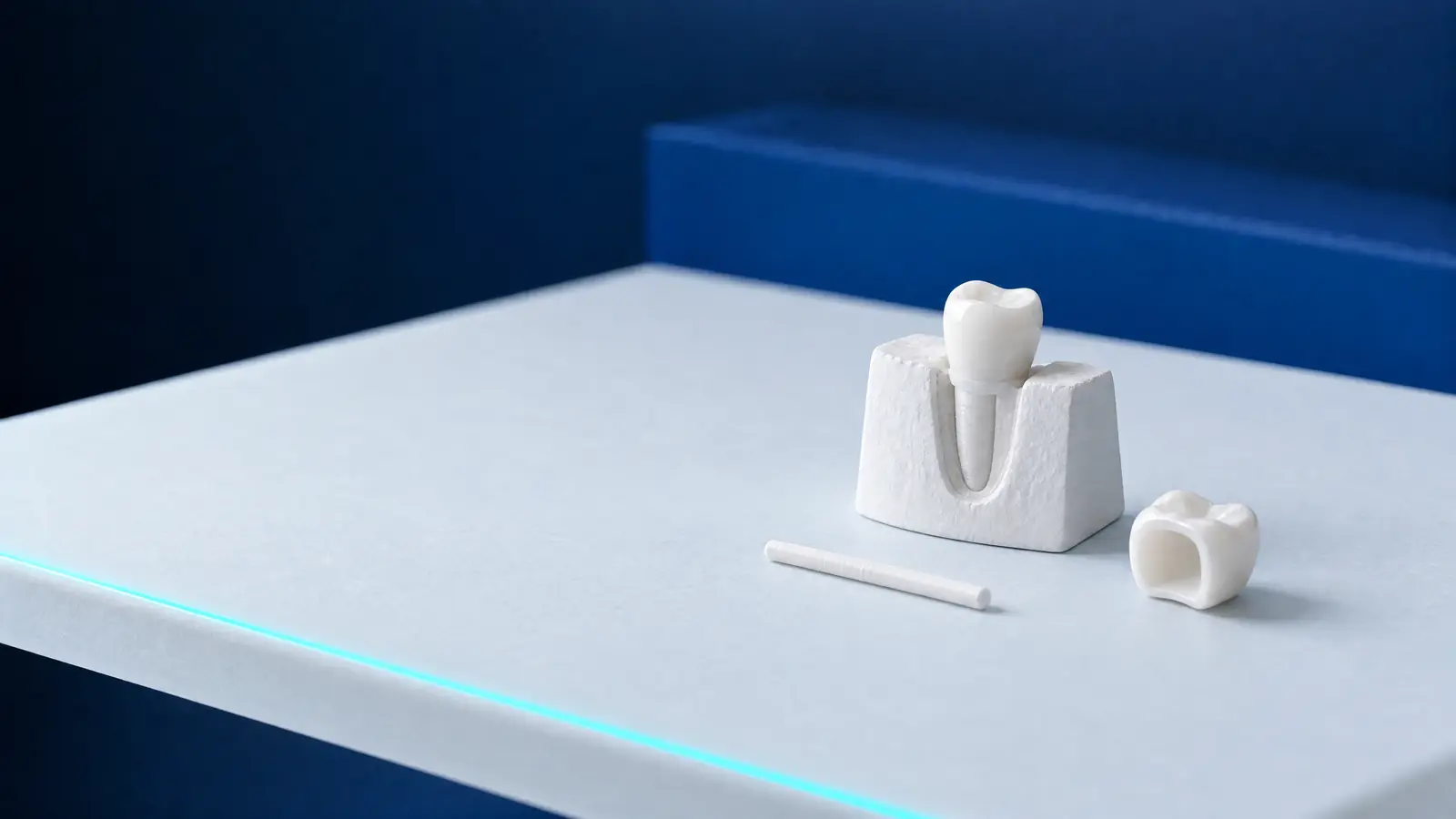
When enough tissue remains above the gum for a ferrule, whether after extrusion or without it, the tooth usually undergoes root canal treatment and is restored with a post and crown. A post retains the restoration rather than strengthening the root; in a meta-analysis of 13 randomised studies, posts reduced failure rates under crowns, while no such difference was found under direct fillings (Jardim et al., 2025).
Root removal is more appropriate if the fracture extends deep into the root, the root is too short or it has split lengthways, as discussed in the article on a cracked tooth. The IADT also lists leaving a trimmed root below the gum, which may help preserve bone for a future replacement when the tooth cannot be restored.
In the clinic’s price list, “Chirurgiczne wydłużenie korony” (surgical crown lengthening) is priced “from 300 zł”, “Odbudowa zęba z wkładem na włóknie szklanym” (tooth restoration with a glass fibre post) costs 1 000 zł, “Korona tymczasowa” (temporary crown) 250 zł, “Korona pełnocyrkonowa” (full zirconia crown) 3 000 zł and “Operacyjne usunięcie korzenia” (surgical root removal) 500 zł. The dentist gives the final scope and cost of treatment after a consultation; prices may change.
How it works at DentalBlue
At DentalBlue in Białystok, a tooth broken at the gum line can be assessed on site: intraoral X-rays, panoramic X-rays and CBCT scans are taken in the clinic’s own radiology unit. The clinic provides root canal treatment under a microscope as well as prosthodontic, orthodontic and surgical treatment; the dentist decides on the course of treatment after an examination. Patients in pain can attend a “Wizytę z bólem” (visit in pain, 340 zł), which includes a panoramic X-ray, consultation, examination and pain relief. The clinic is open Monday to Friday from 8:00 to 20:00 and on Saturdays from 8:00 to 16:00.
Frequently asked questions
How long does orthodontic extrusion of a tooth take?
According to a 2021 review, moving the root with an orthodontic appliance takes an average of 4 to 6 weeks, while holding the tooth in its new position takes 4 weeks to 6 months, depending on the treatment goal (Cordaro et al.). Restoration and a crown follow, so the whole process usually takes several months.
Is the final crown fitted immediately after crown lengthening?
Usually not. The gum margin may still move after surgery, mainly in the first 3 months (Pilalas et al., 2016), so a temporary crown protects the tooth until healing is complete. The dentist decides when to make the final crown at a review appointment.
Must a root left behind after a tooth breaks be removed?
Not always. A root of adequate length with healthy surrounding tissues can often be restored after extrusion or crown lengthening. If restoration is not possible, the dentist removes the root or, under IADT guidelines, leaves it trimmed below the gum. A root left after a fracture needs assessment even if it does not hurt.
Does the NFZ cover saving a tooth broken at the gum line?
Partly. The NFZ funds extraction, fillings and emergency care. For most adults, root canal treatment covers incisors and canines, while women who are pregnant or in the postnatal period are entitled to it for all teeth. Posts and prosthetic crowns are not included in the standard package. The scope of funding depends on clinical indications and the patient’s entitlements (legal status as of 24 October 2026).
Sources
- Dental Traumatology: Bourguignon C et al., IADT guidelines, fractures and luxations of permanent teeth (2020)
- Juloski J et al., J Endod: ferrule effect in root-treated teeth, review (2012)
- Cordaro M et al., Int J Environ Res Public Health: orthodontic versus surgical extrusion, review (2021)
- Pilalas I, Tsalikis L, Tatakis DN, J Clin Periodontol: crown lengthening before restoration, systematic review (2016)
- Elkhadem A et al., Dent Traumatol: complications of surgical extrusion, systematic review (2014)
- Plotino G et al., Int Endod J: surgical extrusion, replantation and autotransplantation, ESE review (2020)
- Jardim JS et al., J Dent: whether a root-treated tooth needs a post, meta-analysis (2025)
- ELI: Rozporządzenie MZ w sprawie świadczeń gwarantowanych z zakresu leczenia stomatologicznego, t.j. Dz.U. 2025 poz. 615
An informational article. It does not replace a consultation, and treatment decisions are made during a visit.