Why does a tooth need restoring after root canal treatment?
A tooth after root canal treatment needs careful restoration because it has usually lost a large part of its own tissue: first to decay or old fillings, then to opening the pulp chamber and preparing the canals. A review by authors associated with the European Society of Endodontology indicates that loss of sound tooth tissue is the most important factor increasing the risk of fracture (Mannocci et al., 2022).
The restoration has two jobs. The first is to protect the weakened walls and cusps from cracking under chewing forces. The second is to seal the tooth from above, so that bacteria from saliva do not get back into the filled canals. That is why endodontic (root canal) treatment and the restoration are best planned together, not as two separate stages.
Crown or filling after root canal treatment?
In back teeth after root canal treatment, covering the cusps with a crown or an onlay is usually recommended, and the decision depends on how much tissue remains. In the study by Aquilino and Caplan (2002), teeth without a crown after root canal treatment were lost 6 times more often than teeth with a crown, and in an 8-year follow-up of back teeth, those restored with a filling alone were extracted 2.29 times more often than those with a crown (Pratt et al., 2016).
The evidence is not clear-cut, however. A Cochrane review (2015) found only one randomised trial, comparing a crown with a composite filling in premolars, and concluded that there were too few data to judge whether a crown is better. The Aquilino and Pratt studies are observational, so they show an association and do not prove that every tooth needs a crown.
In practice the dentist assesses how many walls of the tooth remain and how thick the cusps are. A front tooth with a small access opening to the canal and a molar that has lost two walls are two different situations, even if both have had the same root canal treatment.
When should a crown be fitted after root canal treatment?
A crown or other final restoration after root canal treatment is best done without unnecessary delay once the dentist considers the treatment complete. In the study by Pratt et al. (2016), teeth that received a crown more than 4 months after root canal treatment were extracted about 3 times more often than teeth crowned within 4 months.
This was a retrospective study from a single university clinic, so it does not set a strict deadline, but the direction is clear: the final restoration should not be put off for many months. A temporary filling is meant to protect the tooth for a short time, and until the final crown is ready the tooth can be protected by a temporary crown.
What is the ferrule effect and why does it matter?
The ferrule effect comes from a band of sound tooth tissue above the gum that the crown encircles like a hoop round a barrel. A literature review indicates that a ferrule 1.5 to 2 mm high increases the tooth’s resistance to fracture, and that an incomplete ferrule is better than none (Juloski et al., 2012).
When there is no ferrule, a poor clinical outcome is very likely, according to the same review. When no tissue is left above the gum, the dentist may consider pulling the root up with an orthodontic appliance, and sometimes the honest answer is to extract the tooth and replace it another way. In studies, the benefit of a ferrule is clearer in premolars than in molars (Mannocci et al., 2022).
Post and core: when is it needed?
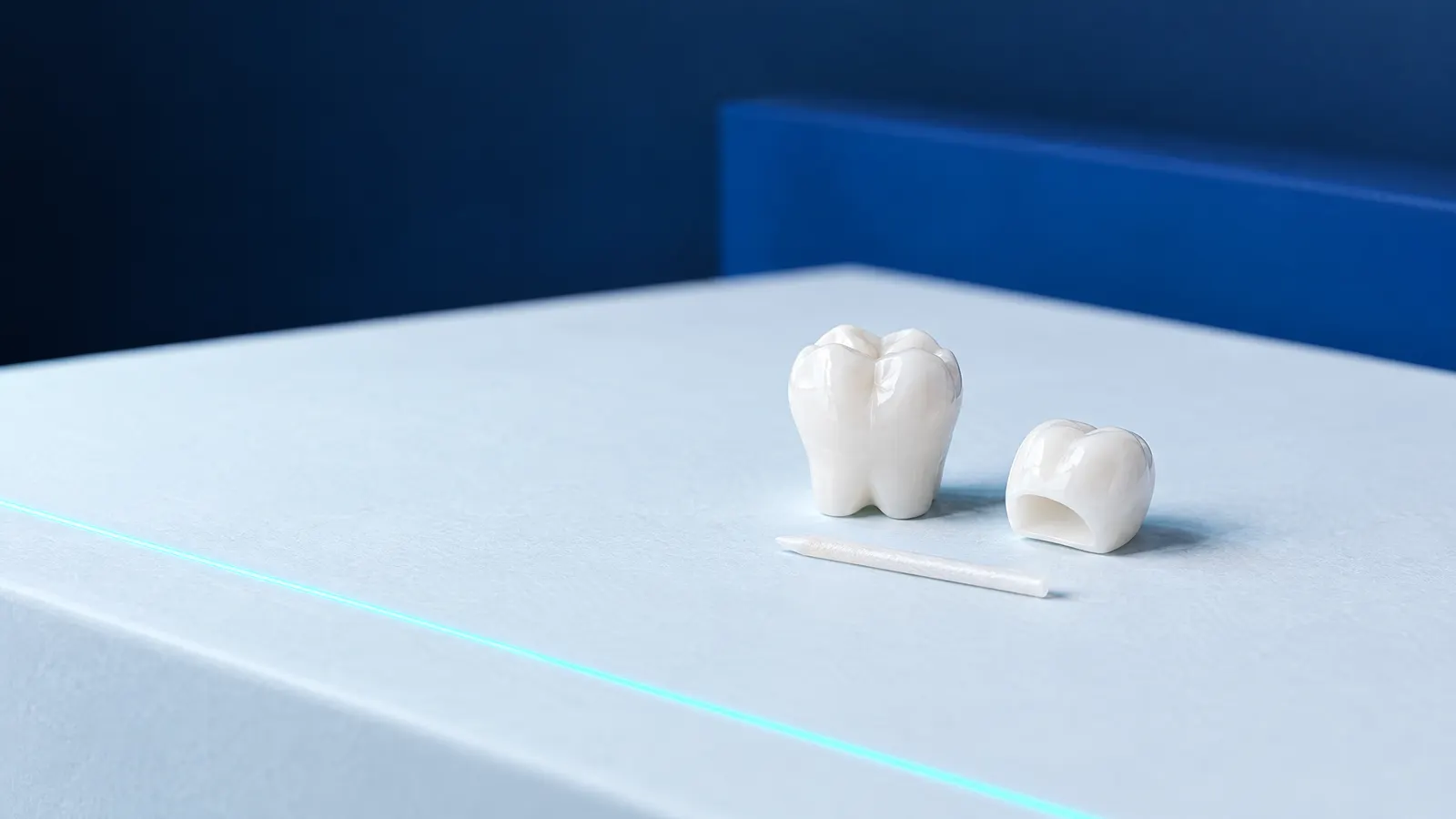
A post and core is needed when too little tissue remains in the crown of the tooth to hold the restoration. The post anchors the restoration in the canal and does not strengthen the root, so not every tooth after root canal treatment needs one.
The review by Mannocci et al. (2022) states that a post is recommended in teeth with no remaining crown wall or with one wall, and that back teeth with a sufficiently deep pulp chamber can be restored predictably without a post. In a meta-analysis of 13 studies, posts reduced the risk of failure only under indirect restorations, meaning crowns, not under fillings; glass fibre posts helped, while metal posts made no difference compared with no post (Jardim et al., 2025, low certainty of evidence).
A post also carries a future cost: if the root canal treatment has to be redone, the post must be removed first. In the clinic’s price list, “Usunięcie wkładu koronowo-korzeniowego” (removal of a post and core) costs 350 zł.
What are the restoration options and what do they cost?
A tooth after root canal treatment can be restored with a filling, a post-retained restoration, an onlay or a crown, and the choice follows from how much tissue remains and where the tooth is. The table sets these options against items in the clinic’s price list; many plans combine two of them, for example a post-retained restoration and a crown.
Under prosthodontics, the price list also includes “Wkład prosty” (simple post, 800 zł) and “Wkład złożony” (complex post, 1 000 zł). Whether a post is needed, and which one, the dentist decides after assessing the tooth on an X-ray and at the examination. The final scope and cost are set at the consultation, and prices may change.
| Option | When it is used | Item and price in the clinic’s price list |
|---|---|---|
| Direct restoration (filling) | Most of the tooth’s walls remain, usually a small access opening | “Odbudowa korony zęba martwego” (restoring the crown of a dead tooth): 600 zł |
| Restoration with a glass fibre post | A large cavity, when the restoration has to be anchored in the canal | 1 000 zł |
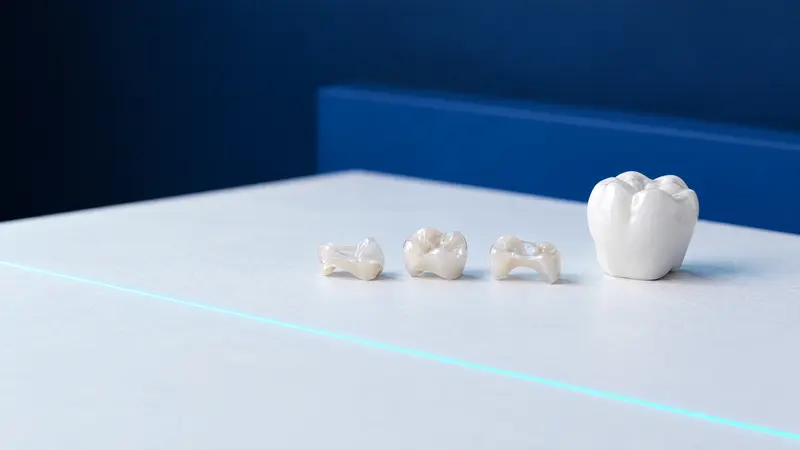
| Onlay or overlay | A back tooth with weakened cusps, without the need for a full crown | Composite 1 200 zł, lithium disilicate 1 900 zł |
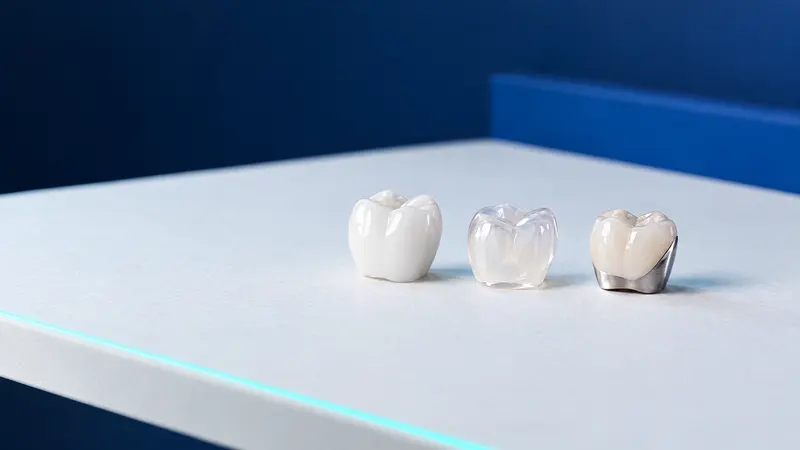
| Prosthetic crown | Major tissue loss, cracked cusps, extensive old fillings | Porcelain fused to metal 2 500 zł, full zirconia 3 000 zł |
| Temporary crown | Protects the tooth until the final crown is made | 250 zł |
The tooth cracked after root canal treatment: what next?
What happens next with a cracked tooth after root canal treatment depends on where the crack runs. The American Association of Endodontists (AAE) distinguishes several situations: a broken cusp can usually be restored with a filling or a crown, but a crack that extends below the gum line means the tooth cannot be saved and has to be extracted.
Cracks do not heal like a broken bone, and despite treatment some may deepen. The review by Mannocci et al. (2022) points out that cracked teeth have the worst prognosis of all after treatment. If a vertical root fracture is suspected, the dentist may order a small field of view CBCT scan.
It is worth seeing a dentist promptly if there is pain on biting, a loose fragment of tooth or swelling of the gum next to a root-treated tooth. If the tooth has to be removed, the options for replacing it are described in the article on choosing between an implant and a bridge.
| Type of crack according to the AAE | What it means | Usual management |
|---|---|---|
| Fractured cusp | A piece breaks off the chewing surface, often next to a filling | A new filling or a crown |
| Cracked tooth | The crack runs from the chewing surface towards the root | Treatment and a crown; extraction if it extends below the gum |
| Split tooth | The tooth is divided into two parts | Cannot be kept whole, sometimes part of the tooth can |
| Vertical root fracture | The crack begins in the root | Usually extraction, sometimes removal of the fractured part |
How root-treated teeth are restored at DentalBlue
At DentalBlue in Białystok, root canal treatment and retreatment are carried out under a microscope, and prosthodontics works in the same building, so the root canal treatment and the restoration of the tooth can be planned together. Intraoral X-rays, panoramic X-rays and CBCT scans are taken in the clinic’s own radiology unit. A patient in pain can come for a “Wizyta z bólem” (visit in pain, 340 zł), and a patient without symptoms for a “Wizyta bez bólu” (visit without pain, 300 zł), which ends with a written treatment plan. The dentist sets the final scope and cost, and prices may change.
Frequently asked questions
How much does it cost to restore a tooth after root canal treatment?
That depends on the option chosen. In the DentalBlue price list, restoring the crown of a dead tooth costs 600 zł, a restoration with a glass fibre post 1 000 zł, an onlay 1 200 zł (composite), 1 800 zł (porcelain) or 1 900 zł (lithium disilicate), and a crown 2 500 zł or 3 000 zł. The dentist sets the final cost at the consultation.
How long can I go with a temporary filling after root canal treatment?
As short a time as possible. A temporary filling does not replace a sealed final restoration, and in the study by Pratt et al. (2016) teeth crowned more than 4 months after treatment were extracted about 3 times more often. The date for the final restoration is best agreed while the root canal treatment is being completed.
Is a glass fibre post better than a metal one?
Studies do not settle this clearly. In the meta-analysis by Jardim et al. (2025), fibre posts reduced the risk of failure under crowns, while metal posts made no difference compared with no post, but the certainty of this evidence is low. The choice depends on the shape of the canal and the restoration plan.
Is a crown after root canal treatment available on the NFZ?
No. Prosthetic crowns are not among the services funded by the NFZ (Poland’s National Health Fund), and funded root canal treatment does not include restoring the crown of the tooth. Adults receive NFZ root canal treatment only for incisors and canines (Ministry of Health regulation, consolidated text Dz.U. 2025 poz. 615, legal position as of 12 October 2026).
Why does a tooth crack more easily after root canal treatment?
Mainly because it lacks tissue: decay, old fillings and opening the pulp chamber weaken the walls and cusps. The review by Mannocci et al. (2022) identifies loss of sound tissue as the most important risk factor, which is why a restoration that covers the cusps protects the tooth from splitting apart.
Sources
- Aquilino SA, Caplan DJ, J Prosthet Dent: crowns and tooth loss after root canal treatment (2002)
- Pratt I et al., J Endod: type and timing of restoration and extraction of root-treated teeth (2016)
- Cochrane: crown or filling for root-filled teeth, CD009109 (2015)
- Juloski J et al., J Endod: the ferrule effect in root-treated teeth, review (2012)
- Mannocci F et al., Int Endod J: restoring root-treated teeth, review (2022)
- Jardim JS et al., J Dent: does a root-treated tooth need a post, meta-analysis (2025)
- AAE: Cracked Teeth, types of cracked teeth and treatment
An informational article. It does not replace a consultation, and treatment decisions are made during a visit.