What is a temporary filling, and what is a dressing in a tooth?
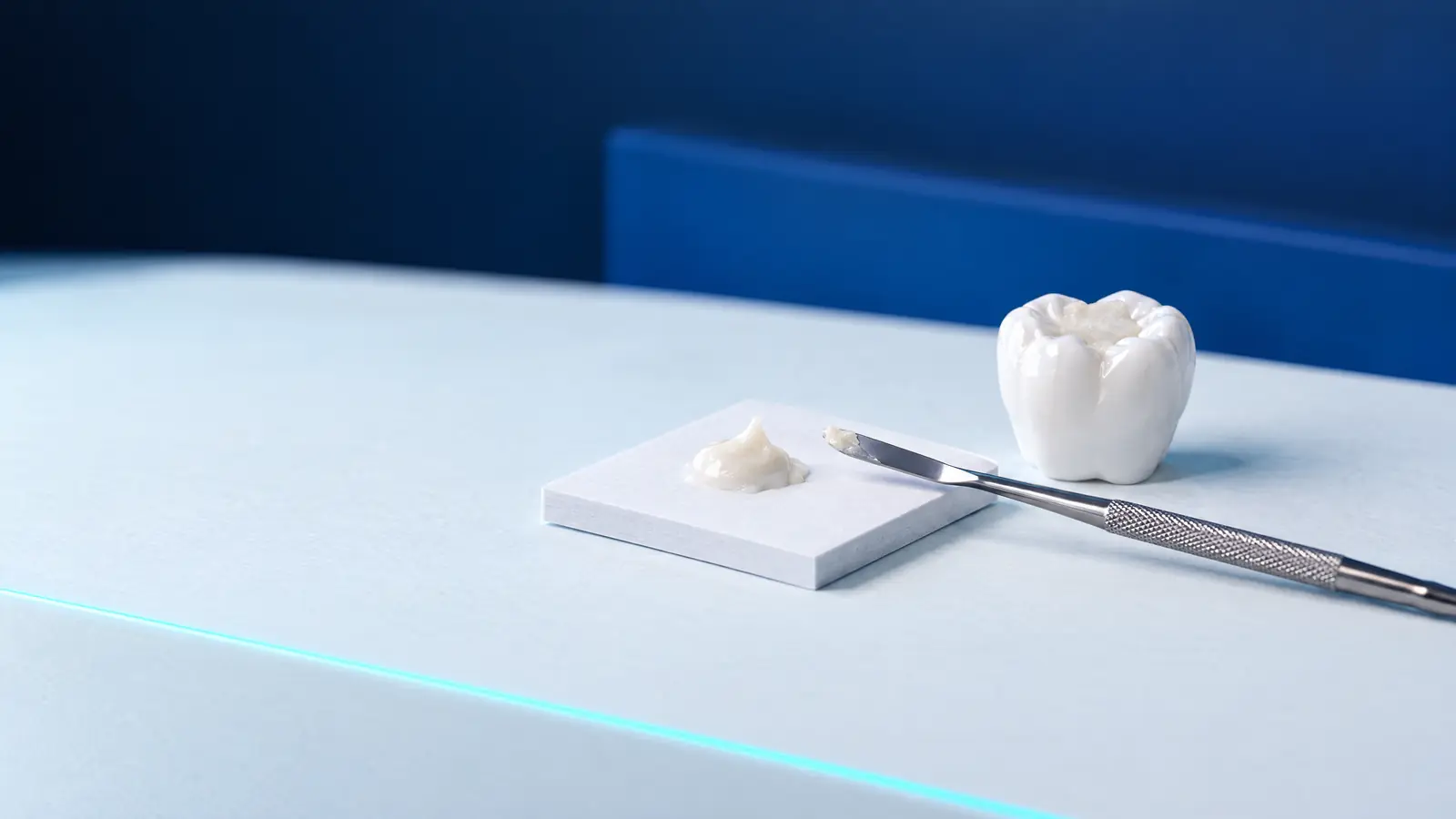
A temporary filling is a filling that closes the tooth for the time between visits and protects its interior from saliva, food debris and bacteria. At the surgery it is usually called a dressing, although the same word is also used for a medicine placed in the canals or the pulp chamber under the layer of temporary material.
The American Association of Endodontists (AAE) stresses that a medicine in the canal does not replace a well-placed temporary filling, because it is the top layer that cuts the tooth off from the mouth. The AAE regards a defective temporary filling during or after root canal treatment as one of the main causes of bacteria leaking into the canals.
A final filling, the ordinary kind made of composite or cement, is meant to last for years; the materials for such fillings are described in a separate article. A temporary filling has a different job: to last until the next stage of treatment, which the dentist has already planned.
When is a temporary filling placed?
A temporary filling is placed when treatment cannot be completed in one visit, or when it is better not to. Most often this is root canal treatment in several stages; the NHS, the UK’s public health service, describes how between root canal visits a patient may have a temporary filling before the permanent one is placed.
A dressing is also placed with deep decay, when the dentist wants to assess the response of the pulp before a final decision, after a visit in pain at which the tooth was opened, and for the time it takes the laboratory to make an inlay, a crown or a bridge. The table sets out typical situations; in each case the dentist sets the date.
| Situation | Typical protection of the tooth | How long it is intended to stay |
|---|---|---|
| Between visits of root canal treatment | Temporary material over the medicine in the canals | Until the next visit; sealed for up to about 3 weeks according to the AAE |
| After root canal treatment is complete, before the restoration | A dressing or an interim filling | As briefly as possible; the restoration is not put off for months |
| Deep decay, decision about the pulp later | An interim filling | Until the check-up set by the dentist |
| Visit in pain, tooth opened | A dressing after preparation of the chamber or canals | Until further treatment on the agreed date |
| Cavity prepared for an inlay or onlay | A temporary filling in the cavity | Until the laboratory-made inlay is fitted |
| Tooth prepared for a crown or bridge | A temporary crown or bridge made of resin or acrylic | Usually 2 to 3 weeks, sometimes longer |
What is a temporary filling made of?
A temporary filling is made of materials that are easy to place and remove and that seal tightly against the tooth for a short time. The AAE lists ready-mixed temporary materials based on calcium sulphate, resin-based materials and reinforced zinc oxide eugenol cements as the most commonly used. Glass ionomer cements and composites are also used as interim fillings for longer periods.
According to the AAE, the layer of temporary material should be at least 4 mm thick to provide an adequate seal. After placing the dressing, the dentist also checks the bite, because the AAE lists skipping this check among the causes of damage to a temporary filling.
The dentist chooses the type of material according to how long the tooth is to stay protected and how large the cavity is. Materials for temporary fillings are also covered by the NFZ (Poland’s National Health Fund), because the regulation on guaranteed dental services lists them among the materials funded in treatment (legal position as of 18 October 2026).
How long can a temporary filling stay in a tooth?
A temporary filling can stay in the tooth only as long as the dentist has planned, and for ordinary temporary materials the AAE gives about 3 weeks. According to the AAE, a layer of at least 4 mm stays sealed for no longer than that, and it calls leaving temporary material in place for longer an outright invitation to leakage and future failure of the treatment.
The AAE notes that this time frame comes mainly from laboratory studies and that no definitive limit has been established after which the canals have to be treated again. The direction is clear, however: the AAE recommends starting the final restoration of a tooth after root canal treatment as soon as possible.
Clinical observations point the same way. In the study by Pratt et al. (2016), teeth that received a crown more than 4 months after root canal treatment were extracted about 3 times as often as teeth crowned within 4 months. It is a retrospective study from a single clinic, but it confirms that a dressing is not treated as a solution for half a year.
Why should a temporary filling not stay for months?
A temporary filling should not stay for months, because over time it loses its seal, and bacteria from saliva can then get into the canals, including those that have already been filled. In a laboratory study by Torabinejad et al. (1990), more than half of the filled canals exposed to bacteria from the crown side were completely contaminated after 19 days, and with a second species of bacteria half were contaminated after 42 days.
The seal from the crown side matters for the outcome of treatment. In a study of X-rays of 1,010 teeth after root canal treatment, there were no inflammatory changes at the root in 91.4% of teeth with a good root filling and a good restoration, but in only 18.1% of teeth in which both were defective (Ray and Trope, 1995).
There is also a mechanical reason. Temporary material is soft and wears away with chewing, and a tooth after root canal treatment protected only by a dressing can crack; the AAE lists fracture of the tooth before the final restoration among the situations in which the canals become reinfected.
Temporary filling fell out: what should you do?
If a temporary filling has fallen out, contact the surgery as soon as possible, because the tooth is open and the canals are exposed to reinfection. The AAE recommends getting in touch immediately if a dressing or a temporary crown comes out, and notes that it is normal for a thin layer to wear off the surface of a dressing.
Until the visit, a few simple rules help, which NHS 111 Wales, the Welsh health service, gives for losing a filling or a crown. On the NFZ, a patient in pain receives help on the day they report, and at night and at weekends there is an emergency dental service.
- Call the surgery that is carrying out your treatment and say that a dressing has come out after root canal treatment or from a cavity.
- Do not bite hard food on that side, and avoid very hot and very cold food and drinks.
- Brush your teeth twice a day with fluoride toothpaste, gently around the open tooth too.
- If a temporary crown has come out, keep it and bring it to the visit.
- With swelling of the gum or face, seek help the same day, and with swelling that makes breathing or swallowing difficult go to the hospital emergency department (SOR) or call 112.
Can you eat with a temporary filling, and how should you brush?
You can eat with a temporary filling, but carefully and preferably on the other side. The AAE recommends not chewing, not drinking hot or cold drinks and not smoking for the first hour after the procedure, and avoiding hard food and biting hard on the treated tooth until the final restoration.
Teeth are brushed as normal, including flossing, only more gently around the dressing, as the AAE advises. The same rules apply to a temporary crown, which according to Cleveland Clinic can be damaged or pulled off by ice cubes, hard nuts, popcorn kernels and chewy sweets.
- For the first hour after the dressing is placed, do not eat, and do not drink anything hot or cold.
- Chew on the other side, especially hard food, until the tooth has its final restoration.
- Avoid chewy sweets and very hard snacks, which can damage the dressing or a temporary crown.
- Brush and floss as usual, with less pressure around the treated tooth.
- Come in if your bite feels uneven, or if severe pain or pressure lasts more than a few days.
Temporary crown: how does it differ from a temporary filling?
A temporary crown covers the whole prepared tooth, not just the cavity, and protects it until the final crown is fitted. According to Cleveland Clinic it is usually made of resin or acrylic, and making the definitive crown in the laboratory most often takes 2 to 3 weeks, sometimes longer; a temporary bridge works the same way for a dental bridge. The details of fitting a crown are described in a separate article on dental crowns.
How it works at DentalBlue
At DentalBlue in Białystok, root canal treatment is carried out under a microscope, and crowns, including temporary ones, and bridges are made as part of prosthodontics, so the date of the final restoration can be planned together with the treatment. In the clinic’s price list, “Wypełnienie tymczasowe długofalowe” (long-term temporary filling) costs 340 zł, “Opatrunek Coltosol” (Coltosol dressing) 350 zł and “Korona tymczasowa” (temporary crown) 250 zł. The final scope and cost are set by the dentist, and prices may change. The clinic is open Monday to Friday from 8:00 to 20:00 and on Saturdays from 8:00 to 16:00.
Frequently asked questions
Can a temporary filling hurt?
The dressing itself should not hurt, although the treated tooth may be tender for a few days. The AAE recommends contacting the surgery if severe pain or pressure lasts more than a few days, the bite feels uneven, or swelling appears in the mouth or on the face.
Can a temporary filling crumble?
It can, because temporary materials are soft and wear away with chewing. The AAE regards wear of a thin layer as normal, but if the dressing is clearly getting smaller, crumbling or falling out, contact the surgery so that the tooth is not left open.
Can I smoke with a dressing in my tooth?
The AAE recommends not smoking, not chewing and not drinking hot or cold drinks for the first hour after the procedure. How long to avoid smoking after a particular procedure is something the dentist tells you individually; the rules after an extraction are described in a separate article on what to do after a tooth extraction.
Is a temporary filling available on the NFZ?
Yes, materials for temporary fillings are among the materials funded in treatment on the NFZ. Bear in mind, however, that adults have root canal treatment on the NFZ only of incisors and canines, that is teeth 1 to 3, and prosthetic crowns are not funded (legal position as of 18 October 2026).
Sources
- AAE: Coronal Leakage, ENDODONTICS Colleagues for Excellence (2002)
- AAE: Post Treatment Care, advice after root canal treatment
- Journal of Endodontics: Torabinejad M et al., bacterial penetration of uncovered root canals (1990)
- International Endodontic Journal: Ray HA, Trope M, quality of the root filling and the restoration and the tissues at the root (1995)
- Journal of Endodontics: Pratt I et al., type and timing of restoration and extraction of root-treated teeth (2016)
- NHS 111 Wales: Lost filling or crown (2025)
- Cleveland Clinic: Dental Crowns (2023)
- ELI: Rozporządzenie MZ w sprawie świadczeń gwarantowanych z zakresu leczenia stomatologicznego, t.j. Dz.U. 2025 poz. 615
An informational article. It does not replace a consultation, and treatment decisions are made during a visit.