What does root canal retreatment involve?
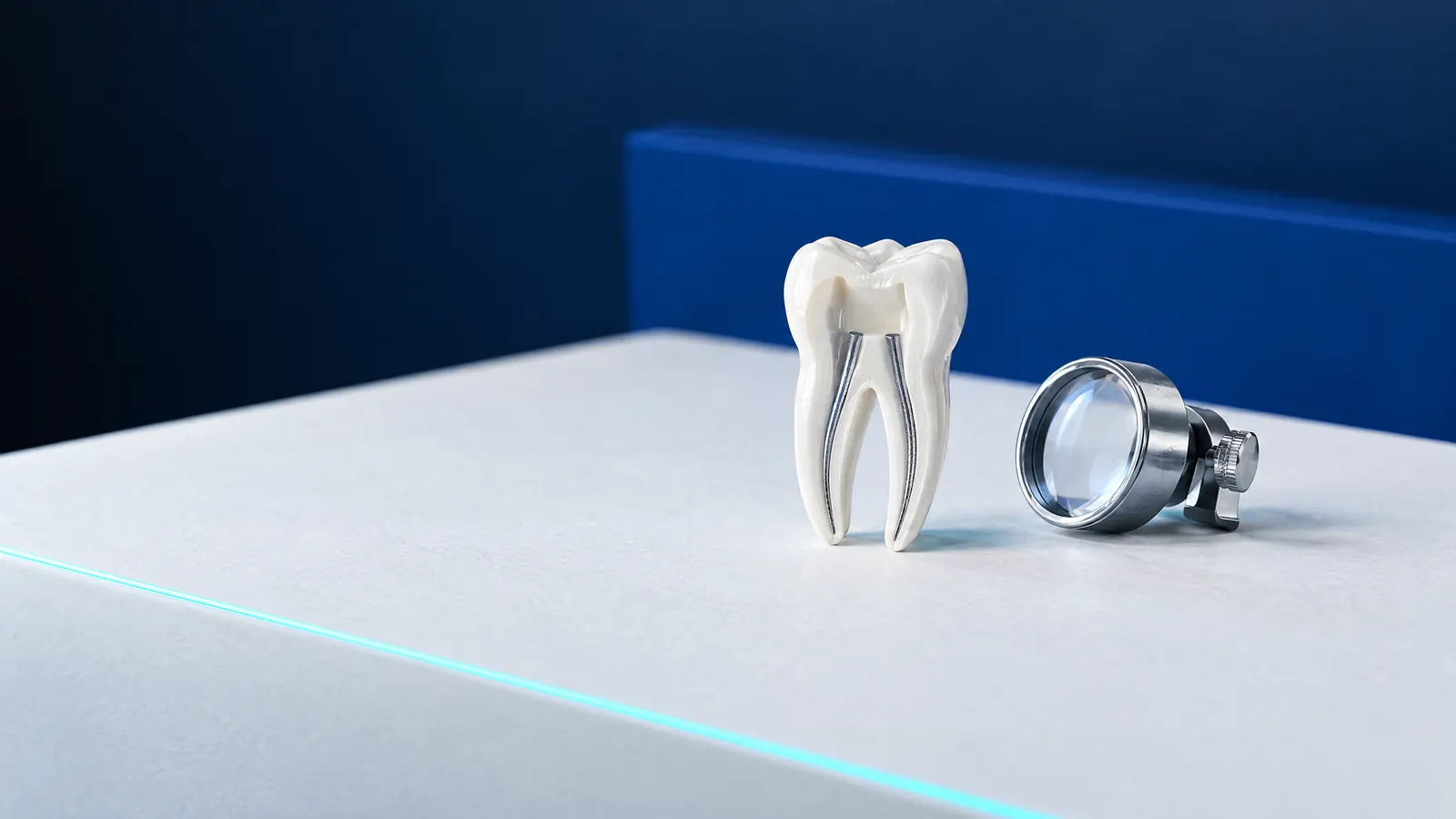
Root canal retreatment, known in dental surgeries as re-endo, is repeat endodontic (root canal) treatment of a tooth that has already been treated but in which infection in the canals has persisted or returned. The dentist removes the existing filling, most often gutta-percha, locates all the canals, shapes and disinfects them again, and then fills them tightly right up to the tip of the root.
Re-endo is usually more difficult than the first treatment. The canals have to be reached through the existing restoration, sometimes through a crown or a post and core, and obstacles may be waiting inside: a broken fragment of an instrument, calcification, a perforation or a canal that was not found the first time. That is why retreatment is usually carried out under magnification, with an operating microscope, which delivers light and an image straight down the axis of the canal.
Why does root canal treatment fail?
Root canal treatment most often fails because bacteria remained in the canal system or got back into it. A review of 63 studies reports that primary root canal treatment succeeds in 68 to 85% of cases under strict assessment criteria, and that this result has not clearly improved in several decades (Ng et al., 2007).
The same research team described the factors that improve the prognosis: no inflammatory lesion at the root tip before treatment, a canal filling with no voids that reaches to within 2 mm of the tip, and a tight restoration on top (Ng et al., 2008). Each of these points, reversed, is one of the typical causes of failure.
- A missed canal: molars often have extra canals that are hard to find without magnification.
- A filling that is too short or contains voids in which bacteria can survive.
- A leaking restoration or crown, through which saliva and bacteria get from above into the filled canals.
- An obstacle in the canal: a broken fragment of an instrument, calcification or a perforation of the root wall.
- A root fracture, usually invisible to the naked eye, which often decides the fate of the tooth.
A root-treated tooth hurts: when is it normal and when is it not?
Toothache in the first days after root canal treatment is common and usually eases quickly. A review of 72 studies reports that about 40% of patients have pain after 24 hours and about 11% after 7 days, and that its average intensity falls over that time from 24 to 5 points on a 100-point scale (Pak and White, 2011).
It is different when the discomfort does not pass after a week, gets worse, or returns after months or years of calm. These are signs that infection is active in the canals or around the root tip. Sometimes there are no symptoms at all, and the lesion at the root tip only shows on a follow-up X-ray.
- Pain on biting or tapping the tooth that lasts longer than a week after treatment or appears later on.
- Swelling of the gum next to the tooth, or a fistula: a small blister from which pus drains from time to time.
- A feeling that the tooth is higher than its neighbours, and tenderness of the gum at the level of the root tip.
- A new or growing lesion at the root tip on a follow-up X-ray, even if the tooth does not hurt.
- Rapidly increasing swelling of the face or neck with a fever needs help the same day, and difficulty breathing or swallowing means the hospital emergency department (SOR) or 112, the emergency number.
How does the dentist assess whether the tooth can be saved?
Whether a tooth can be saved after failed root canal treatment depends on three things: whether the infection can be reached for treatment, whether the root is intact, and whether enough of the tooth's own tissue remains for it to be restored tightly afterwards. The assessment starts with an examination and an intraoral X-ray.
When the picture is unclear, the dentist may order a small field of view cone beam computed tomography (CBCT) scan. The joint position statement of the American endodontic and oral radiology societies lists failed treatment and the planning of retreatment, suspected vertical root fracture and the planning of surgery among the indications for CBCT, while stressing that it is not a screening test (AAE and AAOMR, 2015).
The condition of the gums and bone around the tooth (the periodontium) and the restoration plan also count. A tooth with a root split lengthwise, or one that cannot be restored tightly, is usually not a good candidate for re-endo, even if the canals themselves could be treated.
Re-endo, apicoectomy or extraction?
Root canal retreatment is the first choice when the canals can be reached through the crown of the tooth and the root is intact. A review of studies on re-endo reports healing of the lesion at the root tip in about 77% of cases, including 76.7% complete healing (Ng et al., 2008).
Apicoectomy (root-end resection) is a surgical procedure: the dentist exposes the bone over the root, removes its end together with the inflammatory lesion and seals the canal from the tip. It is considered when access through the crown is impossible or too risky, for example with a long post whose removal could fracture the root, or when retreatment has not led to healing.
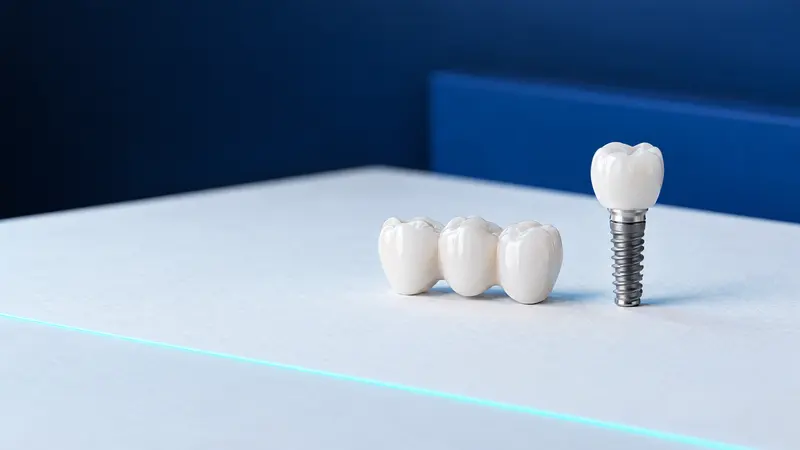
Extraction is the right path when the root is fractured, the tooth cannot be restored or the infection does not respond to treatment. The gap is then filled with an implant, a bridge or a denture, which is a separate treatment with its own plan and cost.
| Path | What it involves | When it is considered |
|---|---|---|
| Root canal retreatment | Removing the old filling, disinfecting and refilling the canals | Root intact, canals accessible through the crown, tooth restorable |
| Apicoectomy | Surgical removal of the root end together with the lesion, through the bone | No access through the crown or post, no healing after re-endo |
| Extraction | Removal of the tooth, then filling the gap with an implant, a bridge or a denture | Fractured root, tooth that cannot be restored, recurrent infection |
How does root canal retreatment work, step by step?
Re-endo runs much like first-time root canal treatment, but with an extra stage: removing what was left in the tooth from the previous therapy. In many cases the treatment is spread over two visits, with a medicated dressing in the canals between them.
- Diagnostics: an examination, an intraoral X-ray and, when the picture is unclear, a small field of view CBCT scan.
- Local anaesthesia and isolation of the tooth with a rubber dam, a rubber sheet that shuts the tooth off from saliva.
- Removing the old restoration and, if needed, the crown or post and core, to reach the canal openings.
- Taking the old filling out of the canals and searching for missed canals, under magnification.
- Clearing obstacles where possible, such as a broken instrument and calcifications, and sealing perforations.
- Shaping the canals and rinsing them with disinfecting solutions, then a medicated dressing or the final filling straight away.
- A tight restoration of the tooth's crown and a follow-up X-ray, and with an extensive lesion further check-ups over the following months.
How much does root canal retreatment cost?
The cost of root canal retreatment depends mainly on the number of canals, because most of the work is charged per canal. Obstacles such as a post to remove, a broken instrument or a perforation also change the price, and the restoration of the tooth, including any crown, is priced separately on top of the treatment.
In the clinic's price list, re-endo under a microscope consists of two items for each canal: a visit with a dressing and a visit at which the canal is filled with warm gutta-percha. The prices in the table apply to private treatment; the dentist sets the final scope and cost after the examination and X-ray, and prices may change.
Under the NFZ (Poland's National Health Fund), adults are covered for root canal treatment of incisors and canines only (teeth 1 to 3), while children up to the age of 18 and women who are pregnant or in the postnatal period are covered for all teeth. The list of services does not require work under a microscope and does not include restoration of the tooth's crown (Ministry of Health regulation, Dz.U. 2025 item 615).
| Item in the clinic's price list | Price |
|---|---|
| Konsultacja przy użyciu mikroskopu (consultation under the microscope) | 300 zł |
| REENDO pod mikroskopem, 1 kanał, opatrunek Calcipast (retreatment under the microscope, one canal, Calcipast dressing) | 800 zł |
| REENDO pod mikroskopem, 1 kanał, wypełnienie gutaperką na ciepło (retreatment under the microscope, one canal, warm gutta-percha filling) | 650 zł |
| Usunięcie złamanego narzędzia pod mikroskopem, każda wizyta (removal of a broken instrument under the microscope, per visit) | 250 zł |
| Usunięcie wkładu koronowo-korzeniowego (post and core removal) | 350 zł |
| Resekcja wierzchołka korzenia (apicoectomy) | 500 zł |
| Resekcja wierzchołka korzenia z biomateriałem (apicoectomy with biomaterial) | 1 500 zł |
| Tomografia komputerowa, szczęka lub żuchwa (CBCT scan, upper or lower jaw) | 300 zł |
How do you keep the tooth working after re-endo?
A tooth after root canal retreatment needs a tight and durable restoration, because whether bacteria return to the canals depends to a large extent on it. A review of studies on root-treated teeth reports their survival as 86% after 2 to 3 years, 93% after 4 to 5 years and 87% after 8 to 10 years, and a crown after treatment was one of the strongest favourable factors (Ng et al., 2010).
In a study of 203 root-treated teeth, teeth without a crown were lost 6 times more often than teeth with a crown (Aquilino and Caplan, 2002). Not every tooth needs a crown, because the type of restoration depends on how much tissue remains, but a temporary filling should not stay in the tooth longer than the dentist planned.
Check-up visits with an X-ray show whether the lesion at the root tip is healing. Bone rebuilds slowly, so assessing the result takes months, not days.
How it works at DentalBlue
At DentalBlue in Białystok, root canal treatment and retreatment are carried out under a microscope. Intraoral X-rays, panoramic X-rays and CBCT scans are taken in the clinic's own radiology unit, so there is no need to go elsewhere for an X-ray. When a surgical procedure is needed instead of re-endo, an apicoectomy or an extraction, it is done under local anaesthesia or, for qualified patients, under general anaesthesia. Implants are planned on a CBCT image from the same unit. A consultation can be booked by phone.
Frequently asked questions
Does root canal retreatment hurt?
Root canal retreatment is carried out under local anaesthesia, which switches off sensation around the tooth. With acute inflammation the anaesthetic works less well, so the dentist may place a dressing first. For a few days after the visit the tooth may be tender on biting; pain that gets worse after a week should be reported.
How many visits does re-endo take?
Usually at least two: at the first the dentist removes the old filling, cleans the canals and places a dressing, and at the second fills the canals permanently. On top of that come the restoration of the crown and a follow-up X-ray. Removing a post or a broken instrument may need an extra visit.
Can re-endo be done when the tooth has a crown or a post?
In many cases yes, but it depends on the construction. An access opening can sometimes be made through the crown, and a post and core can often be removed. When removing the post could fracture the root, the dentist considers an apicoectomy. The decision is made after an X-ray, sometimes after a CBCT scan.
What if a broken instrument has been left in the canal?
A fragment of an instrument in the canal can often be removed under a microscope, although this does not always succeed: it depends on its position, its length and the curvature of the root. When removal is impossible, the dentist tries to bypass the fragment or considers an apicoectomy.
How long before you know re-endo has worked?
Symptoms easing is the first sign, but only an X-ray shows whether the bone at the root tip has healed. In studies of root canal treatment outcomes the result is assessed after at least a year (Ng et al., 2007). The first follow-up X-ray is taken earlier, and an extensive lesion needs several check-ups.
Sources
- Ng YL et al., Int Endod J: outcome of primary root canal treatment, systematic review (2007)
- Ng YL et al., Int Endod J: factors affecting the outcome of root canal treatment (2008)
- Ng YL et al., Int Endod J: outcome of root canal retreatment, systematic review (2008)
- Ng YL et al., Int Endod J: tooth survival after root canal treatment (2010)
- Pak JG, White SN, J Endod: pain before and after root canal treatment (2011)
- Aquilino SA, Caplan DJ, J Prosthet Dent: crowns and tooth loss after root canal treatment (2002)
- AAE and AAOMR: joint position statement on CBCT in endodontics (2015)
- Dz.U. 2025 poz. 615: rozporządzenie MZ w sprawie świadczeń gwarantowanych z zakresu leczenia stomatologicznego (2025)
An informational article. It does not replace a consultation, and treatment decisions are made during a visit.