What is bruxism?
Bruxism is repetitive jaw muscle activity involving clenching or grinding of the teeth, or bracing or thrusting of the lower jaw. This is how it is defined by an international expert consensus from 2013, updated in 2018, which distinguishes sleep bruxism from awake bruxism.
The 2018 consensus stresses that in otherwise healthy people bruxism should not be regarded as a disorder but as a behaviour that may be a risk factor for certain consequences, and sometimes a protective factor. Nor is there a fixed threshold at which grinding becomes a diagnosis; what matters is whether it leads to damage or symptoms.
The experts describe three levels of diagnostic certainty. Possible bruxism is based only on the patient’s own report, probable bruxism on an examination by a dentist, and definite bruxism on an instrumental assessment, for example a recording of muscle activity (EMG) or a sleep study (polysomnography).
Sleep bruxism and daytime bruxism: how do they differ?
Sleep bruxism is jaw muscle activity during sleep, rhythmic or non-rhythmic, while awake bruxism is repeated or sustained tooth contact, or bracing or thrusting of the lower jaw, during the day. Both forms can occur in the same person.
A meta-analysis of studies from 2003 to 2023, prepared by Polish authors, puts the worldwide prevalence of bruxism at 22.22%: 21% for sleep bruxism and 23% for awake bruxism. In Europe the figures were 21% and 18% respectively. The data rely largely on self-report, so they are estimates rather than precise measurements.
| Feature | Sleep bruxism | Awake bruxism |
|---|---|---|
| When it occurs | During sleep | During the day |
| What it involves | Rhythmic or non-rhythmic jaw muscle activity, including grinding | Clenching the teeth, bracing or thrusting the lower jaw |
| Worldwide prevalence | About 21% | About 23% |
| Is the person aware of it | Often not, because it happens during sleep | Not always; the NHS notes that it can go unnoticed |
| Definite diagnosis | Sleep study (polysomnography) or EMG | Instrumental assessment, for example EMG |
Bruxism symptoms worth reporting to your dentist
The symptoms of bruxism affect the teeth, the muscles and the temporomandibular joints, and many people only find out about it from a dentist or from the person who sleeps next to them. The NHS and the expert consensus list the following signs above all.
- Grinding the teeth at night, heard by a partner or someone else in the household.
- Pain in the jaw and facial muscles, pain around the temporomandibular joint.
- Worn, chipped or cracked teeth, often with sensitivity.
- Fillings, crowns or veneers that repeatedly chip or come off.
- Headaches and earache; in studies, awake bruxism is associated with tension-type headache, although the certainty of these data is low.
- Poorer, disrupted sleep.
What causes bruxism, and is it down to nerves?
Bruxism usually has several causes at once, and the NHS names stress and anxiety as the most common. Other factors include sleep problems, certain medicines, smoking and drinking large amounts of alcohol or caffeine.
For this reason, treating bruxism does not end in the dental surgery. If chronic stress, anxiety or sleep problems are in the background, the NHS advises also seeing a GP (family doctor), who can help with managing stress, stopping smoking or investigating sleep problems.
If the grinding started after you began taking a new medicine, it is worth telling the doctor who prescribed it. Do not stop taking a medicine on your own.
What are the risks of bruxism for the teeth, joints and implants?
Bruxism can lead to pain in the jaw muscles and temporomandibular joints, excessive tooth wear, cracked teeth and repeated damage to fillings and prosthetic work. These consequences are listed in the 2018 expert consensus.
In a review of studies, an average of 63.5% of people with bruxism had temporomandibular disorders (TMD), that is, problems with the jaw joints and muscles. In patients with implants, probable bruxism was associated with roughly twice the risk of implant loss (odds ratio 2.19, 27 studies), which is why the dentist asks about it before planning implants, crowns and veneers.
Bruxism does not mean that these complications will definitely occur; in many people it causes no damage. That is why the dentist assesses tooth wear and the condition of restorations at check-ups, before extensive treatment becomes necessary.
Bruxism treatment: what does a relaxation splint achieve, and what about changing habits?
Treating bruxism means protecting the teeth and relieving symptoms, because no method has been confirmed to eliminate the behaviour itself permanently. A Cochrane review found insufficient evidence to regard an occlusal splint as an effective treatment for sleep bruxism, although it may offer a benefit with regard to tooth wear.
A 2026 review (36 studies) describes splints primarily as mechanical protection and the preferred conservative option when the aim is to protect the teeth; in reducing pain, splints and botulinum toxin performed similarly.
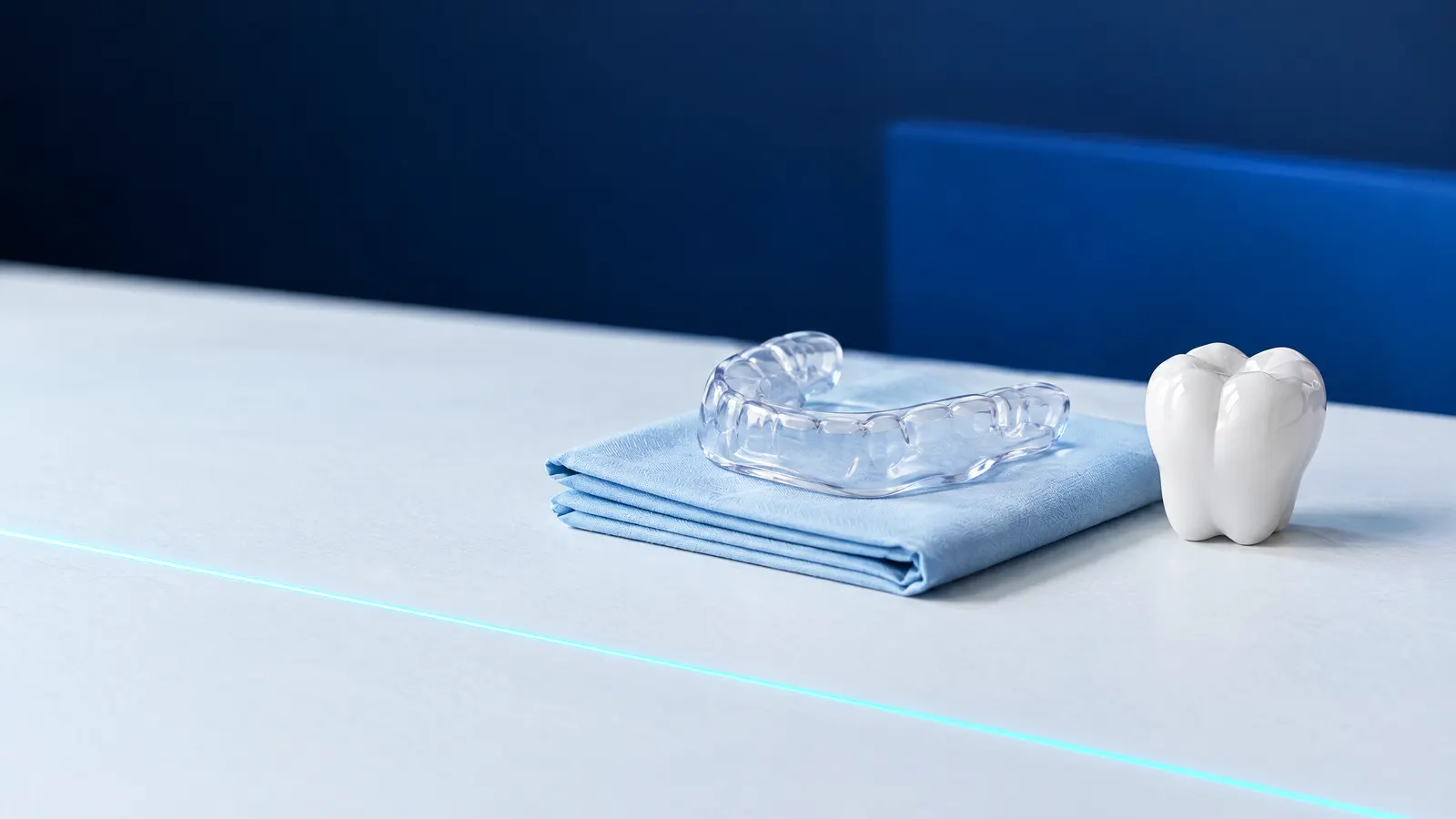
So a relaxation splint, usually worn at night, does not cure bruxism; instead it absorbs the forces that would otherwise act on the teeth and restorations. In awake bruxism, awareness of your own daytime habits also matters, as does the self-help advice given by the NHS.
| Method | What it does | What studies and guidance say |
|---|---|---|
| Relaxation or occlusal splint | Protects teeth and restorations from grinding forces, usually worn at night | Mainly mechanical protection; too little evidence that it treats sleep bruxism |
| Stress reduction and sleep hygiene | Relaxation techniques, regular sleep times | NHS self-help advice |
| Cutting down on stimulants | No smoking, less alcohol and caffeine | NHS self-help advice |
| Short-term pain relief | Ice packs for swelling, over-the-counter painkillers | NHS advice; when the jaw hurts, it is better to avoid hard foods |
| Botulinum toxin | Weakens jaw muscle contraction for several months | Low-quality reviews; outside the licensed indications (off-label) |
Botox for bruxism: what does the research say?
Botulinum toxin is sometimes used for bruxism, but outside its licensed indications (off-label): the summary of product characteristics for Botox in Poland does not list bruxism, and neither do those of the other available toxins checked for this article. This means the medicine has not been authorised for this use, and the decision rests with the doctor after discussing the benefits and uncertainties with the patient.
A 2025 overview of 14 systematic reviews found a reduction in pain in 10 of them, in the number of bruxism episodes in 7 and in bite force in 5. All the reviews, however, were rated as low or critically low quality, and the authors write that methodological limitations do not allow firm conclusions.
Some studies with objective measurement showed weaker contractions but no fall in the number of episodes, and in a small randomised trial (22 people) the fall in the number of episodes seen after 4 weeks was no longer present at week 12. According to a review of 10 studies, the effect appears within 4 weeks, is greatest after 5 to 8 weeks and lasts up to 24 weeks.
How much does a relaxation splint cost, and does the NFZ cover it?
Neither relaxation splints nor occlusal splints are on the list of guaranteed dental treatment services, so the NFZ (Poland’s National Health Fund) does not fund them; the list covers only splints used for dental injuries and jaw fractures. This follows from the Minister of Health’s regulation (consolidated text, Dz.U. 2025 poz. 615), as in force on 12 October 2026.
In the clinic’s price list, “Szyna relaksacyjna twarda” (hard relaxation splint) costs 1 250 zł and “Szyna zgryzowa” (occlusal splint) 600 zł. Botulinum toxin injection appears in the aesthetic medicine category as “Bruksizm (oba policzki)” (bruxism, both cheeks) at 900 zł. The type of splint and scope of treatment are chosen after an examination, the final cost is agreed at the consultation, and prices may change.
How bruxism treatment works at DentalBlue
At DentalBlue in Białystok, the first step can be a visit without pain: a panoramic X-ray (pantomogram), an examination, a consultation and a written treatment plan with the prices of each stage. The X-rays are taken in the clinic’s own radiology unit, with no need to go elsewhere. Relaxation and occlusal splints are in the price list under prosthodontics and under hygiene and aesthetics, and botulinum toxin injection for bruxism is part of the clinic’s aesthetic medicine department. The clinic is open Monday to Friday from 8:00 to 20:00 and on Saturdays from 8:00 to 16:00.
Frequently asked questions
Can bruxism be cured?
Research does not point to any method that permanently eliminates bruxism. Experts regard it as a behaviour rather than a disease, so the aim of management is to protect the teeth with a splint, relieve pain and work on the causes, such as stress or sleep problems.
Bruxism in a child: is it a cause for concern?
Grinding teeth during sleep is common in children: in studies based on parents’ reports it ranged from 3.5% to 40.6% and decreased with age. It is worth showing it to a dentist, especially if the child complains of jaw pain or headaches, or the teeth are visibly wearing down.
Which doctor treats bruxism?
The first step is a dentist, who will assess the teeth, muscles and joints and suggest how to protect the teeth. The NHS also advises seeing a GP when stress, anxiety, sleep problems or addictions are in the background, because these can keep the grinding going.
Can I have implants if I have bruxism?
Yes, but bruxism is a risk factor that needs to be taken into account in the plan. In a review of 27 studies, probable bruxism was associated with roughly twice the risk of implant loss. That is why it is worth telling your dentist about grinding or clenching before implant treatment.
Sources
- Journal of Oral Rehabilitation: Lobbezoo F et al., international consensus on the assessment of bruxism (2018)
- Journal of Clinical Medicine: Zieliński G, Pająk A, Wójcicki M, global prevalence of bruxism, meta-analysis (2024)
- Cochrane: Macedo CR et al., occlusal splints for sleep bruxism (2007)
- Mediately: Botox, charakterystyka produktu leczniczego (ChPL), indications
- Cranio: Aldosari LIN et al., splints versus botulinum toxin in bruxism, systematic review (2026)
- Toxins: Coelho MS et al., botulinum toxin in bruxism, overview of reviews (2025)
- NHS: Teeth grinding (bruxism) (2026)
- ELI: Rozporządzenie MZ w sprawie świadczeń gwarantowanych z zakresu leczenia stomatologicznego, t.j. Dz.U. 2025 poz. 615
An informational article. It does not replace a consultation, and treatment decisions are made during a visit.